Book of the month: Angèle Rawiri

This was a recommendation from Suroor Alikhan, who kindly invited me to be part of the Hyderabad Literature Festival Online series earlier this year and wrote about our event on her blog. Suroor is an extremely widely read person, so I knew when she suggested Gabonese author Angèle Rawiri’s The Fury and Cries of Women, translated into English by Sara Hanaburgh, that it would be worth a look. As the translation came out in 2014, the book fell comfortably before the 2021 cut off I’ve set myself for my year of reading nothing new. I wasted no time in ordering it.

The novel follows Emilienne, a wealthy businesswoman in what we are told is a surprisingly progressive marriage according to the norms of her community. She is the major breadwinner and her husband – who, like her, studied in Paris – was present at the birth of their daughter Rékia and plays an active role in childcare. But all is not well, and when Rékia dies suddenly and violently, the tragedy exposes cracks in the family that threaten Emilienne’s very existence, plunging her into an identity crisis, and forcing her to confront the prejudices, inequalities and values underpinning her life.

It took me a while to understand quite how pioneering a book this is. Because the translation came out in 2014 and because the subject matter feels contemporary (involving a lot of reflection on secondary infertility and female sexuality, including a same-sex love affair), I had assumed the novel was relatively recent. It was only when the subject of AIDS came up some way into the narrative that I discovered it was first published in 1989.

Not only that, but Angèle Rawiri is widely credited with being Gabon’s first novelist, leading with Elonga, published in 1986. I’ve featured a number of trailblazing female writers lauded as their nations’ first published women on this blog over the years (among them Kunzang Choden and Paulina Chiziane), but it is rare to see a female writer named as a nation’s first published author.

Rawiri certainly seems to feel a duty to tackle national problems in her writing. Women’s rights take centre stage but many other political and social issues pass through her narrative too, among them corruption, the way workers become jaded in a capitalist system, and the legacy of colonialism. I was particularly struck by a passage in which Emilienne’s husband Joseph extolls the merits of a single-party system:

let’s have the courage to recognize that we are a selfish tribal people. Take a look at what is happening in the ministries and state-owned companies! First they hire a member of the family, regardless of their abilities, and, if they have none, they look among those around them from their own ethnic group. No, believe me, in order to have a real multiparty system, Africans are going to have to manage to place national interests above their own. In the meantime, the single-party system seems to be what we need. Let me explain: when a country is under the aegis of a single party, its nationals, whatever group they’re from, are forced to meet, discuss, and exchange their opinions about issues that concern them all. They don’t have the time to dwell on tribal issues. Collective motivations almost always win against frictions between individuals. Obviously, with such a political alliance, men learn how to tolerate one another, to love one another, and above all to work toward the same ideals. Isn’t that the goal sought by our leaders!

I don’t agree with Joseph (and I suspect Rawiri doesn’t either), but I’ve never seen the arguments for such a system put so persuasively before.

The passages that deal with female agency and reproductive rights are particularly arresting, and sometimes shocking. For all her professional status and qualifications, Emilienne finds herself at the mercy of a value system that judges women’s worth by their ability to bear children. When she struggles to conceive a second child, her social stock plummets and she is judged to be in need of a ‘cure’. (Indeed, at one stage we are told that a woman choosing not to have children would have to be ‘sick’ in the head.)

As with her presentation of the arguments for a single-party system, Rawiri makes the characters who express these views alarmingly persuasive. (Indeed, were it not for the dedication of the novel to a friend who struggled to conceive, it would sometimes be tempting to think the author’s sympathies lie with them.) In this, the work recalls the brilliant One Part Woman, reviewed on this blog last year.

The novel presents numerous challenges for a twenty-first century reader steeped in the Anglo-American literary tradition. Pacing, a perennial sticking point when stories cross borders, works differently: some apparently major issues are presented or resolved abruptly, while the narrative lingers on events that may seem relatively inconsequential to Western eyes. Some of the dialogue feels rather direct or on-the-nose, and the handling of sexual encounters works according to different norms and assumptions. I also found the choice (whether Rawiri’s or translator Hanaburgh’s) to withhold specific cultural terms a little distancing – referring to another community as ‘that ethnic group’ rather than by name or telling us that characters are speaking the ‘local language’ rather than giving us the word for it.

But this is distance worth travelling in order to experience this trailblazing literary work. Rawiri was not only dealing with challenging subject matter but also carving out a path for a new tradition, depicting places and people who had never been seen in novels before. When novelists like me sit down to write, we follow well-trodden paths, lined with countless examples of how the world around us might be depicted on the page. But although Rawiri may have had some exemplars in the work of Francophone African feminist writers like Mariama Bâ, no-one in her nation had put her surroundings into a published print story before. The scale of her ambition and achievement is extraordinary.

The Fury and Cries of Women (Fureurs et cris de femme) by Angèle Rawiri, translated from the French by Sara Hanaburgh (University of Virginia Press, 2014)

Dublin Book Festival

Last weekend, I had the privilege of being part of the line-up at Dublin Book Festival, an annual celebration of all things literary in Ireland’s capital. My event was a discussion of reading the world with Literature Ireland director Sinéad Mac Aodha (pictured with me above), who helped launch Crossing Over at Hodges Figgis last year. But I was lucky to attend several other things thanks to the Literature Ireland team, who took me under their wing for the weekend.

The first of these was the launch of Your Own Dark Shadow: A Selection of Lost Irish Horror Stories at the Gutter Bookshop.

I don’t consider myself a horror fan, but I was intrigued by what editor Jack Fennell said in his speech about how horror is a way of articulating the sense that something is wrong in the world and helping people to feel less alone in this. My fiction bears hallmarks of this, so I am intrigued to see how this plays out in the collection.

I was also deeply impressed by the ethos of the collection’s publisher, Tramp Press, one of a number of indie houses making strides in Ireland. Their submission window is open now, so if you live outside North America and are looking for somewhere to place work, I would recommend checking them out.

The next day I attended an event on short stories with Jan Carson and Mary Costello (pictured above). In the queue outside I was delighted to bump into debut novelist Alan Murrin, with whom I did an event earlier this year. His recommendation of Mary Costello’s story ‘The Choc-Ice Woman’ was so enthusiastic that I lost no time in buying a copy of her latest collection.

The discussion in the event was illuminating and wide-ranging. Jan Carson talked about how word counts were coming down for many journals and competitions. ‘Watch yourself if you’re always writing to fit others’ requirements,’ she said. She explained that the way into stories for her is through concepts, and gave a brilliant example in the shape a story in her latest collection that was commissioned to explore how Northern Ireland is seen in the wake of Brexit. She had approached the subject by envisaging a baby drifting down a river separating the land of two farmer brothers who don’t get on.

Meanwhile, Mary Costello said that for her the spur to writing comes from thinking about the interior lives of her characters. It will often be physical exercise, whether walking or hoovering, that shakes problems loose in her work.

Next up was an event on the essay, chaired by Brendan Barrington, founder editor of The Dublin Review. I found this very inspiring. Over the hour-long discussion, in which panellists shared some of their favourite pieces from the publication, I was struck by the enthusiasm of these writers for this somewhat enigmatic form, and by their openness to people writing in several genres. ‘If you’re a serious writer and you don’t write an essay occasionally, you’re missing a trick,’ said Barrington at one point. I took this as a challenge. Watch this space.

My event was towards the end of the afternoon and it was wonderful to be greeted by an enthusiastic audience, featuring several familiar faces, among them author Rónán Hession, Africa Institute in Ireland programme director Adekunle Gomez and Lyndsey Fineran, who created my literary explorer role at Cheltenham Literature Festival and is now artistic director of the Auckland Writers Festival.

The discussions afterwards were particularly heartwarming. So many readers shared insights about how reading internationally connected to their experience, and I left with a list of book recommendations. I was also particularly delighted to make the acquaintance of translator Signe Lyng, who brings many of Ireland’s most well-known writers’ work into Danish. She subsequently sent me a list of Danish recommendations. I think I feel a book of the month coming on…

I left Dublin inspired and encouraged. What I’d shared in was an event founded on the belief that storytelling is valuable, not for the money it makes but because of the connections it forges – something that I hope also drives my work.

Irish writing has always had an important place on the international stage, and is perhaps enjoying a particularly powerful moment. At Dublin Book Festival, it was not hard to see why.

Book of the month: Hugo Claus

A few weeks ago, I found myself having lunch next to the Belgian author David Van Reybrouck. We were in the writers’ room at the Cheltenham Literature Festival, where he had just taken part in a panel discussion on the end of empire, drawing on his Baillie Gifford Prize-shortlisted book Revolusi: Indonesia and the Birth of the Modern World, translated by David Colmer and David McKay.

When I explained my role as the festival’s literary explorer in residence and how it had come out of this project and my first book, Reading the World, he exclaimed: ‘I just had that book in my hand!’ It turned out he had picked it up in the festival’s bookshop and checked the list at the back to see what I had chosen for Belgium. ‘You picked a French-language writer I’ve never heard of!’ he said with a mischievous smile.

More than twelve years after I set out to read the world, it was clearly high time I ventured into Flemish literature. So I asked what he would recommend.

According to Van Reybrouck and to the blurb on the back of my 1991 Penguin edition, translated by Arnold J. Pomerans, Hugo Claus’s The Sorrow of Belgium (first published in 1983) is one of its homeland’s most important novels. Set in Flanders between 1939 and 1947, it follows the coming of age of Louis Seynaeve, whose family collaborates with the Germans during the Occupation. Through the unfolding of tortured domestic relationships, it reveals the national and cultural cost of betrayal, brutality and war.

It’s easy to see why The Sorrow of Belgium appeals to Van Reybrouck, whose Revolusi I was listening to while I read this novel. Both books find ingenious ways to pleat together the personal and the political: while Revolusi interweaves extraordinary eyewitness testimony with wide-ranging historical analysis, The Sorrow of Belgium uses intimate, personal details to reveal the psychological cost of occupation and domination. As Louis obsesses over his father’s secret stash of toffees, navigates a series of disturbing early sexual encounters and steers his way through fraught relationships with the nuns and priests in charge of his education, we see the isolation and insecurity that the horrors unfolding largely offstage have wrought in him.

The book captures the tedium and pettiness that can characterise the everyday experience of momentous historical events (as many of us may have found during the pandemic). ‘The only thing you went through [during the Occupation] was making sure you got enough food and clothes and coal,’ Louis tells his mother. This both is and isn’t true: we see all the characters shaped and changed by international events. Although their reality may be measured out in the availability of provisions and snippets of local gossip, the pressure they are under is always evident, coming out in surprising, disturbing and sometimes amusing ways.

Language and storytelling are constant themes. Louis’s father rails against French speakers, while, at the start of the novel, Louis and his boarding school chums make the sharing of so-called ‘banned books’ a condition for admittance into their secret club of Apostles. Even before the Occupation and certainly during it the narrative seems to hum with an awareness of what may or may not be said, and the form of language acceptable.

The Penguin edition adds an extra layer to this. ‘The people of Flanders speak Flemish, a variant of Dutch which is distinguished from the version spoken in the Netherlands by minor differences in accent and vocabulary only,’ writes Arnold J. Pomerans in his ‘Translator’s Note’. The edition proclaims that it is translated from the Dutch, and the blurb even trumpets The Sorrow of Belgium as ‘the most important Dutch novel to have been published since the war’. All of which leaves a reader like me wondering what Claus – whose work has so much to say about language and how it relates to identity, and who is widely described as a Flemish writer – may have made of this. Would he have agreed with Pomerans’s assertion that the differences between Flemish and Dutch are so slight as to be negligible? Did he in fact write this book in Dutch? Or is this an example of an English-language publisher not wanting to risk putting readers off with too much intimidating detail? Would a novel billed as translated from Flemish (if that is what this is) have been a tougher sell?

Language use in the novel is fascinating in other ways too. The narrative bends to explore the limits of subjectivity, diving in and out of Louis’s consciousness so that we are often uncertain how much veracity to accord events. In a manner reminiscent of anglophone modernist greats such as James Joyce, Claus excels at depicting the partial, fragmentary nature of experience and perception. This is something that Louis, himself an aspiring writer, laments:

‘He failed to see connections between things, that was true. For one reason or another he found this proof of his inability to recognise the basis, no, the very structure of things, incredibly depressing. He swore all the way back home. Others were able to gain an immediate, coherent, rational picture of complex, fragmented objects, facts, incidents all around them, but not he, no matter how hard he tried, but then he didn’t try very hard, because he didn’t know how to.’

Yet what seems to Louis to be a failing is, Claus shows us, the reality of human experience. There is often greater honesty in scraps and fleeting impressions than in neat, coherent accounts. The desires and messiness of the body (often described in vivid detail) are more truthful than the high-flown, impenetrable rhetoric that figures such as Louis’s troubled mentor Rock deliver to classrooms of bemused schoolboys.

The personal is political, Claus and Van Reybrouck show us in their different ways, because it is often the best way we can appreciate what has happened. Patchy and flawed though this appreciation may be, it is necessary to keep us conscious of the distance we have travelled. Our grasp on reality is often feeble and fumbling. That is why we need storytelling.

The Sorrow of Belgium by Hugo Claus, translated from the Dutch (Flemish?) by Arnold J. Pomerans (Penguin, 1991)

#WITMonth Book of the month: Angélica Gorodischer

kalpa imperial

This #WITMonth, it was the translator who attracted me to my featured title. I often find this is the case: now that I’m relatively well versed in how books come into English, there are certain translators’ names that predispose me to try stories. Because I admire other projects they’ve done or know them to be particularly committed to championing interesting voices, I regard their involvement with a book as a sign that something is worth investigating.

In the case of Angélica Gorodischer’s Kalpa Imperial, originally published in Spanish in 1983, it wasn’t the translator’s other translations but her novels that piqued my interest. Despite not being particularly keen on sci-fi (although I’m warming up to it in my fifth decade), I’m a big fan of the work of the late Ursula K. Le Guin. If you haven’t read her, you’re in for a treat.

Along with her novels, poetry, short fiction, criticism and books for children, Le Guin’s website lists four translations in her bibliography. Kalpa Imperial: The Greatest Empire that Never Was is one of these.

As its subtitle suggests, the book charts the history of an imaginary empire. It does so through multiple voices, bringing alive the idiosyncrasies, cruelties, obsessions and triumphs of a host of the personages who have shaped and been shaped by this history.

Many of these figures are marvellous creations. Take the dealer in curiosities who buys a boy who can dance in an era when dancing has been forgotten. Or the urchin who shrugs off her abusers and rises to be empress. And there are numerous sadists in the mix too – many of them military men who delight in pursuing their proclivities in the professional arena.

The prose is similarly inventive and startling. Lyricism jostles with surprise on every page. There is also plenty of humour.

Lists in novels are frequently a bugbear of mine: I find them wearing and am often tempted to skip them. But Gorodischer and Le Guin’s lists engrossed me – masterclasses in rhythm and the subversion of expectations.

There is subversion at the structural level too. Sometimes events are narrated several times by different voices – fishermen, passersby, servants and a dedicated storyteller. Indeed, along with the empire itself, the figure of the storyteller is the only consistent presence in the book. Most discussion of the novel I’ve seen declares that there are multiple storytellers involved in it. This wasn’t clear to me – I read the storyteller as being a single voice. But if you know different, please tell me!

Certainly, the tone of the storyteller is varied. At times fawning and affectionate, the narrator can also be downright rude to the reader – ‘if you could imagine anything you wouldn’t have come here to listen to stories and whine like silly old women if the storyteller leaves out one single detail.’

What remains consistent, however, is the book’s excavation of the mechanics and purpose of storytelling. ‘I’m the one who can tell you what really happened, because it’s the storyteller’s job to speak the truth even when the truth lacks the brilliance of invention and has only that other beauty which stupid people call mean and base,’ the narrator declares at one point. And at another: ‘a storyteller is something more than a man who recounts things for the pleasure and instruction of the crowd[…] a storyteller obeys certain rules and accepts certain ways of living that aren’t laid out in any treatise but are as important or more important than the words he uses to make his sentences[…] no storyteller ever bows down to power’.

There is a clarity to the prose and to the insights the book presents into its characters’ motivations that reminded my of Le Guin’s other writing.

This got me thinking anew about the influence of readers and translators on stories. It’s something that’s been on my mind lately as I’ve been receiving feedback from beta readers on the manuscript of my forthcoming book, Relearning to Read: Adventures in Not-Knowing (preorder your signed collectors’-edition copy now!). The brilliant insights and responses I’ve had from these first readers have been invaluable in helping me finetune the book, and they have developed my understanding of it too. Relearning to Read now carries their influence and is the stronger for it.

Translators, of course, aren’t simply readers providing feedback that a writer may respond to or ignore. They rewrite a book in their own words. But this rewriting is in response to reading. It can’t help but meld their own talents and perspectives with the strengths and weaknesses of the primary work. There is an inevitable hybridity to the end result.

Of course, part of what attracted Le Guin to the project of translating Kalpa Imperial may have been the sense of a synergy between her work and Gorodischer’s. Unlike many translators, Le Guin had the luxury of picking and choosing the books she worked on. Translation wasn’t her primary career.

Still, reading her rendering of this Argentinian sci-fi/fantasy classic, I can’t help but wonder if translation itself doesn’t have something of the fantastical or speculative about it: a processes that fuses the capabilities of two minds. It sounds like something Le Guin herself might have envisioned in one of her novels: a revolutionary technology that enables the magnification of creativity, multiplying the powers of those involved. In that sense, when a book is the product of two writers working at the top of their game, as the English version of Kalpa Imperial seems to be, might translations offer a supercharged reading experience, a kind of literature squared?

Kalpa Imperial: The Greatest Empire That Never Was by Angélica Gorodischer, translated from the Spanish by Ursula K. Le Guin (Small Beer Press, 2013)

Picture: ‘kalpa imperial’ by Dr Umm on flickr.com

Book of the month: Machado de Assis

This month, the seventh in my year of reading nothing new, I delved back further than usual. My edition of July’s featured title was published in 2020, but the original came out some considerable time before that, in 1881.

The English translation of The Posthumous Memoirs of Brás Cubas is a collaboration between two translators to whom I owe a debt of gratitude. Back in 2012, Margaret Jull Costa and Robin Patterson were among the nine volunteers who translated A casa do pastor by Olinda Beja so that I would have a book to read from São Tomé and Príncipe.

As its title suggests, the novel by the legendary Brazilian author Joaquim Maria Machado de Assis presents an account written from beyond the grave by its title character, an aristocrat with a string of failed love affairs and thwarted political ambitions to his name. It wastes no time in declaring its singularity. Right from its dedication (to the first worm to gnaw its author’s flesh), it demonstrates a determination to explode conventions and taboos.

The narrative also rides roughshod over literary customs. Digressions abound, chronology scatters and we are repeatedly informed that the author is minded to cut a section we have just read, as well as told about notes for chapters that will not be written, and, once, presented with a passage in which all dialogue is blank. ‘This is, after all, the work of a dead man’, Brás Cubas or whatever remains of him declares, as if with a shrug.

Indeed, being dead seems to absolve the protagonist-narrator of all obligations to please, giving him carte blanche to lay into whomever he chooses. The reader is no exception, and neither is Brás Cubas himself:

The main problem with this book is you, the reader. You’re in a hurry to get old, and the book progresses slowly; you love direct, sustained narrative, a regular, fluid style, whereas this book and my style are like a pair of drunkards: they stagger left and right, start and stop, mumble, yell, roar with laughter, shake their fists at the heavens, then stumble and fall…

Of course, regardless of its narrator’s declarations about having no need to please, such devil-may-care posturing is extremely entertaining and pleasing. A great deal of humour comes from a choice of register that deflates the pretensions of the characters. There is also a wonderful inventiveness to the writing. Although he often abandons analogies in mid-flow, the imagery Brás Cubas does use is often startlingly fresh and witty. ‘One morning, while I was strolling in the garden, an idea appeared on the trapeze I have inside my head,’ he declares at the start of chapter two. Among the many things to admire about the translation is surely the fact that Jull Costa and Patterson have managed to achieve a voice that is simultaneously erratic and distinctive, that, while roving among the registers, feels true to its singular speaker. (Although the inclusion of footnotes creates a strange tension in this anarchic, irreverent text: I found myself constantly questioning whether what seemed to be straight, factual glosses were in fact up to something I hadn’t fathomed – maybe they were.)

Another of the book’s startling qualities is the way it seems to reach both forward and backwards in literary history. Its irreverence and textual high-jinks recall the works of eighteenth century writers such as Sterne; there is more than a touch of the picaresque about it; yet its inventiveness also hints at psychedelia and the experimentation of the greats of modernism. In this sense, Machado has achieved a powerful impression of, if not the eternity that entraps its narrator, then timelessness.

The same goes for its satire. At once of its moment and resonant beyond its setting, Machado’s exposure of the hypocrisy of this society built on the backs of slaves, in which the desire for fame eclipses genuine advancement and learning, speaks to worlds he can never have known.

At one point Brás Cubas even seems to reach from the pages to grip our hands. He imagines a ‘bibliomaniac’ seventy years or so on from the time of writing considering the novel. The description is not flattering – he conjures a sallow, white-haired creature whose main interest in the volume is because it is rare rather than of any literary value.

I like to think I’m some distance from the figure Machado imagined. Yet, knowing the author to have been something of a ‘bibliomaniac’ himself – he reportedly set himself the goal of reading all the world’s classics in their original languages – I suspect he may have more sympathy for such creatures then this depiction implies. At any rate, another seventy years on from the time of the bibliomaniac Brás Cubas pictures, this bibliomaniac salutes his author, even as she corrects him: the value of his novel has nothing to do with its scarcity. It is thankfully widely available. And a jolly good thing too.

The Posthumous Memoirs of Brás Cubas by Joaquim Maria Machado de Assis, translated from the Portuguese by Margaret Jull Costa and Robin Patterson (Liveright, 2020)

Relearning to Read: Adventures in Not-Knowing

A new book? I hear you cry.

Yes! And it’s one that you’ve helped me write. Relearning to Read: Adventures in Not-Knowing is my second non-fiction book and it draws on a new approach to reading that I’ve developed over the twelve years of writing this blog.

Among the many challenges I had to face when I set out to read a book from every country in 2012 – how to fit all the reading in? how to get books from every country? what even is a country? – was the fact that the way I used to read wasn’t going to work. I was in the habit of being clever about books – using context and knowledge to draw out rich insights and make connections. That had worked really well for me for the first thirty years of my life, when I spent most of my time reading books from a world I knew. As a literature student, I really enjoyed researching the texts on my courses, and using criticism and history to help unlock their secrets.

But in 2012, with an average of 1.87 days to read and review each book I was covering that year, there was no time to do any extra reading. Many of the titles came from cultures of which I knew nothing, and were based on belief systems, mores, events and assumptions that were mysteries to me. But there was no way for me to familiarise myself with any of this and adopt the authoritative, knowledgeable tone I had strived for at university. I had to be open about my ignorance and accept that there was a lot I didn’t understand.

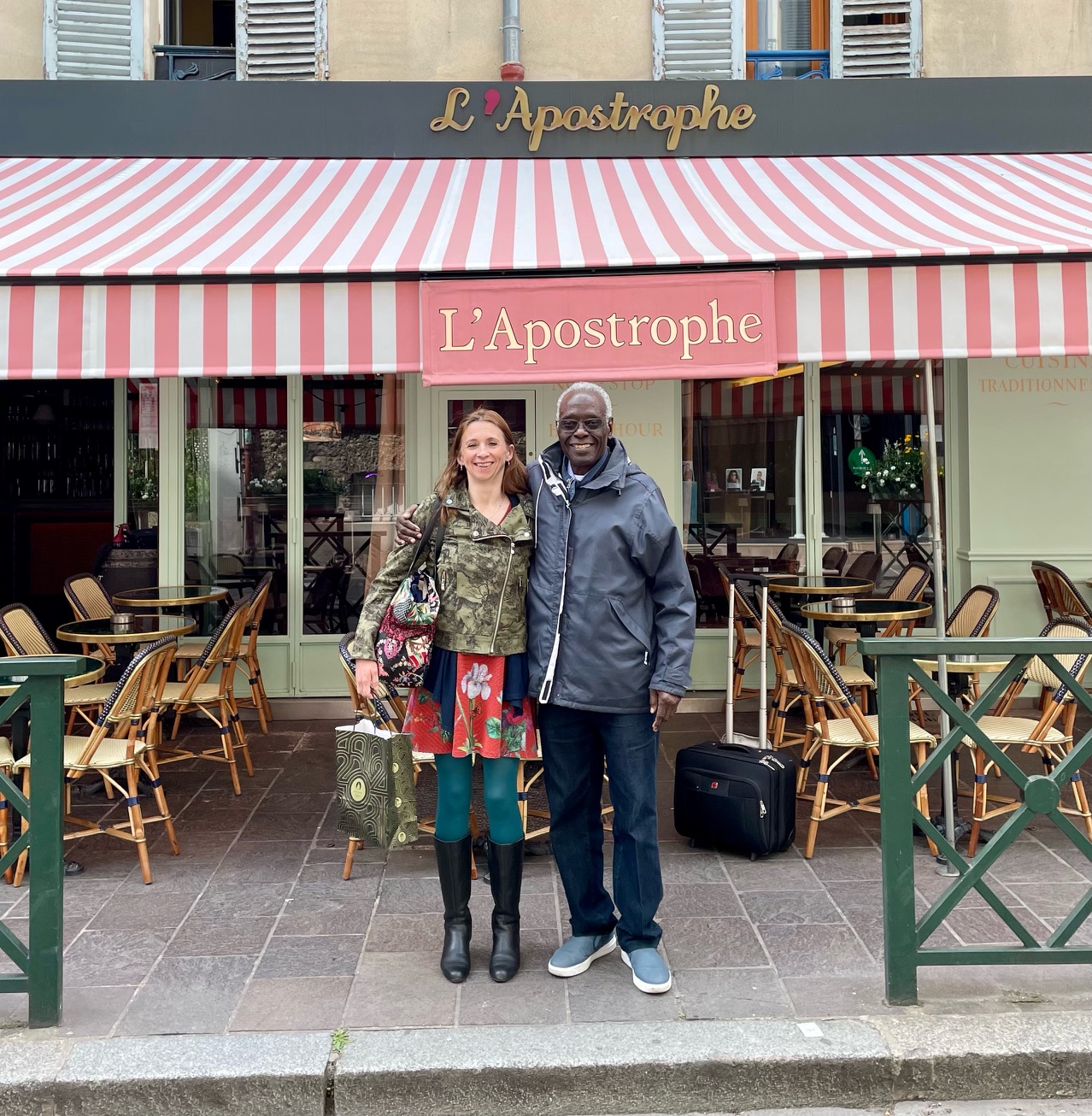
What started as a necessity became a revelation. I discovered that embracing not-knowing, adopting openness and humility, and learning to hold questions in my mind was hugely enriching. Not only did it teach me a lot about myself but it enabled me to build much more meaningful connections with books, people and the world. This has led to many of the exchanges and friendships I established over the years through this blog (like my correspondence with living legend Tété-Michel Kpomassie, who I met in Paris last month – that’s us pictured above). And it has shaped the way I write and think about books – on this blog and elsewhere.

Back in 2021, to explore this approach to reading further, I launched my Incomprehension Workshop. A few months later, to celebrate this blog’s ten-year anniversary, I offered a free virtual session and was delighted to have so many takers that I had to run two to accommodate everyone. Since then, I have run the workshop with readers around the world, most recently in Assam, India. Playing with not-knowing in the company of fellow enthusiastic readers has been a great source of inspiration for me, and a brilliant chance to test and hone a lot of the ideas that inform my new book.

Relearning to Read: Adventures in Not-Knowing is about reimaging the way we read by embracing not-knowing, questioning, humility and curiosity. Each chapter takes a different text likely to be outside the comfort zone of most English-language readers and uses this to play with different questions – what is authenticity? what makes something funny? how does censorship affect reading? and what makes us like a book in the first place? Some of the wonderful readers and writers I’ve encountered over the past twelve years make an appearance, including my hero Tété-Michel. And I also share how reading has shaped my life and rewritten me.

Relearning to Read is out worldwide in English in September 2025. BUT you can preorder it now. Indeed, my publisher Renard Press has made a wonderful offer: the first 100 orders through the Renard Press website will receive a signed, special-edition copy for the price of a standard paperback, shipped ANYWHERE in the world. That’s not all. If you preorder a Renard Press Edition of Relearning to Read, you can also get a Renard Press Edition of my second novel, Crossing Over, half price. Just put both in your basket and enter the coupon code RELEARNING at the checkout, and your collectors’ copies will wing their way to you in September 2025.

Thank you.

Book of the month: Ag Apolloni

This book was one of two sent to me by Colin. He was going on a trip to Kosovo and volunteered to go to some bookshops on my behalf to see what Kosovan booksellers would choose for me as standout books from their nation.

Kosovo wasn’t included in my original year of reading the world. Although it’s recognised by more than 110 countries, it isn’t officially UN-recognised. As such, it’s one of the many nations that fell under the ‘Rest of the World‘ banner, which ended up being represented by Kurdistan that year.

I was intrigued to see what Colin what find. He sent me an email from Pristina, where he had had a great conversation with a bookseller at Libraria Dukagjini. She recommended three titles that had been translated into English: the international hit My Cat Yugoslavia by Pajtim Statovci, who writes in Finnish, translated by David Hackston; Night Trails by Mustafe Ismaili, translated by the author; and Glimmer of Hope, Glimmer of Flame by Ag Apolloni, translated by Robert Wilton and published by Elbow Books. She also mentioned an untranslated novel, Genjeshtars te vegjel by Fatos Kongoli (which translates Google translates as ‘Little Liars’).

I have MCY, but the other two translations intrigued me. Colin posted these to me, persevering when the British customs returned the books first time round. The Ag Apollini in particular caught my eye. ‘A masterpiece,’ proclaimed Mieke Bal on the cover and it had been named as Kosovo’s 2020 novel of the year. I decided I’d better see what all the fuss was about.

Apolloni calls this book a ‘documentary novel’ and I can see what he means. Built around a real-life research trip he made with academic Dritan Dragusha and film director Gazmend Bajri, the narrative records his responses to the stories of two women whose families disappeared during the Kosovo War. One, Ferdonija, spends her life waiting, still setting the table twenty years later in the hope her four sons will return; the other, Pashka, burnt herself to death when the remains of two of her children were returned.

Yet, in many ways, this book is more essay than documentary: it brings in Apolloni’s thinking on Greek tragedy and weaves together literary and cultural references from throughout human history to cast the hideous events of the recent past in a timeless, mythic light. Reflecting on the fact that of the more than 100 plays Aeschylus is known to have written only a handful survive, it explores what loss on every level means and how it shapes the human condition.

At the centre of the book is an intellectual challenge: how do you tell a story about someone who has no future, whose life is in the past? Apolloni puts it like this: ‘how can you write something about someone who just sits and laments their own fate?’ Stories are surely action and agency, after all? Protagonists do things.

Aeschylus provides the answer: the lost play, Niobe, surely did just that, recording the suffering of the bereaved mother at the heart of it, taking the audience into the centre of her pain. Apolloni sets out to achieve something similar.

And he succeeds. This is no cold, academic exercise. Feeling is everywhere in this book, both in the raw and extraordinary portrayal of Pashka and Ferdonija, but also in the other stories that touch theirs, many of which are realised in no more than a sentence or two.

A particularly moving section involves a visit from a high-profile Holocaust survivor, who comes to meet the war’s victims. ‘What I know is that I must be here at least,’ he tells a woman. ‘I must be. I cannot suffer in your place, but I have to be present at your suffering. That’s all I can do.’

Yet, in being present in such a way, he is himself a sort of timeless figure – ‘like the high priest of Shiloh, determined in his compassion to shelter all of the children and raise them in the tabernacle’. By being intensely part of specific, extreme experience, he assumes a sort universality.

This is a key theme of the book: timelessness is made out of intense nowness, out of raw, compacted pain. ‘Tragic myths are created by great shocks. In the direst cases, we are myths recycled.’

So it is that the contemporary details of Ferdonija’s static existence speak beyond their moment. The descriptions of the photographers posing her and staging her home so as to present her grief as they see fit reveal themselves to be part of the changeless human condition. The feelings this evokes resonate with Niobe, with Electra, with Antigone – with all those mythic female figures who lamented and felt the weight of others’ eyes upon them.

The universality of these feelings stretches not only back through time but outwards across political boundaries. In the face of such a story, all people, regardless of their heritage and allegiances, cannot help but respond. So it is that when Gazmend Bajri screens his film, people on all sides of the conflict respond to the suffering: ‘Pain is human, not national. This has nothing whatever to do with nationalism, and so the audience suffered along with the actor.’

Of course, reading this book now, in another time of great suffering, adds another layer. When many in other parts of the world – in Palestine, in Sudan, in Ukraine, to name but a few – are experiencing similar horrors on a comparable scale, this story feels particularly telling. For many, the thought of reading it might seem too much – the last thing you want when we are already bombarded with so much misery.

Yet this is precisely what makes Glimmer of Hope, Glimmer of Flame uplifting. In the face of so much suffering it is easy to feel helpless and overwhelmed. Storytelling – when it is as honest, humane and insightful as this – gives us a way to get alongside these experiences, to be present. By giving shape to sorrow, stories allow us to commune with it: ‘Gazi films Ferdonija so that we too may feel her tragedy; he knows that this is how you kindle cartharsis in the spectator, participating in the suffering of the main character, so that passio becomes compassio.’

There may not be anything we can do in the face of these horrors, Apolloni shows us, but there is a way we can be.

Glimmer of Hope, Glimmer of Flame: a documentary novel by Ag Apolloni, translated from the Albanian by Robert Wilton (Elbow Books, 2023)

Book of the month: Fatou Diome

Don’t judge a book by its cover, the saying goes. Frankly, though, if I were assessing Fatou Diome’s The Belly of the Atlantic, translated by Lulu Norman and Ros Schwartz, on its appearance, I probably wouldn’t have picked it up. The pictures of the figure in the boat and the foot on the ball feel wearily familiar, if not a little clichéd.

Besides, although I’ve read and enjoyed football novels in the past – and know that a great writer can make any topic absorbing – I usually do so in spite rather than because of such subject matter. Not being a sports fan, I rarely find knowing a book is built around a particular game tempting.

But I did pick up this novel, which came out in French in the early 2000s and in English in 2006, for two reasons: partly because Senegal was one of the nations that had relatively few novels available in translation when I did my original Year of Reading the World, but also because I’m a particular admirer of the work of one of its translators: Ros Schwartz. Seeing her name on the title page suggested to me that this would be worth a try.

In fact, this book subverts the apparently familiar tropes of its cover in powerful ways. Narrated by Salie, who lives in France, the novel crystallises around a series of phone calls from her younger brother, Madické. A football fan with a difference, Madické is obsessed not with the French team beloved of his peers but with the exploits of the Italian player Maldini and needs to hear how every match he plays turns out. The one television on their home island of Niodior is temperamental to say the least, hence his SOS calls to his sister to fill him in. These conversations prove the catalyst for a series of reflections on and memories of Salie’s life, the immigrant experience, and the gulf that travelling from one world to another opens up between those who leave and those who stay behind.

The female perspective is part of what makes the book so striking. The opening descriptions of football mania and boys revelling in the beautiful game invite us to assume a male narrator. It is only gradually, with the repeated presence of strong, female characters, and strikingly direct observations about discrimination and the hypocrisy of patriarchal society, that the narrator’s position becomes clear. Indeed, it is only some pages into the narrative that Salie reveals herself as ‘a moderate feminist’ who ‘wouldn’t want testicles for the world’, and who looks with some disdain on the standards her brother is expected to conform to in order to satisfy her home society’s conception of ‘man’.

This covert disruption of what might be thought of as the default narrative voice for a book like this makes much about it fresh and startling, even twenty years after its publication. Familiar ideas are presented from new angles. And the tales of those who remain on Niodior, trapped in cycles of poverty and prejudice, gleam with troubling brilliance. The story of Sankèle, who pays a terrible price in an effort to escape an arranged marriage, is particularly memorable.

For a reader in the UK, the novel may seem uncannily prescient. In its exploration of the desire that many young people have to leave Niodior and try their luck in Europe, and its presentation of the grim reality and crushing obligations that await those who make the leap, the book seems to anticipate the stories that flooded Western media years later of African migrants braving horrific risks in search of a better life. For example, here’s Salie reflecting on the gap between Madické’s idea of her daily life and the reality:

‘It was no use telling Madické that as a cleaning woman my survival depended on the number of floor cloths I got through. He persisted in imagining I wanted for nothing, living like royalty at the court of Louis XIV. Accustomed to going without in his underdeveloped country, he wasn’t going to feel sorry for a sister living in one of the world’s great powers after all! He couldn’t help his illusions. The third world can’t see Europe’s wounds, it is blinded by its own; it can’t hear Europe’s cry, it is deafened by its own. Having someone to blame lessens your suffering, and if the third world started to see the west’s misery, it would lose the target of its anger.’

Of course, the fact that these words written in the early 2000s read as prescient to someone like me also shows up the selectiveness of the anglophone world’s storytelling: the so-called ‘migrant crisis’ is not a new phenomenon, Diome’s novel reminds us, regardless of what prevailing accounts of it may lead us to assume.

Structured as it is, the book can feel a little static. Salie is relatively passive – partly because she is trapped by her situation and partly because she is trapped by the past. As such, she is perhaps more in the position of one of the oral storytellers of her homeland, recounting rather than participating in events. The writing, however, brims with energy. Like its perspective, the novel’s imagery is fresh and striking, melding Senegalese traditions, nature and computer technology to paint the world in bold colours. If, occasionally, the narrative tips over into polemic, well, who are we to argue?

Reading The Belly of the Atlantic made me reflect on many things. It reminded me of the valuable way stories from elsewhere can disrupt, problematise and reshape the narratives that surround us. It also helped me remember how important older books are in anchoring us and counteracting the kneejerk impressions of the now. If we only ever read new titles – no matter how brilliant they may be – we can easily become detached from the threads of history, and lose sight of the lines and grapnels cast back down the decades that bind us to the world and to one another.

The Belly of the Atlantic by Fatou Diome, translated from the French by Lulu Norman and Ros Schwartz (Serpent’s Tail, 2006)

Book of the month: Saud Alsanousi

Back in 2012, when I tried to source and read a book from every country in the world, Kuwait was one of the trickier entries on my list. There were very few traditionally published titles available in English translation. I ended up reading a self-published novel by the hit blogger Danderma, which proved an education in Arabish (Arabic words written informally in the Latin alphabet, usually on computers or mobile phones that do not support Arabic script) and the craze for frozen yoghurt sweeping the country at the time. Indeed, Danderma was very helpful to me and shared some fascinating insights into the challenges facing writers in Kuwait, some of which I related in my first book, Reading the World.

Knowing that there had to be many other interesting Kuwaiti writers whose work hadn’t yet made it into the world’s most published language, I resolved to revisit the country’s stories. Twelve years later, I’m back, thanks to a tip-off from translator Sawad Hussain, who responded to my call for books published pre-2020 that deserved a second look, as part of my year of reading nothing new.

Hussain’s translation of Saud Alsanousi’s Mama Hissa’s Mice follows the (mis)fortunes of Katkout, Fahd and Sadiq, three friends growing up in Surra, central Kuwait, during the late-twentieth and early-twenty-first century. Coming from different sects and ethnic backgrounds, the young men share little but their fury and frustration at the divisions that compound the destruction wrought in the wake of the Iraqi invasion. In an attempt to overcome this, they form a group, Fuada’s Kids, which aims to bind Kuwaitis together by appealing to their nostalgia, but in so doing risks costing them everything.

Disorientation is at the heart of this novel. The narrative, like the central characters’ world, is fractured and splintered, reflecting the feeling that ‘it’s as if an enormous fist has plowed into Kuwait, leaving it in ruins’. The present-day, adult reality is intercut with flashbacks and with chapters from an autobiographical novel, some of the of which have been removed to placate the government censors.

Indeed, censorship is another key theme. Growing up, the boys learn that questions can be dangerous. Seemingly innocuous issues such as how someone pronounces a word or the spelling of certain names can crack open rifts and even invite physical violence. Small wonder, then, that self-censorship and sanitization flow through many of the conversations, because, as Fahd’s grandmother Mama Hissa is fond of observing, ‘all cowards stay safe.’

For English-language readers, there is an extra level of challenge. The unease and self-questioning that the story prompts with its challenging structure and courting of the unsayable is compounded with cultural disorientation. It is often unclear how certain statements should be read. We can’t know the significance of certain jokes – or whether some phrases are meant as jokes at all. The childhood memory of the boys pretending to be Palestinians throwing stones at Jews, for example. Is this said ironically, or bitterly? Would this be shocking in this society or unquestioned? And how ought we to respond?

There are also a large number of unfamiliar cultural terms in the text. Hussain does an elegant job of elucidating key elements but refuses to patronise or pamper readers by over-explaining. The terms are left Roman rather than italicised – a reminder that it is we, rather than the world of the story, who are foreign. (For more on the politics of italicisation, check out Daniel José Older’s YouTube video ‘Why We Don’t Italicize Spanish’ below.)

But there are also moments of powerful connection. From Alsanousi’s skilful marshalling of the child’s-eye view to reveal the strangeness of behaviours adults take for granted, to his intense, visceral presentation of moments of fear and suffering, and from the way he builds nostalgia to his layering of action so that we grow to remember events as the central characters’ do, this novel reaches out and grasps us.

It also showed me my own world through new eyes. A Londoner born and bred, I had long been in the habit of looking askance at the overseas investors who own empty properties in many of the capital’s most desirable postcodes. Reading Mama Hissa’s Mice made me consider the question from another angle: when you live with the threat of invasion and societal collapse, ‘foreign houses are assets for when something happens’. Wouldn’t many of us make similar choices if we had experienced such things?

This was a difficult read. But as a result it was also surprising one. An enriching one. A challenging one. It required me to sit with not-knowing in the same way that Shalash the Iraqi did – accepting my limitations and recognising that this is not a story that can or should centre my knowledge or perspective as so many of the books produced by the anglophone publishing industry do. I’m very glad to have had the chance to experience it.

Mama Hissa’s Mice by Saud Alsanousi, translated from the Arabic by Sawad Hussain (Amazon Crossing, 2019)

Picture: NASA Astronauts, Public domain, via Wikimedia Commons

Book of the month: Hubert Mingarelli

It’s nearly ten years since I started my Book of the month slot on this blog, after having been blown away by an Italian writer who has since taken the English-speaking world by storm. In another six years, I will have featured more Books of the month than the 197 titles that comprised my original year of the world.

Making book reviewing on this platform a long-term commitment has had a profound impact on how I read. Finding a title worthy of featuring each month has been a good way of holding myself accountable to stay connected to what is happening in international publishing, and it has enabled me to channel and share some of the many recommendations I am still fortunate to receive from readers all over the planet. Because I only feature one book a month, I rarely take recommendations from book PRs, and because I am keen to support the industry and to keep this blog free of commercial influence, I buy nearly every title I feature, rather than accepting free copies. I try to maintain the spirit of my original quest: a personal, independent and entirely unscientific record of diverse reading experiences that I aim to approach with openness, respect and curiosity.

Some months, the choice of what to feature is easy. Other months, particularly when I am in the thick of research for my own writing projects, it is a struggle to find something that fits (I don’t always have to love the books I feature unreservedly, but I have to feel that they are interesting and deserving of wider notice). Most of the time, however, I am torn between several titles and forced to neglect books that I would really like to tell you about. As I always try to review something in the month I read it, this means many brilliant reads get left behind.

This year of reading nothing new, however, I am relaxing my month rule slightly and taking the opportunity to return to a few of the stories that have stayed in my mind over the years. The first of these is A Meal in Winter by Hubert Mingarelli, translated from the French by Sam Taylor.

This title was recommended to me a few years back by my friend, author Caroline Brothers. I was looking for something that would absorb me and this short novel was Caroline’s answer.

Set during the second world war, the narrative follows three German soldiers sent out into the winter-bound Polish countryside to find a Jew to bring back for execution. Having caught one hiding in the woods, they hole up at an abandoned cottage to share a meal before returning with their captive. Over the hours that follow, the implications of their actions force themselves to the surface and the toll their murderous work takes on all present becomes clear.

Knowing that a novel is set during the second world war is often a turn-off for me. There are so many brilliant (and not so brilliant) stories set during this period that it seems to me that a book has to work doubly hard to make something powerful out of subject matter that has been handled by so many writers.

A Meal in Winter delivers. A masterclass in subtlety, it unravels the psychology of the aggressor, revealing how violence rebounds on its perpetrators, shattering and unmaking those who enact it every bit as much as its victims. Even at the sentence level, through the lens of Taylor’s translation, we see how thinking glitches and recoils in the face of inhumanity. The interior monologue of the narrating soldier abounds with jagged rhythms and defensive repetitions, rearing and bucking in the face of horrors he cannot own.

There is one section in particular that echoes in my mind, years after I read it, when the narrator reveals why seeing little individual touches on his victims’ clothing irks him so profoundly:

Because if you want to know what it is that tormented me, and that torments me to this day, it’s seeing that kind of thing on the clothes of the Jews we’re going to kill: a piece of embroidery, coloured buttons, a ribbon in the hair. I was always pierced by those thoughtful maternal displays of tenderness. Afterwards I forgot about them, but in that moment they pierced me and I suffered for the mothers who had, once, gone to so much effort. And then, because of this suffering they caused me, I hated them too. And the more I suffered for them, the more I hated them.

And if you want to know more, my hatred knew no bounds when they were not there to hug their darlings tightly to their breasts while I killed them. Once, they had embroidered a snowflake on their hat or tied a ribbon in their hair, but where were they when I was killing them?

The brilliance of this – the way the traumatised mind contorts its owner’s atrocities so as to apportion blame to his victims – is staggering. This is how we work, Mingarelli shows us. This is what we do. Even when we have committed monstrous acts, we share human feelings and we still need to find a story that makes our actions acceptable, that allows us to live with ourselves.

It is relatively easy to write about victims, at least in my experience. It is hard to write about perpetrators. And it is fiendishly difficult to do so in a way that makes readers feel for their plight and recognise the victim in them, even as we abhor their deeds.

That Mingarelli achieves this is the source of A Meal in Winter’s power and hope. The story is bleak. But the fact that the author presents it with such humanity and insight is deeply moving and inspiring. Even as we destroy one another, human beings possess an extraordinary capacity for empathy and compassion. We truly are marvellous wretches. In fewer than 150 pages, Mingarelli shows us the full range of his and our capabilities. Unforgettable.

A Meal in Winter by Hubert Mingarelli, translated from the French by Sam Taylor (Granta, 2013)

Picture: German military map showing planned assault on Poland in 1939 https://static.dw.com/image/50105792_303.jpg, Public domain, via Wikimedia Commons