Hong Kong International Literary Festival

Two women sitting on chairs in front of a colorful backdrop with the text 'Inspiring Generations'. One woman holds two books, and the other holds a book and a notebook. A small table with two water bottles is in front of them.

Just a week after I returned from the Dibrugarh University International Literature Festival in Assam, India, I jetted off again, this time to take part in the 25th annual Hong Kong International Literary Festival.

My engagements there began with an intense schedule of school visits. Jetlag notwithstanding, I was picked up at 7.15am on my first morning by one of the festival’s brilliant team of volunteers, a committed network of writers and book lovers based in Hong Kong. Over the next three days, I Ubered around Hong Kong Island, delivering ten talks and incomprehension workshops at schools everywhere from the lofty heights of the Peak to Tai Po.

The institutions I visited were a mix of government-funded ‘public’ schools, international schools and English Schools Foundation schools. I was told I might experience quite a difference in response from place to place, particularly as English is a second-language for many students at the public schools.

In truth, though, enthusiasm and sparkiness were evident everywhere. At one girls’ school, where a teacher had warned me the students were often shy, my incomprehension workshop proved a riotous hit, with everything form the Epstein files to six-seven coming into the discussion. At another public school, a teacher who started off sitting to one side couldn’t help jumping up and joining in with great excitement. Afterwards, he told me with emotion that the session had taken him back to his student days and reminded him what he loves about literature.

A flat lay image displaying a thank you certificate addressed to Ann Morgan, a box labeled 'American School Hong Kong', a small notebook with sticky notes, and a gray folder with buttons, all arranged on a table.

As my books are for adults, I never usually do events for primary school children. Consequently, I was rather surprised to arrive at one school and find 60 ten-year-olds waiting for me. Apparently, the pupils there had looked at the speaker brochure and picked me out as someone they particularly wanted to hear from. I adapted my talk accordingly and we had a wonderful session about reading stories from around the world that finished with a forest of hands up to ask questions.

There was a similarly enthusiastic response at the literary festival, at which I did three events. I ran my incomprehension workshop with a small but engaged audience at the very cool Fringe Club. As ever, the discussion generated some mind-blowing responses, showing me new things in stories I have worked with many times before. Several participants shared afterwards that the workshop had allowed them to confront fears and vulnerabilities they had long held about their relationship to reading.

The next day, it was my privilege to chair a panel discussion with three translators at Hong Kong’s Goethe-Institut. Local German-English translator and novelist Nicholas Stephens, Chinese-English translator and novelist Jacqueline Leung and poet Dong Li, who translates between German, French, English and Chinese, shared their insights into their craft. The discussion was wide-ranging and lively, taking in everything from AI to authenticity, and it laid bare the extraordinary humanity and generosity that underpins human translation.

My final event at the festival (pictured at the top) was perhaps the most special of all: a conversation with Jennie Orchard, the editor of The Gifts of Reading for the Next Generation, to which I contributed an essay last year. Jennie was the reason I was in Hong Kong, as she had recommended me to festival director Laura Mannering. She graciously focused the discussion on my new book, and it was a treat to unpack some of the things that have unfolded over the 15 years since I started this blog in her company and in front of a warm and generous audience who bought up every last copy of Relearning to Read in the festival shop. The timing of the event was auspicious too: both our books had just been featured unexpectedly in an article on reading in the UK’s Times Literary Supplement, so it was wonderful to be in conversation in person as well as on the page.

My schedule being rather full, my time for literary exploring at the festival was limited. However, I did manage to attend a really interesting discussion with the Argentine-American writer Hernan Diaz, who spoke about how his career in academia had made him alive to the ‘viscosity’ of language and had very interesting things to say about his perspective on the stories countries tell about themselves: ‘What is a national history but a very hardened cliche?’ I also picked up some great recommendations for Hong Kong writers and was thrilled by an event featuring local authors Ysabelle Cheung, Kaitlin Chan and Karen Cheung talking about writing female experience.

I have a feeling this may prove the source for my next Book of the month. Watch this space…

Free incomprehension workshop taster

Good news! If you’ve been wanting to try my incomprehension workshop, your chance has come! I’ll be offering a virtual taster session and chatting to super reader, blogger and all-round translation champion Marina Sofia at 7.30pm (UK time) on Tuesday 20 January 2026.

Over the past few years I’ve run the workshop with readers of all ages from 10 upwards around the world, most recently for the fourth time at the Cheltenham Literature Festival (pictured above). The sessions are usually ticketed or run in-house for organisations, so this is a rare opportunity to try it from the comfort of your own home for free.

If you haven’t heard of the incomprehension workshop, it’s the basis of my new book, Relearning to Read: Adventures in Not-knowing. Prompted by the realisation that no-one can be an expert on all the world’s stories, it invites readers to play with how paying attention to what we don’t understand can help us read ourselves and our world better.

Playful, disruptive, warm and inclusive, this hour-long free event is for curious readers everywhere. Simply register here to join us: https://us02web.zoom.us/meeting/register/mvu2Yq8uRdCOZCinIaj_kA

My Trip to Greenland with Tété-Michel Kpomassie

As followers of this blog will know, my hero is Tété-Michel Kpomassie, the author of the landmark travel memoir An African in Greenland, translated by James Kirkup, which was my Togolese choice for my 2012 project to read a book from every country. After the book was rereleased as a Penguin Modern Classic in 2021, Kpomassie and I became friends. In the final chapter of my new book, Relearning to Read, I write that I hope I will one day travel to Greenland with him.

This summer, I got to do just that, spending two weeks travelling along the west coast of the world’s largest island, stopping at many of the places Kpomassie first visited sixty years ago, courtesy of the expedition cruise company Aurora Expeditions (known as AE Expeditions in the UK).

It was the trip of a lifetime and a huge privilege to experience such an extraordinary place in such exceptional company. In addition to countless illuminating discussions about Kpomassie’s inspirations, and views on everything from writing and family to travel and alcohol, I got to meet some of his friends, including a woman who was four years old when Kpomassie first visited Greenland in 1965 and stayed with her family.

This weekend, the UK’s Sunday Times newspaper published my account of our adventure in their Travel supplement, giving it the honour of making it the cover story. You can find the online version here. I hope it will be the first of several kinds of storytelling that come out of this amazing adventure.

Publication day: Relearning to Read

It’s out! My fourth book, Relearning to Read: Adventures in Not-Knowing, officially hits the shelves today. It’s available worldwide in English and can be ordered through all the usual channels and bookshops, as well as directly through my publisher’s website.

Drawing on the interactions I’ve had through this blog and through the reading workshops I’ve been running for the last four years, it explores how embracing not-knowing can enrich our reading of ourselves and our world.

Each chapter takes an extract from a different book likely to be outside most anglophone readers’ comfort zones as a launchpad for exploring themes such as how do we read books written from political viewpoints or based on religious views we don’t share? What do we do if we don’t know if a story is funny? And why might taste sometimes lead us astray? I hope it’s playful, mischievous, a bit subversive and thought-provoking.

In the spirit of this, the book comes in three slightly different covers, reflecting the fact that there is more than one way of reading. If you order one, you won’t know what you’re going to get! And as a bonus, Renard Press is running a promotion: if you add Relearning to Read and the signed, limited-edition version of my novel Crossing Over to your basket on their website, and use the coupon ‘relearning’, you’ll get the novel half price. The offer runs until the end of October, so hurry if you like the sound of this.

Every book will have its pound of flesh – at least that’s my experience. This one certainly had some twists and turns in the early days of developing the idea. Once I had the form clear in my mind, however, the writing process was a joy.

There’s been some wonderful feedback. We’ve already had an international rights inquiry from a publisher in another territory. (If you would be interested in translating or publishing the book in another language, please drop Will at Renard Press a line.) Relearning to Read has already been included on the syllabus of a university course in the UK and I’ve been invited to speak about it at festivals in the UK, India and Hong Kong.

What’s more, I’ve been particularly thrilled to see writers I admire supporting the book with generous endorsements. These include superstar translator and novelist Anton Hur, who called Relearning to Read ‘a lively discussion on how to read books from around our increasingly fractured world – and how to live within the chaos,’ and novelist, professor, translator and former English PEN president Maureen Freely, who wrote:

‘Living as we do in the golden age of surveillance marketing… it has become ever more difficult to negotiate uncertainty – in life as on the page. With this beautifully imaginative guide, Ann Morgan makes an eloquent case for reading beyond the bounds of our understanding, not just to broaden our horizons, but to better understand ourselves. I shall be taking it to my next book group! I urge you to do the same.’

Not everyone has been impressed, however. When I told my eight-year-old that my fourth book was being published today, she pulled a face. ‘What? You mean you’ve only written four books in your adult life?’ she said.

Still, I hope other family members approve. In particular, my Dad. Sadly I can’t ask him: he died unexpectedly as I was preparing to write the final chapter, and this changed the shape of the ending a little. One of the earlier chapters also features the story of how his father, a native Welsh speaker, moved into the English-speaking world. I hope Dad would have enjoyed reading it.

Certainly Dad would have enjoyed the international angle. Travelling was one of the things he most wanted to do in retirement. He had renewed his passport a few weeks before he died and was looking forward to several trips.

I have dedicated Relearning to Read to his memory. As it sets off around the world, it makes me smile to think that, in a way, Dad is travelling with it too.

Sherborne Travel Writing Festival

I’m not a travel writer. At least, that’s what I’ve always thought. This year, however, I do seem to be spending quite a lot of time speaking, writing and thinking about travel. Not only am I preparing to cover the literary trip of a lifetime for a national newspaper later this summer (watch this space), but I’ve also taken the stage at two travel writing festivals.

The second of these was the Sherborne Travel Writing Festival, which took place earlier this month. Now in its third year, the three-day event in Dorset, UK, is the brainchild of Rory MacLean, who is celebrated for writing genre-busting books about moving across and beyond national borders. His debut, Stalin’s Nose: Across the Face of Europe, was published in 1992 and is still startlingly relevant (and very funny) today.

Much like MacLean’s work, the festival celebrates travel writing in the broadest sense. The traditional formula of the white European reporting on how he finds remote corners of the globe was not much in evidence in this year’s line up. Instead, the programme included an extraordinary range of speakers, from the brilliant Nandini Das, who held the audience captive with a talk on Britain’s first bungling attempts to forge diplomatic relations with the Mughal Empire, to Kapka Kassabova, who spoke movingly of the three months she spent living with Europe’s last moving pastoralists in the mountains of her native Bulgaria while researching her latest book Anima.

I was privileged to take the stage twice. I started off in the interviewee’s chair, spending a wonderful hour talking about Reading the World with journalist and fellow translation champion Rosie Goldsmith (you can see us pictured above). Ten years on from the launch of the first edition of that book, it was a pleasure to reflect back on the journey so far and look forward to the publication of Relearning to Read this September. Goldsmith is one of the best in the business when it comes to chairing literary discussions. If you’re a fan of book podcasts, the Slightly Foxed Podcast, which she hosts, is well worth a listen.

Then it was my turn to ask the questions. I was joined on stage by Xiaolu Guo, who I had the privilege of chairing at Cheltenham Literature Festival last year. An artist who has travelled in many senses (across the world, between languages, between media, through books and across numerous periods of literary history), Guo is a fascinating writer and speaker. We focused on her memoir, My Battle of Hastings, which draws on a year she spent living in the British seaside town of Hastings, where William the Conqueror routed the Anglo-Saxons in 1066. But it was also great to touch on her new novel, Call Me Ishmaelle, a feminist retelling of Moby Dick.

Offstage, there were many similarly fascinating discussions. It was a joy to meet many enthusiastic readers and writers, and a testament to the warm welcome Rory MacLean and his team offer that so many authors from the first two editions of the festival were also in attendance. The weekend was crowned by the announcement of a new annual travel writing prize attached to the festival, the Sherborne Prize for Travel Writing, which will be awarded for the first time next year to a published British or European author whose work encourages understanding between peoples and across societies. Given the breadth and creativity of the team’s vision of travel writing, it’s exciting to think of what this new award might do to broaden the field. And I wonder if in future years the organisers might be persuaded to expand the remit even further to include works published in English from all over the world.

In my experience, there are two kinds of literary festival – those that capitalise on culture and those that nurture it. Sherborne Travel Writing Festival is firmly in the second camp. I left fizzing with ideas and thrilled by new connections. It will be exciting to see where the festival takes us next.

Picture: courtesy of Rosie Goldsmith.

Relearning to Read: Adventures in Not-Knowing

A new book? I hear you cry.

Yes! And it’s one that you’ve helped me write. Relearning to Read: Adventures in Not-Knowing is my second non-fiction book and it draws on a new approach to reading that I’ve developed over the twelve years of writing this blog.

Among the many challenges I had to face when I set out to read a book from every country in 2012 – how to fit all the reading in? how to get books from every country? what even is a country? – was the fact that the way I used to read wasn’t going to work. I was in the habit of being clever about books – using context and knowledge to draw out rich insights and make connections. That had worked really well for me for the first thirty years of my life, when I spent most of my time reading books from a world I knew. As a literature student, I really enjoyed researching the texts on my courses, and using criticism and history to help unlock their secrets.

But in 2012, with an average of 1.87 days to read and review each book I was covering that year, there was no time to do any extra reading. Many of the titles came from cultures of which I knew nothing, and were based on belief systems, mores, events and assumptions that were mysteries to me. But there was no way for me to familiarise myself with any of this and adopt the authoritative, knowledgeable tone I had strived for at university. I had to be open about my ignorance and accept that there was a lot I didn’t understand.

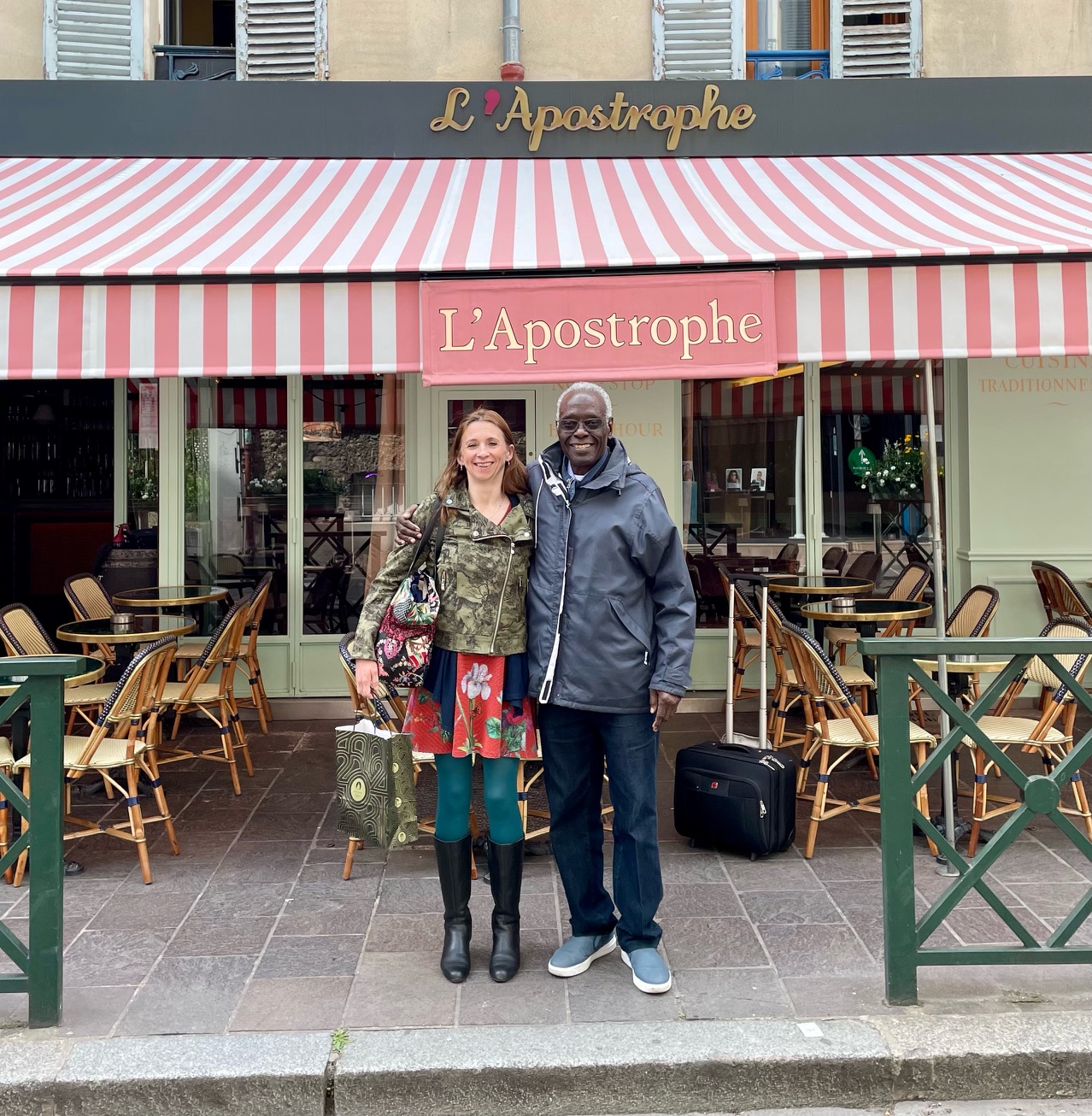
What started as a necessity became a revelation. I discovered that embracing not-knowing, adopting openness and humility, and learning to hold questions in my mind was hugely enriching. Not only did it teach me a lot about myself but it enabled me to build much more meaningful connections with books, people and the world. This has led to many of the exchanges and friendships I established over the years through this blog (like my correspondence with living legend Tété-Michel Kpomassie, who I met in Paris last month – that’s us pictured above). And it has shaped the way I write and think about books – on this blog and elsewhere.

Back in 2021, to explore this approach to reading further, I launched my Incomprehension Workshop. A few months later, to celebrate this blog’s ten-year anniversary, I offered a free virtual session and was delighted to have so many takers that I had to run two to accommodate everyone. Since then, I have run the workshop with readers around the world, most recently in Assam, India. Playing with not-knowing in the company of fellow enthusiastic readers has been a great source of inspiration for me, and a brilliant chance to test and hone a lot of the ideas that inform my new book.

Relearning to Read: Adventures in Not-Knowing is about reimaging the way we read by embracing not-knowing, questioning, humility and curiosity. Each chapter takes a different text likely to be outside the comfort zone of most English-language readers and uses this to play with different questions – what is authenticity? what makes something funny? how does censorship affect reading? and what makes us like a book in the first place? Some of the wonderful readers and writers I’ve encountered over the past twelve years make an appearance, including my hero Tété-Michel. And I also share how reading has shaped my life and rewritten me.

Relearning to Read is out worldwide in English in September 2025. BUT you can preorder it now. Indeed, my publisher Renard Press has made a wonderful offer: the first 100 orders through the Renard Press website will receive a signed, special-edition copy for the price of a standard paperback, shipped ANYWHERE in the world. That’s not all. If you preorder a Renard Press Edition of Relearning to Read, you can also get a Renard Press Edition of my second novel, Crossing Over, half price. Just put both in your basket and enter the coupon code RELEARNING at the checkout, and your collectors’ copies will wing their way to you in September 2025.

Thank you.