Vatican City: gospel truth?

Vatican City was always going to be a challenge. With an area of 0.2 sq miles and fewer than 900 citizens, it is the world’s smallest independent state. It’s also one of the most unusual – Vatican City nationals are made, not born (hardly surprising, given that the majority of its residents, barring a few Swiss Guards, are Roman Catholic priests) and the state is thought to be the only country in the world where you can take out money from a cash machine by following instructions in Latin.

All this made getting a novel, short story collection or memoir out of the place look doubtful. I was beginning to think I was going to have to resort to a papal bull just for the sake of having something to read.

Then I google-stumbled (gumbled – I think this should be a word) across an intriguing-sounding book called Gone with the Wind in the Vatican or Shroud of Secrecy, as my edition has it. Claiming to be the first treatise of written protest from within the Church since Martin Luther’s theses in 1517, the book is a sort of collective memoir-cum-exposé published by an anonymous group of Vatican prelates, calling themselves the Millenari, in Italy in 1999.

One of the group, Monsignor Luigi Marinelli (whose anagrammatic last name makes you wonder quite how many other people were in the Millenari), has since acknowledged his involvement in the book’s production. He has been investigated by the Roman Rota, the Vatican’s court, which also sought to recall the book from Italy and restrict its publication in translation – a controversial move, given that Italy is a separate sovereign state. Clearly, I had to see what all the fuss was about.

Right from the start (in the subtitle, in fact), the book sets out its mission to tell ‘the story of corruption within the Vatican’ and propose measures to help the secretive and hierarchical institution ‘cleanse what has become a festering wound’. It then proceeds to allege that almost every kind of malpractice and intrigue – blackmail, fraud, sexual favours, masonic links, spying, drug abuse, and even Satanic rituals – is rife among the elite clergy at the top of the Holy See, leaving those who want to advance their careers no option but to play the same game.

Crucially, unlike many works that criticise the Church, the book is written from a standpoint of belief both in Christian theology and in the potential of the institution. In fact, the authors go out of their way to demonstrate their faith, larding the text with quotations from scripture and even likening themselves to biblical prophets. At times, this repeated self-justification takes on a panicky air – although this is perhaps not surprising when you consider the power of the institution they are up against.

The most compelling passages of the book centre on the descriptions of the mechanisms within the ‘dictatorship’ of the Holy See and the way ‘the diplomacy of the Vatican immediately influences any states with which it has diplomatic ties’. At times cynical and sardonic, the narrative voice cites numerous instances of favouritism and petty rivalries advancing the careers of unsuitable (and often unqualified) candidates and blighting the prospects of deserving clergy. Perhaps most chilling of all are the allegations surrounding the way those high up in the hierarchy control and manipulate the Pope for their own ends:

‘To create a power vacuum at the top, they encourage the Pope to immerse himself in apostolic visits. […] Once back in Rome, bewildered and dazed by the rush of the crowd, ears still ringing with delirious hosannas, it is virtually impossible for the Pope to discover the intrigues of the court. […] When the Pope returns, steeped in glory, he is too tired and distracted to notice the insidious conspiracies hidden in the documents he signs. Everyone drafting the documents knows that the aging Pope won’t absorb the notes on the report.’

Perhaps because this is ‘a book of many voices’, the tone of much of the work is inconsistent, veering between the declamatory, the technical and the downright sensational. While some of the instances cited involve names and verifiable information, many of the anecdotes included are anonymous, and written more in the tone of salacious gossip than hard fact, so much so that I found myself wondering whether the writers’ assertions about favouritism said more about their frustrated hopes for their own careers than about the mechanisms themselves. There are also numerous references to miracles and revelations that non-Catholics will find hard to credit.

Nevertheless, as a window into a closed and mysterious world, this is a fascinating book. Accurate or not, it is also clearly a very brave work. No doubt it’s one of the more unusual texts I’ll encounter this year.

Shroud of Secrecy: The story of corruption within the Vatican (Via col vento in Vaticano) by The Millenari, translated from the Italian by Ian Martin (Key Porter Books, 2000)
Cuba: stellar work

One of the strange things about translated books is that they reach us quite a while after they were written. Sometimes, as in the case of smash hits like Stieg Larsson’s Millennium Trilogy, this might be only a matter of a few months. More often than not it takes several years.

Then there are books like Lydia Cabrera’s Afro-Cuban Tales, which was published in Spanish in 1940 and only made it into English 64 years later. These burst into an era very different from the moment in history in which they were created, a bit like light reaching us from extinct stars.

The book was a recommendation from David Iaconangelo, the founder of Zafra Lit, a bilingual blog dedicated to new Cuban short fiction. He described the stories as so well-written and original that they were ‘somewhere between a work of anthropology and fiction’, and said Cabrera’s work documenting the way various African and Cuban cultures fused in the tales she recorded had had a major influence on later writers such as Alejo Carpentier. I was also intrigued to see from Fernando Ortiz’s introduction to the Spanish edition that this is apparently the first book ever published by a Havana-born woman. Clearly, I was going to have to take a look.

Iaconangelo was certainly right about the originality: I’ve never come across stories more extraordinary than these. Operating in a universe of turtle-men, tiger-men and elephant-men, where stags ride horses, fishermen negotiate with their prey and earthworms compete for the hands of beautiful heroines, these tales pull apart the threads of reality’s backdrop and invite the reader to step through to the weird, cruel and magical cosmos beyond.

Language itself buckles, blends and warps in its attempt to contain the vibrant currents that flow through these tales, with the cultural fusion reflected by the inclusion of utterances from the now extinct creolized dialect Bozal, as well as phrases from Lucumi, Congo and Abakua tongues. As one footnote explains, ‘the original meaning of many of the African words in this book has been lost’, giving a lot of them the mysterious quality of magical incantations, for which they were used in some Afro-Cuban circles.

In addition, the stories themselves test the limits of the language in which they are couched: in ‘Bregantino Bregantin’, for example – in which men are banished and women live along with a single male bull – communication changes so that ‘all masculine words not directly related to the bull were eliminated from the language’. The effect of reading this in the original, gendered Spanish must be particularly striking.

For all their strangeness, however, the stories nevertheless manage to comment on the world around them. Indeed, the distance that some of the more surreal episodes create probably grants the narratives more leverage to attack racism and the hypocrisy of institutions like the Church – ‘all of us are children of saints, and all of our meanness and the pleasure we take in sinning comes directly from them,’ begins one particularly mordant tale.

There are also moments of exceptional beauty, as in the opening paragraph of ‘The Mutes’:

‘On the first night, the moon looked like a thin strand of hair. On the next, like the edge of a transparent sickle. Next it looked like a slice of juicy honeydew melon, and then like a round millstone. Finally it dropped off into the night’s deep mouth, where the Eternally Hidden, the person whom no one has ever seen and who lives at the bottom of the bottomless, smashes up all the old moons with a stone to make stars while another moon is on its way.’

Brave, beautiful, weird and maddening, the stories that Lydia Cabrera gathered and filtered through her own writerly imagination are a lesson in how to break the rules and create something astonishing. As a collection, this book shouldn’t work: it’s inconsistent and erratic; characters stroll on half way through narratives and divert them another way; some stories peter out and the voice varies wildly between tales. But then, superficial logic would also tell us we shouldn’t be able to see light from stars that no longer exist.

Afro-Cuban Tales (Cuentos negros de Cuba) by Lydia Cabrera, translated from the Spanish by Alberto Hernandez-Chiroldes and Lauren Yoder (University of Nebraska Press, 2004)

Ukraine: killer punchlines

This was one of those books that you hear about and want to read. Not only was the premise of the novel – about an obituary writer who shares his flat with a king penguin – intriguing, but the story of Andrey Kurkov’s rise to become one of Ukraine’s most celebrated writers was pretty gripping in its own right: having to deal with more than 500 rejections from publishers, Kurkov self-published his early works and sold them on the streets of Kiev. Clearly, this was one dedicated writer.

The unlikely hero of Kurkov’s most famous work, which bears the Ronseal-style title Death and the Penguin, is Viktor, a novelist manqué who strikes it lucky when a newspaper hires him to write advance obituaries of some of the country’s great, good and not so good. All seems to be going well and Viktor looks set to break out of the lonely, frugal existence he has shared with Misha, a king penguin he adopted when the zoo closed down, until the subjects of his obituaries start to die in suspicious circumstances. As it becomes clear that his ‘vital images of the future departed’ carry more significance than he could ever have imagined, Viktor finds himself embroiled in an increasingly sinister plot, and realises he will need to use all his powers of invention to escape with his life.

Funny, dark and spare, Kurkov’s prose evokes complex situations in a handful of words. The writer does this by using small details to reveal the humanity of his characters: a militiaman’s wish for a quiet shift, a cartoon on TV, a gangster’s pride about his car.

He combines this with razor-sharp perception to produce striking and often touching reflections on death, loneliness, friendship and love. In particular, Viktor’s meditations on the strange alchemy that is the obituary writer’s craft – creating something fixed and definitive out of a mass of memories, half-truths and anecdotes – are fascinating:

‘The past believed in dates. And everyone’s life consisted of dates, giving life a rhythm and sense of gradation, as if from the eminence of a date one could look back and down, and see the past itself. A clear, comprehensible past, divided up into square of events, lines of paths taken.’

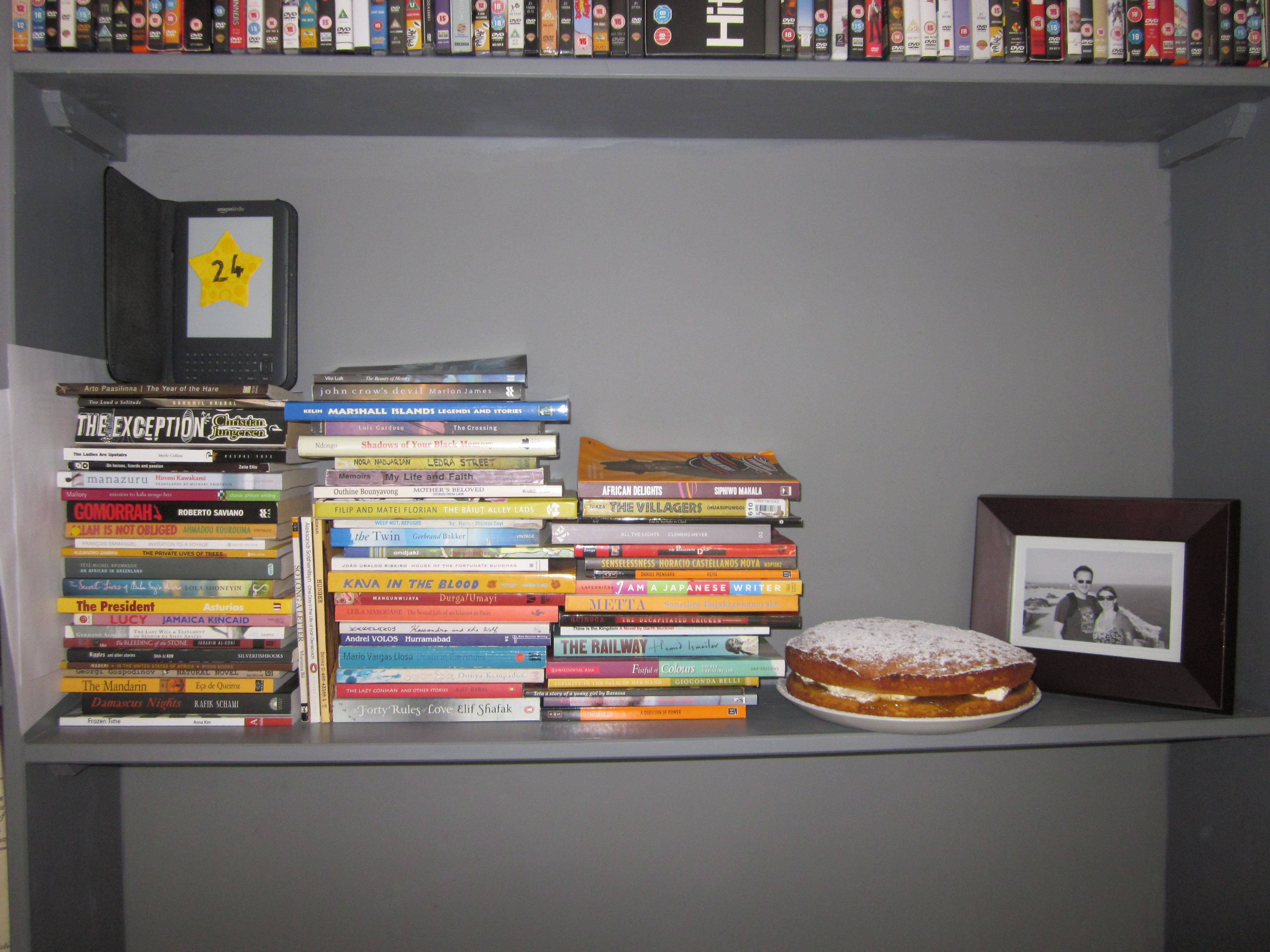
Similar to Vatanen’s hare in Arto Paasilinna’s The Year of the Hare (my Finnish book), Misha the penguin acts as a kind of barometer for his master, reflecting his mental and emotional state. He also humanises Viktor, giving him the vulnerability necessary to enable Kurkov to steer him through the moral hinterland the plot demands without losing the reader’s sympathy.

The result is that rarest of beasts: a novel that is every bit as gripping as it is well-written. I read it in virtually one sitting – and not merely because I had to keep up with the schedule. Great.

Death and the Penguin (Smert’postoronnego) by Andrey Kurkov, translated from the Russian by George Bird (Melville International Crime, 2011)

Tunisia: maze of discovery

This was a recommendation from one of the newest book bloggers on the block. Based in Redeyef, Tunisia, English teacher Ali Znaidi set up Tunisian Literature (in English) in May 2012 to plug a gap in the blogosphere, which seemed to have nothing in English dedicated specifically to Tunisian writing.

Providing news, book reviews and other information, Znaidi aims to raise awareness about his country’s literature. It therefore seemed natural to turn to him for a recommendation for this project – particularly as, from what I could find out, Tunisian literature is relatively rarely translated, compared to literature from many other Arab countries.

Znaidi confirmed what I suspected about the scarcity of Tunisian texts in English, but he came back with several suggestions. Of these, I went with Talismano by French-language writer Abdelwahab Meddeb.

Told by a Tunisian writer living in Paris (much like Meddeb himself), the 1979 novel, which the author reworked in 1987, is built around an imagined return to Tunis, Fez and the other cities of the narrator’s youth. As he wanders for a period of roughly 24 hours through streets built half from memory and half from fantasy, the protagonist tests the boundaries of experience and writing itself, by turns engaging in the sensual, riotous and often shocking events he encounters and stepping back to comment on the world and his place in it.

Culture and identity are central threads. As the writer walks through his ‘maze of discovery’, he records the impact that colonialism and the different communities that migrated to the region have had on the places he sees, mingling aspects of Islamic and Judao-Christian culture with ancient myths and secularism to create a heady, bustling and often bewildering text.

A polymath par excellence, Meddeb reaches for cultural references the way an experienced chef works with rare herbs and spices, adding complex layers of flavour and piquancy to his creation. From Dante, Hesse and Joyce, to the Koran and ancient Egyptian theology, the text is broad and full in its scope – a book more of the world than of any particular time and place.

Some of the references are clearly deliberately obscure, however, the experience of reading the novel as a Brit with very little knowledge of Tunisian culture added another layer of disorientation: there were times when I was not sure whether my missing things was part of the author’s design or a function of my own cultural blind spots.

This becomes clearer as the narrative unfolds, carrying with it a series of knowing commentaries on writing and the author’s craft. Perhaps the most telling of these comes right at the end in the Epilogue:

‘We have confided through writing, but without giving you a foothold, have strained your eyes with our arabesque of words, have recommended the circuits of our journey, have warned you of the fissure in all that meets the eye, have unsettled you on high moral grounds, have ruined you among the most robust constitutions, have dusted myself off, vanished into thin air, have found my way inside you through the least perceptible slit’.

No wonder then that extracting coherent meaning from the narrative sometimes feels like trying to scale a glass wall.

This can make for a frustrating reading experience, particularly in the early stages. However if you allow yourself to surrender to the narrative, and let it flow over you, carrying with it its tide of impenetrable allusions, you may be surprised by the insights and recognitions that flash suddenly from it like gems buried in the shifting sand of the seabed.

Beautiful, maddening, disturbing and strange, this is a book for the intrepid armchair adventurers out there. It is not a comfortable ride, but when you reach the end and look back along the route you’ve travelled, you get one hell of a view.

Talismano by Abdelwahab Meddeb, translated from the French by Jane Kuntz (Dalkey Archive Press, 2011)

Czech Republic: out of bounds

This book breaks the rules. So far, everything I’ve read for this project has been written and published since the country in question existed in its modern-day form (hence the fancy footwork getting a story from South Sudan). However Too Loud a Solitude by Bohumil Hrabal first appeared in 1976 in what was then Czechoslovakia — in the days when the Czech Republic was nothing more than a figment of Communist leader Gustáv Husák’s nightmares.

I say ‘appeared’, but that’s not quite right. In fact, because of the repressive mechanisms of the state at the time, the book was self-published secretly. It wasn’t until 1989, around the time of the Velvet Revolution – when the country moved from Communism to liberal democracy paving the way for the split from Slovakia in 1993 – that it came out officially.

This made it the last novel that Hrabal, dubbed ‘the sad king of Czech literature’ by one biographer, published before his death. Clearly, this was an important literary milestone on the road to the new republic. I was going to have to take a diversion and have a look.

As antiheroes go, they don’t come much more dubious than Hanta, an eccentric loner who has spent 35 years crushing outlawed books and waste paper in a sinister police state. Working alone with his hydraulic press turning rare book collections into bales of compacted paper, he is an agent of forces that all freethinking readers must abhor.

Yet, as we enter into Hanta’s ‘heavily populated solitude’, we come to discover the love of books that he has developed through his work and the inadvertent education it gives him. As we read about the care he takes over the thousand of volumes he processes – and often rescues for his private collection – we encounter one of the most moving, passionate and devastating testaments to the power of literature the world has ever seen.

Hrabal’s descriptions of a book lover’s interactions with texts on every level are extraordinary. From Hanta’s accounts of his reading fuelling ‘an eternal flame I feed daily with the oil of my thoughts, which come from what I unwittingly read during work’, to the thought he puts into the construction of bales – frequently placing a favourite text in the heart of them or a picture that might catch someone’s eye from the side of the truck that transports them for pulping – we inhabit his obsession with books as objects and as windows on other worlds.

Perhaps the most powerful example of this is Hanta’s violent reaction to the ‘inhuman’ modern press he goes to visit at Bubny. Processing books at breakneck speed, the machine reduces the workers who feed it to thoughtless minions:

‘pulling covers off books and tossing the bristling, horrified pages on the conveyor belt with the utmost calm and indifference, with no feeling for what the book might mean, no thought that somebody had to write the book, somebody had to edit it, somebody had to design it, somebody had to set it, somebody had to proofread it, somebody had to make corrections, somebody had to read the galley proofs, and somebody had to check the page proofs, print the book, and somebody had to bind the book, and somebody had to pack the books into boxes, and somebody had to do the accounts, and somebody had to decide that the book was unfit to read, and somebody had to order it pulped […] and somebody had to drive the truck here, where workers wearing orange and baby-blue gloves tore out the books’ innards and tossed them onto the conveyor belt, which silently, inexorably jerked the bristling pages off to the gigantic press to turn them into bales, which went on to the paper mill to become innocent, white, immaculately letter-free paper, which would eventually be made into other, new books’.

This understanding of destruction as part of the life-cycle of beautiful things is threaded through the text on every level. The same phrase starts each chapter before buckling under the pressure of the final section, while the plot itself, led through a spiral of literary references that are devoid of pretension and grounded in Hanta’s engagement with the beating heart of the texts he reads, folds in on a conclusion that is every bit as inevitable and necessary as it is heartrending. An astonishing piece of work. I’m not sure I’ll ever quite get over it.

Too Loud a Solitude (Příliš hlučná samota) by Bohumil Hrabal, translated from the Czech by Michael Henry Heim (Abacus, 2011)

Denmark: office politics

The Exception by Christian Jungersen was one of several books suggested by Danish book blogger Christina Rosendahl. I was grateful for the tip-off as Danish-to-English translations are not particularly common and my knowledge of the literary scene in Denmark is, well, probably slightly less extensive than my grasp of 18th century marquetry.

In actual fact, Rosendahl’s words about this novel weren’t the most glowing of recommendations – she said it was ‘quite good’. However, the subject matter intrigued me, and, as it’s a thriller, I thought it might make a welcome contrast with some of the other books I’ve been reading this year.

The story turns around four women working at the Danish Centre of Genocide Information. Tasked with collating, curating and archiving data about the world’s atrocities, they come under strain from a series of pressures to do with budget cuts, politics and their own loyalties and foibles that skew and twist the office dynamics. But when two of them receive death threats, the working environment takes a turn for the poisonous and it’s not long before the barbarity they document comes crashing into their comfortable lives.

Office dynamics are Jungersen’s speciality. Adept at isolating and revealing the mechanisms that enable people to be ‘so dishonest with themselves that they aren’t even aware of what they are doing’, he lays bare the steps by which ordinarily decent people can victimise and bully a colleague, all the while believing they are doing nothing wrong. This is rendered all the more impressive by the split narrative, which sees the story told through the eyes of all four women, and the weaving in of theories about the psychology of those who commit acts of genocide, which enables Jungersen to draw interesting parallels with the mental violence perpetrated in the office.

Jungersen gets round the problem of having to shoehorn a lot of background information and theorising into the novel by having several of the characters write articles about the psychology of genocide. This emphasises the ‘cognitive dissonance’ through which they are able to hold several conflicting ideas in their heads at the same time, acting cruelly while maintaining a belief in their own goodness – just as they write pieces about the mental mechanisms of ‘evil’ without applying them to their own lives.

Nevertheless, he labours the point a little towards the end, even quoting a section from one essay twice in case the reader has somehow missed the comparisons he is drawing. Similarly, although generally well handled, one or two of the more outlandish twists in the plot – which, without giving too much away, brings a Serbian war criminal into the orbit of the women’s workplace – are a little hard to swallow.

By and large, though, this is a gripping, thought-provoking and intelligent piece of work. It makes us question the patterns we  play out in our day-to-day lives and acts as a powerful warning against the sort of lazy pack mentality that can be all too easy to slip into. It was a jolly good pageturner too.

The Exception (Undtagelsen) by Christian Jungersen, translated from the Danish by Anna Paterson (Phoenix, 2007)

Cameroon: joking aside

Just as one writer can become the go-to wordsmith for a particular nation in the eyes of the rest of the world (see my post on Afghan literature below), so one book can become so famous that we forget the author ever wrote anything else. In the case of Mongo Beti, I was all set to read The Poor Christ of Bomba, the 1956 novel banned in Cameroon for lampooning the religious and colonial authorities. Several people had recommended it and it seemed like an obvious choice.

But, as I was googling around Beti, I stumbled upon a description of his slightly later humorous book, Mission to Kala. Intrigued at the thought of reading my first African comic novel, I decided to give it a go.

Told by Medza, a self-confessed ‘professional failure’, the novel describes the summer he fails his baccalaureat and undertakes a trip to a remote village to escape his father’s wrath. Charged with bringing back his neighbour’s wife, who has absconded to the region, the young man sets out to recover his community’s honour. But he has not reckoned on the welcome his distant relatives have in store for him and, finding himself celebrated as a celebrity and erudite man of the world, he begins to gather the gumption he needs to face his terrifying father and make his own way in the world.

Beti’s instinct for comedy is up there with the best of them. From the bathetic chapter introductions, of which the penultimate one is my favourite – ‘in the course of which the reader will become convinced that the final climax of this story is at last in sight – a conviction which is, most unfortunately, mistaken’ – to hilarious set pieces such as the white-knuckle bus ride which anticipates The Italian Job when the vehicle ends up hanging over a precipice, the book is bursting with rib ticklers. Perhaps the funniest sequence of all is when Medza finds himself beseeched to impart his great insights into Western learning to the villagers and, having exhausted his paltry stock of knowledge fairly quickly, is forced to improvise.

The comedy is heightened by Peter Green’s 1958 translation, which often sees him reaching into the PG Wodehouse and Evelyn Waugh lexicon and pulling out phrases such as ‘a really barbarous howler’ and ‘Oh the greedy beast!’ It would be interesting to see how a contemporary translator might render Beti’s words differently and whether this would alter the feel of the book at all.

As in his more famous novel, Beti has serious points to make. These focus largely on colonialism, religion and the questionable choices of parents, as one of the most powerful passages towards the end of the book demonstrates:

‘We were those children – it is not easy to forget – and it was our parents who forced this torment upon us. Why did they do it?

‘We were catechized, confirmed, herded to Communion like a gaggle of holy-minded ducklings, made to confess at Easter and on Trinity Sunday, to march in procession with banners on the Fourteenth of July; were militarized, shown off proudly to every national and international commission.

That was us remember?

‘Ragged, rowdy, boastful, nit-infested, cowardly, scab-ridden, scrounging little beasts, feet swollen with jiggers: that was us; a tiny squeaking species adrift in the modern age like poultry in mid-Atlantic. What god were we being sacrificed to, I wonder?’

Arresting though these passages are, they sit oddly with the jovial tone of the rest of the book. Reading them is a bit like watching a dinner party guest explode into a rant in the middle of a witty anecdote, leaving you unsure when it’s OK to start laughing again. Similarly, one or two of the set pieces Beti seeds in early in the novel fail to materialise, making Medza’s claims that he ‘can’t remember’ how certain things turned out feel like a bit of a fudge.

Overall, though, this novel was a great joy to read and had me laughing nearly all the way through. I’m already looking forward to getting acquainted with Beti’s other works when I’ve finished reading the world. And you can’t get a much better recommendation than that.

Mission to Kala by Mongo Beti, translated from the French by Peter Green (Mallory Publishing, 2008)

Germany: now and then

The question of who decides which of the many millions of books in other languages make it into English has fascinated me since I started to plan this project to read a book from every country in the world in 2012. As confirmed by a recent seminar on ‘Gatekeepers’ at the London Book Fair’s Literary Translation Centre, it’s a complex chicken-and-egg sort of issue that depends on who you think drives trends in publishing – publishers, readers, critics, translators or someone else entirely?

One person who was also at the Gatekeepers seminar was translator Katy Derbyshire (although I didn’t know this until a former colleague, translator Cathy Kerkhoff-Saxon, introduced us a few weeks later and we made the connection). Based in Berlin, Derbyshire has recently set up a book group for publisher And Other Stories, a small indie house that prides itself on sourcing great literature from some way off the beaten track.

The purpose behind the group, as she explained to me, is to use German literature fans to assess titles and recommend which ones the company should sign up for English translation. And Other Stories is, as far as she knows, the first publisher to work in this way and since the company was founded in 2010 it has built a reputation for putting out high-quality and innovative titles. Now Derbyshire hopes that her group of around 13 exchange students, translators and writers (most of them not native German speakers) will contribute to the growth of the company’s list by picking out works different to the clichéd German ‘Nazi novels’ that many UK publishers lean towards.

The connection with Derbyshire was doubly surprising because And Other Stories had sent me one of the first books she translated for them only a few weeks prior to the London Book Fair. With the powers that be seemingly conspiring to steer me towards this particular title, it seemed perverse to choose anything else.

Peopled with outsiders and underdogs, Clemens Meyer’s Leipzig Book Fair Prize-winning short story collection All the Lights puts society’s misfits centre stage. From the boxer on a losing streak to the unemployed loner whose world has shrunk to the letters he receives describing a long-lost friend’s adventures in South America, the characters in Meyer’s universe are all diminished, saddened versions of their younger selves, often set against the unforgiving backdrop of post-unification East Germany.

Many have retreated into paranoia, as in ‘The Shotgun , the Street Lamp and Mary Monroe’, in which a mentally ill addict mutters to himself in the living room up the hall from the bedroom where his girlfriend lies, ominously still:

‘I need a strong heart so I don’t go back to my shoes. In my shoes, out in the hall. I’ve hidden something in there under the orthopaedic insole, it’s a sort of emergency supply, but I don’t need it anymore, I’ll chuck it down the toilet later and flush it away, but actually an emergency supply’s only for a real emergency, and I’m sure that won’t happen now, and if it does I’ll stick it out, so I might as well just leave the stuff in my shoe.’

Meyer’s minimalist style (rendered through Derbyshire’s deft translation) enables him to cram words with significance, changing the mood in a clause and sketching a backstory in a sentence. This means that he can evoke extremely powerful and often surprising responses in the reader. ‘Of Dogs and Horses’, for example, in which we spend the story anticipating one kind of disaster only for the rug to be pulled from under us in quite another way in the final ten words, is devastating. Similarly, in ‘Fatty Loves’, we find ourselves in the unusual position of pitying a middle-aged teacher dismissed for an inappropriate relationship with a young girl.

This minimalism combines with a jagged chronology in which time jumps like a scratched record, hurling the characters back and forth between the present and the years gone by. With hints of missed connections between the stories – the same description of a girl’s teeth cropping up twice leading us to wonder whether the adult in one story is the same as the girl in ‘Fatty Loves’, familiar hints of the school sports field, and the humming of fridges in several lonely flats – this creates a powerful sense of wistfulness, as though other, better possibilities are forever unfolding slightly out of reach.

Once or twice the structure becomes a tad baggy as a result, as in ‘Riding the Rails’, the least successful story in the collection, in which a pair of ex-cons lose themselves in a rent-boy scam. For the most part though, it is incredibly skilfully handled.

Stuart Evers writes in his introduction that the stories reveal ‘the terrifying possibility of now’, but there is a sepia tint to Meyer’s lens that undercuts this statement. These tales take place in a world where people are woken by digital clocks rather than mobile phone alarms, where they make calls from phone boxes, write letters, and think in Deutschmarks, and where the tentacles of the internet have yet to penetrate. Seen in this light, the works are more about the tragic properties of ‘then’ than the possibilities of now. But Meyer’s achievement is to make that ‘then’ belong to all of us, whether we lived through it or not. Outstanding.

All the Lights by Clemens Meyer, translated from the German by Katy Derbyshire (And Other Stories, 2011)

Haiti: am I being stupid?

The question of what counts as ‘national literature’ is a tricky one. As I’ve found during the first four months of this project, lots of people have very different ideas about what it means.

Some people say it’s all about books by people from particular countries. Others think it has to be set in a certain place. The real hardliners claim it’s both, while another contingent argues that it’s more about what stories countries consider to be part of their national literature.

As the months have gone on, I’ve found myself leaning towards a definition involving books written by people with strong connections to particular nations. Usually these will be people with citizenship, but at the very least they’ll be writers who have lived in a country long enough for it to be woven into the story of who they are.

However, the protagonist of Dany Laferrière’s novel I am a Japanese Writer, which is on the shortlist for the 2012 Best Translated Book Award, would probably disagree. Having bagged an advance for his next novel on the strength of the title alone – it’s also called I am a Japanese Writer – the Haitian-Canadian struggles to get started on the manuscript. Claiming to be ‘tired of cultural nationalism’ and wanting to ‘show that borders have disappeared’, he attempts to immerse himself in whatever Japanese culture he can find in his home town of Montreal in the hope that a story will emerge from it. But when news of the book sparks a cultural movement in Japan and the Japanese embassy wants to involve him in all sorts of literary ventures and events, the writer finds he may have bitten off more than he can chew.

As the subject matter suggests, the book unpicks what makes up works of art. For my purposes, the meditations on cultural identity – from comments highlighting the oddness of concepts such as the ‘French kiss’, which ‘exists everywhere but France’, to full-blown discussions of nationality – were particularly fascinating. I couldn’t help but be challenged by one particular passage early in the narrative:

‘I don’t understand all the attention paid to a writer’s origins. […] Very naturally, I repatriated the writers I read at the time. All of them: Flaubert, Goethe, Whitman, Shakespeare, Lope de Vega, Cervantes, Kipling, Senghor, Césaire, Roumain, Amado, Diderot – they all lived in my village. Otherwise, what were they doing in my room? Years later, when I became a writer and people asked me, “Are you a Haitian writer, a Caribbean writer or a French-language writer?” I answered without hesitation: I take on my reader’s nationality. Which means that when a Japanese person reads me, I immediately become a Japanese writer.’

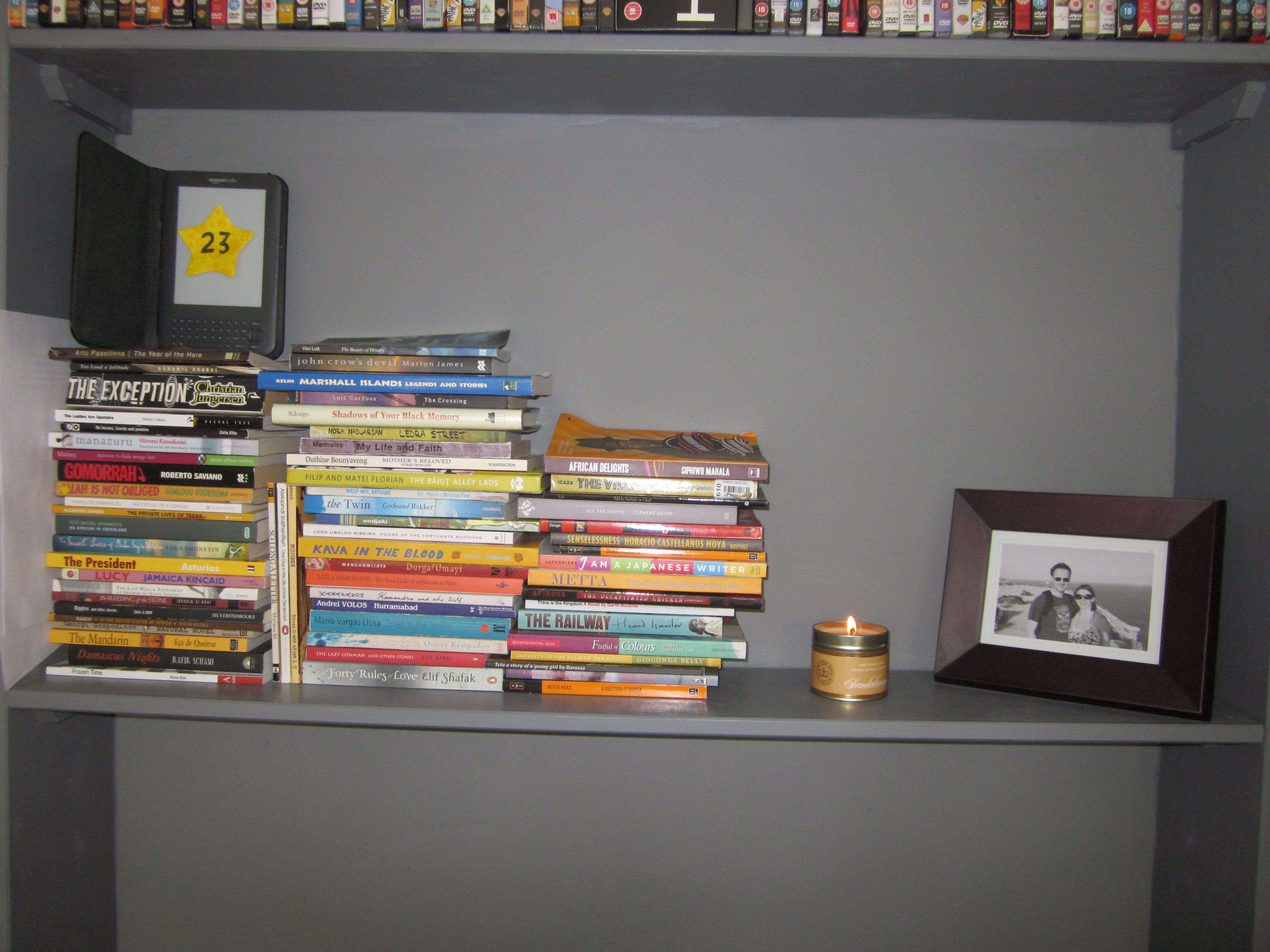
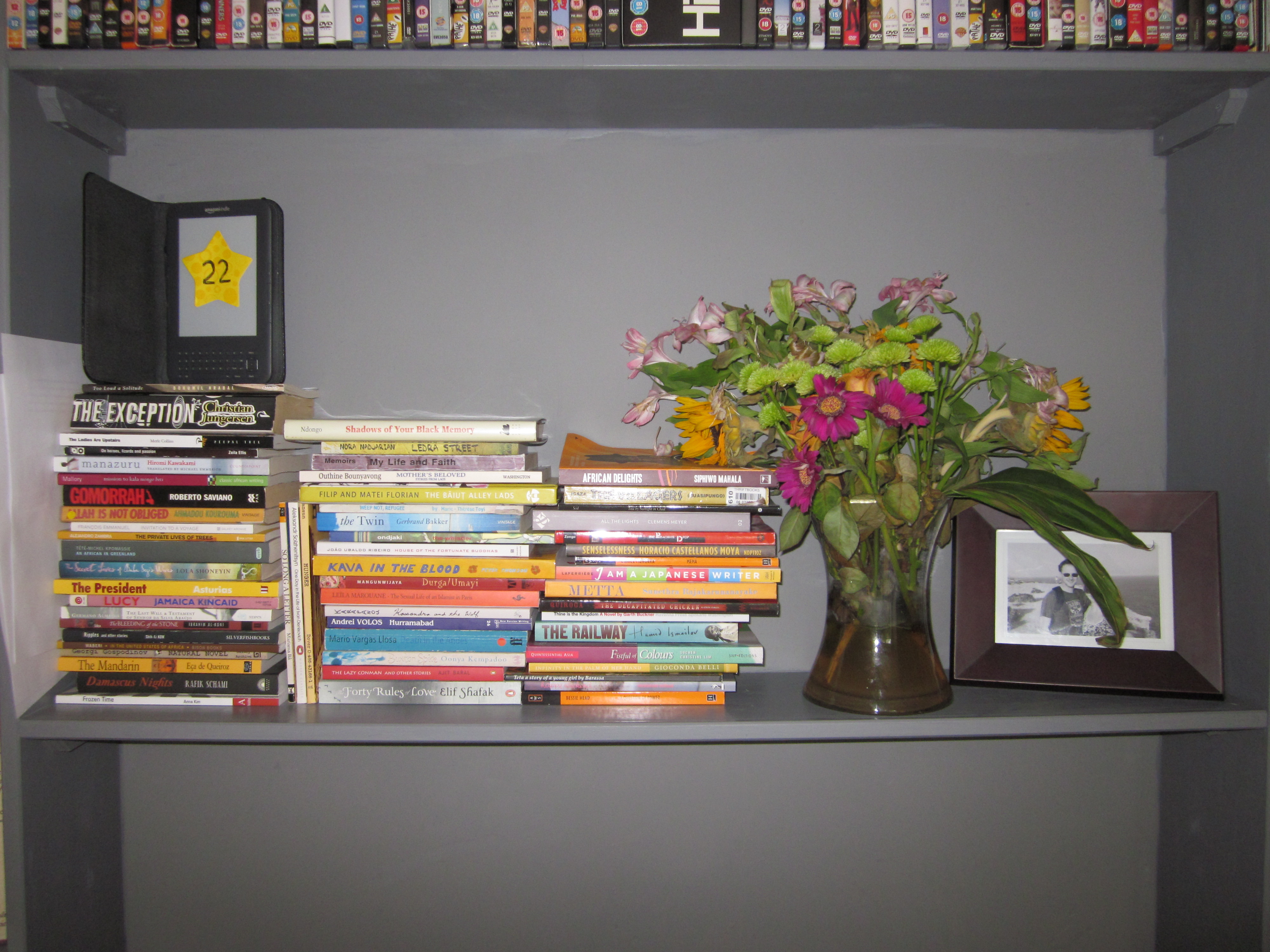
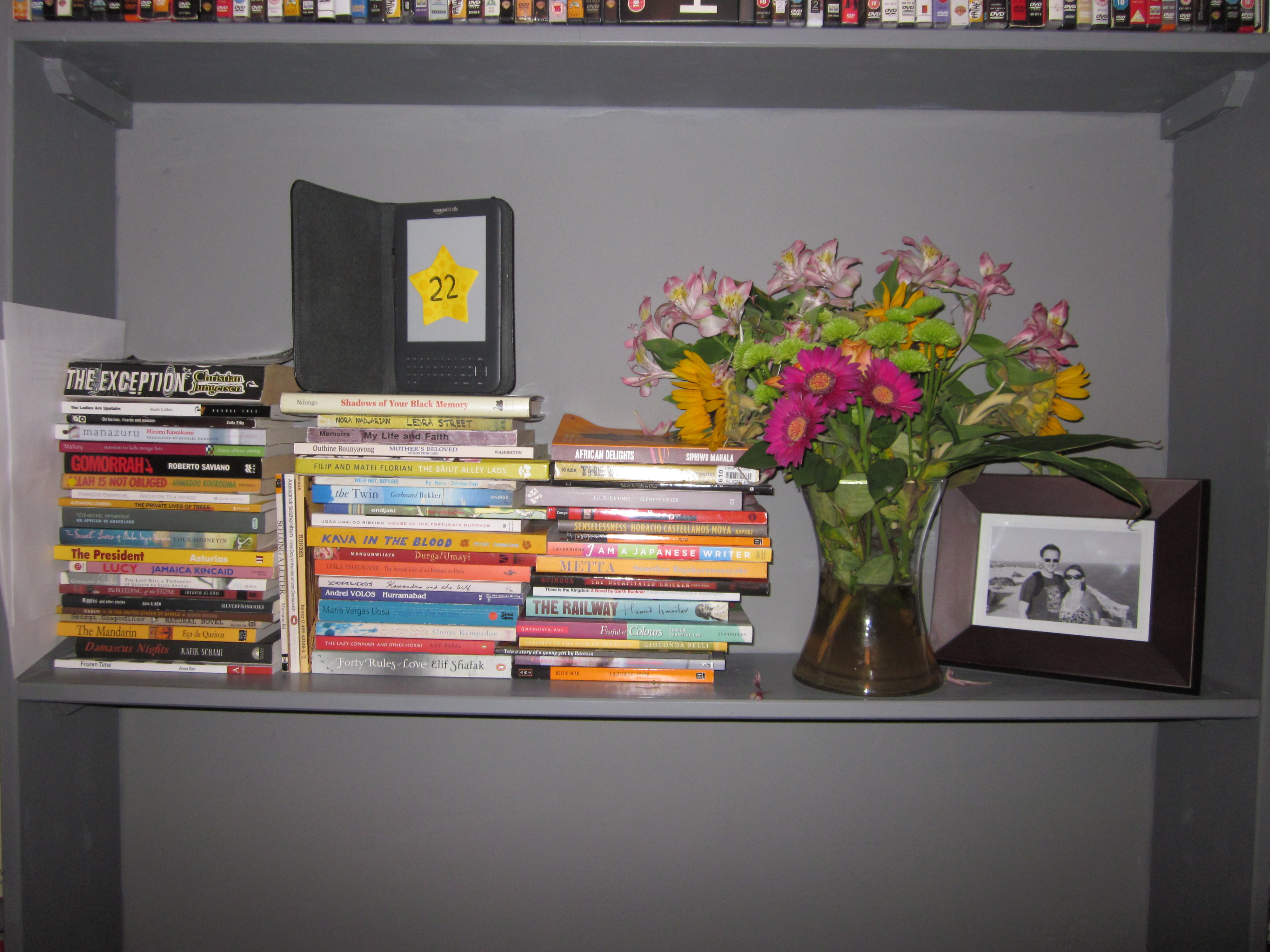
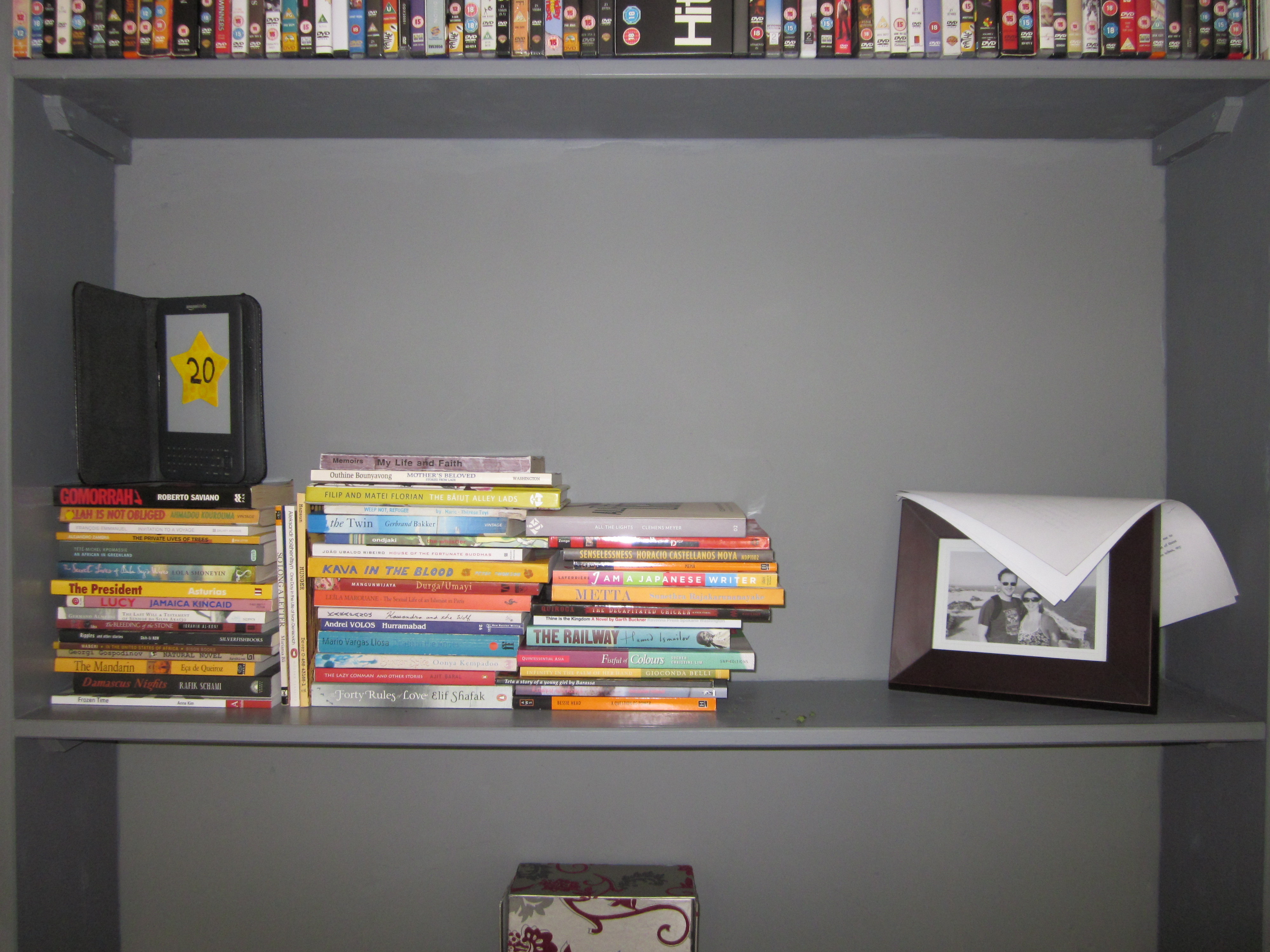
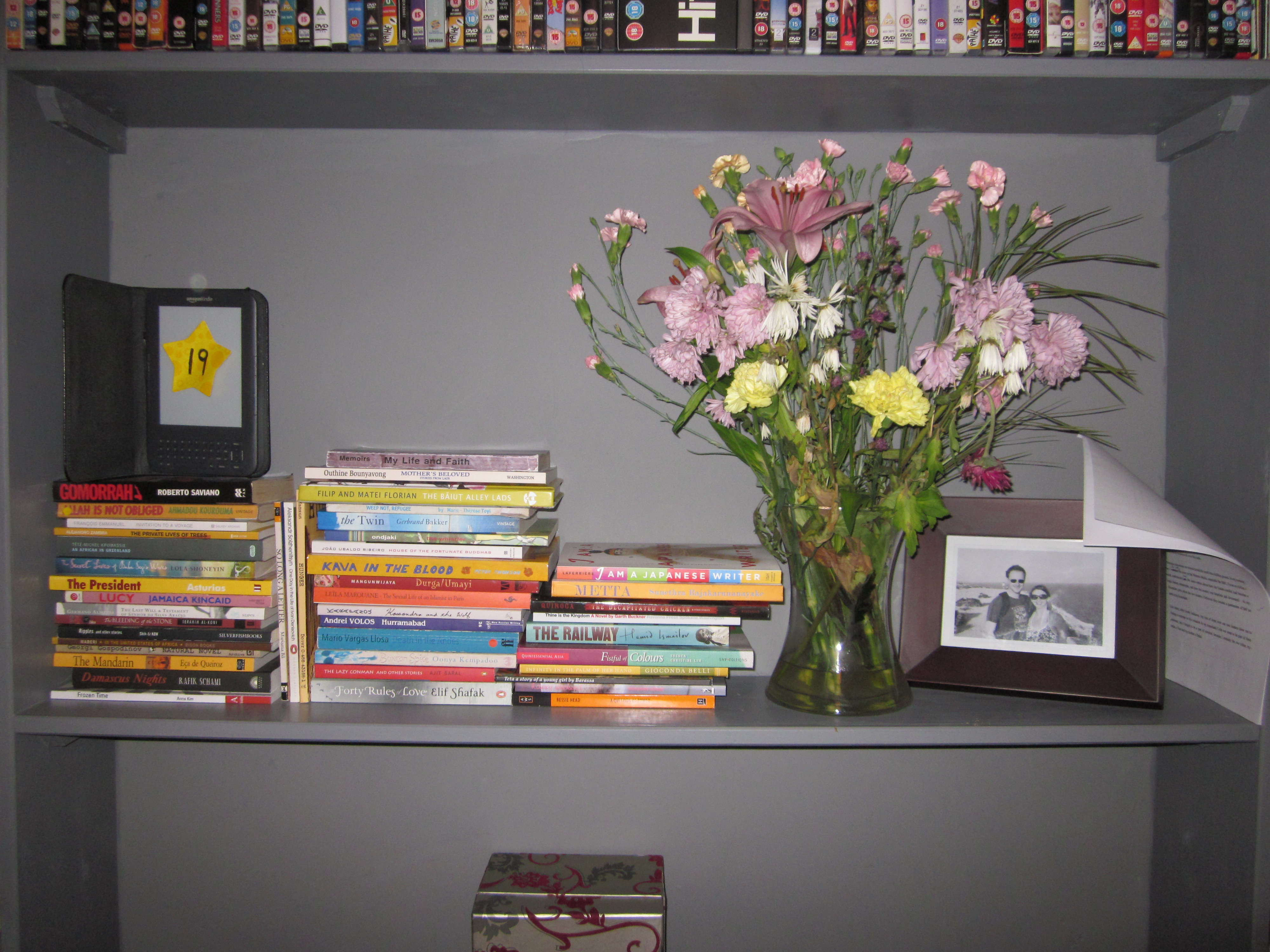
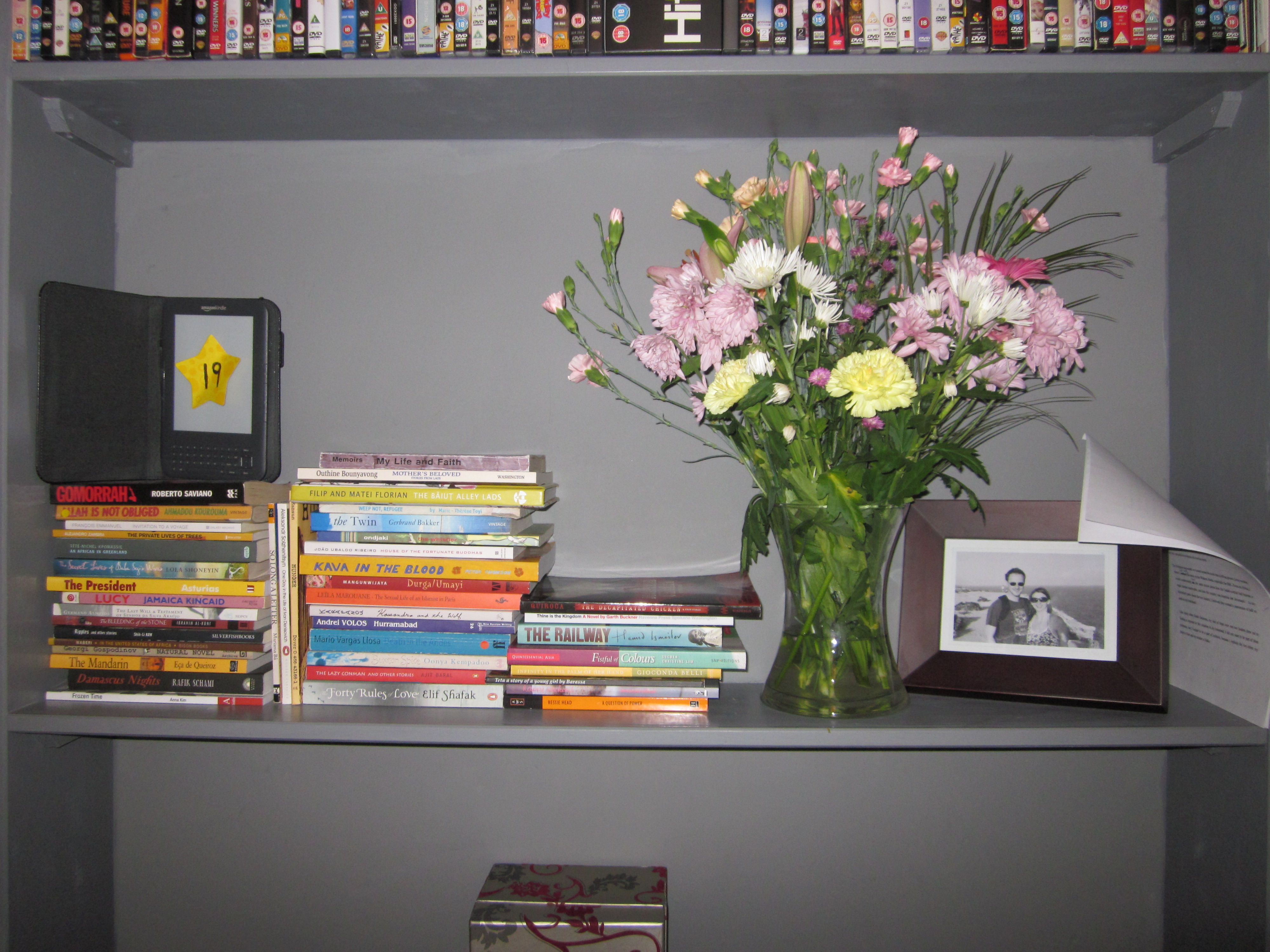
Where did this leave A Year of Reading the World then? Was I being foolish to even contemplate something so reductionist as trying to read a book from every country? Was I one of the ‘space police’ the protagonist describes, grimly shoehorning writers into boxes they would never choose? What if, as Laferrière’s protagonist would have it, I was simply assembling piles of British books on the shelf in my living room because, being British, I was unable to read books on any other terms?

These weighty discussions are offset by the narrator’s self-deprecating humour as he repeatedly dismantles his soap boxes and shifts ground. The witty portrayal of writer’s block and the protagonist’s ham-fisted attempts to immerse himself in Japanese culture – at one stage he bombards a bewildered Korean with questions on the assumption that the two countries are ‘the same thing’ – are great fun.

In addition, the arguments are undercut by the way Laferrière circles his readers, Sumo-wrestler-style, daring us to make the false move of conflating his protagonist with him. The writer may be a Haitian-Canadian living in Montreal and working on a novel with the same title as his creator’s, but he is of course not Laferrière. Or is he? And would it add any more authenticity and credibility to his arguments if the two were one and the same?

Ultimately, of course, the protagonist’s self-deterministic approach to his own work is blown apart by the wild reaction of the Japanese. Whether he likes it or not, the work he produces (or, in this case, has yet to produce) can not be controlled. As this fiendishly clever and enjoyable book demonstrates, the act of publishing is about setting a work free for others to criticise, categorise and cannibalise as they chose. Cultural nationalism may be a construct, but it is a construct to which the vast majority of the world subscribes.

Does that make it true? I don’t know. But hey, if all I’m doing here is assembling a library of British books, novels like this mean it’s definitely my most interesting and diverse collection to date.

I am a Japanese Writer by Dany Laferrière, translated from the French by David Homel (Douglas & McIntyre, 2011)

Uruguay: losing your head

There are some titles that reach off the shelves, grab you by the throat and all but frogmarch you to the check out (or in this case the virtual cash desk with the little man hiding somewhere around the back of the computer) to make you buy the book. Horacio Quiroga’s The Decapitated Chicken and Other Stories was one of these: as soon as I stumbled across the work on one of Wikipedia’s lists of writers by nationality, I knew I was going to read it. The fact several visitors to this blog subsequently recommended it only made me more excited about what I might find inside.

As its name suggests, this collection of short stories – selected from across Quiroga’s oeuvre by translator Margaret Sayers Peden – focuses on the startling, violent moments in which lives are altered beyond recall. Death, cruelty and vicious coincidence stalk its characters, feeding off their weaknesses and rarely allowing anyone to escape scot-free. There is the Indian worker driven to plot his bloody revenge by the high-handed discipline of a captain in A Slap in the Face’ and the father who retreats into eerie hallucinations after his young son’s death in a shooting accident in ‘The Son’ – a real shiver-in-the-sunshine moment in the best of the Gothic tradition. Meanwhile, the mini-masterpiece that is the title story shows how years of disappointment, hard luck and neglect can be distilled into a single, horrific act.

Jean Franco and George D Schade make much of the disturbing events of the writer’s own life in their Foreword and Introduction (several of Quiroga’s closest relatives and friends died in violent accidents, his first wife committed suicide and he killed himself in 1937). While these traumas must have impacted heavily on Quiroga, there is a strangely panicky feeling about the critics’ repeated references to them, as though they are anxious contain, defuse and even explain away the savage power of the text. At times, their comments take on the apologetic tone of the relative outside the room of the manic-depressive, whispering that dear Quiroga is not quite well.

This is perhaps because many of the stories in the book exhibit a disturbing, almost anarchic, approach to reality and sanity that is even more troubling than the violence they portray. From weird parables such as the story of ‘Julian Darien’, in which a tiger transforms into a boy only to be tortured to death by the villagers when his mother dies, to the excellent The Pursued’ — which describes the narrator’s obsession with a mentally ill friend-of-a-friend that makes him desperate to get at ‘the madman behind the actor who was arguing with me’ — the stories never allow the reader to relax. Turn your back for a second and the landscape has shifted, the rules changed: Quiroga is a writer who must be watched at all times.

It doesn’t always work. Some of the reversals are too abrupt and, while many of the animal stories are compelling, the anthropomorphism occasionally falls flat on its face – ‘Anaconda’, for example, in which snakes set out to attack the research centre trying to find an antidote to their venom feels like a bridge too far. Similarly, Quiroga’s dipping between registers, which is often effective, can sometimes feel odd, as in the opening story ‘A Feather Pillow’, the ending of which reads more like a public health pamphlet than a denouement.

But these are minor quibbles. All in all, this is a masterful collection that lifts the lid on some of the deepest and darkest wells of human experience. It will linger with the reader long after it’s been put on the shelf. Highly recommended.

The Decapitated Chicken and Other Stories by Horacio Quiroga, translated from the Spanish by Margaret Sayers Peden (University of Wisconsin Press, 2004)