Azerbaijan: in search of identity

I had hoped this post would be on a book by Emin Milli. I found him on Twitter, describing himself as a ‘dissident writer living in Azerbaijan’ – rather brave from what I’ve heard about the strictness of the regime. In fact, according to his website, Milli is no stranger to this himself: he was sentenced to two and a half years in prison in 2009 and was only released conditionally in November 2010.

Sadly, when I contacted Milli, it turned out that the book of short stories he is working on won’t be ready until next year. He offered to translate and send me a couple of pieces – he works as an interpreter as well as a writer – but as I was really looking for a complete book, I decided not to put him to the trouble of doing that.

In the meantime, a contact at Sheffield Hallam University had sent through a suggestion of Ali and Nino by Kurban Said. This book presented another dilemma: although Azerbaijanis apparently consider it their national novel, at least according to Paul Theroux’s introduction in my edition, the identity of its author has been a mystery for many years. Several non-Azerbaijani writers have been in the frame since the book first appeared in Germany in 1937, alongside Baku-born Islam convert Mohammed Essad Bey (aka Lev Nussinbaum). He is the writer that journalist Tom Reiss concluded was behind the book – Reiss went on to write a biography of Bey, titled The Orientalist, which was shortlisted for the Samuel Johnson Prize in 2006. In addition, other scholars argue that Azerbaijani statesman Yusif Vazir Chamanzaminli is the main author.

The odds were that the novel is by an Azerbaijani, but there was still room for doubt. Was this enough for me to justify making it my choice for the nation?

Faced with very little else available in translation, I finally decided to go for it when I discovered that the journal Azerbaijan International had dedicated an entire issue to the book. Whatever the truth about its author, it was clear that the novel had had a lasting impact on the nation. And so, at the risk that new evidence emerges that blows all this out of the water, I decided to give it a go.

The novel is set in the early decades of the 20th century, during the turbulent run up to the declaration of a separate Azerbaijani state, and tells the story of a relationship between Christian beauty Nino and Muslim Ali. Caught between the conservative traditions of Asia and the liberal culture of Europe, and with the might of Russia bearing down on the region, the lovers find themselves forced to question their desires and identities. And, as the world plunges into war, they realise that events on battlefields hundreds of miles away will decide whether a society in which their love can thrive will continue to exist.

The conflict between East and West is at the heart of this book. From the very first chapter, in which a geography teacher explains that Baku sits on the cusp of two continents and tells Nino and his classmates that it is partly down to them ‘whether our town should belong to progressive Europe or to reactionary Asia’, questions of allegiance and identity are at the forefront of the narrative. This plays out on every level, from different ways of eating through to the design of houses – all of which are presented with much affection and wit. I particularly enjoyed Ali’s conservative uncle’s description of his visit to the opera in Berlin:

‘We were taken to an opera, called L’Africaine. On stage stood a very fat woman and sang dreadfully. We disliked the woman’s voice very much. Kaiser Wilhelm noticed this and punished the woman on the spot. In the last act many negroes came and erected a big pyre. The woman was bound hand and foot and slowly burnt to death. We were very pleased about that. Later somebody told us that the fire had been only symbolical. But we did not believe this, for the woman shrieked just as terribly as the heretic Hurriet ul Ain, whom the Shah had had burnt to death in Tehran just before we set out on our journey.’

When it comes to the position of women in society, the contrast between the two cultures couldn’t be more stark. While Nino’s father advises Ali that marriage should be based on equality when he goes to ask for her hand, his own father tells him that ‘women are like children, only much more sly and vicious’ and his friends and other relatives advise him that wives have no souls and should be controlled with violence. And when Nino is kidnapped and Ali is forced to pursue her kidnapper’s car across the desert, the codes of honour by which he and his peers operate look set to have horrific consequences for his love.

It seems impossible that a relationship could bridge such a gulf, but the beauty of the book is that Said is able to reveal the coming together of two people in a way that is utterly believable and compelling. While recognising that culturally and historically they ‘ought to be blood enemies’, Ali and Nino are able to find ways of transcending their backgrounds while holding on to the truth of who they are. This does not come without great pain and sacrifice. In fact, much of the book is concerned with the struggles the lovers face to accommodate each other’s needs and desires – from the miserable months Nino spends walled up in a harem in Persia, to the indignation Ali has to swallow at hearing Europeans praise his beautiful, unveiled wife. However, according to the story at least, such reconciliation is possible, even if much is lost along the way.

As a metaphor for the dawning of the new Azerbaijani nation, which managed a few brave years before being swallowed into the Soviet Union for much of the 20th century, the book is a powerful and memorable one. Written with great humour and beauty, it brims with affection for this nation of contrasts and contradictions. A wonderful read.

Ali and Nino by Kurban Said, translated from the German by Jenia Graman (Vintage 2000)

Egypt: breaking boundaries

This was another recommendation from Roger Allen, Professor Emeritus of Arabic & Comparative Literature at the University of Pennsylvania. His number-one tip for Egypt was Nobel Prize-winner Naguib Mahfouz – and he should know as he met the great man several times and translated several of his books. However if I were looking for something other than work by the nation’s leading literary giant, he had several more suggestions up his sleeve from among the thousands of excellent Egyptian writers on the market today. Ain Shams University professor Radwa Ashour was one of these.

I thought about it for a while. On one hand, I was very tempted by Mahfouz: several visitors to this blog had written highly of his work and I was sure I’d be in for a treat with practically any of his books. On the other hand, though, I couldn’t help feeling that Mahfouz was a safe choice. This journey was about discovery, after all, and I was eager to see what else was out there by writers I hadn’t heard of before – so I went for Ashour and chose her book Spectres.

Interlacing the lives of two Cairo academics, history lecturer Shagar and literature expert Radwa Ashour, this part-novel, part-autobiography and part-documentary explores the frontiers of storytelling. The two women are born on the same day and grow up during the mid-20th century, witnessing the Suez Crisis and the protests that shook the capital in the decades after it. As each runs up against the limitations of her gender, political sphere and the medium within which the author allows her to exist, the women seek to shape their own narratives out of the shards and fragments that litter their lives.

This is a courageous and often angry book. Whether it deals with the prejudice against women that causes Shagar’s great-grandmother to be viewed with suspicion because she refuses to marry again and Radwa’s children to be held up at passport control, or the political manoeuvres at the university that see one of Shagar’s colleagues hounded out, Ashour’s writing is indignant and powerful.

This is particularly the case when it comes to the central issue that runs through the book and, to a certain extent, shapes the women’s lives: Palestine. Marshalling sources ranging from Mahatma Gandhi’s 1938 claim that ‘Palestine belongs to the Arabs’ through to testimonials from villagers and Israeli officers about the Deir Yassin massacre, Ashour compiles a compelling  array of evidence to support her character’s forthright attacks on Zionist writers such as Elie Wiesel, ‘who wrote volumes against silence and described in detail the ordeal of the Jews in the Holocaust, of which he himself was a survivor, [but] did not see the contradiction in his own total silence in the face of what was happening to the Palestinians’.

However, as Shagar discovers when she attempts to present a paper at a conference organised on the 25th anniversary of Zionist Martin Buber’s death, the Palestinian perspective is one that struggles to find a platform. Vulnerable to accusations of bias and partiality – and the indifference of a West so far removed from Arab concerns that in 1991 an announcer on CNN is able to compare Baghdad under fire to ‘a huge Christmas tree […] “It’s a magical, thrilling sight!”‘ – the issue remains caught in the perennial paradox that in order for Palestinians to debate on equal terms with their opponents they must already have won the argument and proved their sovereignty to those who refuse to accept it.

Faced with the difficulty of constructing a narrative in the face of such powerful counter-narratives, the novel challenges and interrogates itself, oscillating between fact and fiction in search of a middle path that can carry the truth of both. Ashwour’s voice breaks into the text repeatedly, questioning the decisions she has made about characters, discussing her work in relation to her other books, and revealing the dizzying possibilities open to her as a weaver of stories – a sentiment she finds echoed in a translation of Aristotle cited in the text:

‘The work of the poet is not to narrate that which has happened, but rather that which might happen or is possible in accordance with probability or necessity’.

Seen in this light, this novel, first published in 1998, is in the extraordinary position of being able to enter into dialogue not only with the past but also with the future. With its telescoping of time, that sees, for example, Shagar simultaneously engaged with the events of 1946 and 1972 in Tahrir Square – and its swoops into and out of the future tense – the book seems to extend a line forward to the momentous events that shook the country only last year and takes on an eerily prophetic quality.

Entwining these themes, Ashwour delivers a challenging and complex read that tests the boundaries of communication. Bursting with references and the sheer volume of the ideas it explores and conveys, the novel strains at its seams, spilling out into the world beyond its pages and compelling the reader to engage with what it has to say. The result is passionate, rigorous and shaming.

Spectres by Radwa Ashour, translated from the Arabic by Barbara Romaine (Arabia Books, 2010)

Honduras: the look of love

This was a recommendation from Kathy. In response to my half-way appeal for countries I had yet to find books from, she contacted her friend Erik, who had spent some time living in Honduras.

The familiar response came back that there wasn’t much literature in translation from the country. Erik’s first choice would have been Ramón Amaya Amador’s Prisión verde but as far as he knew – and as far as I’ve been able to find out – this is not available in English. In the absence of anything by Spanish-language authors that I could read in translation, Erik suggested artist and writer Guillermo Yuscarán, whom he described as a ‘quasi Honduran author’.

The quasi refers to the fact that Yuscarán was actually born in the US with the name William Lewis. It wasn’t until 1972 that he came to Honduras, fell in love with the place and eventually made it his home, even going so far as to take a Honduran name. Given my general rule of thumb that a writer has to have spent enough time in a country for it to be part of their life story in order for their work to be eligible to represent that nation on the list, Yuscarán definitely fitted the bill.

Written during his first visit to Honduras and illustrated by the author, Points of Light paints a disturbing and enchanting picture of the country that stole Yuscarán’s heart. By turns brutal and whimsical, the stories shimmer with the hopes and dreams of a multitude of characters engaged in the struggle to survive. There is the chronically ill boy Raimundo who sings in the town and on the buses to feed himself and his siblings, the prostitute Lia who dies in childbirth on the beach, and the poor child Vicente who wants to reach the moon down from the sky. Through them all, moves the blind man Toribio, a magnetic figure who draws the stories together and provides a series of almost other-worldly insights.

Yuscarán’s direct and often apparently simple style is well-suited to telling the stories of characters who are thwarted by life. His portrait of Miguel, for example, a disabled man who was abandoned in Tela at the age of two – ‘a piece of bait for life to strike at’ – and now lives in a shack on the beach, forever cut off from the girls he would love to get to know, is devastating in ‘The Milk of Human Kindness’. Similarly, the discussions between Toribio and a terminally ill child in ‘Emilio Aguilar’ capture of world of feeling in a very few words.

But that’s not all. A strong artistic sense runs through the book, bringing out the richness, beauty and possibility of even the bleakest existences. We see it in the vivid descriptions of the colours of the natural world – the sunrise’s ‘spidery pattern of oranges and yellows for Lia’s song and Pablito’s dreams to ride on’, for example – and in the awakening sensibility of the many artists who people the narratives. While gringo Memo (a self-portrait, perhaps?) ‘had always wanted only to see what was real, no matter how painful or overwhelming’, Vicente experiences the marketplace as being ‘alive with color […] each person [..] a spark of light leaping in and out of a great painting’. And when the painter Soledad, who sees ‘the truth of colour in all things’, completes his magnum opus of a great bird on a wall looking out to sea, his creation takes on an extraordinary life of its own:

‘That night, The Great Bird moved its head, then blinked one eye; the massive wings fluttered. Far out at sea, a fog bank moved rapidly toward shore, sliding across the water to the sheer cliff walls. As the fog passed, dissipating into mist, Soledad saw the moon over Tela, shining downward like some enormous beacon. His eyes widened as the sphere suddenly became transparent, before filling with liquid colours, shades he saw as his own cosmic fluids – his own blood – in transformation: rich incandescent blues and greens; a kaleidoscope of oranges and yellows becoming livid pink, then violet, then crackling into sprays of porous magenta. Blinded by the brilliance, Soledad closed his eyes.’

Though there are many great moments, some of the stories lack momentum. ‘Dona Lina Catero’, for example, in which an old woman goes about her business, waxing lyrical to the village youngsters, is more of a portrait. Similarly, ‘Son of Esquipulas’, the final story in the collection, feels more like a mosaic of incidents rather than a single coherent piece.

Overall, though, it’s hard not to be struck by the freshness of the vision in the writing. Forty years on, with his place in Honduras’s cultural hall of fame assured, Yuscarán’s first book retains its power to surprise, sadden and transcend. It is in many ways a love letter to the country he would adopt. On the strength of it, it’s hard to see how Honduras could not embrace him.

Points of Light by Guillermo Yuscarán (Nuevo Sol Publicaciones, post 1989)

Slovenia: expect the unexpected

Guernica Press may not have been able to help with my Latvian query in time for the end of the year, but it came up trumps for Slovenia. As Mike explained when I emailed to ask about Nora Ikstena’s work, the company was just in the process of publishing a novel by Slovene author Luka Novak. It was called The Golden Shower or What Men Want – would I be interested in seeing a copy?

Not only was the title intriguing (if a little disconcerting), but Luka Novak sounded like quite a character in his own right. The co-host of a popular Slovenian TV cookery show and programme director of the Slovenian Book Fair, he ran a publishing house for 20 years, as well as launching what is apparently Eastern Europe’s first ever concept store. He also ran for Mayor of Ljubljana in 2006, speaks six languages, and has translated 20 books, including Julian Barnes’s Flaubert’s Parrot, into Slovenian.

Phew. I had to see what this one-man cultural extravaganza’s novel was like.

The book starts when a middle-aged psychiatrist and his younger actress girlfriend arrive in Provence, France, for a holiday, which he intends to spend writing a book of cultural essays. It’s not long, however, before their plans start to go awry and the couple, along with Orada, the doctor’s Bosnian masseuse neighbour back in Ljubljana, and a German mythology professor, find themselves caught up in a covert cultural, religious and political movement that aims to take over and remake the world in its own image.

Novak is great at making his characters reveal their inconsistencies through their actions and the stories they tell about themselves. From the brilliant portrait of procrastination in the early chapters, where the psychiatrist is always on the point of sitting down to write his essays but finds himself forced to seek refuge in glass after glass of rosé, to the constant shifting of ground that characterises his arguments with Larisa  during which the pair wander miserably around picturesque French towns, neither getting to do what they want to, with the fact of their childlessness only a Freudian slip away – the novel is full of instances of self-deception and people interacting at cross purposes.

This is helped greatly by Novak’s witty voice. Whether his characters are asserting the opinion that ‘in Ljubljana they’re incapable of making a coherent croissant’ or expressing home truths about the Bosnian War there is a pithiness to his writing that makes for absorbing reading. This is coupled with a series of great cameo characters. I particularly enjoyed the German couple at Ducasse’s country inn, who have planned out every minute of their holiday, barring the ‘five percent spontaneity they generously afford themselves on every trip’.

The humour is important because it buys Novak considerable slack when the narrative rises into the realms of the surreal, tugging at its moorings like a hot air balloon. Watching the plot move into farce after 80 pages or so  with kimono-sporting monks, religious SWAT teams, gender-morphing musicians and the President of Slovenia all dropping in under the watchful eye of the mysterious aesthete, Contractor  is disconcerting and would no doubt be off-putting if the novel weren’t so enjoyable to read.

The same is true of the clamour of philosophical and religious references in the narrative. These centre around Contractor’s desire to reconstruct religious tableaux for the modern age in an effort to create what is variously described as ‘a commercial for a better world’, a ‘pornographic invitation to rebellion’ and the basis for the ‘alteration of people’s very sensibility’. The whole thing might be unbearably pretentious in another writer’s hands, but in Novak’s it’s quirky, intriguing and odd.

That said, the book is not without its frustrations. Even with the general rule of thumb (broken occasionally with the story of the German mythology professor) that the chapters alternate between the experiences of the psychiatrist and Orada, it’s often hard to know where you are. I spent the beginning of several sections straining to catch a familiar reference so that I could work out who I was reading about  a tricky extra complication when you’re dealing with a plot that embraces randomness. In addition, there are some abrupt shifts that leave us scrabbling to catch up. In one paragraph, for example, Orada is watching the Venezuelan police seize an accomplice on the beach; in the next, Contractor is stopping his motorbike in some woods. It’s left to us to infer that Orada hopped on behind him.

All in all, though, this is an enjoyable and surprising novel. No doubt the plot and the subject matter will be too wacky for some readers, but if you give yourself over to it, the narrative sweeps you along, delivering a good helping of insights, thrills, spills and laughs along the way. Apparently, Novak is working on a second novel, this time about the mysterious death of an eccentric pianist-performer in 1980s Paris. I’m intrigued to see what that will entail…

The Golden Shower or What Men Want (Zlati Dez ali Kaj Hoce Moski) by Luka Novak, translated from the Slovenian by Urska Charney (Guernica Editions, 2012)

United Arab Emirates: on the money

One thing this quest has taught me is that there’s no harm in trying. You can never predict whether someone will help you from reading their biography or studying their tweets. The worst that can happen when you fire off an email asking for suggestions of books from far-flung corners of the planet is that you receive a grumpy message in reply (rare) or you hear nothing back (more common and completely understandable). But every so often, if you type really nicely and wish double hard, you strike gold.

With this in mind, I sent an email to University of Pennsylvania Professor Emeritus of Arabic & Comparative Literature and leading translator Roger Allen back in June this year, asking for advice on some of the Middle Eastern countries I had yet to source books for. As I discovered when I came across an interview with him on the blog Fascinated by the Arab World,  Allen was uniquely placed to help me. Not only does he hold the US’s oldest professorial post for Arabic as a separate language, but he has also translated books by some of Arabic literature’s finest writers, among them Egypt’s Naguib Mahfouz, whom he met many times.

In spite of his busy schedule, Allen replied with several thoughts. All in all, he confirmed, there was very little available in translation from the Gulf states. However, when it came to the UAE, there was one writer he could recommend with some short story collections in translation: his name was Mohammad Al Murr. I lost no time in looking Al Murr up and within minutes his intriguingly titled The Wink of the Mona Lisa and Other Stories from the Gulf was winging its way to me.

Al Murr’s collection spans a cross-section of UAE society. From the businessman flying first-class to the thief rustling camels to please his prostitute girlfriend, Al Murr’s characters are eclectic and often surprising. There is the driving instructor who charms her way into a family circle, the trumpet player with impractical plans for starting a string of businesses, and the middle-aged man who becomes obsessed with owning a talking parrot.

Quirky and intriguing, the stories often deal with the minutiae of existence, showing how a look, a word or even an apparent wink – as in the case of the title work – can change the course of a life. Often these changes centre on small tragedies or victories, as in ‘The Night’s Catch’, in which three boys steal and sell some pigeons from a violent collector in order to pay for a trip to the cinema, but they frequently point to more fundamental shifts. The outstanding ‘Road Accidents’, for example, in which a husband and wife undertake a treacherous drive through fog, testing and exposing the cracks in their relationship along the way, is a masterclass in using small details as chess pieces to play out psychological battles.

In this world where much is left unsaid and people are often at cross purposes to one another – conducting affairs, gossiping about irrelevancies around a sick-bed and, in the case of the children in the collection, bemused by the oddness of the things others take for granted – it is often left to the non-human participants in the stories to act out hidden tensions and desires. While the naughty pet ape Umm Kamil leads her owners a merry dance in ‘Just Standing There, Smiling’, crashing a wedding and at one point even disrupting worship in a mosque, Adoul the monkey becomes the agent of his mistress’s cruel revenge on a servant in ‘The Awesome Lady’.

One or two of the more enigmatic stories, such as ‘The Secret’, in which a boy becomes a mute because of something he witnesses, have an unfinished quality. In addition, the play with dialogue and one-sided conversations, which works brilliantly in stories such as ‘Words, Words, Words’, overwhelms the drive of a few pieces so that occasionally it seems as though Al Murr is more interested in exploring the technical possibilities than developing the action.

Overall, though, this is a fascinating collection. Packed with rich perceptions, it is an intense evocation of people’s lives and concerns. It is also testament to Al Murr’s skill that our faith in the situations he creates does not falter, no matter how bizarre they may be. It will be a long time before I forget the image of Umm Kamil appropriating the bride’s veil during a wedding feast.

The Wink of the Mona Lisa and Other Stories from the Gulf by Mohammad Al Murr, translated from the Arabic by Jack Briggs (Motivate Publishing, 1998)

Mongolia: a high point

There were two choices in the frame for Mongolia. One was a collection of folk tales picked up at Chinggis Khaan International Airport in Ulaanbaatar by writer friend Emily Bullock. The other was Galsan Tschinag’s The Blue Sky, a book recommended by fellow literary globetrotter Paul.

The folk tales sounded tempting, particularly as, weighing in at just 119 very small pages and with lots of illustrations, they would probably have taken less than an hour to read. However, when I found out more about Galsan Tschinag’s extraordinary life story, my attention was hooked.

Born as Irgit Schynykbajoglu Dshurukuwaa (his name in Tuvan), Tschinag adopted German as his written language during his time studying at the University of Leipzig in the sixties before becoming a singer, storyteller, poet, shaman and Tuvan chief. Angered by the impact of the Communist regime on his people, he led a huge caravan of Tuvans back to their ancestral home in the Altai Mountains and campaigns for the rights of the group to this day. He also apparently managed to cure himself of a life-threatening heart condition using his shamanic powers.

By the time I’d finished reading about him, I couldn’t help feeling that Galsan Tschinag was running Tete-Michel Kpomassie a close second for the title of ‘writer I’d most like to meet’.

Drawing heavily on Tschinag’s childhood, The Blue Sky is the coming of age story of a young shepherd boy in the Altai Mountains. On the face of it, he and his family pursue the nomadic herding ways of life that Tuvans have practised for generations; yet far away in the interior of Mongolia change is afoot with the influence of the Soviet Union prompting seismic shifts that will ripple out to the farthest corners of the country and alter the boy’s life for ever.

Few writers inhabit their characters’ thoughts as convincingly as Tschinag does. Capturing the wonder and weirdness of childhood, he has a gift for bringing us into his protagonist’s hopes and dreams. We share in the boy’s fantasies of becoming a baj by building up a flock of more than 1,000 sheep and his wacky plan to count to that number by assembling 100 people and ticking off their fingers one by one, and they feel real and immediate, and strangely reminiscent of our own childhood imaginings. In addition, we recognise the quirky literalism of childhood – which leaves the boy watching his relatives in bewilderment for signs of their necks twisting after a comment from his mother that their heads have been turned – and the power of make-believe which transforms an eagle sighting into a full-blown attack when the boy tells his parents about his day.

This sense of recognition helps Tschinag bring us close to customs and practices that might otherwise feel irreconcilably alien and strange. Identifying with the boy, we can inhabit his world, where sniffing people is a way of expressing affection, children smoke pipes and urine is a remedy for sore eyes. As Tschinag describes the family’s formal adoption of the mysterious old lady who declares herself the boy’s grandma and the extraordinary rituals carried out to honour and respect animals and nature, it is as though we are sitting round the fire in the yurt with the characters, swapping stories.

As a result it is impossible not to feel connected to and invested in this world – and to bristle like Arsylang the dog at the approach of the outside influences set to destroy it. From very personal instances – such as the return of the boy’s older brother and sister from boarding school for the holidays and the awkwardness that springs up between the once-inseparable siblings – to news that the Mongolian Old White Man of traditional New Year’s celebrations has morphed into the Russian Father Frost, we see everywhere the erosion of this rare way of life. And when his father’s attempt to embrace modern hunting techniques backfires tragically towards the end of the narrative, we feel the full weight of the boy’s grief, not only for his personal loss, but for the passing of belonging, identity and meaning itself.

Achingly sad and yet passionately life-affirming, this book is up there with the very best. It is an extraordinary achievement by a writer skilled at celebrating both the unique and the universal. To read it is to marvel at the variety, beauty and strangeness of the human race – and to feel privileged to be part of it.

The Blue Sky (Der blaue Himmel) by Galsan Tschinag, translated from the German by Katharina Rout (Milkweed Editions, 2006)

Comoros: beyond belief

I thought this one might defeat me. As far as I could see, there was not – nor had there ever been – a single novel, short story collection or memoir published in English translation by a writer from the Comoro Islands. No matter who I asked or how charmingly I smiled at the Google homepage, the answer was always the same: nada. It seemed I had come to the end of the road.

In despair, I mentioned the dilemma to my colleague – the same colleague who came up trumps with the Niger book. A few weeks later he was back with, in his words, ‘possible gold’. He’d found a CV online of Anis Memon, a lecturer in French and Italian at the University of Vermont. It stated that in 2005 he’d done a translation of Le Kafir du Karthala by Mohamed Toihiri, the Comoros’ permanent representative to the United Nations and, according to Simon Gikandi’s Encyclopedia of African Literature, the country’s first published novelist. Perhaps if I contacted Memon, he might be able to dig out the manuscript for me?

I fired off an email and received a modest response from Memon. He said he couldn’t vouch for the quality of the translation as it was a personal project he’d undertaken when Mohamed Toihiri was a visiting lecturer one year at Memon’s grad school. The two had spent quite a bit of time together and as a result Memon had decided it would be good practice for him to try and translate one of the writer’s novels. Still, if I wanted to look at the manuscript, he’d see if he could find it for me.

A nail-biting wait ensued. The way I saw it, Memon’s translation was probably my one chance of reading a Comorian novel in English. I just hoped he was better at backing up and archiving his files than I was.

Luckily, that turned out to be the case and when I next checked my emails while on holiday in Spain, the file was waiting for me. The Kaffir of Karthala was mine to read.

Beginning on the day Dr Idi Wa Mazamba discovers he has terminal cancer, the novel tells the story of one man’s struggle to free himself from the conventions, patterns and prejudices that have dogged his life. Liberated by the knowledge that his days are numbered, married Mazamba embarks on an affair with a French woman, Aubéri, and comes to look at the world around him with new eyes. Yet this fresh vision brings with it a heightened awareness of the racism, corruption and contradictions that riddle society. Appalled by the hypocrisy he encounters, Dr Mazamba hatches a plan to challenge the status quo while he still can.

Toihiri is a clear-eyed writer, who excels at presenting complex situations in concise, memorable ways. Whether he is describing the inequality of living conditions in Chitsangani – ‘a neighbourhood where the Middle Ages and the Third Millennium went hand in hand’ and where ‘here one slept on a mat of fleas, there one got ill from hyper-cleanliness’ – or the double standards that see foreign nationals and the ‘generous partner’ donors who pull the political strings behind the scenes receiving top treatment while patients in Mazamba’s hospital can not afford drugs, Toihiri’s descriptions are precise and fearless.

Often, they are very funny too. Ranging from witty anecdotes to satirical attacks, such as the summary of the political career of Marshal Kabaya – ‘at first Minister of Sand in Your Eyes, he was then promoted, following a shuffling of the cabinet, and became the Minister of State in Charge of the Occult Sciences’ – they puncture pomposity and pretence wherever Toihiri sees it. Meanwhile, the writer balances these descriptions with a wry affection for some of the customs on the archipelago that keeps the narrative from becoming overly bitter, as when Mazamba explains the rivalry between the islands to Aubéri:

‘In Ngazija and Mmwali they say that the Anjouanese are poisoners, that they’re skinflints, morbidly jealous, that you mustn’t even look at their women otherwise they’ll arrange to have you thrown off a bridge; we actually say a lot of nonsense about each other.’

Perhaps the most fascinating passages of the book for readers unfamiliar with Comorian culture, like me, are those surrounding marriage traditions in Mazamba’s home village. There, the concept of the ‘great wedding’, a huge celebration which each man is expected to save for and go through once in his life, regardless of whether he is already married to another woman or not, holds sway. And when Issa, Mazamba’s best friend, allows himself to be flattered into going through a great wedding with a canny teenager, the folly of the institution is laid bare.

Occasionally, Toihiri’s desire to encapsulate contradictions and struggles in punchy imagery runs away with the narrative. Muslim Mazamba and Jewish Aubéri’s first physical encounter, for example takes place in a church during a trip they both conveniently have to take to apartheid-riven South Africa. Reading the descriptions of Mazamba breaking his Ramadan fast with Aubéri’s bodily fluids under the shadow of a crucifix, I couldn’t help feeling the author was labouring the point. In addition, the final stages of the plot, during which Mazamba is unexpectedly manoeuvred into a position of influence that enables him to take radical action, rely too much on coincidence and luck to be entirely credible.

But then I’m writing this having just read a translation that until a couple of months ago existed only on the hard drive of an academic I’ve never met more than 3,000 miles away. Hmmn. Perhaps anything is possible after all…

The Kaffir of Karthala  (Le Kafir du Karthala) by Mohamed Toihiri, translated from the French by Anis Memon

Lesotho: women’s rites

The suggestions for the small southern African Kingdom of Lesotho were a bit thin on the ground. The two authors who had been recommended, Thomas Mofolo and AS Mopeli-Paulus, were both long-dead, pre-independence writers whose books came out in the early 20th century.

I was sure there had to be more some more recent Sesotho literature available in English. But it wasn’t until I got talking to people at the recent, excellent International Translation Day event in London, that another lead emerged. There, a world-literature fan told me that her book group had read and enjoyed How We Buried Puso by Morabo Morojele, a contemporary Mosotho author.

Heartened by this news of a recently published book in English by a writer from Lesotho, I returned to my search refreshed. It was then that I stumbled on a surprising statistic: according to the CIA World Factbook, female literacy in Lesotho is unusually high for the region (estimated to be around 95.6 percent in 2010). It’s so widespread in fact that it outstrips male literacy by quite a long way – only 83.3 percent of men in the country can read.

If I found a book by a Mosotho author, then, it might well turn out to be by a woman. And so it proved: a few searches for ‘Lesotho women writers’ later, I was ordering a copy of Basali! – a collection of short stories by Basotho women, edited by K Limakatso Kendall.

The product of her two-year Fulbright Scholarship in Lesotho, the anthology grew out of work Limakatso Kendall did with students at the National University of Lesotho, who gathered, transcribed, translated and even wrote the stories in the book. Many of the tales were told originally in Sesotho and consist largely of episodes from the storytellers’ lives. These range from accounts of what led the narrators into particular vocations, including health work and life in a convent, to stories of overcoming hardships and challenges, such as Tembela Seleke’s memory of her return to South Africa years after the assassination of her husband there and ‘M’amoroosi ‘M’aseele Qacha’s tale of a woman’s reaction to the discovery that her schoolboy son has brought home a wife. There are also celebratory pieces, such as ‘The Universe’ – the only poem in the book – which is a sort of hymn to the beauty of the natural world.

Discrimination underscores many of the stories. Published in 1995, only a few years after the collapse of apartheid in neighbouring South Africa, the collection reveals the legacy of widespread racial persecution in many of the narrator’s lives. We see it in the terror of Usiwe as she contemplates a trip back across the border in ‘The Lost Sheep is Found’, as well as in the first story ‘Three Moments in a Marriage’ by Mpho ‘M’atsepo Nthunya, in which Agnes remembers her family’s mistreatment at the hands of the Boer police.

The gender discrimination that has limited many of the women’s choices also drives a lot of the stories. Although local traditions mean that, in many areas, girls are better educated than boys because boys are taken off to be trained for farming, physical labour and other traditionally masculine pursuits at a young age, the strongly patriarchal structure of society there dictates that decision-making rests entirely with the men, leaving women at the mercy of their male relatives.

This power imbalance manifests itself in many ways, such as the extreme domestic violence depicted in ‘M’atseleng Lentsoenyane’s ‘Why Blame Her?’, in which a wife is beaten because of her inability to bear children. However, it is also a spur to great courage and ingenuity. In Mzamane Nhlapo’s ‘Give Me a Chance’, for example, we hear the story of Mama KaZili, who refuses to let her children starve because of her husband’s irresponsible behaviour and trudges through the snow to confront his indignant relatives with a speech that deserves a place among the great feminist manifestos:

‘”Yes I know the Bible,” she answered. “It says women should keep silent: ‘they are commanded to be under obedience, as also saith the law’. Customary laws also treat women as children who are supposed to be under the man’s guidance and protection. Women are considered weak and naive. They have to seek permission even for little things like visiting friends and parents; in looking for employment; when they want to go to school, or ask for a scholarship or a loan; in applying for a site… Name them all.” […]

‘”All these forms of gender inequalities and injustices take place in a government that repeatedly points out with pride that it has been elected by women because men, who are predominantly away in the South African mines, are mostly pro-BCP. Society and government don’t want to give women a chance. Women have to seek permission for everything that can improve their lives. Before I pass away in this world I want to have had a chance to improve my life and the lives of my children.”‘

Such words are very inspiring, particularly when accompanied by the celebration of women’s friendships and relationships that runs throughout the book. From the ‘Letter to ‘M’e’, in which a daughter praises her mother, to the intriguing description of the motsoalle (best friend) celebration in ‘Three Moments in a Marriage’, there is a strong sense of camaraderie and sisterhood between Basotho women as they struggle in the face of hardships and discrimination, and seize the chance for education, described by Julia ‘M’amatseliso Khabane as ‘a weapon to fight life’.

The result is a stirring and memorable collection. While the anecdotal quality of the stories can mean that a few of them lack polish and impact, the overall effect is striking. I was inspired and moved. Great stuff.

Basali!: Stories by and about women in Lesotho edited by K Limakatso Kendall (University of Natal Press, 1995)

Armenia: another side

It’s rare that a writer advises you against reading his or her work. But that’s what happened when Armand Inezian stopped by this blog back in August. Seeing that his collection of short stories, Bringing Ararat, was listed under Armenia, Inezian very honestly said that he didn’t feel his connection with the country was strong enough as, although he comes from an Armenian family, he grew up in Boston and can’t write in Armenian. He added that his work has not been translated into Armenian either.

It was great to have Inezian’s perspective, as the question of exactly where the boundaries of national literatures lie has been a recurring theme in this project. I’ve encountered people who think hugely differently about this: while some are happy to regard books by an author whose parents come from a country as being part of that nation’s literature, others claim that the writer must be born, raised and still living in that country to qualify. There are even those who insist that a book must also be set in the country in question to count.

Personally, I’ve found my perspective on this issue shifting over the year with each tricky dilemma I’ve encountered and I’m still not entirely sure where I stand on it. Still, if Inezian didn’t feel his book was an Armenian work, perhaps I should listen to him.

Nevertheless, I was keen to involve Inezian in some way. If I wasn’t going to read his book (and let’s face it the choice of Armenian literature available in English is not massive), then perhaps I could pick his brains instead. Were there any Armenian writers whose work he could suggest? The answer came in the form of a link to information about Armenian Golgotha by Grigoris Balakian on Goodreads.

I have to confess that my heart sank when my copy arrived. Not only was this, judging by the title and subtitle (A memoir of the Armenian Genocide, 1915-1918), a very serious book, it was also a very long one. Its 500 or so large pages were covered with dense and relatively small print. The first sentence, too, with its earnest consideration of the political atmosphere of Europe in the wake of the assassination of Archduke Franz Ferdinand, filled me with foreboding. What had Armand Inezian let me in for?

The book records Armenian priest Grigoris Balakian’s experiences during World War I. Having finished his divinity studies at the University of Berlin just as the conflict began, Balakian travelled home to Constantinople in the hope that he could be of service to the Armenian population there. But as the eyes of the world turned to the trenches in Western Europe, Balakian witnessed the Ottoman regime beginning to target the 2 million ethnic Armenians within present-day Turkey’s borders, deporting hundreds of thousands of people to die barbaric deaths along the lonely mountain roads and plains of Asia Minor.

Caught up in this forced exodus, Balakian spent three years travelling and working in constant fear of being executed like the thousands of corpses he encountered en route. With only his ingenuity, determination and faith to guide him, he attempted to shield, hearten and save his Armenian peers, all the while holding on to the hope that he would one day be able to share their story with the rest of the world.

Balakian was an extraordinary individual, whose character shines through on nearly every page. Following the dry political summary of the opening lines, the narrative quickly becomes personal and detailed, bearing witness to its author’s great presence of mind in the face of extreme events. Whether he is using an anti-war rally he attended as an ‘opportunity to study up close the psychology of the organized German working class’, bargaining with the authorities for the lives of his companions, or talking to an official guilty of the deaths of thousands of his countrymen, Balakian displays an uncommon ability to keep his head.

This detachment means that he is able to embark on ‘a process of harrowing mental record-keeping’, remembering and relating details that would be lost to most people and delivering reams of compelling and historically significant descriptions. From his rare, foreigner’s-eye-view  of Berlin in 1914, through to the ‘whirlwind of blood’ he encountered in Asia Minor, Balakian’s accounts are meticulous. He spares nothing in his effort to convey the horrendous sufferings of his friends and compatriots, many of whom he claims were tortured and hacked to death by mobs bearing household and farmyard implements to save the authorities the cost of bullets. ‘If all the seas were ink and all the fields were paper, still it would be impossible to describe, in detail, the reality of the endless tortures of hundreds of thousands of them,’ he writes.

For Balakian, recounting these events is a sacred act. As he explains in his author’s preface, he regards his work as a ‘holy book’ for Armenia, which was first founded in around 600 BC. It is also the fulfilment of a promise made to some of his massacred compatriots and the bedrock of his decision ‘not to die’ during the genocide, which he believes kept him alive.

Inevitably, with so much emotional freight to carry, the narrative occasionally gets bogged down. Some of the writing is overblown and hyperbolic – the author’s repeated laments over the ‘martyrology of Armenian virgins’, for example, stick in the craw. The storytelling also comes second to Balakian’s desire to include everything he remembers, meaning that the latter stages of the book can be hard going and repetitive. In addition, for a reader with no contextual knowledge like me, it’s hard to know how much of the often very anecdotal and partisan accounts to trust.

Nevertheless, this is an important and impressive memoir. It not only opens up a much-neglected chapter in history and challenges Westerners like me to rethink our version of the events of the early 20th century, but it also presents a moving portrait of one man’s survival, patriotism and faith. If you’ve ever questioned the point of storytelling, the answers are in this book.

Armenian Golgotha by Grigoris Balakian, translated from the Armenian by Peter Balakian with Aris Sevag (Vintage, 2010)

Costa Rica: searching for solutions

This book was one of a pile of tempting-looking titles that Richard from now-defunct Aflame Books very kindly gave me earlier this year. I had originally been planning to try to source some other recommendations for Costa Rican literature and had in fact had some leads from Cherie at Palabras Errantes. She suggested Anacristina Rossi and Carmen Naranjo as two respected writers from the country.

However, when I tried to track down their books, there was a problem: translations by these writers are extremely thin on the ground. Only a couple of Carmen Naranjo’s short stories seem to be available in English, while Anacristina Rossi’s work is either untranslated or prohibitively expensive – the English translation of her novel The Madwoman of Gandoca that I finally managed to track down would have cost me more than £100 to buy and ship.

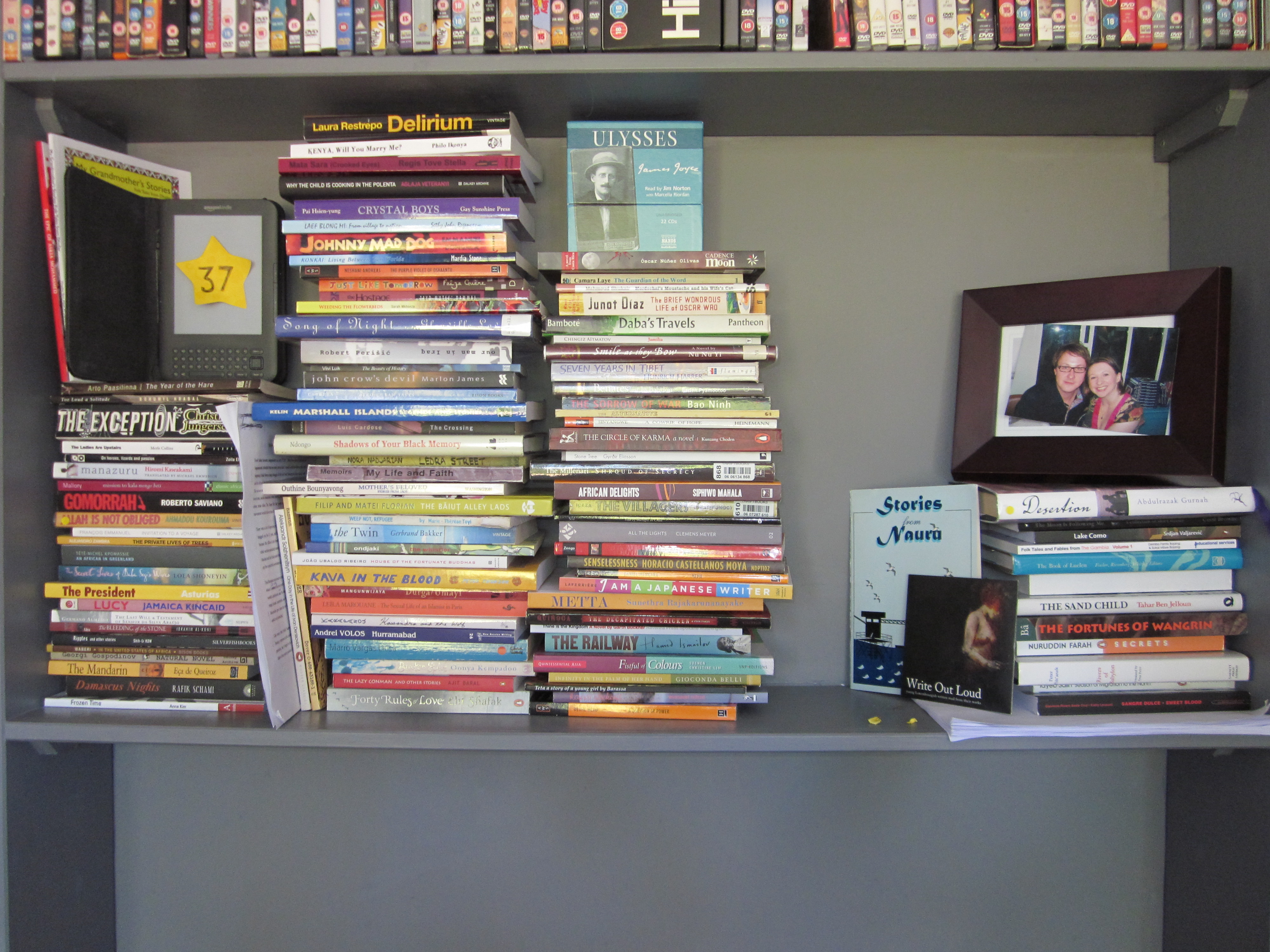
That was a bridge too far for me, particularly when I already had a Costa Rican novel peering down at me from the shelf above my desk. Cadence of the Moon by Óscar Núñez Olivas it would be.

Based on the crimes of Costa Rica’s first recorded, and as yet unidentified, serial killer, the novel follows young journalist Maricruz and jaded, divorced police detective Gustavo as they ply the tools of their respective professions to try to solve the case. The extreme sadism and skill of the murderer and the compromised nature of the organisations in which they work test their ingenuity, endurance and professional ethics to breaking point. With only their intelligence and consciences to guide them, do Gustavo and Maricruz have what it takes to find the killer and see justice done?

Gender politics play a huge part in the book. From the ‘game of Red Riding Hood and the Big Bad Wolf’ Maricruz is forced to play to win her male colleagues’ cooperation every day of her working life, through to the gruesome, female-focused mutilation rituals of the murderer, this is a novel about how men and women interact. Some of the observations can feel a little two-dimensional and cliched, as when Maricruz’s gay friend Pedro launches into a lecture about the narrowness of straight men, however there are some nice touches that lift the narrative and the handling of the relationship between the two central characters is generally good.

Olivas also does tension well. While working a series of outlandish elements into the story – among them the occult, an underground political movement, and the symbolic significance of the phases of the moon – he manages to keep the plot moving and make it believable. Nevertheless, readers (at least those who can get hold of a copy of this now out-of-print translation) will probably find the ending surprising, given that here the narrative veers sharply away from the conventions of the murder-mystery form, having adhered to most of them throughout the book.

This is probably due to the fact that the things Olivas seems most interested in as a writer are only tangentially connected to the murder case. In many ways, the real focus of the novel is on the politics and compromises that riddle big organisations, such as Maricruz’s newspaper and the police. During the course of the story, both of these come under pressure from outside influences, ranging from advertisers and funders in the case of the newspaper, through to public opinion and government interests in the case of the police – although it must be said that some of the ethical dilemmas Olivas poses his characters are a little underwhelming. Maricruz’s initial reluctance to cultivate Gustavo as an off-the-record source because she believes she should publish everything she discovers, for example, comes across as more than a little naive.

Interestingly, while Olivas, himself a journalist, is relentlessly scathing about the European publisher Mr Grey – who makes crass pronouncements about the ineffectualness of Costa Ricans and all but strangles the newspaper in his desire to micromanage it – the writer is more chary when it comes to the police. Alongside the FBI expert who sweeps in to draw up a psychological profile of the killer, Gustavo and his colleagues appear bumbling and crude in their methods. Whether this is a reflection of the status quo or not I don’t know, but it seems odd that Olivas does not try to balance the exposure of the Costa Rican police force’s weak points with some observations about how its methods might compare favourably with the clinical, anonymous approach of the US agent.

All in all, however, it was a pleasant surprise to find that this book was more than it was cracked up to be. From the cover picture of a gagged woman on a full-moon night, I assumed I’d be getting a brutal and sensationalist whodunnit. In fact, the contents where a lot more subtle and thought-provoking. Hmmn. What’s that old adage about books and covers again?

Cadence of the Moon (En Clave de Luna) by Óscar Núñez Olivas, translated from the Spanish by Joanna Griffin (Aflame Books, 2007)