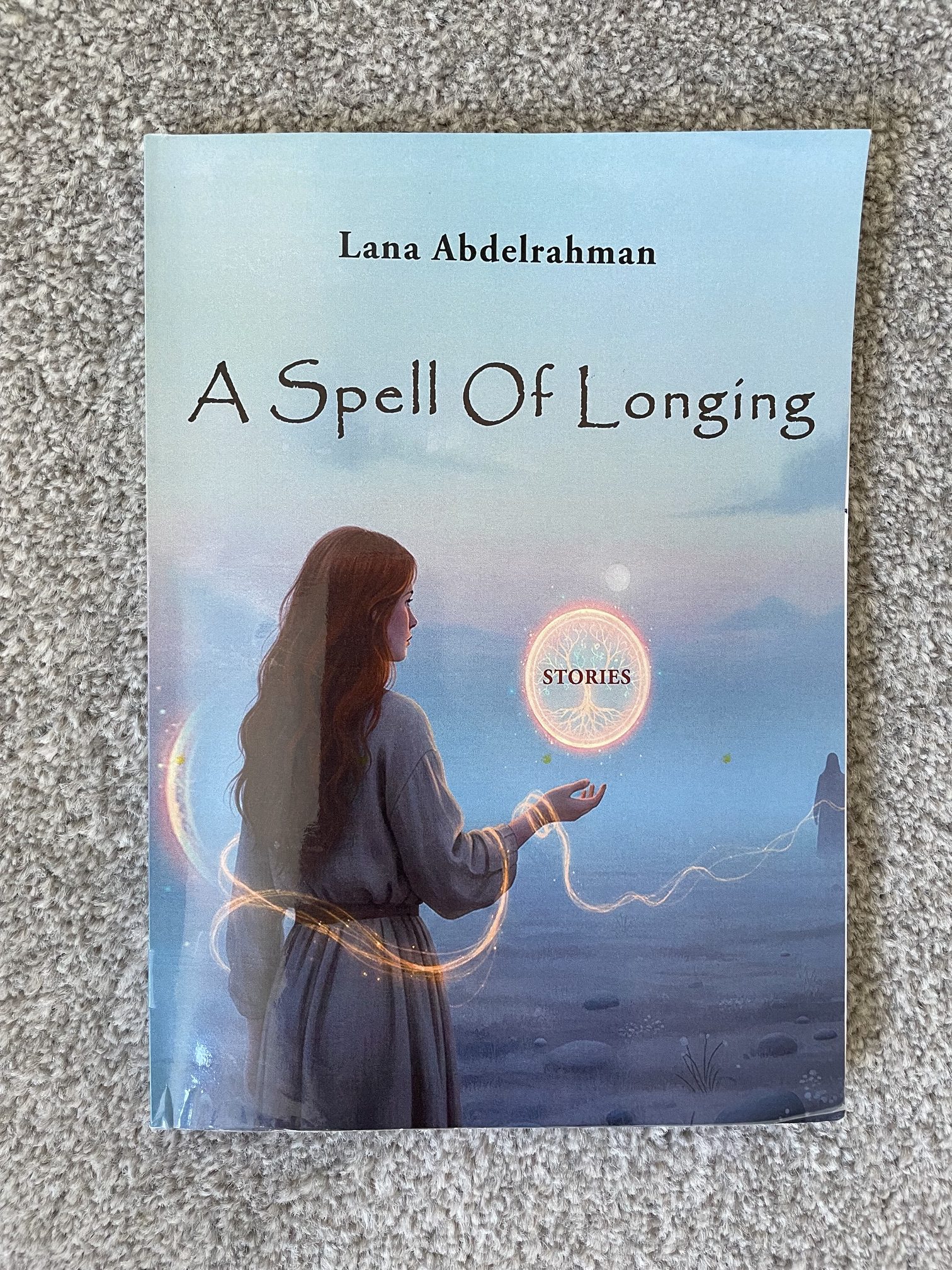
Book of the month: Lana Abdelrahman

This Women in Translation month, I’m featuring a collection of short stories by the Lebanese writer and critic Lana Abdelrahman. I had the pleasure of meeting and sharing a stage with Abdelrahman at the Dibrugarh University International Literature Festival in Assam, India, earlier this year. When we said goodbye, she generously pressed a copy of her short story collection A Spell of Longing, translated by Gretchen McCullough, Mohamed Metwalli and Karmen Hanna, into my hands.

Published by Egyptian press Azha Books, this wide-ranging collection features characters experiencing alienation or psychological rupture, often in mundane settings. A young woman walks down the street and encounters her dead uncle; a girl’s consciousness floats in her bedroom unable to communicate with her bereaved parents; a tailor becomes fixated on an old man who keeps bringing a woman’s clothes for repair; a corrupt businessman conducts a one-sided interview with the reader in which he explains why he is the obvious choice to be the next big political leader.

Cognitive dissonance abounds, twisted together with a strong strand of surrealism. The characters are often uneasy and so are we as readers, never able to be certain of the rules of the worlds through which we move. Occasionally, hints of profound trauma bubble to the surface – passing references to the war that devastated (and continues to devastate) Lebanon, mentions of abrupt deaths and losses. The fact that these are largely kept on the edge of the field of vision makes for a very powerful and unsettling reader experience – we feel what it is to try to live in a world that looks safe but may shatter at any moment.

As a writer who loves playing with distorted perspectives and self-doubt in my fiction, I particularly enjoyed the more interior stories, in which characters sit with their impressions and question themselves. ‘Five Faces of Hayat’s World’ was a standout for me – a collection of fragments written around the protagonist’s fiftieth birthday as she struggles to ‘continue the living required of her’. Among many fine moments, it contains one of the best descriptions of wanting and failing to complete a piece of writing I’ve ever read:

‘In her drawers were many papers, fragments of stories that remained incomplete because they stayed hostage to a tomorrow that never came. She continued writing without completing what she wrote, and this is what tortured her more – the existence of suspended things that needed a rising she was incapable of.’

Female agency is also a strong thread. Many of the stories feature women finding ways to free or at least assert themselves in the face of (often male) treachery, inadequacy or entitlement. A housemaid expresses her desire to go swimming on her one precious day off; the dead uncle’s niece decides to break off her engagement; a problem neighbour prompts a woman to resolve to go ‘in search of the truth of what’s happening’.

Scheherazade, the legendary storyteller in one of the Arab world’s most famous texts, who saves herself by narrating tales so gripping that the tyrant intent on killing her keeps her alive night after night, seems to linger in the margins. Indeed, A Thousand and One Nights is mentioned on the first page of the opening story. Abdelrahman is building on a literary tradition in which female ingenuity and agency has long been celebrated – a sharp contrast to the relatively passive princesses being rescued by handsome princes that form the stock characters of many Western fairy tales and classics.

Indeed, the stories in A Spell of Longing are not written or published in tune with Western sensibilities (although, as is so often the case with literature from the Global South, the references are extremely diverse, making the framework of most anglophone writers look parochial by comparison – Edith Piaf, Hercules and Samson all feature in these pages). As a result, pacing and exposition sometimes work rather differently to the mechanisms readers of mainstream British fiction will be used to. Endings can feel abrupt or sometimes seem to deflate what has gone before. Similarly, the layout – with, for example, opening paragraphs indented as epigraphs would be in British texts and hyphens used as dashes – will challenge those habituated to mainstream anglophone publishing norms.

But for me, this is precisely the joy of reading A Spell of Longing. This is not a book aimed at or curated for a reader like me. Indeed, it is a book that I would be unlikely to encounter in the UK at all. As such, when I read it, I am a guest in someone else’s space, given the opportunity to see how things are done elsewhere, without any attempt to mediate or dilute them for my perceived taste. This can be challenging, particularly if you are used to being centred in the books you read, but it is also a great privilege: a welcome disruption to the habits that surround us and a reminder that customs that can often seem mandatory are just choices. Like many of Abdelrahman’s protagonists I arrived at the end resolved to keep walking my own path.

A Spell of Longing by Lana Abdelrahman, translated from the Arabic by Gretchen McCullough, Mohamed Metwalli and Karmen Hanna (Azha Books, 2026)

Book of the month: Basma Abdel Aziz

An editor once told me that she worked on the basis that a reader has to hear about a book five times before he or she will buy it. April’s Book of the month is a neat demonstration of her theory.

In the two years since Elisabeth Jaquette’s translation of Egyptian writer Basma Abdel Aziz’s The Queue came out, the book has flashed repeatedly on my radar. It cropped up in several articles about underrated books by women. Marcia Lynx Qualey, tireless champion of Arabic literature, made much of it on her excellent blog. When it made the shortlist for the inaugural TA First Translation Prize, I finally cracked and bought a copy.

The novel centres around Yehya, a man wounded in a political uprising in an unnamed state. Forced to join the static queue at the Gate – the sinister, faceless institution that has assumed power in the wake of the Disgraceful Events – Yehya, his friend Nagy and lover Amani must pit themselves against the system in order to stand a chance of obtaining the operation that will save his life. As they do so, they encounter a host of other characters, including a school teacher barred from practising for allowing a subversive essay to be read in class and a man petitioning for compensation on behalf of a cousin killed in the service of the state, and witness the slow disintegration of society in the face of an increasingly intransigent regime.

Like its author, who is nicknamed ‘the rebel’ in her home country, the novel is unashamedly political. Its ideas lie close to the surface and, although the state in which it is set is unnamed, readers cannot fail to miss the references to the Arab Spring. Whether she is portraying the way that legislation can become weaponised to weaken and even kill citizens by making it impossible for them to obtain the things necessary for their survival, or showing how seemingly innocuous objects such as mobile phones can be used against their owners, Aziz writes with insight and wry humour. The best passages reveal the human toll that such inhuman policies exact. The following is a good example:

‘Everyone was on equal ground. But they all had the same look about them, the same lethargy. Now they were even all starting to think the same way. […] The queue was like a magnet. It drew people toward it, then held them captive as individuals and in their little groups, and it stripped them of everything, even the sense that their previous lives had been stolen from them.’

For obvious reasons, the novel has been compared to works by George Orwell and Franz Kafka and like those books (and the political theatre of Bertolt Brecht), it has a distant, no-man’s-land quality, as though it has tapped into a universal nightmare. Many of the lesser characters remain nameless and are identified only by their clothing or physical characteristics, and the descriptions of the city are mostly stark and spare.

However, a humanity throbs at the heart of Aziz’s writing, indicating a possibility for redemption that other such works sometimes lack. In the face of the cruelty of the state, the friendship between the central characters and the connections between the secondary figures who support and encourage one another to endure the endless waiting persist and even strengthen. Although they may be powerless to ameliorate their material circumstances, individuals in the queue retain control over the expression of their humanity. If not exactly heartening, this observation adds subtlety and depth to the writing. The same is true of the sections that reveal how queue life is liberating in some ways for a number of the characters – particularly the women – because it enables them to break free of social mores and become more assertive.

The book is not always an easy read. Like the queue itself, the plot remains static for long periods before jerking forward suddenly. Occasionally the narrative gets bogged down in logistics and abstractions that are hard to follow – mimicking, perhaps, the legal documents and pronouncements that stymie so many of the characters’ lives. Its abrupt shifts in perspective are sometimes disconcerting and its prose is occasionally simple to the point of being bald.

On the whole, though, the novel is too important for any of this to matter. In capturing a specific moment and using it to express universal truths about freedom and identity, it joins the ranks of great stories that endure across the generations. In twenty years’ time, when the Arab Spring has faded from many memories, readers will still be hearing about this book frequently enough to keep picking it up.

The Queue by Basma Abdel Aziz, translated from the Arabic by Elisabeth Jaquette (Melville House, 2016)

Picture: ‘Once Bank Misr Reopened in February People Queued For Hours To Collect Their Money’ by Alisdare Hickson on Flickr.com.

Egypt: breaking boundaries

This was another recommendation from Roger Allen, Professor Emeritus of Arabic & Comparative Literature at the University of Pennsylvania. His number-one tip for Egypt was Nobel Prize-winner Naguib Mahfouz – and he should know as he met the great man several times and translated several of his books. However if I were looking for something other than work by the nation’s leading literary giant, he had several more suggestions up his sleeve from among the thousands of excellent Egyptian writers on the market today. Ain Shams University professor Radwa Ashour was one of these.

I thought about it for a while. On one hand, I was very tempted by Mahfouz: several visitors to this blog had written highly of his work and I was sure I’d be in for a treat with practically any of his books. On the other hand, though, I couldn’t help feeling that Mahfouz was a safe choice. This journey was about discovery, after all, and I was eager to see what else was out there by writers I hadn’t heard of before – so I went for Ashour and chose her book Spectres.

Interlacing the lives of two Cairo academics, history lecturer Shagar and literature expert Radwa Ashour, this part-novel, part-autobiography and part-documentary explores the frontiers of storytelling. The two women are born on the same day and grow up during the mid-20th century, witnessing the Suez Crisis and the protests that shook the capital in the decades after it. As each runs up against the limitations of her gender, political sphere and the medium within which the author allows her to exist, the women seek to shape their own narratives out of the shards and fragments that litter their lives.

This is a courageous and often angry book. Whether it deals with the prejudice against women that causes Shagar’s great-grandmother to be viewed with suspicion because she refuses to marry again and Radwa’s children to be held up at passport control, or the political manoeuvres at the university that see one of Shagar’s colleagues hounded out, Ashour’s writing is indignant and powerful.

This is particularly the case when it comes to the central issue that runs through the book and, to a certain extent, shapes the women’s lives: Palestine. Marshalling sources ranging from Mahatma Gandhi’s 1938 claim that ‘Palestine belongs to the Arabs’ through to testimonials from villagers and Israeli officers about the Deir Yassin massacre, Ashour compiles a compelling  array of evidence to support her character’s forthright attacks on Zionist writers such as Elie Wiesel, ‘who wrote volumes against silence and described in detail the ordeal of the Jews in the Holocaust, of which he himself was a survivor, [but] did not see the contradiction in his own total silence in the face of what was happening to the Palestinians’.

However, as Shagar discovers when she attempts to present a paper at a conference organised on the 25th anniversary of Zionist Martin Buber’s death, the Palestinian perspective is one that struggles to find a platform. Vulnerable to accusations of bias and partiality – and the indifference of a West so far removed from Arab concerns that in 1991 an announcer on CNN is able to compare Baghdad under fire to ‘a huge Christmas tree […] “It’s a magical, thrilling sight!”‘ – the issue remains caught in the perennial paradox that in order for Palestinians to debate on equal terms with their opponents they must already have won the argument and proved their sovereignty to those who refuse to accept it.

Faced with the difficulty of constructing a narrative in the face of such powerful counter-narratives, the novel challenges and interrogates itself, oscillating between fact and fiction in search of a middle path that can carry the truth of both. Ashwour’s voice breaks into the text repeatedly, questioning the decisions she has made about characters, discussing her work in relation to her other books, and revealing the dizzying possibilities open to her as a weaver of stories – a sentiment she finds echoed in a translation of Aristotle cited in the text:

‘The work of the poet is not to narrate that which has happened, but rather that which might happen or is possible in accordance with probability or necessity’.

Seen in this light, this novel, first published in 1998, is in the extraordinary position of being able to enter into dialogue not only with the past but also with the future. With its telescoping of time, that sees, for example, Shagar simultaneously engaged with the events of 1946 and 1972 in Tahrir Square – and its swoops into and out of the future tense – the book seems to extend a line forward to the momentous events that shook the country only last year and takes on an eerily prophetic quality.

Entwining these themes, Ashwour delivers a challenging and complex read that tests the boundaries of communication. Bursting with references and the sheer volume of the ideas it explores and conveys, the novel strains at its seams, spilling out into the world beyond its pages and compelling the reader to engage with what it has to say. The result is passionate, rigorous and shaming.

Spectres by Radwa Ashour, translated from the Arabic by Barbara Romaine (Arabia Books, 2010)