Sherborne Travel Writing Festival

I’m not a travel writer. At least, that’s what I’ve always thought. This year, however, I do seem to be spending quite a lot of time speaking, writing and thinking about travel. Not only am I preparing to cover the literary trip of a lifetime for a national newspaper later this summer (watch this space), but I’ve also taken the stage at two travel writing festivals.

The second of these was the Sherborne Travel Writing Festival, which took place earlier this month. Now in its third year, the three-day event in Dorset, UK, is the brainchild of Rory MacLean, who is celebrated for writing genre-busting books about moving across and beyond national borders. His debut, Stalin’s Nose: Across the Face of Europe, was published in 1992 and is still startlingly relevant (and very funny) today.

Much like MacLean’s work, the festival celebrates travel writing in the broadest sense. The traditional formula of the white European reporting on how he finds remote corners of the globe was not much in evidence in this year’s line up. Instead, the programme included an extraordinary range of speakers, from the brilliant Nandini Das, who held the audience captive with a talk on Britain’s first bungling attempts to forge diplomatic relations with the Mughal Empire, to Kapka Kassabova, who spoke movingly of the three months she spent living with Europe’s last moving pastoralists in the mountains of her native Bulgaria while researching her latest book Anima.

I was privileged to take the stage twice. I started off in the interviewee’s chair, spending a wonderful hour talking about Reading the World with journalist and fellow translation champion Rosie Goldsmith (you can see us pictured above). Ten years on from the launch of the first edition of that book, it was a pleasure to reflect back on the journey so far and look forward to the publication of Relearning to Read this September. Goldsmith is one of the best in the business when it comes to chairing literary discussions. If you’re a fan of book podcasts, the Slightly Foxed Podcast, which she hosts, is well worth a listen.

Then it was my turn to ask the questions. I was joined on stage by Xiaolu Guo, who I had the privilege of chairing at Cheltenham Literature Festival last year. An artist who has travelled in many senses (across the world, between languages, between media, through books and across numerous periods of literary history), Guo is a fascinating writer and speaker. We focused on her memoir, My Battle of Hastings, which draws on a year she spent living in the British seaside town of Hastings, where William the Conqueror routed the Anglo-Saxons in 1066. But it was also great to touch on her new novel, Call Me Ishmaelle, a feminist retelling of Moby Dick.

Offstage, there were many similarly fascinating discussions. It was a joy to meet many enthusiastic readers and writers, and a testament to the warm welcome Rory MacLean and his team offer that so many authors from the first two editions of the festival were also in attendance. The weekend was crowned by the announcement of a new annual travel writing prize attached to the festival, the Sherborne Prize for Travel Writing, which will be awarded for the first time next year to a published British or European author whose work encourages understanding between peoples and across societies. Given the breadth and creativity of the team’s vision of travel writing, it’s exciting to think of what this new award might do to broaden the field. And I wonder if in future years the organisers might be persuaded to expand the remit even further to include works published in English from all over the world.

In my experience, there are two kinds of literary festival – those that capitalise on culture and those that nurture it. Sherborne Travel Writing Festival is firmly in the second camp. I left fizzing with ideas and thrilled by new connections. It will be exciting to see where the festival takes us next.

Picture: courtesy of Rosie Goldsmith.
Relearning to Read: Adventures in Not-Knowing

A new book? I hear you cry.

Yes! And it’s one that you’ve helped me write. Relearning to Read: Adventures in Not-Knowing is my second non-fiction book and it draws on a new approach to reading that I’ve developed over the twelve years of writing this blog.

Among the many challenges I had to face when I set out to read a book from every country in 2012 – how to fit all the reading in? how to get books from every country? what even is a country? – was the fact that the way I used to read wasn’t going to work. I was in the habit of being clever about books – using context and knowledge to draw out rich insights and make connections. That had worked really well for me for the first thirty years of my life, when I spent most of my time reading books from a world I knew. As a literature student, I really enjoyed researching the texts on my courses, and using criticism and history to help unlock their secrets.

But in 2012, with an average of 1.87 days to read and review each book I was covering that year, there was no time to do any extra reading. Many of the titles came from cultures of which I knew nothing, and were based on belief systems, mores, events and assumptions that were mysteries to me. But there was no way for me to familiarise myself with any of this and adopt the authoritative, knowledgeable tone I had strived for at university. I had to be open about my ignorance and accept that there was a lot I didn’t understand.

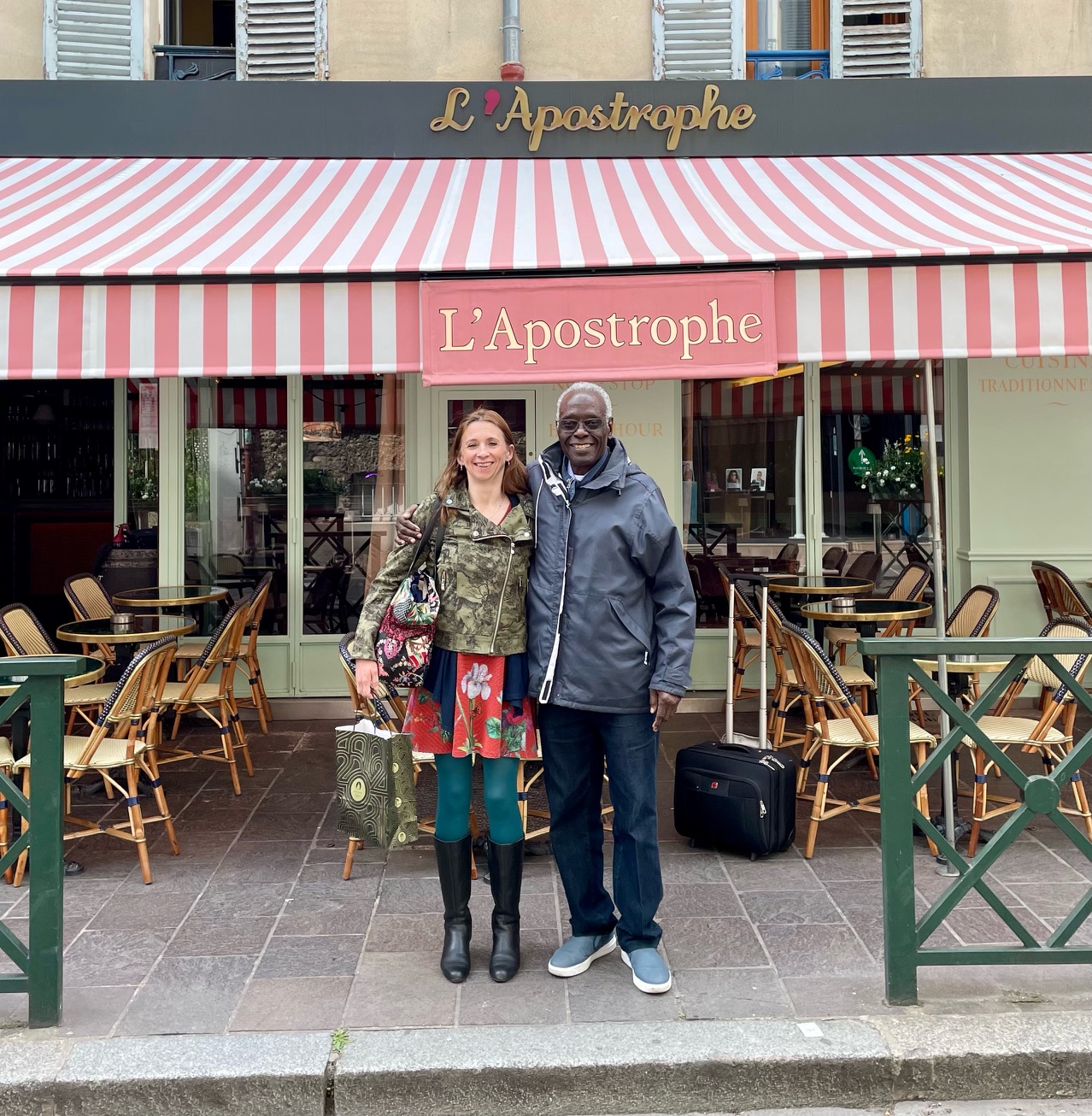
What started as a necessity became a revelation. I discovered that embracing not-knowing, adopting openness and humility, and learning to hold questions in my mind was hugely enriching. Not only did it teach me a lot about myself but it enabled me to build much more meaningful connections with books, people and the world. This has led to many of the exchanges and friendships I established over the years through this blog (like my correspondence with living legend Tété-Michel Kpomassie, who I met in Paris last month – that’s us pictured above). And it has shaped the way I write and think about books – on this blog and elsewhere.

Back in 2021, to explore this approach to reading further, I launched my Incomprehension Workshop. A few months later, to celebrate this blog’s ten-year anniversary, I offered a free virtual session and was delighted to have so many takers that I had to run two to accommodate everyone. Since then, I have run the workshop with readers around the world, most recently in Assam, India. Playing with not-knowing in the company of fellow enthusiastic readers has been a great source of inspiration for me, and a brilliant chance to test and hone a lot of the ideas that inform my new book.

Relearning to Read: Adventures in Not-Knowing is about reimaging the way we read by embracing not-knowing, questioning, humility and curiosity. Each chapter takes a different text likely to be outside the comfort zone of most English-language readers and uses this to play with different questions – what is authenticity? what makes something funny? how does censorship affect reading? and what makes us like a book in the first place? Some of the wonderful readers and writers I’ve encountered over the past twelve years make an appearance, including my hero Tété-Michel. And I also share how reading has shaped my life and rewritten me.

Relearning to Read is out worldwide in English in September 2025. BUT you can preorder it now. Indeed, my publisher Renard Press has made a wonderful offer: the first 100 orders through the Renard Press website will receive a signed, special-edition copy for the price of a standard paperback, shipped ANYWHERE in the world. That’s not all. If you preorder a Renard Press Edition of Relearning to Read, you can also get a Renard Press Edition of my second novel, Crossing Over, half price. Just put both in your basket and enter the coupon code RELEARNING at the checkout, and your collectors’ copies will wing their way to you in September 2025.

Thank you.

Book of the month: Hubert Mingarelli

It’s nearly ten years since I started my Book of the month slot on this blog, after having been blown away by an Italian writer who has since taken the English-speaking world by storm. In another six years, I will have featured more Books of the month than the 197 titles that comprised my original year of the world.

Making book reviewing on this platform a long-term commitment has had a profound impact on how I read. Finding a title worthy of featuring each month has been a good way of holding myself accountable to stay connected to what is happening in international publishing, and it has enabled me to channel and share some of the many recommendations I am still fortunate to receive from readers all over the planet. Because I only feature one book a month, I rarely take recommendations from book PRs, and because I am keen to support the industry and to keep this blog free of commercial influence, I buy nearly every title I feature, rather than accepting free copies. I try to maintain the spirit of my original quest: a personal, independent and entirely unscientific record of diverse reading experiences that I aim to approach with openness, respect and curiosity.

Some months, the choice of what to feature is easy. Other months, particularly when I am in the thick of research for my own writing projects, it is a struggle to find something that fits (I don’t always have to love the books I feature unreservedly, but I have to feel that they are interesting and deserving of wider notice). Most of the time, however, I am torn between several titles and forced to neglect books that I would really like to tell you about. As I always try to review something in the month I read it, this means many brilliant reads get left behind.

This year of reading nothing new, however, I am relaxing my month rule slightly and taking the opportunity to return to a few of the stories that have stayed in my mind over the years. The first of these is A Meal in Winter by Hubert Mingarelli, translated from the French by Sam Taylor.

This title was recommended to me a few years back by my friend, author Caroline Brothers. I was looking for something that would absorb me and this short novel was Caroline’s answer.

Set during the second world war, the narrative follows three German soldiers sent out into the winter-bound Polish countryside to find a Jew to bring back for execution. Having caught one hiding in the woods, they hole up at an abandoned cottage to share a meal before returning with their captive. Over the hours that follow, the implications of their actions force themselves to the surface and the toll their murderous work takes on all present becomes clear.

Knowing that a novel is set during the second world war is often a turn-off for me. There are so many brilliant (and not so brilliant) stories set during this period that it seems to me that a book has to work doubly hard to make something powerful out of subject matter that has been handled by so many writers.

A Meal in Winter delivers. A masterclass in subtlety, it unravels the psychology of the aggressor, revealing how violence rebounds on its perpetrators, shattering and unmaking those who enact it every bit as much as its victims. Even at the sentence level, through the lens of Taylor’s translation, we see how thinking glitches and recoils in the face of inhumanity. The interior monologue of the narrating soldier abounds with jagged rhythms and defensive repetitions, rearing and bucking in the face of horrors he cannot own.

There is one section in particular that echoes in my mind, years after I read it, when the narrator reveals why seeing little individual touches on his victims’ clothing irks him so profoundly:

Because if you want to know what it is that tormented me, and that torments me to this day, it’s seeing that kind of thing on the clothes of the Jews we’re going to kill: a piece of embroidery, coloured buttons, a ribbon in the hair. I was always pierced by those thoughtful maternal displays of tenderness. Afterwards I forgot about them, but in that moment they pierced me and I suffered for the mothers who had, once, gone to so much effort. And then, because of this suffering they caused me, I hated them too. And the more I suffered for them, the more I hated them.

And if you want to know more, my hatred knew no bounds when they were not there to hug their darlings tightly to their breasts while I killed them. Once, they had embroidered a snowflake on their hat or tied a ribbon in their hair, but where were they when I was killing them?

The brilliance of this – the way the traumatised mind contorts its owner’s atrocities so as to apportion blame to his victims – is staggering. This is how we work, Mingarelli shows us. This is what we do. Even when we have committed monstrous acts, we share human feelings and we still need to find a story that makes our actions acceptable, that allows us to live with ourselves.

It is relatively easy to write about victims, at least in my experience. It is hard to write about perpetrators. And it is fiendishly difficult to do so in a way that makes readers feel for their plight and recognise the victim in them, even as we abhor their deeds.

That Mingarelli achieves this is the source of A Meal in Winter’s power and hope. The story is bleak. But the fact that the author presents it with such humanity and insight is deeply moving and inspiring. Even as we destroy one another, human beings possess an extraordinary capacity for empathy and compassion. We truly are marvellous wretches. In fewer than 150 pages, Mingarelli shows us the full range of his and our capabilities. Unforgettable.

A Meal in Winter by Hubert Mingarelli, translated from the French by Sam Taylor (Granta, 2013)

Picture: German military map showing planned assault on Poland in 1939 https://static.dw.com/image/50105792_303.jpg, Public domain, via Wikimedia Commons

Book of the month: Jia Pingwa

Book publicists are a curious breed. Although I rarely accept proofs and buy almost all the books I feature on this blog, I frequently receive emails from people promoting titles that will clearly be of no interest to me. Mainstream books by British and American writers. Business books. Academic books on subjects outside my area of expertise. As I delete these emails, I wonder if the people who send them see their job primarily as a numbers game: if they simply scattergun enough emails out into the universe, someone is sure to take the bait.

But every so often I encounter a book publicist who thinks carefully about my interests and sends me a suggestion that hits the nail on the head. These people can be gamechangers.

The fact that I do a Book of the month post on this blog is down to such a publicist. Back in 2014, Daniela Petracco at Europa Editions contacted me about an as-then little-known Italian author. I explained I was no longer doing book reviews here, but she wouldn’t take no for an answer. She didn’t care. She had to send me this novel, regardless. She loved it and she was sure I would too.

Reluctantly, I accepted a copy, was blown away by what I read and started my Book of the month slot in order to be able to tell people about it. And the novel? My Brilliant Friend by Elena Ferrante, translated by Ann Goldstein.

This month, I had a similar experience. In response to my call for books published no later than 2020 that I might feature in my year of reading nothing new, I had an email from Daniel Li, working on behalf of Sinoist Books. He sent me three suggestions that he thought might fit the bill (which immediately made me warm to him, as this was a number of books I could reasonably check out, rather than an endless list of possibilities that would require several hours to unpick). Of these, Jia Pingwa’s Broken Wings, translated by Nicky Harman, caught my eye.

Described as a thriller, the novel tells the story of Butterfly, a young woman kidnapped from the city and taken to a rural village to be sold as a wife to one of the many men left single because of the gender imbalance resulting from China’s one-child policy and rapid urban migration. It opens with her scratching her 178th mark to record the days of her imprisonment on the wall of the cave in which she is held, and centres around the question of whether she will ever escape and find her way back to the life for which she pines.

But there the similarities to a thriller end. In fact they end even before the opening page, because in his foreword, Jia pretty much gives away the plot: he reveals that the novel grew out of a story he heard from an old man from his village about his daughter who was kidnapped and rescued, and who then, in the face of unbearable media attention, eventually returned to live with her kidnappers.*

Instead of delivering a gripping story (or instead of primarily doing that), this novel offers something even more engrossing: entering into and inhabiting the unimaginable, and making it feel personal, real. Jia puts it like this:

‘When I was young, death was just a word, a concept, a philosophical question, about which we had enthusiastic discussions that we didn’t take too seriously, but after I turned fifty, friends and family began to die off one after another, until finally my mother and father died. After that I began to develop a fear of death, albeit an unspoken one. In the same way, when a short while ago cases of trafficking of women and children began to appear in the media, it felt as remote from my own life as if I was reading a foreign novel about the slave trade. But after I had heard what happened to the daughter of my village neighbour, it all became more personal.’

In order to communicate this shift, Jia enters into Butterfly’s experience to an astonishing degree. He starts with the hardships of life on the unforgiving loess plateau, where people scratch a living trying to dig for rare nonesuch flowers and growing blood onions. The specificity of the detail is extraordinary. ‘What is there to see?’ the neighbour exclaimed when Jia asked if he had been to see his daughter. Jia shows us: the millstone with its runner stone worn to half the thickness of the bed stone over years of use; the rim of the well, scored with grooves; the gourds withering on a frame near the cave entrance.

Although spare to start with – reflecting, perhaps, Butterfly’s numbness – the language flowers over the course of the novel, as she adapts to life in the village. We start to see the beauty in rituals that at first seemed crude and beneath notice. As the prose takes trouble over recording the details of how to make a good corn pudding, we see Butterfly learning to value the world around her differently, adjusting to her new reality. At times the writing is strikingly lyrical and almost painful in its poignancy:

‘At noon, I gazed at the hills and gullies and knolls far away. Distance seemed to soften them so they looked like watery billows. I longed to escape from this ocean and climb back on dry land again. But when the sun set and it turned chilly and the light left the strip, the sea suddenly died, and I was left like a stranded fish.’

But it is Jia’s presentation of female experience, rendered through Harman’s arresting choices, that is most impressive. The description of her eventual violation by her so-called husband, Bright, and the physical trials of pregnancy are exceptionally well handled. And the portrayal of labour and birth are quite astonishing – up there with Eva Baltasar’s descriptions in Boulder, translated by Julia Sanches.

There are challenges for the anglophone reader. Oddly though, these do not concern the cultural differences you might expect – although the world Jia depicts operates according to strikingly different values, the humanity in his writing makes it relatable. Instead, it is technical choices concerning pacing and what descriptive information to include that occasionally prove taxing. Several times I found myself wrongfooted by not knowing whether a character was present or had moved to a place or performed an action, when a writer working in another tradition would have told me.

This was interesting, though, rather than off-putting – an insight into the things I take for granted and the supports I am used to expecting when I read. And a reminder that the technical and stylistic mores that we tend to regard as markers of good or bad writing in the anglophone tradition are more malleable and subjective than we might think.

Because the writing in Broken Wings is not simply good. It is marvellous. Playful, expansive, precise, moving and surprising, it sweeps us into another world, transforming this sad story into something almost sacred. Jia and Harman put it best, again in the foreword:

‘A novel takes on a life of its own, it is both under my control and escapes my control. I originally planned it purely a lament by Butterfly, but as I wrote, other elements appeared: her baby grows in her belly day by day, the days pass and her baby becomes Rabbit, Butterfly’s sufferings increase, and she becomes as pitiable a figure as Auntie Spotty-Face and Rice. The birth of a novel is like the clay figure shaped in the image of a divinity by a sculptor in a temple; once it is finished, the sculptor kneels to worship it because the clay figure has become divine.’

Broken Wings by Jia Pingwa, translated from the Chinese by Nicky Harman (Sinoist Books, 2020)

* The publisher informs me that this foreword is an afterword in most editions, including the original Chinese, but it appears as a foreword in some ebook editions. Because of the sensitive nature of the subject matter, they encourage readers to read it first (although my usual advice would be to leave all extraneous text until after you have read the primary text).

Picture: I, Till Niermann, CC BY-SA 3.0 http://creativecommons.org/licenses/by-sa/3.0/, via Wikimedia Commons

Book of the month: Laia Fàbregas

There’s been a wonderful response so far to my call for suggestions for my year of reading nothing new. Translators have been particularly forthcoming, proving once more how central they are to championing the circulation of texts between languages. Already, my TBR pile is teetering under the weight of many new additions, several of which I hope to feature on the blog this year.

First up is a title translated by Samantha Schnee, founding editor of Words Without Borders. She tweeted the following: ‘It’s a novel called LANDING by Laia Fabregas which was published by the wonderful but sadly now defunct HispaBooks back in 2016. They found a lot of hidden gems so their list is worth a look.’

The premise to Landing (most of the opening chapter of which is available to read here) reads like a thriller: a man and a woman sit next to each other on a flight from Barcelona. After the man dies during the descent, the woman takes a box from him that he was planning to give to his son in the Netherlands. The narrative that follows, told in chapters alternating between his and her perspectives, pieces together what led them to this point and how their brief encounter changes the woman’s life for good.

Yet, although the book opens with a bang, this is a not a high-stakes page-turner. It is the writing, rather than the premise, that captivates and compels. Interior and intimate, the narrative brims with insights that are almost breathtaking in their succinctness and directness: ‘how difficult we can make things for ourselves when we don’t have the nerve to say what we’re thinking or what’s going on;’ ‘In a flash I understood why he was the way he was, he had lost his father too young, which is why he’d had to make himself more important than he was.’

The unfurling of the female protagonist’s story and character is particularly fascinating. Early on, we become aware that the lens through which we are looking in her chapters is skewed or perhaps blurred. We learn that she has been told by her boss at the tax office that she ought to be more sociable and that she is engaged in some kind of search. Her distinctive, thrawn take on the world around her is by turns disarming and disconcerting. But it is only gradually that the extent of her trauma and isolation is revealed.

In the course of the narrative, there are some beautiful and quirky philosophical reflections and diversions. I particularly enjoyed the presentation of Ana Mei Balau, a polyglot whose work involves discovering untranslatable words, inventing equivalents in other languages and then receiving royalties for their use for the first few years they’re in circulation. Similarly, the depiction of the artistic journey of Willemien, the man’s dead wife, is wonderfully realised, illustrating a point reminiscent of Susan Sontag’s argument that art shouldn’t represent ideas and submit to interpretation but simply be.

In the face of such subtlety and richness, the demands of the plot can occasionally start to chafe. It is as though the story outgrows its premise – wanting, like Willemien’s art, simply to be rather than to explain itself – with the result that events can occasionally feel a little contrived or forced. A couple of times, the female protagonist tells another character information without letting us in on the secret, leading to a kind of collapse of the fourth wall where we become aware of Fàbregas choosing to withhold details so as to maintain tension. ‘Sometimes the reasons that two people come together are completely circumstantial. But all that matters is what happens next,’ the male protagonist observes. But that isn’t all that matters. Not in this novel, at least. Indeed, what happens becomes increasingly secondary to the rich, interior worlds Fàbregas reveals.

The timing of the book’s original publication may have something to do with this. When my first novel, Beside Myself (about twins who swap places in a childhood game and get trapped in the wrong lives), came out in 2016, narratives that alternated between perspectives to excavate trauma and explore secrets were relatively common. The age of the psychological thriller was upon us. A year later, Gail Honeyman’s Eleanor Oliphant is Completely Fine – to whose title character Fàbregas’s protagonist bears more than a passing resemblance – would take the anglophone world by storm.

But in 2011, when Landen hit the shelves in Spanish, this sort of storytelling was far less prevalent – in English-speaking circles, at least. As such, the concept may have felt more radical and organic than it does now. It may also be that there is greater tolerance in hispanophone literature for withholding information in plain sight.

Though they might read as criticisms, these thoughts aren’t meant negatively. If anything, this experience proves how powerful this novel is: the things that would make this book compelling in most writers’ hands become secondary and slightly awkward on account of the quality of the writing. Fàbregas doesn’t need to employ such mechanisms to convince us to stick with her.

Fifteen years after it appeared in Spanish and eight years after Schnee’s translation was published, Landing remains resonant. It is a book that explores distance in all its forms – in language, in culture, in memory and in our most intimate relationships. It is compelling in spite of rather than because of its premise – a humane, wise and addictive reflection on peopleness that slips by so effortlessly it almost seems to read itself.

Landing by Laia Fàbregas, translated from the Spanish by Samantha Schnee (Hispabooks, 2016)

This year I’m reading nothing new. I’m only featuring titles on this blog published no later than 2020. If you have an older title from elsewhere that you think I should consider, please send me an email (ann[at]annmorgan.me) or leave a comment below.

2024: My year of reading nothing new

This week, Renard Press, publisher of my most recent novel, included a note on royalties in the regular newsletter it sends to its authors. Discussing the focus on bestseller sales figures in the anglophone book world, publisher Will Dady wrote this:

Because publishers don’t publish hard data about sales (and I do think this is a good thing, because I don’t think art should be reduced to sums, products and units), the majority of information about book sales comes from Nielsen Book Scan, the industry reporting company, which details sales made through reporting avenues. As such, it’s tempting to look at Nielsen’s data – e.g., looking at the Bookseller from last week, Richard Osman’s latest sold 5,272 copies in the week, Grisham’s latest sold 1,157, etc – and compare unfavourably to these numbers. But this is not the sort of publishing we’re doing here. This is big-budget, mass-market fiction, in general chasing trends, aiming for big sales on day one and then more often than not going out of print within two years.

I don’t think this Pile ’em High publishing does anyone any favours when we’re talking about literary fiction. In my (oh so humble) opinion it’s devoid of personality, wasteful of resources and disrespectful of those who carefully crafted the work, as it means giving away huge discounts, often paying for inclusion and placement, overprinting copies and then remaindering or destroying them, and in the end netting the author and publisher a comparative pittance.

Interestingly, the other side of Big Publishing’s sales isn’t discussed very often – those who fall by the wayside. If you’re not Grisham, David Walliams or the small handful of beautiful young things tipped to be the Next Big Thing, what happens? According to data from the S&S/Penguin trial in the States, half of all the Big Five’s titles sell a grand total of 12 copies or less. Yes, astounding. (And one wonders what discount those were sold at, too…)

So what makes good sales for indies – or rather, for anything apart from Richard Osman and Co? Well, again, it’s difficult to know. There’s a great piece on Jericho Writers’ website here from Sam Jordison, of Galley Beggar fame – and as he says, while the 3,000 copies number often does the rounds for mass-market fiction, it’s thought to be more like 250 copies for literary fiction – and far less for poetry (as pithily put in the Bookseller, ‘Even in this record year [2022], Julia Donaldson will outsell the entire UK poetry market’, and the Poet Laureate’s whole backlist sold in a year half of what Osman’s latest novel did in a week), and theatre titles tend to be linked to productions. So I’m pleased to look at our royalty reports and see our writers easily outselling at least half of Penguin’s list, and finding – and, crucially, speaking to – readers in the face of a fragmented market and great adversity. 

I feel I need to end this note with a contentious, ‘And what does it matter?’ While sales figures are of course important, and give an idea of how many people have pored over your work over time, looking beyond numbers is vital, and I firmly believe your work enriches the literary canon of our age. I couldn’t be prouder of the list we’ve built and the community you’re part of. We’ve all put our all into these books, and Renard commits to keeping you in print for all the readers that are yet to come. 

Dady’s words struck a chord with me. They helped crystallise some issues that have been on my mind for a while. I’m fortunate that all three of my books continue to be available in most of the territories in which they have been published, but I have seen how the relentless focus on what’s coming next leads to many titles being ignored, falling off the shelves and out of print without a trace.

In some cases, the speed with which this happens verges on the unethical. Many new authors never stand a chance of reaching readers, leading some to feel that they have been let down by those they trusted with their work. There is also the problem of the waste of resources pumped into producing books that can never reasonably be expected to sell in significant numbers – something becoming ever harder to defend.

All this is rarely the fault of individuals. Many of those I have met at big publishers are brilliant and passionate, and care deeply about getting great work to readers. But the system has become so beholden to the bottom line and so weighted towards those all-important early sales figures that it’s almost impossible for new or different work to make a lasting impact.

This is one of the reasons that many of the titles I feature on this blog are not new: I want to do what I can in my small way to help prolong the shelf-life of great books. And it’s one of the reasons why I enjoy the podcast Backlisted, which celebrates old books, albeit largely anglophone ones. (Well worth a listen if you’re a podcast fan.)

However, I think I could do more.

As an individual reader, it’s easy to feel you can’t do much to make a difference. But I have seen from the exchanges I’ve had through this project and from the success of initiatives such as Women in Translation how personal choices can influence others and drive change.

With this in mind, I am making 2024 my year of reading nothing new. Excluding those titles I have to read for work and research (and those handful of books I have already promised to look at), I plan not to read or feature any titles published after 2020 on this blog this year.

To this end, I’d love your recommendations of older books in translation or from elsewhere that deserve a second look. Maybe you’re a translator who feels one of your favourite projects never got enough attention. Perhaps you’re a publisher who wishes more people could find that title you fell in love with a decade ago. It could be that you’re a reader who still thinks about a particular novel several years after you finished it. Whatever the story, I’d love you to tell me about it.

And if you fancy joining me on this adventure or have made similar book choices in the past, it would be lovely to hear from you too. Happy reading!

Picture: ‘Recycled books at Big River Books’ by Beau Claar, CC BY-SA 3.0, via Wikimedia Commons

Book of the month: Leïla Slimani

Lately, I’ve been reading a lot of books about books. Specifically, books about reading, writing and translating. This is partly because I find these kinds of books fascinating but also because my next book is going to be about rethinking the way we read. More details to follow soon…

So it was a joy to hear from academic, translator and champion of women in translation Helen Vassallo (if you haven’t yet come across her Translating Women site, it is a treasure trove of insightful commentary and exciting titles) about a new collection of work by French-Moroccan literary superstar Leïla Slimani that she had just brought into English. And an even greater joy when she kindly sent me a copy.

Unlike the novels that made Slimani’s name (chief among them Lullaby or The Perfect Nanny, as it was variously translated into English, which won the Prix Goncourt and became France’s most-read book of 2016) The Devil Is in the Detail brings together three slender works released separately in French. It is the first in a series published by Liverpool University Press with Florida State University’s Winthrop-King Institute that aims to showcase ‘cutting-edge contemporary French-language fiction, travel writing, essays and other prose works’ that ‘reflect the diversity, dynamism, originality, and relevance of new and recent writing in French’.

Certainly, the collection features a diverse range of prose. Short stories rub shoulders with essays. There’s the transcript of a staged conversation Slimani had with newspaper director and writer Éric Fottorino. And the volume ends with an urgent piece in praise of politician and women’s rights champion Simone Veil, followed by a selection of quotations from her. It is the sort of amalgam that marketing bods at mainstream anglophone publishing houses would veto in a heartbeat.

Thank goodness, then, for indies and university presses. Because the curation of these superficially dissimilar pieces reveals striking threads running through Slimani’s thinking and creative practice.

Take her views on reading’s relationship to feminism. For women, as she explains in On Writing, her interview with Fottorino, time with books is essential because ‘a woman who reads is a woman who is emancipating herself’. With this in mind, she echoes Virginia Woolf’s call for a room of one’s own, claiming that this is important to allow space for reading as much as for writing.

This idea of the part reading plays in shaping women’s agency is demonstrated in the short story ‘Elsewhere’. Protagonist Rim finds books hold the key to her freedom. Her father ‘gorged her with stories’, giving her the world in printed form so that in the end she is confident enough to go out and meet it on her own terms.

Slimani’s reflections on her writing are particularly fascinating. Unabashed about discussing her own struggles – from an abandoned project to inhabit the minds of the Charlie Hebdo attackers to an unpublished first novel – she is disarmingly honest about the effort it requires: ‘There probably are such people, born writers destined for greatness, but I think there are a lot of people who just need to work hard, to meet the right person at the right time or need inspiration to strike at the right moment.’

Such frankness feels unfamiliar coming from such a lauded writer. In the English-speaking world, the fiction of the overnight success still has a powerful hold over the way we talk about books. (‘Ssh, don’t tell people that,’ a PR person muttered to a novelist friend of mine when they mentioned they had six failed manuscripts in their bottom drawer.)

But then, Slimani has always been a writer to challenge convention. Whether she’s penning gripping thrillers that win the highest literary honours (admittedly not such a departure in the Francophone world, where crime fiction more often receives critical acclaim), or exposing the hypocrisy underpinning the treatment of Moroccan women, she is unapologetic in her views, even when this risks controversy. Refusing to allow ‘a pseudo-respect for other cultures’ to muzzle her, she calls out injustice where she sees it.

Yet this forthrightness rests on a belief in the importance of togetherness and the joy of sharing space with those who think differently. The short piece ‘Our Gods and Our Homelands’ ends with an appeal for the France of 2016 to mirror the big Christmas meals Slimani remembers enjoying in Morocco as a child:

‘where everyone was welcome, where no one judged either the drunkenness of some or the outspokenness of others. Where the older generation did not dismiss the things the younger ones cared about, where everyone present chuckled at the blasphemers. Where at the end of the day the only thing that mattered was the awareness of how lucky we were to be together in a world where everything is hell-bent on dividing us.’

As we move into 2024, may our world take on more of the spirit of Slimani’s childhood Christmases. And may our reading, like this collection, be wide-ranging, ambitious, thought-provoking, challenging, engrossing and inspiring.

Thanks to everyone who continues to follow this blog, and whose comments, messages and suggestions keep fuelling and expanding my reading and writing adventures. Wishing you all a very happy Christmas and a joyful New Year.

The Devil Is in the Detail and other writings by Leïla Slimani, translated from the French by Helen Vassallo (Liverpool University Press, 2023)

Book of the month: Krisztina Tóth

The other night, I was at an award ceremony. No, not the Booker Prize, but one nearly as influential, at least as far as translated literature is concerned.

Held at the Warwick Business School at the Shard in London, the seventh annual prize-giving for the Warwick Prize for Women in Translation celebrated a shortlist of eight titles drawn from 153 eligible entries (nearly three times as many as the award attracted in 2017). This year, the shortlist featured texts from two new source languages: Danish and Vietnamese. It being the first year the award welcomed self-translations, there was also one of these on the shortlist: the fantastic graphic novel Your Wish is My Command by 26-year-old Egyptian Deena Mohammed (pictured on the left of the screen above). This went on to win – an exciting choice.

One of the highlights of the evening was the fact that the translators of each of the shortlisted titles appeared either virtually or in person to talk briefly about the books and read an excerpt. Sometimes harrowing, sometimes amusing and invariably thought-provoking, these presentations provided brilliant windows into the works in contention, confirming once more the key role translators play in championing books from elsewhere. Indeed, it was Peter Sherwood’s delivery of two extracts from his translation of Krisztina Tóth’s Barcode that led me to seek it out and choose it as my latest Book of the month.

Though first published in Hungarian in 2006, this collection of fifteen stories feels startlingly fresh. Some of this may have to do with the fact that the majority of the pieces focus on childhood and adolescence, unpacking experiences that have a timeless universality (or at least feel relatable to those of us who were children in the late twentieth century). An American penfriend comes to stay and turns a schoolyard crush sour; a class detention pushes an anxious girl to make a false confession; friends in a deprived housing estate trade rumours about the grotesque demise of former residents while the authorities embark on a project with much more damaging consequences.

Yet the content is only a small part of the book’s power. The stories centring adult experiences – lost love, difficult neighbours, traumatising brushes with medical staff and airport officials – contain a similar compelling immediacy, pointing to something much more subtle and skilful at work in the writing.

There is a virtuosic quality in the leaps Tóth makes. Concision is made much of in anglophone creative writing teaching, with students encouraged to cut all unnecessary words. Tóth’s approach is somewhat different: she sets up her worlds so convincingly that she can afford to skip several steps in her narration, trusting that her reader will keep up. During a beach scene, we jump to a discussion about going to ‘fetch it’ and know immediately that ice-cream is on the cards; the discovery that a child has worms is conveyed through an expletive.

A similar dexterity is at work on the structural level. Tóth constructs many of the stories like essays or pieces of creative life writing: several apparently disconnected episodes or themes are introduced and then brought together to form a point. Between them, Tóth leaves gaps, trusting the reader to infer what is going on behind the scenes.

Though it’s risky and potentially reductive to try to explain a writer’s techniques too neatly, a key glimmers tantalisingly in the title story: ‘Tepid Milk (Barcode Lines)’. There, the narrator describes her method for writing secrets in her school books:

‘I often wrote very personal messages in the bottom margins. I drew the letters extra long, so they became distorted and stick-like, which made the written words look like parallel stripes. And when I also made the stem of the letters a little thicker, the secret looked like a barcode: to decipher it you had to look at it from a different angle.’

These are, in some ways, stories that invite us to consider them from multiple angles. Less like the photographs to which short stories are often compared in anglophone discourse, these are more akin to snowglobes that we can turn and consider from a range of perspectives, seeing what reveals itself and catches the light.

Much as he did at the WIT ceremony, Peter Sherwood brings Tóth’s work to life on the page. His lovely line in cosy colloquialism complements the stories’ conversational and sometimes confessional feel, as well as playing up the moments of humour. This also makes the darkness that lurks in the margins and occasionally spills into the centre all the more menacing.

Seventeen years after it made its appearance in its original language, it is a joy to see this brilliant collection reach the anglophone world. ‘A classic is a book that has never finished saying what it has to say,’ wrote Italo Calvino in The Uses of Literature, translated by Patrick Creagh. In English, Barcode has just begun to speak.

Barcode by Krisztina Tóth, translated from the Hungarian by Peter Sherwood (Jantar Publishing, 2023)

Reading the World: publication day giveaway

*Giveaway now closed*

It’s out! The shiny, new, paperback edition of Reading the World: How I Read a Book from Every Country (featuring a new foreword and numerous updates) is officially available from today.

To celebrate, I have five signed copies (which I will personalise) to send anywhere in the world. For readers outside the UK and Commonwealth, this is a rare opportunity to get your hands on this latest version, as it is not available to buy where you are.

All you have to do to put yourself in the running for a copy is recommend me a book in the comments below. The offer is open until 31 October 2022 and I will contact the winners after that date.

Ooh, and if you need convincing about whether you’d be interested in Reading the World, there’s a recording of me reading an extract from it below. This describes the moment in late 2011 that started this project off, when I realised how narrow my reading habits had been and decided to spend 2012 trying to put that right…

*Giveaway now closed*

Book of the month: Emmelie Prophète

One of the joys of this project is the contact it’s given me with readers and writers around the globe. It’s always a joy when someone I know to be a committed book lover stops by the blog, sends me an email or replies to a tweet to let me know about books they’ve enjoyed.

So when prolific reader Judy, whose recently concluded book blog continues to be a mine of recommendations, shared a couple of her favourite recent translated reads with me, I lost no time in seeking them out – and in so doing, I discovered my next Book of the month.

Blue, translated by Tina Kover, is the first novel to be brought into English from Emmelie Prophète, an award-winning writer and diplomat, and the director of the National Library of Haiti. Plotwise, it’s at once deceptively simple and hard to sum up. In essence, a woman waits at departures in Miami. As she contemplates her return to Port-au-Prince and the scene of the struggles of her childhood, memory unlocks a raft of personal and inherited trauma, revealing a bedrock of suffering that underpins the existence of all the women in her world.

Normally, I avoid the temptation to present a book as speaking for a particular community – something the marketing departments of anglophone publishers are often all too eager to do. Yet this novel actively invites the idea. Time and again, the narrative voice extrapolates from the specific to the general, identifying here ‘a metaphor for the country’s glittering sickness’, there the rhythm of ‘the heart of all women who have been poorly loved’. In this sense, the narrative voice seems more choric than individual, actively encouraging the reader to see it as an ambassador for Haitian women’s experience.

The book challenges in other ways too. From the start, it makes no secret of its resistance of Anglo-European narrative conventions. Beginning, middle and end have no place here. Instead, the telling circles its subject matter, like one of the planes waiting to land at the airport. ‘By the end of the story, or what will seem to be the end, [the voices it contains] will seem like nothing but an endless cry echoing from the depths of this country,’ we are told.

The language use is as fresh and inventive as the structure. ‘An umbrella opens in my head,’ the narrator tells us. Meanwhile, watching many of her compatriots encountering suspicion and questioning at security, she identifies their biggest crime as being ‘Carriers, probably, of all sorts of dreams.’ The book is, essentially, a poem in prose.

Inevitably, the result is slippery. There are not many fingerholds for those used to grasping a narrative thread and stories that work on the principle of one thing leading to the next. Although we enter into the narrator’s thoughts, she holds the reader at arm’s length, resisting any attempt to make her our creature. The heavy, mournful nature of the subject matter will also prove too much for some.

But for those willing to give themselves over to the rhythm of the telling and let go of the need to be ‘right even before the question is asked’ – a Western trait the narrator criticises at several points – there are riches in store. Unapologetic and unflinching, Blue demands to be taken on its own terms. It does not need our approval.

Blue (Le Testament des solitudes) by Emmelie Prophète, translated from the French by Tina Kover (Amazon Crossing, 2022).

Picture: ‘Haitian Metal Art’ by Alex Proimos on flickr.com