Book of the month: Krisztina Tóth

The other night, I was at an award ceremony. No, not the Booker Prize, but one nearly as influential, at least as far as translated literature is concerned.

Held at the Warwick Business School at the Shard in London, the seventh annual prize-giving for the Warwick Prize for Women in Translation celebrated a shortlist of eight titles drawn from 153 eligible entries (nearly three times as many as the award attracted in 2017). This year, the shortlist featured texts from two new source languages: Danish and Vietnamese. It being the first year the award welcomed self-translations, there was also one of these on the shortlist: the fantastic graphic novel Your Wish is My Command by 26-year-old Egyptian Deena Mohammed (pictured on the left of the screen above). This went on to win – an exciting choice.

One of the highlights of the evening was the fact that the translators of each of the shortlisted titles appeared either virtually or in person to talk briefly about the books and read an excerpt. Sometimes harrowing, sometimes amusing and invariably thought-provoking, these presentations provided brilliant windows into the works in contention, confirming once more the key role translators play in championing books from elsewhere. Indeed, it was Peter Sherwood’s delivery of two extracts from his translation of Krisztina Tóth’s Barcode that led me to seek it out and choose it as my latest Book of the month.

Though first published in Hungarian in 2006, this collection of fifteen stories feels startlingly fresh. Some of this may have to do with the fact that the majority of the pieces focus on childhood and adolescence, unpacking experiences that have a timeless universality (or at least feel relatable to those of us who were children in the late twentieth century). An American penfriend comes to stay and turns a schoolyard crush sour; a class detention pushes an anxious girl to make a false confession; friends in a deprived housing estate trade rumours about the grotesque demise of former residents while the authorities embark on a project with much more damaging consequences.

Yet the content is only a small part of the book’s power. The stories centring adult experiences – lost love, difficult neighbours, traumatising brushes with medical staff and airport officials – contain a similar compelling immediacy, pointing to something much more subtle and skilful at work in the writing.

There is a virtuosic quality in the leaps Tóth makes. Concision is made much of in anglophone creative writing teaching, with students encouraged to cut all unnecessary words. Tóth’s approach is somewhat different: she sets up her worlds so convincingly that she can afford to skip several steps in her narration, trusting that her reader will keep up. During a beach scene, we jump to a discussion about going to ‘fetch it’ and know immediately that ice-cream is on the cards; the discovery that a child has worms is conveyed through an expletive.

A similar dexterity is at work on the structural level. Tóth constructs many of the stories like essays or pieces of creative life writing: several apparently disconnected episodes or themes are introduced and then brought together to form a point. Between them, Tóth leaves gaps, trusting the reader to infer what is going on behind the scenes.

Though it’s risky and potentially reductive to try to explain a writer’s techniques too neatly, a key glimmers tantalisingly in the title story: ‘Tepid Milk (Barcode Lines)’. There, the narrator describes her method for writing secrets in her school books:

‘I often wrote very personal messages in the bottom margins. I drew the letters extra long, so they became distorted and stick-like, which made the written words look like parallel stripes. And when I also made the stem of the letters a little thicker, the secret looked like a barcode: to decipher it you had to look at it from a different angle.’

These are, in some ways, stories that invite us to consider them from multiple angles. Less like the photographs to which short stories are often compared in anglophone discourse, these are more akin to snowglobes that we can turn and consider from a range of perspectives, seeing what reveals itself and catches the light.

Much as he did at the WIT ceremony, Peter Sherwood brings Tóth’s work to life on the page. His lovely line in cosy colloquialism complements the stories’ conversational and sometimes confessional feel, as well as playing up the moments of humour. This also makes the darkness that lurks in the margins and occasionally spills into the centre all the more menacing.

Seventeen years after it made its appearance in its original language, it is a joy to see this brilliant collection reach the anglophone world. ‘A classic is a book that has never finished saying what it has to say,’ wrote Italo Calvino in The Uses of Literature, translated by Patrick Creagh. In English, Barcode has just begun to speak.

Barcode by Krisztina Tóth, translated from the Hungarian by Peter Sherwood (Jantar Publishing, 2023)

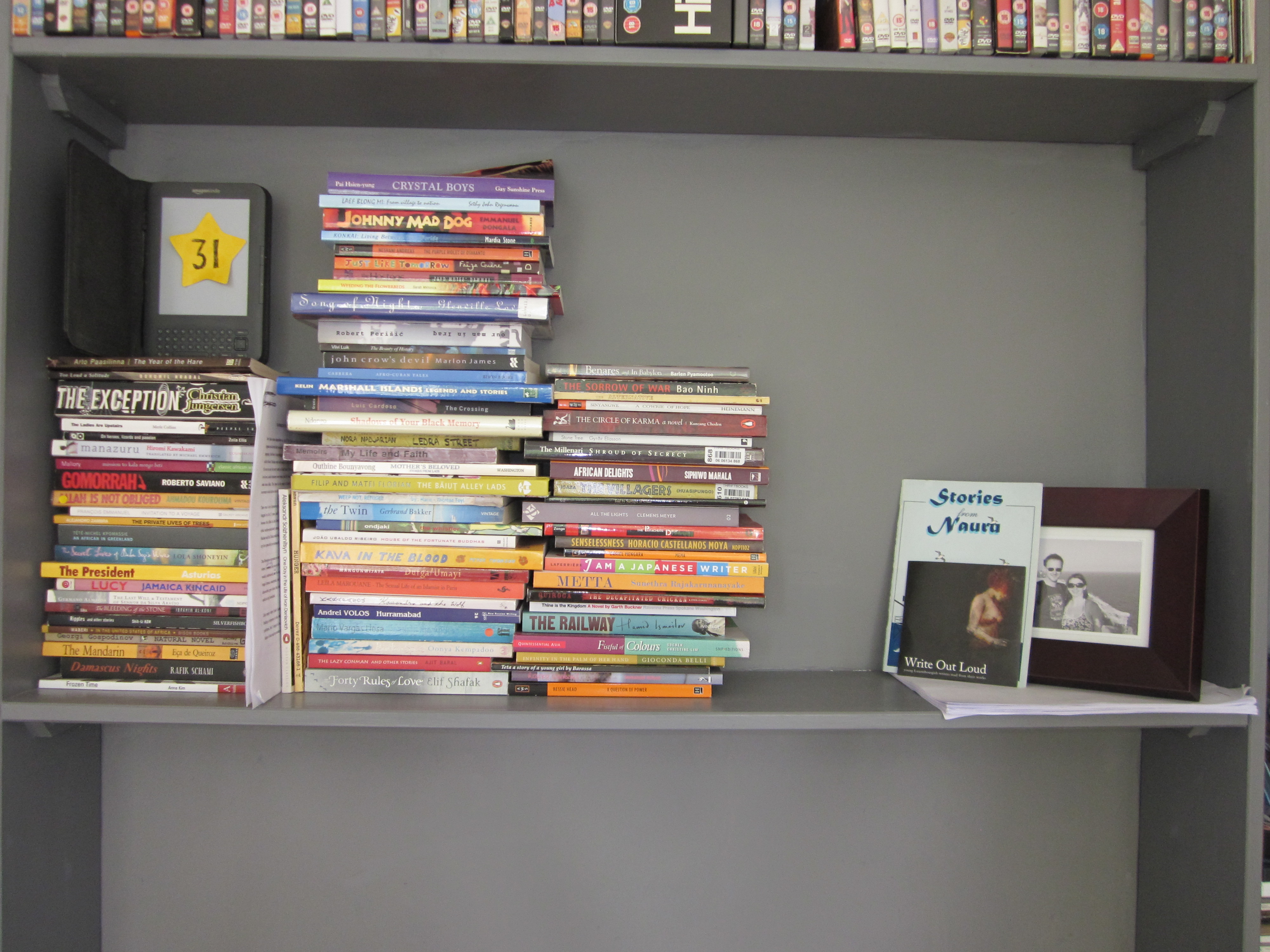
Postcard from my bookshelf #4

One of the things I loved about my Year of Reading the World was the way it brought me into contact with booklovers around the planet. In the five years it’s been going, this blog has had views from more than 230 territories – far more places than the 196 UN-recognised nations (plus Taiwan) that I set out to read books from in 2012.

It’s been brilliant hearing from readers in so many regions and the international nature of the project is a constant reminder to me of the potential stories have to connect us across cultural, geographical, political and religious divides.

However, one nation stands head and shoulders above the rest in terms of its interest in the quest. Roughly a third of all the views this website has ever had have come from the US. That’s three times as many as those from the next most-interested country: my homeland, the UK. Indeed, it was the interest of US-based TV channel CNN International that first brought the project onto the radar of many people around the world.

As such, I decided that this month’s translated book gift should go to someone from the US, in recognition of that nation’s enthusiasm for the idea of reading the world.

As you might imagine from the stats, there have been lots of American entries for this project. These include people of all ages and backgrounds, many of whom have inspiring things to say about what books have done for them. There are aspiring writers, librarians, students, teachers, translators and many others in the mix. And there are a number of people who have faced or are facing extraordinary personal challenges.

I was struggling to pick a winner. But then one comment caught my eye and I knew in an instant which book I wanted to send to that person.

The message came from Jane Banks, a university professor-turned-book editor in New Orleans. She wrote this:

I mostly edit books by non-native writers. I have edited two books on the war in the Balkans, both translated from Albanian, one Ph.D. dissertation by a student from Iran, a book about utopian urban planning in Europe and Central America by a professor from Portugal, and my current book by a professor in Australia on video piracy and online culture in her native China.

I love these projects because they give me a window on other countries and cultures and because armchair traveling is next best to the real thing. I would love to read books, fiction or non fiction, that have a significant sense of place. I live in New Orleans and find that books set here often use the city itself as a character. I’d like to read books like that, from any country at all.

Immediately, I thought of the novel Metropole by Hungarian writer Ferenc Karinthy. It’s an extraordinary book in which a linguist accidentally gets on the wrong plane and finds himself in a country where, unusually for him, he can make neither head nor tail of the language. Disorientated and increasingly anxious, he wanders around a city that becomes ever more menacing and strange – a character in its own right, just as Jane describes.

So there you are, Jane. This one’s on its way to you. I hope you enjoy it as much as I did.

There will be a bonus postcard from my bookshelf this month in celebration of World Book Day. Keep your eyes peeled for an announcement on 23 April. 

And if you’d like a chance to receive a postcard from my bookshelf, visit the project post and leave a comment telling me a bit about you and what you like to read. The next regular recipient will be announced on May 15.

Hungary: lost in transit

This was a recommendation from Stewart of booklit.com. As the driving force behind not only booklit.com but also the World Literature Forum, Stewart knows a thing or two about global literature, so I was keen to see what his suggestion would be like.

Written in 1970 but not translated into English until 2008, Ferenc Karinthy’s Metropole tells the story of Hungarian linguist Budai who inadvertently gets on a flight to the wrong destination and, instead of arriving at the conference he is due to speak at, finds himself stranded in a mysterious country where he cannot make himself understood. Bewildered and increasingly desperate, he must bring all his knowledge, academic training, cunning and instincts to bear in an attempt to crack the cryptic language of the citizens and find his way home.

Karinthy is a skilful storyteller. Sweeping the reader along over the obstacles to credibility – the absence of anyone with knowledge of any of the two dozen languages Budai speaks and the apparent indifference of the hotel staff to his plight, not to mention the whole business of getting there in the first place – he creates a compelling work.

He does this by embracing the unbelievable nature of the story and stretching its boundaries even further: the office block under construction near the hotel grows at an impossible rate, for example, and the city seethes in a ‘never-ending rush hour’. As a result, like the protagonist, we are never quite sure where we are and find ourselves wondering with Budai whether he is ‘on planet earth at all or in some other part of the cosmos’ – or indeed in an imaginary world where the rules are different from our own.

This sense of disorientation is heightened by Budai’s linguistic expertise. Watching a man used to navigating his way between cultures as easily as most of us get around our houses try and fail to achieve even the most basic level of communication is gripping.

At times it can be very funny, as when the hero is ‘all but dancing with rage […], his arms threshing the air’, but as the book goes on and Budai retreats into reticence as a result of the continual rebuffs he encounters it becomes increasingly tragic and disturbing. The unmaking of his confidence and sense of identity develops into a chilling parable about the rapidity with which all of us can be made to abandon our skills and self-belief in the face of sustained rejection and frustration.

If I had to name a gripe, it would be that the pacing is a little odd towards the middle of the book. As Budai circles the communication problem, returning again and again to the same doubtful solutions like someone trying to break into a locked house, the narrative becomes a touch repetitive.

But this is nitpicking. Overall this is a thoroughly engrossing and masterful work about the potentially life and death consequences of not being able to communicate. It is the only book I’ve read where all dialogue bar the words spoken by the protagonist is gobbledygook, yet it is also one of the most thorough and powerful celebrations of language in all its forms. A joy.

Metropole (Epepe) by Ferenc Karinthy, translated from the Hungarian by George Szirtes (Telegram Books, 2012)

Amended on July 30 2018 to correct the spelling of the protagonist’s name.