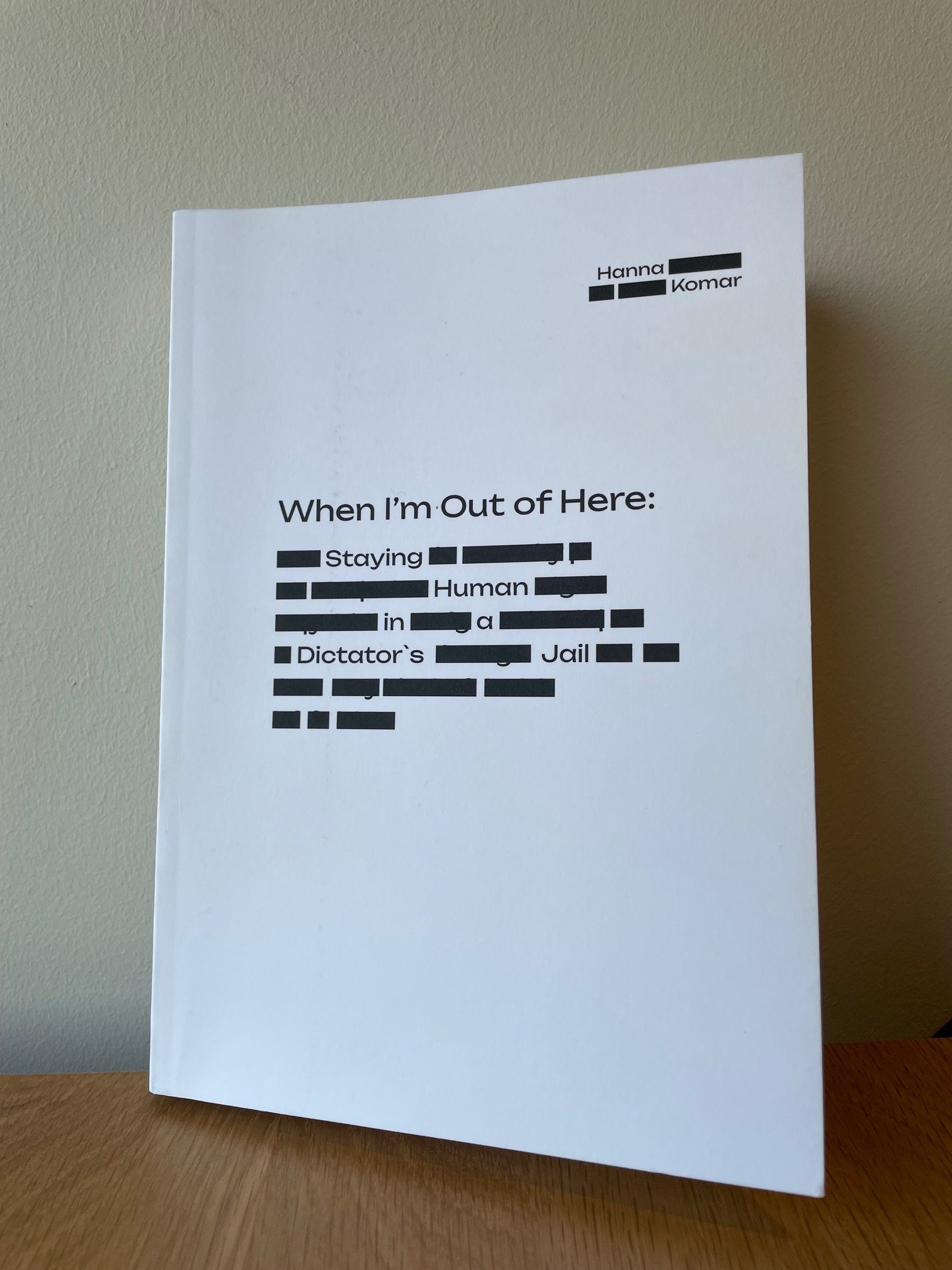
This book came onto my radar when we invited London-based Belarusian poet and translator Hanna Komar to be a guest on Collected, the podcast I produce for the Royal Literary Fund. The conversation that resulted with fellow poet Julia Copus was extremely powerful. Komar spoke with such poise and clarity about her writing and her experience being imprisoned for nine days after the 2020 Belarusian protests that I knew I would have to read her work.
When I get Out of Here: Staying Human in a Dictator’s Jail documents the experiences of Komar, her fellow prisoners and supporters after she was detained for peacefully protesting the controversial re-election of President Alexander Lukashenko for a sixth term. A choric text that brings together a range of voices, inspired in part by the work of Nobel laureate Svetlana Alexievich, it is the result of Komar’s efforts to ‘stay a poet’, as she put it to Copus, during her imprisonment by noticing and recording everything she could about the situation and what it did to her.
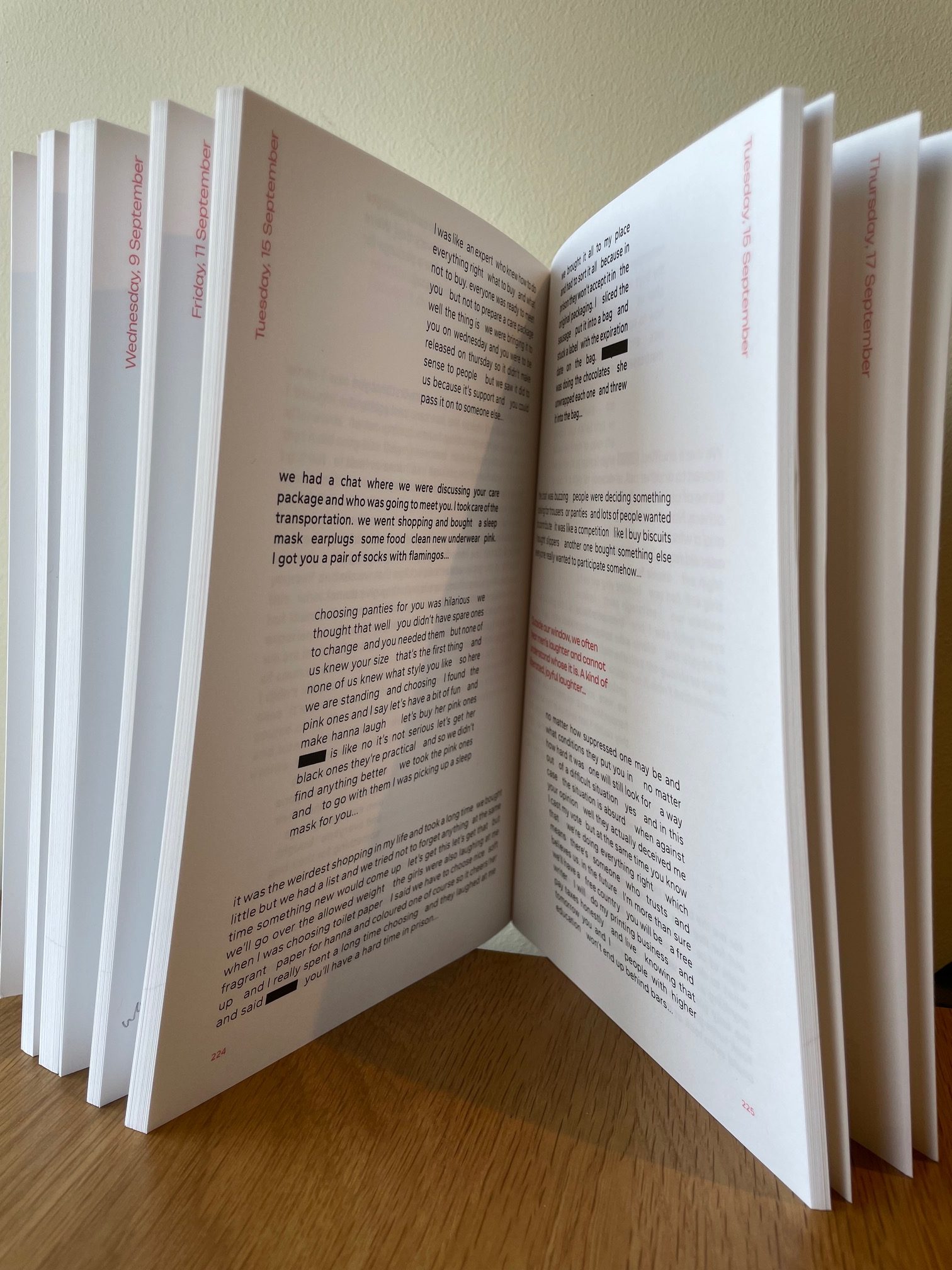
The first thing that strikes you is the layout. From the blacked out words on the cover to the blocks of text in different weights and colours within (Komar’s words are printed in red, while those of all others are in shades of black and grey), this book announces on every page that it is different. Its order is different too – beginning with acknowledgements, notes about Komar and co-translator John Farndon (who, I was amazed to learn, has written more than 2,000 books) and a glossary. Even the punctuation flouts convention: other than full-stops and the occasional question mark and ellipsis, there are no marks. Instead, Komar inserts gaps of varying lengths to indicate pauses and hesitations in the words she is recording. The visual message is clear: this is a disrupted text, sprung from a world in which the rules as we know them have been overturned.
In this warped reality, details become very important. Many of the early entries concern practical matters: the items that are most useful to include in care packages sent in to detainees, information on prisons where the water is safe to drink, workarounds for getting messages to inmates hidden in books, the importance of a hoodie when sleeping on a lice-infested mattress. And there are dark threats in physical observations too – blood spatters on a holding room floor, globules of faeces on an exercise yard drain.
The details of human interaction speak more loudly too in this narrowed world. With the guards weaponising unpredictability, even the most innocuous encounter with them is freighted with menace (apologies that WordPress doesn’t seem to allow me to show the gaps here):
‘you don’t know at what moment what will annoy them in you and you can become a victim of this harsher scenario and this uncertainty this lack of logic say they didn’t like someone and that’s it and this fear that it could be you who will fall into a narrower category of people who get the worst treatment although of course if we are talking about reality which is normal not distorted not twisted inside out then all this is horrible it’s a violation at every stage and so on…’
Goodness and beauty also speak through small details and human encounters in this muffled world. From the generosity of fellow prisoners in pooling their resources and the support of friends and acquaintances raising money and waiting outside the prison gates to the solace the women find in group singing, there is much to take heart from in the way the inmates band together to strive for self-preservation.
Perhaps most inspiring of all is the clarity, directness and dignity with which Komar marshals her thoughts and those of others to depict this experience unfolding day by day. It is an extraordinary thing to observe and document psychological rupture and the threat of your own unravelling in the way that Komar does, taking us into responses that are felt rather than reasoned. ‘I can’t believe my eyes but I believe my feelings’, she tells us and the wonder of this book is that she takes us into these feelings, so that we too feel the weight and outrage of living ‘in a state of unfreedom’ in a way that no amount of purely factual description can convey.
Often the language is plain and direct, ribboned through with a hint of Belarusian syntax that helps situate the voice. Much of the book’s power lies in this: we frequently see details recorded without comment, presented baldly for us to encounter and make sense of much as the inmates do. But this plainness makes the moments of high emotion or more elaborate descriptions all the more striking. Take this passage from the middle of the book: ‘Hours of waiting. Feels like we were put into a tin of condensed milk and from time to time we are dripped onto a spoon from the pierced hole.’ Coming in the midst of relatively bald, functional language, the image of the condensed milk is so intense it is almost painful.
Generosity is perhaps the strongest theme of the book. Generosity between the prisoners and from supporters, but also the generosity with which Komar regards all those around her, even the guards – ‘A woman was groping our bodies roughly while the men were watching,’ she writes in one of the later sections. ‘Did she care? Did she want to show that she had no sympathy for us? Does she feel herself and her body? When was the last time someone was gentle with her?’
This generosity and interest in all people also extends to the reader. Much of the book is written in the second person, as though we are in the jail too, and many of the early entries and pieces of advice around care packages are presented as pieces of information we might find helpful. This is intentional: ‘Democracies everywhere are under strain – and we need to be prepared,’ Komar states in the blurb. ‘[This book is] about hope that survives behind bars, and how solidarity can be built anywhere – even if you’ve never had to before.’ She writes not merely to convey her impressions to us as bystanders but because we may one day find ourselves in her position and need to draw strength from her insights.
I hope Komar is wrong in this, but I know she is wise. She has written a rare thing: a book that encapsulates the best and worst humanity has to offer, both the coldness and cruelty we can show to one another and the dignity, humanity and grace with which we can meet such treatment. An important, moving and urgent piece of work.
When I’m Out of Here: Staying Human in a Dictator’s Jail by Hanna Komar, translated from the Belarusian by Hanna Komar and John Farndon (Skaryna Press, 2026)