Guinea: history reclaimed

Guinean author Camara Laye is best known for his novel The Radiance of the King. In fact if you search for Guinean literature in English, you could be forgiven for thinking that this work is the only book from the Francophone African nation, which is made up of more than 24 ethnic groups, to have made it into the language of Milton, Shakespeare and Dan Brown.

I’ve certainly not been any able to find any other translated Guinean authors (although I’d love to hear about it if you have), so, in the interests of not making the most obvious choice, I decided to read one of Laye’s lesser known works: The Guardian of the Word.

Part anthropological account and part novel, with a dollop of sermonizing thrown in for good measure, the book focuses on the month Laye spent recording the stories of renowned Guinean griot (storyteller) Babu Condé in the village of Fadama in 1963. Beginning with the quest of brothers Moké Mussa and Moké Dantuman to hunt the fearsome Buffalo of Dô, the tales broaden out to bring in a huge cast of historical and mythic characters who contributed to the rise and eventual break up of the medieval Mali empire, and reveal a world of magic, mystery and rich heritage.

Laye makes clear from the start that he has high ambitions for the work. Through recording these stories, which to him ‘constitute the soul of ancient Africa’, he hopes not only to preserve the region’s history before development sweeps it away but also to prompt ‘the awakening of a new civilization’. As he explains at length in his opening his chapter, ‘Africa: Voices from the Depths’, Laye regards traditional stories as essential to his compatriots’ developing a sense of identity and a society that is more than a mere emulation of the European structures they had imposed on them until the mid-20th century:

‘Should not the wisdom of the Ancients and of their past serve as an example to our rising generations? In a continent where the heat in certain regions reaches 40° in the shade, should our African “emancipation” consist of the three-piece, all-wool suit and the bottle of scotch? Should it not rather have its source in our own deep roots in the distant past, and, at the same time, in the opening up of our new frontiers to universal values?’

However Laye’s impassioned appeals and his fascinating descriptions of the steps he had to take to win the privilege of recording the stories – from wearing certain garments to observing particular forms of etiquette – are just the prelude to Condé’s tales. Bristling with proverbs, rich imagery and bursts of humour, these accounts show storytelling at their best. As a Western reader, I found myself continually surprised by twists, turns and tropes that were like nothing I had come across before: where the hero would pick the wrong girl in the European fairy tale, he picks the right one and then comes to grief another way; where Western legends are usually content with mighty men having one formidable mother, here the tyrant Sosso is carried to term by three women, transferring between wombs every three months; and where marriage is usually a happily-ever-after scenario in the stories I grew up with, it is here the start of a battle of wits and (more often than not) sorcery between husband and wife.

Indeed the graphic nature of the storytelling, both sexually and in terms of the violence it involves, is often shocking. Maghan Kön Fatta’s eventual conquest of his wife Sogolon, who casts spells on him and refuses to sleep with him until he threatens to slit her throat ‘like a chicken’, makes for challenging reading, not least because the couple seem to get along very well after Fatta has his way.

Now and again, Laye’s passion for what he is doing threatens to overwhelm the narrative. At points in the stories where the rhetoric gets too grand or digressions with unnecessarily detailed cultural exposition and musings on the role of women creep in it’s tempting to wonder quite how much of the work is as Condé told it. More than once, Laye’s Uriah Heapish protest that ‘We are but the modest transcriber and translator’ seems to ring a little hollow.

But this does not take away from the book’s charm or how engrossing it is. If anything the subtle tug-of-war between oral storyteller and modern novelist adds to the richness of this fascinating text, which itself records a story that was shaped and embroidered over generations as the griots passed it down. I wonder what, if any, version of the saga is told in Fadama today.

The Guardian of the Word (Le Maitre de la Parole) by Camara Laye, translated from the French by James Kirkup (Fontana, 1980)
 

Central African Republic: tales of yore

I knew this was going to be tricky when Catherine Teya, president of the Central African Republic Association of Europe (SEWA Europe), struggled to suggest a book from CAR that I could read in English. However, it wasn’t until I did a bit more detailed research into the state that I began to understand quite what the challenges were.

Riddled with unrest and pockets of lawlessness since it gained independence from France in 1960, CAR is one of the planet’s least developed and most isolated countries. Indeed, as award-winning photojournalist Spencer Platt explains in his 2008 dispatch from the country, it has to all intents and purposes been abandoned and forgotten by the rest of the world. With frequent coups and attempted coups forcing crisis after crisis on its impoverished citizens, most of whom will not live to see their 45th birthdays,  it’s small wonder that very few books by writers in the country have made it into print in recent decades, let alone been translated into English.

However, although she was unable to recommend anything directly, Catherine Teya was nothing if not helpful. She sent me a number of links that might assist me in my quest, among them the website of Solidarité Franco Africaine, which features an overview of Central African writers. Perhaps one of these might have been translated in to English, she suggested.

As luck would have it, sloshing about in Amazon’s dankest recesses, I stumbled on a 1970 translation of a novel by Pierre Makombo Bamboté, one of the writers on Solidarité Franco Africaine’s list. There was no information, no summary and no picture. The book was in an ‘unknown binding’ and I could tell nothing about it beyond the date the English version was published, its title and the number of pages it had. Still, given the lack of anything else to go on, it had to be worth a shot.

First published in French in 1966, Les Randonnées de Daba (or Daba’s Travels from Ouadda to Bangui as the English version has it) follows young Daba as he leaves his parents’ village to visit friends and relatives around CAR and further his education. Moving between the Westernised milieu of his French boarding school and the rich rural traditions of the communities he stays with during his holidays, Daba develops a love for his country, as well as a desire to explore the rest of the world – and has some gripping adventures along the way.

Daba’s is a culture where storytelling is part of the furniture. From the very opening lines, in which Daba’s mother tells the tale of the will-o’-the-wisp bird, fielding her son’s comments and chiding him for questioning her skill as a narrator, the power of the oral tradition is clear. This comes across in the novel too: the text is frequently interspersed with stories told by adults the boy meets and the narrative itself has an organic feel, as though Bamboté is sitting just across from us, developing the story as he goes along.

This instinct for storytelling also manifests itself in the evocative descriptions that fill the book. Whether he is describing the ‘sparkling white wings of insects, looking like thousands of stars, [that] glittered in the headlights’ on a drive through the jungle, the way a crocodile’s tail ‘would suddenly spank the water and send a great sheet of white spray up into the air’, or Daba’s eerie sense of being followed when returning home from a day spent tracking lions with his friends, Bamboté is a master of transporting his readers into the midst of the places he describes.

Indeed, for all its exotic crocodile hunts and days off school because of prowling panthers, the book has a profoundly nostalgic feel. This is partly down to the author’s skill, which makes us yearn for a place we have probably never been (the presence of Daba’s French penfriend Guy throughout much of the book suggests that it was probably aimed at a European rather than a CAR readership), but it is also because of the look and feel of the book. With its illustrations sprawling over the pages like jungle creepers and the smell of its old pages, it reminded me of the books my mother gave me from her own childhood.

Now, 42 years after it was published, Daba’s Travels from Ouadda to Bangui and the handful of Bamboté’s other translated novels offer a rare window on a much-neglected and surely now much-changed corner of the globe. I wonder how long it will be before English-language readers get a chance to take another look.

Daba’s Travels from Ouadda to Bangui (Les Randonnées de Daba) by Pierre Makombo Bamboté, translated from the French by John Buchanan-Brown (Pantheon, 1970)

Kenya: a momentous proposal


Say the words ‘Kenyan writer’ to most world literature fans and they will come back with one name: Ngũgĩ wa Thiong’o. Imprisoned for speaking out against injustice and corruption, the author of such landmark books as A Grain of Wheat and Wizard of the Crow abandoned English to write in his first language Gikuyu in the late seventies. He is revered around the world for his work and his passionate advocacy and has been given many awards, seven honorary doctorates and held numerous visiting professorships.

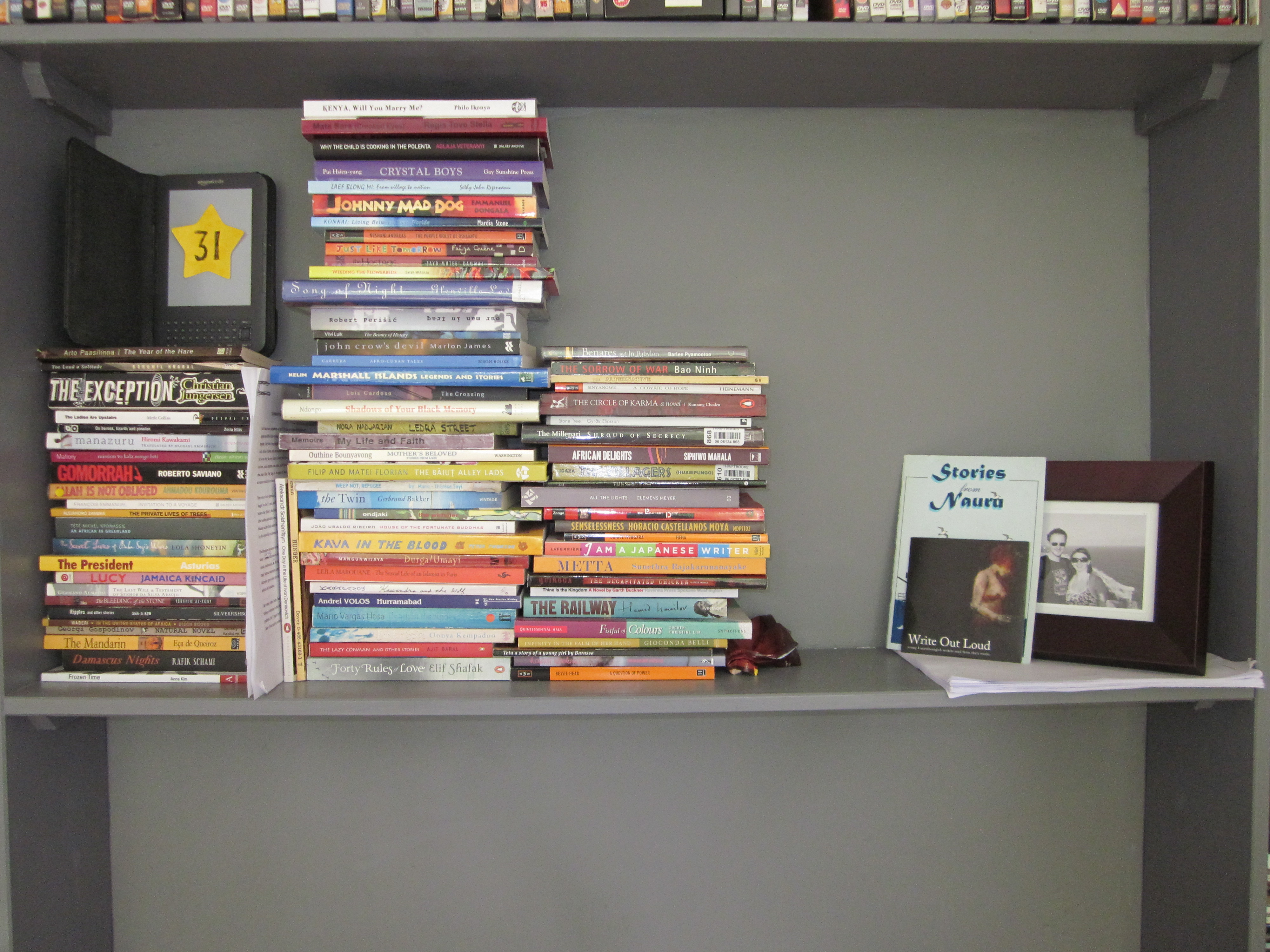
It seemed a no-brainer that I would read one of this literary giant’s novels as my Kenyan choice. But then I heard about Philo Ikonya. Arrested repeatedly for her human rights activism and living in exile in Norway since 2009, the poet and novelist is an avid blogger and journalist, as well as a keen linguist. She is also president of PEN Kenya.

Intrigued though I was to read the work of Kenya’s great man of letters, Ikonya and her oddly titled novel Kenya, Will You Marry Me? piqued my interest. I decided to give it a go.

In a nutshell, the novel is a love story. It gives an account of a life-long passion for and relationship with the country Kenya in all its exuberance and raw pain. Growing up in a village near Nairobi, the young narrator uses dolls to act out and embody some of the conflicts she sees around her, while flashes forward and backward in time and stories from other relatives and friends bring home the personal consequences of such traumatic events as the attempted coup of 1982 and the humanitarian crisis in the wake of the rigged election of 2007, as well as the long shadow of colonialism. Hurt but not discouraged by all that she has seen, the young woman transforms herself into the embodiment of Change during the course of the narrative, urging her fellow countrymen and women to get behind her and appealing to the nation she loves to unite itself with her.

Nationhood and what it means to belong to a country bind the narrative like the spine of the book. Frequently speaking about Kenya as a person, the narrator emphasises that ‘history and politics live in homes’, showing how events in parliament pervade even the bed sheets and the cooking pots of the most remote villages. This sense of the interconnectedness of national and domestic events is coupled with a great love and celebration of the beauty of the land and, as the narrator’s grandfather explains, a ‘greater love [which] is to realise that these are only ours for some time and that your children must find them still here’.

As a result of her intense connection with her country, the narrator feels every threat to its wellbeing as a personal attack. This leads to a barrage of righteous anger against the injustice of colonial rule, the heartlessness and corruption of politicians, the cruel rapes suffered by many of the country’s women and children, and the fact that ‘people gifted with melanin continued to be left out of the game’. Often, this takes the form of powerful, rhetorical addresses in which the narrator apostrophises various groups in her effort to galvanise them into positive action, taking in everyone from her dolls and her compatriots, to corrupt politicians and even Western readers:

‘You, most of you, in the West have the comfort of analyzing what you call deception, we are grateful for the small straws of hope we see near us. We cannot afford to shun all.’

Ikonya’s poetic sense comes through strongly in the narrative, adding subtle layers of meaning. Whether she’s playing with rhymes to make deeper points – ‘I have never been able to hear the word “bribe” without seeing “tribe”. Vice like lice lives in families too’ – or stripping back the etymology of place names and sexual terms to reveal the power struggles that lie beneath, she uses words richly, milking them for every last drop of significance.

Readers unfamiliar with Kenyan history and politics, as I was, will sometimes struggle to follow the narrative, which is often essentially a stream of consciousness ‘crisscross[ing] years, beating arrangements in books’. In addition, the novel’s fragmented and free-flowing nature means that there is often very little to drive it forward other than the narrator’s passion. The fingers begin to itch to flick in the last third where earlier polemics on corruption and women’s rights are reprised without much development.

Nevertheless the commitment and fervour of the narrator carry the day. As a portrait of patriotism, this stands in stark contrast to the rather anaemic if not downright cynical expressions of national pride we tend to hear in the UK. It is an urgent reminder of the importance of politics and the influence that individuals can have on events larger than themselves. No wonder the people in power felt threatened.

Kenya, Will You Marry Me? by Philo Ikonya (Langaa Research & Publishing Common Initiative Group, 2011)


Republic of Congo: war of words

There are some titles that seem to tell you everything you need to know about what’s inside a book. In the case of Johnny Mad Dog, a novel by academic Emmanuel Dongala who fled his native Republic of Congo for the US in 1997 during the civil war, I was pretty clear about what to expect: violence, unpleasantness, people being killed in cruel and unusual ways and possibly an incident with a vicious canine, depending on how literal a writer Dongala was. Just as well then that I’m not a great believer in taking things at face value, because if I had done so I might have bypassed this novel and missed out on a whole lot more.

Set during the civil war, the book follows two characters as they struggle to survive and succeed in the midst of a humanitarian crisis. While scholarly Laokolé tries desperately to get herself, her younger brother Fofo and their disabled mother out of the city as looters descend for 48 hours of mayhem, 16-year-old rebel soldier, rapist and looter Johnny Mad Dog battles for supremacy among his peers, never more than moments away from the next senseless confrontation that could end his life. At last, drawn together into the heart of the vacuum as society implodes around them, the teenagers come face to face.

Yes, violence features heavily. There are sickening killings and assaults. There is the child shot by Johnny and his cronies on the roadside and the television star raped in the studio in front of her camera crew in the minutes before she is due to go on air. What stops these episodes from being gratuitous, however, is Dongala’s insight into the processes by which we justify unforgivable actions to ourselves. Tuned into Johnny’s thoughts as he commits these crimes, we hear his paranoid delusions that his victims are somehow from rival factions – or even Chechen spies – and his bizarre conviction that the women he abuses enjoy what he is doing.

Dongala’s ability to inhabit the minds of his characters also gives rise to some unexpected flashes of comedy. We witness the bathos and confusion of the rebels as they try to dream up a nom de guerre for their breakaway faction and find themselves repeatedly suggesting the names of cars and football teams, and the ludicrous exceptions they make to the dictates of their leaders in this land where there is ‘no longer any logic’.

There are some passages of powerfully empathetic writing too. Dongala’s portrait of Laokolé’s struggles, taking in everything from her thwarted desire to study engineering to the shame and discomfort of having to do without sanitary towels amid the crowds fleeing on the roads, is quite extraordinary.

Inevitably for so humane a writer, the targets of the greatest scorn and anger are not the bungling kids perpetrating violence but the organisations and authorities that dehumanise killers and victims alike. Of these, the UN representatives and rich Westerners at the embassy where Laokolé goes to seek shelter come in for the greatest vitriol – although Dongala is careful to include a sympathetic American who tries to rescue Laokolé and so avoids slipping into the same generalisations that make him angry. Perhaps most scathing of all is the scene in which a convoy of UN vehicles sent to rescue the Western nationals knocks down a young Congolese girl begging for a place in the cars and then halts to allow one woman to run back and collect her ‘little one’, which turns out to be a lap-dog.

Dongala’s impatience to relate these intense experiences means that occasionally his plotting can be a little abrupt. The American’s offer of adopting Laokolé, for example, seems to come a bit out of nowhere, although the extremity of the circumstances might excuse it. In addition, a few of Laokolé’s turns of phrase, such as her claim at one point to have been ‘yielding to an atavistic human instinct’, are a little hard to swallow even for a bright and well-educated 16-year-old.

Overall, though, this book delivers a lot more than its fierce title promises. Subtle and surprising, it takes readers by the hand and leads  us through the chaos of civil war, finding meaning amidst the madness. A powerful work.

Johnny Mad Dog (Johnny chien méchant) by Emmanuel Dongala, translated from the French by Maria Louise Ascher (Picador, 2005)

Liberia: breaking the taboos

This book was recommended to me by Justin at the African Books Collective when I dropped by the their stall at the London Book Fair back in April. I’m glad he brought it to my attention as the subject matter and cover – which makes the book look a bit like a self-help manual – mean that I probably would never have chosen it on my own.

Written by Dr Mardia Stone, a Liberian obstetrician and gynaecologist living in the US, the book is an account of her homosexual half-brother Konkai’s diagnosis and struggle with AIDS in the late eighties and early nineties. Charting her sibling’s decline and death back in the days when very little was known about the disease, Stone confronts her and her family’s fears and prejudices, weaving in and challenging the attitudes to homosexuality that she and her relatives grew up with in Liberia and discovering a capacity for love that breaks down social barriers.

Stone’s unflinching honesty and direct style make the book. From reflections on death and mortality through to confessions of her and her other siblings’ tendency to laugh at their brother and sweep his sexuality ‘under the carpet’ in the years before his illness, the book is fearlessly frank as well as touching and tender. At times this can make for shocking reading, as when Stone writes about Konkai’s deliberate promiscuity without protection after his diagnosis when his anger and pain were at their peak.

Stone’s frankness  also paves the way for some refreshingly open discussion of the approach to homosexuality in many African countries: ‘You will sometimes hear African people say that Africans, for the most part, are not homosexuals because culturally or traditionally most Africans know nothing about homosexuality. […] It is still taboo in many countries. Yet, I have seen a number of African homosexuals living “in” and “out of the closet” in Africa,’ she writes. Indeed, as Stone explains in her preface and again at the end of the book, a large part of her motivation for writing her brother’s story came from a sense that, because of this reticence, ‘Africans themselves are not writing their stories, everybody else is writing for them’.

In addition to its personal and cultural discussions, the book is also a valuable documentation of a key moment in the history of modern medicine. Having been a hospital doctor in New York during the eighties, Stone writes powerfully about the fear she and her colleagues felt when they first encountered patients with the newly discovered HIV/AIDS virus. Her account of her first exposure to a pregnant woman with the disease is particularly compelling:

‘The woman was immediately isolated. A stack of disposable gowns, masks, shoe covers, gloves and hats were placed in front of her room door. No one dared to enter without being properly suited. We looked like astronauts ready to enter a space shuttle every time we entered her room wearing our protective biohazard suits. Some of us even doubled [sic] gowned, double booted and wore triple hats and masks. We were that fearful. None of us wanted to go into her room alone so we always arranged to see her in pairs or as a group.

‘In the course of caring for our patient, I had to draw her blood. The very thought of this routine procedure was terrifying. […] Terrified, I searched for a fellow resident to assist me, hold my hand and give me encouragement. No one agreed and no one was ‘available’. Even the nurses seemed to be on the snail track to Timbuktu, and because I had a heavy load of over twenty patients that day, I put on my brave face and with a brave heart entered the room alone, in my space suit.

[…]

‘”You people make me feel like a demon,” [the woman] said in response. “Why do you treat me this way? I may have AIDS, but I am a human being. I feel bad enough already and I am hurting because I may lose my baby. Is there no compassion left in any of you?”‘

Occasionally, the directness of the writing leads to assertions that some readers will find uncomfortable. In particular, the discussion of Konkai’s early abuse as a child by a young adult in Liberia and the role this may have played in the development of his identity and sexuality, while no doubt worth exploring, is muddy and at points seems to conflate homosexuality and paedophilia. However, as this seems at odds with Stone’s views elsewhere in the book, it’s possible that this is down to slightly awkward expression of these ideas rather than deliberate intention – it’s interesting to note the disclaimer at the beginning that states the work ‘is not a pronouncement on any debates about the nature of sexual orientation’. The closing sections of the book could also have done with some cutting.

All the same, this does not detract from the fact that this is a brave and often deeply moving book. Few would argue with Stone’s central discovery in the midst of Konkai’s cruel deterioration that ‘compassion is the key to our human experience’. A welcome voice from a part of the world where such subjects rarely get put into words.

Konkai: Living between two worlds by Mardia Stone (Cotton Tree Press, 2011)

Namibia: marital ties

I started reading this book while sitting in a television studio waiting to be interviewed about A Year of Reading the World by Isha Sesay for her NewsCenter show on CNN International. I was quite nervous and sitting at the newsreader’s desk with lots of cameras and screens with my face on them leering down at me wasn’t the most relaxing of places to be reading, so it’s a testament to the power of Neshani Andreas’s storytelling that The Purple Violet of Oshaantu managed to draw me in all the same.

Published in 2001 and already considered a classic, the novel follows Mee Ali and her friend Kauna as they struggle against the patriarchal structures of society in rural northern Namibia. When Kauna’s abusive and unfaithful husband Shange dies suddenly, the women feel the full force of the way society is weighted against them and it is left to Mee Ali to help her companion rise above the waves of prejudice, avarice and cruelty that threaten to wash her away.

Andreas excels at capturing the little details that tell us everything we need to know about a character’s emotional state. From the incongruous reactions that show mental turbulence, as when Kauna laughs hysterically in the wake of discovering her husband’s body, to the flashes of insight that strike through everyday conversations, shedding light on secrets and fears, the narrative is full of riches. I particularly liked Mee Ali’s description of Kauna’s in-laws’ responses to her sensible suggestion that they should wait for doctors to determine the cause of Shange’s death instead of jumping to conclusions: ‘They looked at me as if I had another head, that of a cow perhaps. Did I look foolish?’

These insights make Andreas’s portrayal of the injustice of women’s lot very powerful. Interspersing the narrative with accounts of the extreme suffering inflicted on wives in the community, such as the public breakdown of Mee Namutenya when her husband takes a second wife and Mee Sara’s persecution by witch doctors on the death of her husband, Andreas presents a controlled and compelling argument against the practices that have so long been justified as tradition. Perhaps the most memorable of these concerns Mee Ali’s indignant reaction to the way her own happy marriage to Michael is viewed by her community:

‘Now this. “Oh, he doesn’t beat you? You are lucky.” I am really tired of it all. Yes, Michael is a good man and I am grateful for that. I just don’t know what people want me to do. Kneel down at his feet and say, “Thank you, Michael, for marrying a low class”? I am not lucky. I simply do not deserve to be treated like a filthy animal.’

Yet although the village women police and persecute each other through gossip, there is nevertheless an underlying sense of community and mutual support that erupts to the surface now and then with joyous results. Chief among these moments is the time when Kauna screws up her courage to ask her neighbours to come and do okakungungu [join together to work on her land] so that she can get her field dug before the rains come. The subsequent scene when the women respond to her call is incredibly moving.

Occasionally the time shifts can be a little disorientating. In addition, the long chunks of dialogue sometimes make the narrative feel more like a play script than a novel.

As a whole though, this is a powerful and important work by a writer who deserves her place among Africa’s literary greats. It certainly helped to calm my nerves.

The Purple Violet of Oshaantu by Neshani Andreas (Heinemann, 2001)

Swaziland: teenage rebellion

The tiny Kingdom of Swaziland doesn’t sound too promising when you’re on the hunt for world literature. According to the CIA World Factbook, it has the globe’s lowest life expectancy, with those born in 2011 only predicted to live an average of 31.88 years – just a year older than I am now.

Given such a bleak backdrop, I assumed any story I did find would be pretty solemn. So when The Modern Novel recommended Sarah Mkhonza’s self-published memoir Weeding the Flowerbeds, I was in for a surprise.

Recalling Mkhonza’s time boarding at Manzini Nazarene High School in the seventies, the book reflects on life in southern Africa in the years after Swaziland declared independence from British rule. With Apartheid and racism enshrined in the statutes of all the region’s nations, there is much for young girls Bulelo (Mkhonza), Sisile and Makhosi to struggle against, but there is also a wind of change blowing that promises more opportunities and possibilities for young women than ever before.

As in John Saunana’s novel The Alternative (my Solomon Islands book), boarding school with its British structures and legacy is a microcosm of the struggles the nation faces as it tries to shape an identity independent of its colonial past.  From the prejudice against Zulu and the very anglocentric reading lists – including Shakespeare, the Victorian classics and The Flies of the Lord as one confused English teacher calls the book he has to give lessons on – to the continued religious efforts to teach the ‘saga of the cross […] to the children of Swazis who still believed in muti [magic] and sangomas’, Bulelo is surrounded by the attitudes of the old regime.

Mkhonza treats this with a great deal of humour, recalling how she and her classmates ‘wondered what the United States of England was like’. She is also refreshingly honest about the way she and her fellow students ‘used the power of the underdog toward white people’, bamboozling their British-born teachers with dialect and slang. This is nevertheless tempered with a great deal of affection for many of the staff and the opportunities her education gave her: ‘This is why you are reading this book,’ she writes at one point. ‘We had some very good teachers who were dedicated to teaching us’.

The memoir really comes alive in the passages where Mkhonza recalls her female friends and the challenges facing them as young women, a subject to which Mkhonza has devoted much of her adult life and because of which she was forced to leave Swaziland in 2003. Among the more serious accounts of the mistreatment of women in wider society, there are some wonderfully funny stories of the sisterly bond developed over boyfriends, whose letters came secretly to PO Box 315 Manzini (I wonder what would happen if we wrote to that address now?), and the covert reading of Drum magazine. Indeed, the brusque problem-page advice of Agony Aunt Dolly is too good not to share:

‘You are stupid if you think the man loves you and you are still in high school. You are stupid when you think an older man can love you better than his wife. If you have sex with him, you will become pregnant, and that will be the end of you.’

Powerful episodes aside, though, the narrative often lacks tension and a throughline to drive it forward. At times, particularly when Mkhonza reflects on the boredom that characterises much of school life, we can feel as though we are plodding with Bulelo from class to class and, like her, begin to wonder exactly why we are bothering. There are also some quirks with the writing style, which skips between the past and present tenses in a way that is too erratic for it to be deliberate.

Many of these problems could have been ironed out with the help of a sensitive editor, something that Mkhonza, as a self-publishing writer, was probably obliged to do without. As it stands, though, this is an intriguing and witty, if inconsistent, account of how a significant moment in Swaziland’s history played out in young lives. It is full of hope, and worth reading for Aunt Dolly alone.

Weeding the Flowerbeds by Sarah Mkhonza (Sarah Mkhonza, Xlibris, 2009)

Mauritius: travellers’ tales

This was a second-hand recommendation. It was posted on the A Year of Reading the World Facebook page by Michael Walkden, who said he’d recently met Natasha Soobramanien, a writer of Mauritian descent, and asked her to recommend a book for his project (intriguingly, he didn’t say what his project is – if you’re reading this, Michael, I’d love to hear more). She’d suggested Benares by writer and film director Barlen Pyamootoo and he thought he’d pass the tip on.

I was doubly grateful for the recommendation when, on researching the novel, I discovered that it was very short. So short, in fact, that in most editions it is published with another novella, In Babylon. This would certainly help to keep me on target to read one book every 1.87 days. In fact, I reckoned I could probably read the whole thing in a single journey to work.

The doors beeped shut on the East London line and I plunged into Pyamootoo’s tale of two men who set out to find a couple of prostitutes in Port Louis to bring back to their village of Benares for the night. Driven into town by trusty friend and former mill worker Jimi, the pair meander around the red-light district, paying visits to several formidable madams before finally managing to engage two women to accompany them home. As the car takes them back through the benighted landscape and the men and women sound each other out through small talk, a wider discussion opens up about identity, companionship and the loss of the old ways of life.

Pulling out of Canada Water station, I made a note in the margin about the details that bring the narrative alive: the brothel with the beds with concrete bases, the narrator’s friend Mayi’s eyes ‘rolling and blinking like a wanted man’s’, the lights of smugglers’ boats flashing out at sea.

These give Pyamootoo license to dwell on ostensibly simple and even mundane exchanges, using them to chart the minute shifts in dynamics that keep the drama and tension in the scenes. This only breaks down once – when the narrator stops the car to go into a restaurant and buy some cigarettes. Here, the flat transaction feels like an unnecessary interlude, although it may serve to point up the subtle transformation taking place in the car.

This, as I realised while changing lines at Highbury & Islington station, concerns the slow seep of the background into the foreground. While the descriptions of the billboards and buildings sites around the capital start off as almost incidental details, the development and commercialisation of much of the island at the expense of its poorest communities – as evidenced by the closure of Benares’s mill – come to underpin the novella.

Each of the characters gradually reveals vulnerabilities and insecurities that derive from the breakdown of the old structures. The only way to bridge these gaps is to tell stories, as the narrator discovers when he embarks on a wistful account of his journey to the other Benares, a sacred city in India where many Hindus go to die in the hope of attaining paradise: ‘I thought to myself that stories must be what we travel for, to have something to tell the people we love’, he reflects.

Pyamootoo’s writing about this ‘feeling of opening up to the world, of becoming part of some sort of network’ is so compelling and seductive that I finished the last 10 pages of the novella sauntering along the pavement away from King’s Cross, oblivious to the commuters shoving past me. I hadn’t expected the story to be so beautiful and so surprising. It made me sad to turn the last page. If only every journey to work could be like this.

Benares by Barlen Pyamootoo, translated from the French by Will Hobson (Canongate, 2004)

Zambia: what price education?

This 2000 novel by Binwell Sinyangwe, another pick from Heinemann’s African Writers Series, promised something I hadn’t come across in any of the books I’ve read so far this year: a story centring on the hardships facing women in rural Africa written by a man.

Its premise is disarmingly simple. At the start, widow Nasula has less than three weeks to find the 100,000 kwacha she needs to pay for the next stage in her only daughter’s education, after more than a year of trying to get the money together. The rest of the narrative portrays the extreme lengths she goes to in an effort to raise the funds that are her daughter’s only hope of escaping a life of poverty.

In many ways, this is a profoundly feminist book. Dedicated to the memory of Sinyangwe’s wife Grace, the narrative reveals ‘the unfairness of the life of a woman’, returning again and again to Nasula’s desire for her daughter to be able to ‘carve a decent living that would make it possible for her not to depend on a man for her existence’. These hopes spring from Nasula’s memories of her own bitter experience of marriage and ill-treatment at the hands of her in-laws, recollections that bring out some of Sinyangwe’s best rhetoric:

‘Nasula had not forgotten. She would not forget. How could she? They had turned her into a servant, a slave in a chief’s palace. They had turned her into a stream in which to wash and kill the stink of their humanity. They had turned her into the hunter’s flat stone on which to sharpen their spears and axes. Into icisongole [a hard-shelled fruit] to play iciyenga [a game like jacks] with during the day, a fruit to be eaten at by the chief during the night. Into a source of laughter.’

Sinyangwe heightens our sense of Nasula’s plight with his repeated references to the common hardships facing many Zambians during the nineties. With the end of government grants, poor rains and the spread of HIV/AIDs, these are ‘the years of havelessness’ for rural and urban workers alike, in which many who previously prospered, and to whom Nasula turns for help, struggle to survive.

In the hands of a lesser writer, this material would be woven into a two-dimensional sob story. Instead, Sinyangwe rises to the challenge, imbuing his narrative with the vigour, vibrancy and ingenuity of his heroine. As we watch Nasula undertake the marathon walk to her in-laws, sleep in the city market to protect her possessions and challenge criminals and corrupt officials single-handedly, it’s impossible not to admire her.

If the narrative is occasionally a little overwritten, with a few too many adjectives fighting for space, the power of the plot more than makes up for it. So much so, in fact, that in the gripping final chapters, it’s easy to forget that what we are reading is not an account of some grand odyssey but the story of one woman’s attempt to secure a basic necessity for her child. It’s humbling to remember this as the narrative draws to its close – and more effective than any sob story could ever be.

A Cowrie of Hope by Binwell Sinyangwe (Heinemann, 2000)

Tunisia: maze of discovery

This was a recommendation from one of the newest book bloggers on the block. Based in Redeyef, Tunisia, English teacher Ali Znaidi set up Tunisian Literature (in English) in May 2012 to plug a gap in the blogosphere, which seemed to have nothing in English dedicated specifically to Tunisian writing.

Providing news, book reviews and other information, Znaidi aims to raise awareness about his country’s literature. It therefore seemed natural to turn to him for a recommendation for this project – particularly as, from what I could find out, Tunisian literature is relatively rarely translated, compared to literature from many other Arab countries.

Znaidi confirmed what I suspected about the scarcity of Tunisian texts in English, but he came back with several suggestions. Of these, I went with Talismano by French-language writer Abdelwahab Meddeb.

Told by a Tunisian writer living in Paris (much like Meddeb himself), the 1979 novel, which the author reworked in 1987, is built around an imagined return to Tunis, Fez and the other cities of the narrator’s youth. As he wanders for a period of roughly 24 hours through streets built half from memory and half from fantasy, the protagonist tests the boundaries of experience and writing itself, by turns engaging in the sensual, riotous and often shocking events he encounters and stepping back to comment on the world and his place in it.

Culture and identity are central threads. As the writer walks through his ‘maze of discovery’, he records the impact that colonialism and the different communities that migrated to the region have had on the places he sees, mingling aspects of Islamic and Judao-Christian culture with ancient myths and secularism to create a heady, bustling and often bewildering text.

A polymath par excellence, Meddeb reaches for cultural references the way an experienced chef works with rare herbs and spices, adding complex layers of flavour and piquancy to his creation. From Dante, Hesse and Joyce, to the Koran and ancient Egyptian theology, the text is broad and full in its scope – a book more of the world than of any particular time and place.

Some of the references are clearly deliberately obscure, however, the experience of reading the novel as a Brit with very little knowledge of Tunisian culture added another layer of disorientation: there were times when I was not sure whether my missing things was part of the author’s design or a function of my own cultural blind spots.

This becomes clearer as the narrative unfolds, carrying with it a series of knowing commentaries on writing and the author’s craft. Perhaps the most telling of these comes right at the end in the Epilogue:

‘We have confided through writing, but without giving you a foothold, have strained your eyes with our arabesque of words, have recommended the circuits of our journey, have warned you of the fissure in all that meets the eye, have unsettled you on high moral grounds, have ruined you among the most robust constitutions, have dusted myself off, vanished into thin air, have found my way inside you through the least perceptible slit’.

No wonder then that extracting coherent meaning from the narrative sometimes feels like trying to scale a glass wall.

This can make for a frustrating reading experience, particularly in the early stages. However if you allow yourself to surrender to the narrative, and let it flow over you, carrying with it its tide of impenetrable allusions, you may be surprised by the insights and recognitions that flash suddenly from it like gems buried in the shifting sand of the seabed.

Beautiful, maddening, disturbing and strange, this is a book for the intrepid armchair adventurers out there. It is not a comfortable ride, but when you reach the end and look back along the route you’ve travelled, you get one hell of a view.

Talismano by Abdelwahab Meddeb, translated from the French by Jane Kuntz (Dalkey Archive Press, 2011)