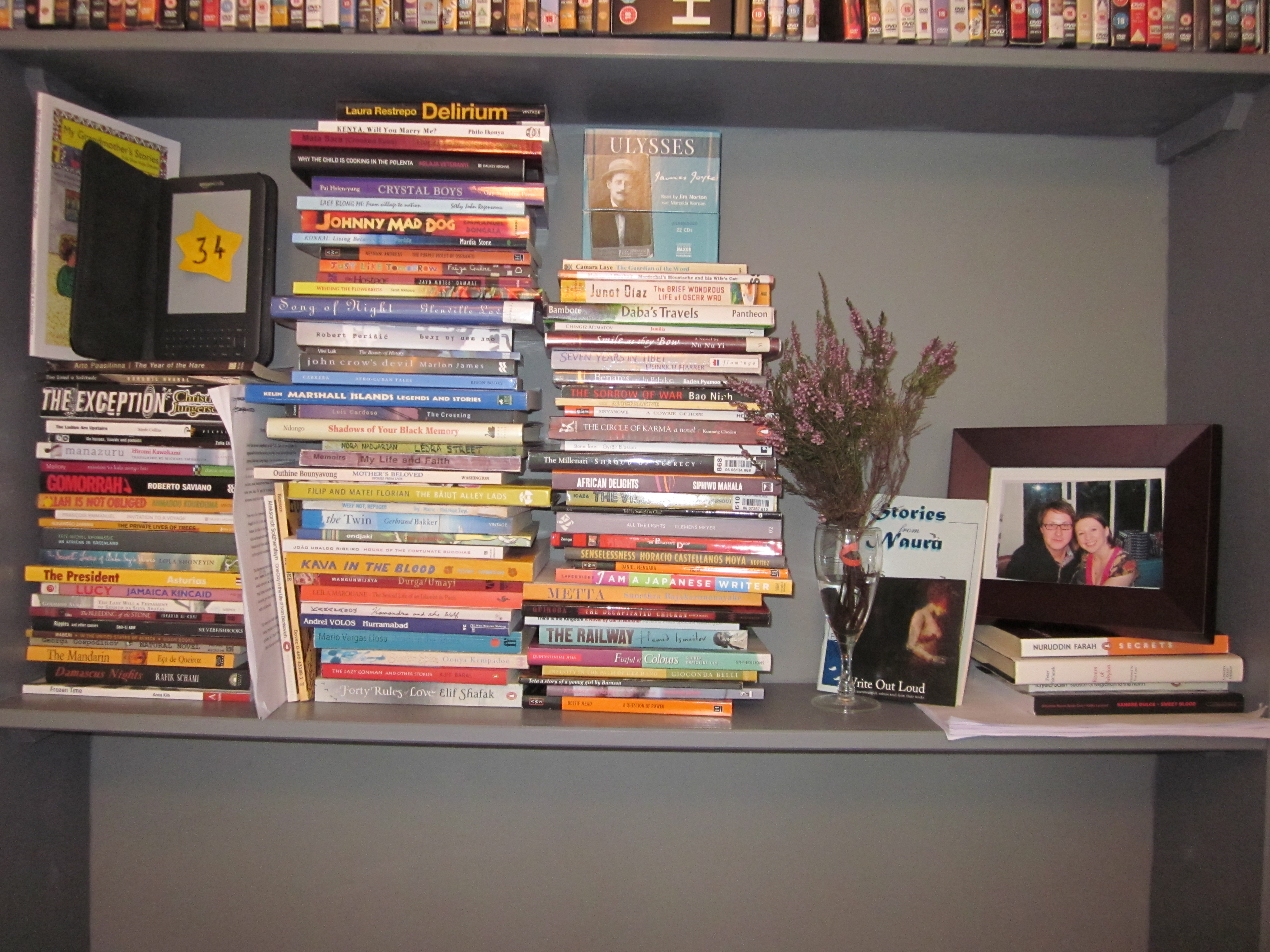
Armenia: another side

It’s rare that a writer advises you against reading his or her work. But that’s what happened when Armand Inezian stopped by this blog back in August. Seeing that his collection of short stories, Bringing Ararat, was listed under Armenia, Inezian very honestly said that he didn’t feel his connection with the country was strong enough as, although he comes from an Armenian family, he grew up in Boston and can’t write in Armenian. He added that his work has not been translated into Armenian either.

It was great to have Inezian’s perspective, as the question of exactly where the boundaries of national literatures lie has been a recurring theme in this project. I’ve encountered people who think hugely differently about this: while some are happy to regard books by an author whose parents come from a country as being part of that nation’s literature, others claim that the writer must be born, raised and still living in that country to qualify. There are even those who insist that a book must also be set in the country in question to count.

Personally, I’ve found my perspective on this issue shifting over the year with each tricky dilemma I’ve encountered and I’m still not entirely sure where I stand on it. Still, if Inezian didn’t feel his book was an Armenian work, perhaps I should listen to him.

Nevertheless, I was keen to involve Inezian in some way. If I wasn’t going to read his book (and let’s face it the choice of Armenian literature available in English is not massive), then perhaps I could pick his brains instead. Were there any Armenian writers whose work he could suggest? The answer came in the form of a link to information about Armenian Golgotha by Grigoris Balakian on Goodreads.

I have to confess that my heart sank when my copy arrived. Not only was this, judging by the title and subtitle (A memoir of the Armenian Genocide, 1915-1918), a very serious book, it was also a very long one. Its 500 or so large pages were covered with dense and relatively small print. The first sentence, too, with its earnest consideration of the political atmosphere of Europe in the wake of the assassination of Archduke Franz Ferdinand, filled me with foreboding. What had Armand Inezian let me in for?

The book records Armenian priest Grigoris Balakian’s experiences during World War I. Having finished his divinity studies at the University of Berlin just as the conflict began, Balakian travelled home to Constantinople in the hope that he could be of service to the Armenian population there. But as the eyes of the world turned to the trenches in Western Europe, Balakian witnessed the Ottoman regime beginning to target the 2 million ethnic Armenians within present-day Turkey’s borders, deporting hundreds of thousands of people to die barbaric deaths along the lonely mountain roads and plains of Asia Minor.

Caught up in this forced exodus, Balakian spent three years travelling and working in constant fear of being executed like the thousands of corpses he encountered en route. With only his ingenuity, determination and faith to guide him, he attempted to shield, hearten and save his Armenian peers, all the while holding on to the hope that he would one day be able to share their story with the rest of the world.

Balakian was an extraordinary individual, whose character shines through on nearly every page. Following the dry political summary of the opening lines, the narrative quickly becomes personal and detailed, bearing witness to its author’s great presence of mind in the face of extreme events. Whether he is using an anti-war rally he attended as an ‘opportunity to study up close the psychology of the organized German working class’, bargaining with the authorities for the lives of his companions, or talking to an official guilty of the deaths of thousands of his countrymen, Balakian displays an uncommon ability to keep his head.

This detachment means that he is able to embark on ‘a process of harrowing mental record-keeping’, remembering and relating details that would be lost to most people and delivering reams of compelling and historically significant descriptions. From his rare, foreigner’s-eye-view  of Berlin in 1914, through to the ‘whirlwind of blood’ he encountered in Asia Minor, Balakian’s accounts are meticulous. He spares nothing in his effort to convey the horrendous sufferings of his friends and compatriots, many of whom he claims were tortured and hacked to death by mobs bearing household and farmyard implements to save the authorities the cost of bullets. ‘If all the seas were ink and all the fields were paper, still it would be impossible to describe, in detail, the reality of the endless tortures of hundreds of thousands of them,’ he writes.

For Balakian, recounting these events is a sacred act. As he explains in his author’s preface, he regards his work as a ‘holy book’ for Armenia, which was first founded in around 600 BC. It is also the fulfilment of a promise made to some of his massacred compatriots and the bedrock of his decision ‘not to die’ during the genocide, which he believes kept him alive.

Inevitably, with so much emotional freight to carry, the narrative occasionally gets bogged down. Some of the writing is overblown and hyperbolic – the author’s repeated laments over the ‘martyrology of Armenian virgins’, for example, stick in the craw. The storytelling also comes second to Balakian’s desire to include everything he remembers, meaning that the latter stages of the book can be hard going and repetitive. In addition, for a reader with no contextual knowledge like me, it’s hard to know how much of the often very anecdotal and partisan accounts to trust.

Nevertheless, this is an important and impressive memoir. It not only opens up a much-neglected chapter in history and challenges Westerners like me to rethink our version of the events of the early 20th century, but it also presents a moving portrait of one man’s survival, patriotism and faith. If you’ve ever questioned the point of storytelling, the answers are in this book.

Armenian Golgotha by Grigoris Balakian, translated from the Armenian by Peter Balakian with Aris Sevag (Vintage, 2010)
Democratic Republic of Congo: bewitched

I stoogled upon Frederick Yamusangie’s website when doing a bit of preliminary research into literature from the DRC earlier this year. Born in what was then Zaire (the country reclaimed its name in 1997 after the ousting of President Mobutu), the Congolese writer studied Communication Engineering at the University of Kent and now lives in the UK, where he has self-published several poetry anthologies and his novel Full Circle. As it turned out, after several more hours of searching and sending out queries, he is one of the very few DRC writers to have work available in English today.

It’s hardly surprising when you consider what the Francophone nation has been through. Home to the planet’s deadliest conflict since World War II, Africa’s second-largest country has seen more than 5.4 million of its people die as a result of the fighting since 1998. Despite being rich in natural resources, DRC is the state with the second-lowest GDP per capita in the world. Small wonder then that promoting a publishing industry does not figure very high in many people’s priorities there.

With so little to go on, it seemed perverse not to give Yamusangie’s novel a try. And so, swallowing those die-hard qualms about self-publishing – which have turned out to be misplaced in several cases this year – I downloaded the book and set to.

Full Circle follows city boy Dada, who is sent to live in the village of Bulungu and learn about his culture when his father leaves the country to take up a diplomatic post in the US. The community seems pleasant enough at first, but as time goes by Dada discovers dark secrets and deep rifts beneath its peaceful surface that threaten to destroy him. Will secular Dada survive this superstitious minefield? Will his peers accept him as one of their own? And will the shapeshifting human-crocodiles in the nearby river get to carry out their wicked plans?

Yamusangie presents a nation divided by money. On one side sits Dada, who, because of his privileged upbringing, has ‘more knowledge of Western Europe than his own country’ and has never travelled in Zaire before. On the other is the rural population with its strong tribal traditions, loyalties and beliefs. At the start of the book, Dada is convinced that he knows enough about his culture and could ‘live in the USA[…] and still know how to relate to [his] own people’. Yet as the book goes on, he discovers he has much to learn.

The customs Dada discovers are eclectic and sometimes surprising. Magic, superstition and animistic beliefs weave through everything and are treated as part of normal life. When Dada goes for lunch at his teacher Mrs Betika’s house, for example, she tells him not to worry about a snake in the henhouse because it is the reincarnation of her auntie. Indeed, enchantments are big business, with many of the local spiritualists jostling to corner each others’ shares of the market and even plotting to murder a newcomer who seems to be too successful for his own good. The discussions of these customs and how they fit with the prevailing religion of Christianity, as well as the pressures on young people to abandon the old ways are fascinating, as are the glimpses into the rites of the secret society that tries to recruit Dada.

At times, however, the author’s sociological and historical insights hi-jack the narrative and send it hurtling off on long detours, sometimes threatening to derail it. This is not helped by an increasingly outlandish plot, which is sometimes held together with rather flimsy logic. For example, the reasons the police give for releasing Dada when he is accused of murdering a friend – that a child would never admit to doing such a thing and that children are incapable of killing anyone – are rather questionable.

It’s a shame, because there are some great moments in the story. The scene where the dead boy’s relatives converge on Dada’s guardian’s house seeking revenge is gripping. And by using a quote from that most famous of Congo-based novels, Joseph Conrad’s Heart of Darkness, Yamusangie makes his ambitions for the book clear.

With some robust editing and another eye on the work, he might have got there. As it stands, though, this is a fascinating and surprising book that opens up a little-known part of the world to English-language readers. It is rough round the edges, as many self-published books can be, but it contains some good things. I’m glad I chose it.

Full Circle by Frederick Yamusangie (iUniverse, 2003)

Tanzania: family politics

When one publisher recommends the work of another, you know you’re likely to be on to a good thing. And so, when Lynette Lisk, commissioning editor of the Heinemann African Writers Series, told me that she admired the work of Bloomsbury-published Abdulrazak Gurnah, I lost no time in looking him up.

Spanning 100 years, Gurnah’s 2005 novel Desertion weaves together the threads that lead a young Tanzanian man, Rashid, to leave his homeland in the early sixties and make his life in England. It starts in the dying months of the 19th century, with the scandalous love affair of Rashid’s grandparents – an unconventional English traveller and a shy local woman – before darting forward to Rashid’s childhood in the mid-20th century and on past the declaration of Tanzania’s independence to his lonely and wistful middle age. Steered by Rashid himself, who writes much of the story, with an interjection from his brother Amin and a poem from his sister Farida, the narrative brims with questions and observations about identity, nationality, belonging and love.

Gurnah is a writer with an eye for the thousand little human foibles that can combine to clog up and alter the course of a life. Whether he is describing Rashid’s great-grandfather Hassanali’s hesitance and self-effacement, born out of the ridicule he recognises in the eyes of those who visit his shop, the double-think that allows the British colonisers to despise corruption in others and yet practise it themselves, or the rituals and cruelty that stand in for intimacy between siblings, Gurnah is forever revealing the processes that mould and set personalities.

This perceptiveness extends to larger social structures too. Through the patterns Gurnah traces, we learn the limitations of the social codes surrounding courtship marriage that stymie Rashid’s grandmother’s life and the effect of the gross under-provision of schools for girls. Crucially, however, these observations are not delivered through authorial tirades but lived and enacted by the characters so that it is only when we sit back and think about the story that we realise the wider implications of what we are reading.

Alongside this runs a lively discussion about storytelling, which erupts into the narrative as Rashid begins to question the version of events he presents. Speculating, contradicting himself and imagining where he does not know, Rashid rehearses his family’s history, increasingly aware of the possibilities in fiction, both in the choices he makes as a writer and in the scope the form offers to process, assimilate and remake the past.

Fiction also presents Gurnah with the opportunity to unpack the legacy of colonialism in a far more inventive and impactful way than essays might afford. While his portrait of the British Victorians sitting on the veranda swapping racist ideology well into the night ‘to make themselves feel significant and present in the world’ is compelling, his description of Rashid’s lonely arrival in a Britain leaves a lasting impression. It also buys him the leverage to reach forward in time and challenge assumptions that still underpin much of social interaction today:

‘In time I drifted into a tolerable alienness. Living day to day, this alienness became a kind of emblem, indeterminate about its origins. Soon I began to say black people and white people, like everyone else, uttering the lie with increasing ease, conceding the sameness of our difference, deferring to a deadening vision of a racialised world. For by agreeing to be black and white, we also agree to limit the complexity of possibility, we agree to mendacities that for centuries served and will continue to serve crude hungers for power and pathological self-affirmations.’

For all its sociological and historical observations, though, this is first and foremost an engrossing and deeply moving novel. It is a book to get lost in, led by an expert storyteller, who wins our trust and piques our interest from the very first page. I’ll be looking up more of Gurnah’s works when this year’s literary adventures are over. Wonderful.

Desertion by Abdulrazak Gurnah (Bloomsbury, 2005)

The Gambia: a clamour of voices

I learnt a valuable lesson during the hunt for this title: if you’re looking for suggestions of books to read, contacting national writers’ associations may not always be the wisest option. No sooner had Cherno Omar Barry, general secretary of the Writers’ Association of The Gambia, kindly sent my request out to the organisation’s members than my inbox was flooded with emails from writers advising me to read their books. One person even asked if I was in The Gambia at the time of writing as, if so, he would hand deliver me a manuscript to make sure I got it safely.

Excellent though I’m sure many of the suggestions were, the fact that they were being recommended by the authors themselves meant that I had no reliable way of choosing between them. In my experience, it’s rare that you find an author who doesn’t think you should read his or her book, and the enthusiasm with which writers advocate their creations is often no indicator of the quality of the work.

However, in amongst the flood of messages, there was one apparently impartial suggestion. It was from Joy, who recommended Folk Tales and Fables from The Gambia by Dembo Fanta Bojang and Sukai Mbye Bojang. I googled the book and, finding it was also championed by the African Books Collective – whose publications I have enjoyed consistently throughout this project – I decided to give volume one a go.

Written in response to a realisation that traditional fireside storytelling is dying out in The Gambia, the work brings together stories told by the authors’ grandmother and great-grandmother, as well as tales from friends and neighbours, in a lively anthology. Magic and myth jostle with creative explanations of rituals and natural phenomena to create a fascinating world, in which hares and hyenas can be brothers-in-law, cats go on pilgrimage to Mecca, and severed heads boss heroes about from the branches of trees.

There are some mind-bending events and images along the way. From the marvellous depiction of a herd of violin-playing goats descending on the field of the helpless landowner in ‘The obstinate farmer of Njaiyen’ to the drowned boys who are transformed into a pumpkin and served up by their unwitting mother in ‘The Hassan half brothers’, the stories are frequently surprising. Indeed, many of them are shocking in the cruel and unusual violence they portray – in ‘Lolly the Witch’, for example, we hear about how a cunning boy outwits a cannibal enchantress, who takes delight in tricking and devouring her daughters’ suitors, with a pile of human faeces and a bag of eyes. Similarly, the stories don’t hold back from outrageous, physical humour, with farting playing a pivotal role in several tales – Waahou is even knocked dead by another character’s legendary flatulence in ‘The three men of Tangana’.

The tales are so diverse, ranging from naturalistic human stories through to outlandish, magical fables, that it’s hard to generalise about them. However, if I had to pick a recurring theme it would be the idea that it is impossible to transcend your nature for ever. We see this in the first story, ‘Burr Njai takes another wife’, in which the donkey queen, having transformed herself into a woman to marry a human king, is at last forced to change back and rejoin the herd. The idea also drives the plot in ‘Samba Becomes Friends with Gaindeh Njiai’, in which a lion and a man realise it is impossible to maintain a childhood friendship, and ‘The Cow, Hyena, Lion and Hare Share a Home’, in which an attempt at a peaceful, cross-species community fails.

Interestingly for a work inspired by traditional local storytelling, this book is perhaps the most international and modern I’ve read to date in terms of the way it was put together. As Bojang and Bojang explain in their introduction, the final version was shaped by comments from fellow Creative Writing and New Media Google group members and readers on the peer-review writers’ site Authonomy.

For all the feedback, however, there are still one or two editorial choices that jar. The decision to include stock photographs of some of the animals mentioned in the stories is a strange one. In addition, although Bojang and Bojang have clearly made an effort to make the narratives read well, there are some abrupt endings, changes of direction and omissions that leave the reader foundering. The blunt, pragmatic language of the stories, while often adding to the humour, also sometimes misses the mark. Waahou’s fatal pondering as to whether Fusall has ‘any bad odour left in his anal system’, for example, raises a laugh for the wrong reasons.

All in all, though, this is an entertaining and illuminating collection. It is sad to think that many of these stories, which surely would be even richer in the hands of a skilled narrator around the fireside one Gambian night, are now rarely told.

Folk Tales and Fables from The Gambia (volume 1) by Dembo Fanta Bojang and Sukai Mbye Bojang (Educational Services, Gambia, 2011)

Niger: a great saga

I knew Niger was going to be a tough nut to crack when, in response to my searching for ‘Nigerien literature’, Google asked me whether I meant ‘Nigerian literature’ instead. Although I did eventually track down the names of several Francophone authors from the country, among them Abdoulaye Mamani, Amadou Ousmane and Idé Oumarou, none of their work seemed to have been translated into English.

This may be because, as AS Kindo Patengouh argues in his 2005 paper Literary production in Niger: The case of the novel, in this very ethnically diverse country only 30 percent of the population read and write French, meaning that the audience for works in the country’s official language, in which most if not all Nigerien novels are written, is relatively small. As such, it is probably difficult for the works to make enough of an impact to attract notice from further afield.

There was an outside possibility in the shape of Harmattan, a novel about child marriage in Niger, by Belfast-born Gavin Weston, who lived and worked in the country for several years during the mid-eighties. However, any whisper of an argument that the book might count as Nigerien literature for my purposes was silenced when my copy arrived bearing an endorsement from Kellie Chambers at Ulster Tatler, declaring it the harbinger of ‘a new era in Northern Irish literature’.

Reluctantly, I added the book to next year’s to-read mountain. There had to be something out there available in English by a storyteller more closely linked to Niger itself.

Then a colleague volunteered to see what he could turn up. Clearly, his research skills are better than mine because, within a couple of hours he was back with a possible solution. It wasn’t a Nigerien novel. But in many ways it was something even more exciting: the transcription of an epic story told by a Nigerien griot over the course of two evenings in the appropriately named village of Saga at the beginning of the 1980s.

Ten years in the transcribing, translating and annotating, Nouhou Malio’s account of The Epic of Askia Mohammed tells of the life and times of Mamar Kassaye (also known as Askia Mohammed), who ruled the Songhay empire between 1493 and 1528. Switched for his mother’s servant’s child when he is born to protect him from his uncle, who has killed all his older siblings because of a prophecy that one of them will kill him, Mamar grows up in a brutal and brilliant society. He dedicates himself to spreading Islam and prosecutes a holy war across the region, fathering a dynasty and leaving a legacy of brave and bloodthirsty deeds that ensures his life is the stuff of legend six centuries after his death.

Mamar’s world is at once strange and oddly familiar. Levitating cities and uncanny enchantments fill the text, while shocking deeds, such as cutting a horse’s tendons in a fit of pique and laying a trap to bury a rival alive, are narrated so matter-of-factly as to feel distant, as though the emotional compass of the epic is calibrated very differently from our own. Yet, every so often a line, image or event will strike a surprising parallel with the modern Western world. I particularly liked the description of the group of griots spreading rumours about Amar Zoubami’s prowess in the run up to a competition to win the hand of the richest woman in Gao – by the sound of it, it would have given the snappiest PR team a run for its money.

Throughout the narrative, the meticulous work that editor and translator Thomas Hale and his team of transcribers and scholars have done to preserve the character of Malio’s performance as faithfully as possible is clear. This comes across in the unusual use of repetition, both of individual words and complete phrases, which creates a strong sense of the rhythm and drama of the rendition. It is also clear in the ellipses, which mark words and lines that could not be made out on the recording.

Rather than give in to the temptation to create a polished, complete work at the expense of absolute fidelity to the original account, as I suspect Camara Laye may have done in The Guardian of the Word (my Guinean pick), Hale and his team present exactly what they heard. When it works best, it is as though we are sitting in Malio’s hut, moving up to let someone past and so missing the odd line. The flip side, of course, is that certain passages can be quite fragmented and hard to make sense of, although Hale has done his best to make up for this with a plot summary at the beginning.

Overall, this is a fascinating, if occasionally frustrating, read. At times bewildering and shocking, it is also enthralling. And despite the incompleteness of the text and the cultural mores that can leave the Western reader fumbling for the meaning, there are moments of magic where the pages seem to be stripped away and we are transported to sit in that village two miles south of the Nigerien capital Niamey, listening to a story told more than 30 years ago.

The Epic of Askia Mohammed recounted by Nouhou Malio, translated from the Songhay by Thomas A Hale (Indiana University Press, 1996)

Morocco: feminine endings

Shafiqah1 put a comment on the blog earlier this week. ‘Please read Tahar Ben Jelloun, any of his works, if you are enjoying Francophone Literature, I promise you won’t regret it!’ she wrote.

It was as if she’d read my mind. In fact, I’d just finished Tahar Ben Jelloun’s The Sand Child and was preparing to post on it when her comment came in.

Shafiqah1 wasn’t the only Ben Jelloun fan to have visited the blog. Back when I first asked the world’s book lovers to tell me what I should be reading late last year, litlove also put in a vote for the writer.

However, what finally made me pick The Sand Child from the cluster of fascinating-sounding Moroccan titles on the list was a recommendation of a very different kind, from a person who doesn’t technically exist.

The Sand Child is the novel Doria, the gutsy teenage heroine of my French choice Just Like Tomorrow, is reading when we first stumble into her tough life on the Paradise Estate in a part of Paris the guidebooks never mention. As I liked Doria, I thought I would probably get on well with a book she enjoys. I also loved the idea of books talking to and about one another, signposting me from one to the next like clues on a massive literary treasure hunt.

And if I needed anything else to persuade me, Doria’s pithy précis of the book was more than enough to make me want to read it:

‘It’s about a little girl who got brought up as a boy because she was the eighth daughter in the family and her father wanted a son. Plus, at the time when it was set, you didn’t have ultrasound or contraception. No kids on sale or return, you get me.’

As Doria suggests, gender issues are at the heart of the novel. Like several other stories I’ve read from relatively conservative Islamic countries, the book is startling in its explicitness and the fearless way it tackles taboos. Focusing on the lonely and troubled Ahmed, who was raised to despise femaleness as a ‘natural infirmity’ that threatens the family’s future because women are forbidden by law to inherit more than a third of their father’s wealth, the narrative presents a complex picture of gender dysphoria that reveals the narrowness of society’s definitions. As Ahmed him/herself explains, ‘the huge ordeal through which I am passing has meaning only outside those petty, psychological schemata that claim to know and explain why a woman is a woman and a man a man’.

Even more engrossing, however, is the picking apart of storytelling that Ben Jelloun weaves through the text. Frequently interrupted by a tour guide-cum-storyteller and various listeners, characters and even literary figures from other tales, the narrative becomes a battleground of interpretations, speculation and suspicion. Just as Ahmed is both male and female, victim and aggressor, transgressor and conformist, so the story veers between truth and falsehood as a range of would-be narrators squabble over its meaning, providing alternative endings and even, at one stage, burning the original text. It is as though plurality and ambiguity are the only things of which we readers can be sure, a sentiment explored by the Blind Troubadour, who weighs in towards the end:

‘Besides, a book – at least that’s how I see it – is a labyrinth created on purpose to confuse men, with the intention of ruining them and bringing them back to the narrow limits of their ambitions.’

Such elusiveness might be maddening in the hands of another writer, but in Ben Jelloun’s it is intriguing, amusing and even beautiful. In fact certain images, such as the description of adopting another identity being like putting on ‘a wonderful magic jellaba, a cloak cut out of the sky and studded with stars’, reach out from the hubbub of the novel’s voices to stop you in your tracks, like rare treasures mixed in among the knick-knacks at a bustling bazaar.

The overall effect is rich, engrossing and challenging. Readers wanting a quiet meander along well-trodden paths are probably best advised to steer clear. But if you don’t mind being pushed, jostled, pulled in all directions, spun round and tumbled into the odd ditch, then this is the book for you.

The Sand Child (L’enfant du sable) by Tahar Ben Jelloun, translated from the French by Alan Sheridan (Quartet Books, 1988)

Mali: truth to tell

This book has been on the list since I started preparing for this project. First published in 1973, Amadou Hampâté Bâ’s The Fortunes of Wangrin won the 1974 Grand prix littéraire d’Afrique noire and has long been hailed as one of the classics of Francophone African literature. Nearly 40 years later – as far as I can make out – it is still one of the few Malian prose works available in English translation (although I’d love to hear about others if you know of more books that should be added to the list).

The narrative purports to be an account of the life and times of teacher-turned-civil servant and all-round hustler Wangrin, as told to Bâ by the man himself shortly before his death. Working in Mali during the first half of the 20th century – when the country was under French rule – Wangrin quickly learns to play his peers and colonial employers off against one another for his own ends. Deft, resourceful and at times maddeningly slick, Wangrin rises to prominence and prosperity, until at last his ambition, enemies and the prophecy of ruin spoken on his birth conspire to bring him low once more.

Wangrin is an extraordinary creation. Presented as an almost mythic figure in the way his birth is portrayed and declaimed, this ‘profoundly strange human being with so great a mixture of good qualities and faults that, at a mere glance, it was impossible to describe him’, as Bâ writes in his Foreword, fascinates and bewilders his contemporaries and the reader alike. Whether he is undercutting the European millet trade, capitalising on the guilt of two brothers eager to give their relative a proper burial, outsmarting a corrupt official in the courtroom, or beating thugs in a fight, Wangrin is mesmerising. Indeed, his influence extends even to his author, who, whenever Wangrin’s antics teeter on the callous, is quick to leap to his protagonist’s defence, reminding us of his humanity to the poor and weak and the fact that in the Mali of the time ‘it was either destroy or perish, play tricks on others or be their helpless victim’.

The narrative’s colonial setting bears this assertion out. Ranging from wry jabs at the French administration, such as the list of ‘mannerisms that adorn French utterances’ and must be learnt by Malians if they are to converse with ‘white-Whites’, through to scathing portraits of cruelty and prejudice – among them the official who ‘would have been a blessing if he hadn’t had the unfortunate habit of cracking his whip across the backs of a couple of people and taking two or three others to jail who were guilty of the terrible crime of not having saluted their Commandant from twenty-five yards’ – Bâ’s criticism of the regime is unrelenting. Small wonder that in this compromised society, where educated Malians like Wangrin are recruited to spy on and cheat their peers for their European masters, canny citizens play the French at their own game and put their personal interests first.

Yet perhaps the biggest conflict of all lies not within the narrative itself, but on its margins. Sniping at each other across the body of the text are Bâ’s dogged insistence on the veracity of the account and the prevailing critical opinion that the work is largely fictional, embodied in my edition in Abiola Irele’s Introduction, which argues that ‘the essential consideration here must surely be not the exactitude of the recollection but the evocative power of the account’.

That would just about stand had Bâ not been needled into writing an impassioned Afterword in response to his book’s initial reception, in which he insists on the truth of what he has written:

‘Although the existence of the man who chose to call himself Wangrin is generally accepted as a historical fact, they [critics] think I “romanticized” his life somewhat and even added a subtle sprinkling of oral tradition and supernatural events of my own making in order to flesh out the story and give it a patina of symbolical significance.

‘I’ll repeat once more, then, for anyone who still might be in doubt, that I heard everything relating to the life of the hero […] from Wangrin himself, in a Bambara often poetic, full of verve, humor, and vigor, to the soft musical accompaniment of his griot Dieli Maadi. To this very day I recall with emotion Wangrin’s voice against the background of a guitar.’

There may very well be more to this than meets the eye. If I had more knowledge of the context of the work and Bâ’s writing, I might discover that, far from the impassioned appeal it appears, this is yet another turn of the screw on the part of a witty author who is every bit as ingenious as the character he describes.

As it stands, though, for the reader coming to the text with no prior knowledge as I did, the clash between the Introduction and the Afterword is deeply uncomfortable. It was enough to make me refrain from using the word ‘novel’ when talking about the book. To do so felt as though I would be favouring an imposed and largely Western reading of the work at the expense of its author’s intentions. It left me troubled. But perhaps that’s precisely what Bâ set out to do.

The Fortunes of Wangrin (L’Etrange destin de Wangrin) by Amadou Hampâté Bâ, translated from the French by Aina Pavolini Taylor (Indiana University Press, 1999)

Eritrea: heart and home

This was a recommendation from an Eritrean friend of mine. She had read Sulaiman Addonia’s The Consequences of Love not long after it came out in 2008 and enjoyed it. If I was looking for Eritrean literature in English, this was her top tip.

I had my reservations: a brief scan of Addonia’s biography revealed that, although he was born in Eritrea to an Eritrean mother, he has spent very little of his life there, having fled to Sudan and subsequently Saudi Arabia as a young child. He now lives and writes in London – could his work really be counted as Eritrean?

Then I thought about my friend’s own story. Like Addonia, she was driven from Eritrea, which has long been in the grip of a regime so oppressive that Reporters Without Borders ranks the country below North Korea for press freedom. The danger is such that my friend has been unable to visit her family there since she left, and her mother has never met her son-in-law and grandchild as a result. I began to wonder if such stories of separation and displacement were not as much a part of Eritrean life as the experiences of those who’ve stayed put.

Exile is also central to Addonia’s novel, which is set in the late 1980s, towards the end of Eritrea’s bitter 30-year war with Ethiopia. Like its author, the central character, 20-year-old Naser, has spent his teenage years in Saudi Arabia. Yet, although he has escaped the perils of conflict, he finds himself hemmed in by a whole range of other restrictions in Jeddah, where religious police scour the streets for people who break the strict behaviour codes, lovers are flogged and executed in Punishment Square and the vitriolic sermons of the blind imam blare through the city.

Lonely and anxious for the mother he left behind in Eritrea, Naser faces a life of isolation, until a mysterious, veiled woman drops a love letter at his feet one day. But in a society where communication between unmarried men and women is banned, it will take all Naser and his secret admirer Fiore’s courage and ingenuity if they are to give their happiness a chance.

Naser’s world is one where direct emotional expression is outlawed. Whether they are yearning for their homelands or pining for lovers, he and his cronies must shroud and sublimate their feelings so as to avoid chastisement at the hands of the ever-watchful authorities.

Such repression in this ‘world of black and white’ can have surprising results as blocked emotions and impulses play out through other means. There is Jasim’s café – where wealthy older men coerce the waiters, including Naser, into being their sexual partners until they get married and have a legitimate outlet for their libido – and there is the thriving trade in banned books, including Tayeb Salih’s Season of Migration to the North (my Sudanese pick), through which the characters live vicariously from inside the country Jasim describes as ‘the biggest prison in the world’. In addition, creativity blossoms, in the shape of Fiore’s drawings, the lovers’ impassioned letters, and the inventive means by which they get messages to one another. As Naser puts it, ‘caged emotions make poets out of all of us, even the illiterate’.

Caged emotions also make for a compelling story. In this tale of ‘love before sight’, the scene where Fiore is finally able to remove her hijab and the lovers come face to face after months is very moving. The sky-high stakes also make for a nail-biting conclusion, although, for my money, the final unravelling is too heavily foreshadowed to come as a surprise. However other readers may feel the dramatic irony creates a tension all its own.

Taken as a whole, though, this is a thoroughly engrossing and often beautifully written portrayal of what happens when regimes and laws run counter to human needs and emotions. As Naser puts it, it is the story of an individual’s struggle to ‘do what it takes to get a life that is rightfully [his]’ – a struggle that, by the sound of it, many Eritreans know all too well.

The Consequences of Love by Sulaiman Addonia (Vintage Digital, 2008)

Somalia: digging deep

This novel has been sitting on my to-read pile since January. It was one of the books that Steve and I picked out on a frenzied afternoon in New York City when the reality of what this project would involve was just sinking in. That day, we descended on indie bookshop McNally Jackson and, under the bewildered gaze of the staff, spent several hours rifling through the world-literature section and building big piles of possible prose works I could read from some of the most far-flung destinations on the map.

Several of the books I bought that holiday became blog posts earlier in the year, others were shuffled on to my ‘2013-and-beyond’ pile when more intriguing recommendations came in, and yet others still sit biding their time on one of the many heaps of undecided books dotted around our living room as I write. In fact, when I picked up Nuruddin Farah’s Secrets the other week, I couldn’t remember anything about it. It was only when I cast an eye over the blurb that the reason the book appealed to me that blundering January day came flooding back.

Having been exiled from Somalia since the 1970s, multi-award-winning author Farah was finally able to return to his homeland in 1996. Secrets, which came out the year its author won the Neustadt International Prize for Literature, is his first novel since that trip.

The book tells the story of Kalaman, a self-made computer company owner in Mogadiscio, who is forced to confront some devastating home truths when his childhood sweetheart Sholoongo returns from America and elbows her way back into his life. Outside Somali society is crumbling as the civil war takes hold, but inside the tried and tested structures of family and friendship are cracking too, as Kalaman, Sholoongo, his mother and grandfather dredge up recollections and revelations that will shake his sense of identity to the core.

Right from the very first sentence, which is hurled out with the flair of a master magician adept at winning the attention of the crowd – ‘One corpse, three secrets!’ – we know we are in the hands of a great storyteller. Yet, as the novel unfolds and the narrators cut in, querying, contradicting and rubbishing one another’s words, Farah reveals himself as not simply a conjuror, but an alchemist, aware of the conditions that transform the essence of stories and truth into startlingly different forms.

Whether ‘shapeshifter’ Sholoongo is picking Kalaman up on his account of their relationship, which he presents as being dominated by her but she portrays quite differently, or Nonno is unmaking and remaking his grandson’s recollections of his childhood, there are always conflicting and often diametrically opposed versions of events that must be assimilated. Secularism jostles with spiritualism; Islamic teachings rub shoulders with folklore; and the contemporary, naturalist novel finds itself hijacked by superstition, sorcery and a woman with the power to will herself into people’s dreams. As Kalaman reflects, ‘truth, after all, has its dynamism, and memory its momentary lapses’. It is up to each person to ‘inquire into the meaning of truth, and how to distinguish our find from other categories of truth’.

In the face of such multivalency, there is no place for trite simplifications. The inadequacy of the assumptions by which we all too often navigate our way through the world is perhaps most keenly shown in Kalaman’s reflection on common perceptions of the Somali conflict:

‘I let it go as I often have let go foreigners’ throwaway remarks spoken in ignorance, foreigners who held the view that “Somali politics is clan politics”. It would take me years to convince them otherwise.’

The novel does come with a health warning, though: its continual deconstruction of truth and reality can be tiring. Occasionally in the ‘Interlude’ chapters, which feature some of the book’s densest and most opaque writing, I found myself feeling as though I were waiting by the door at a party where an intense philosophical debate had erupted late in the evening, when I was ready to get my coat.

But this probably says more about me than it does about the novel. Overall, this is a rigorous, gripping and intriguing work. It challenges, shocks, delights and entertains in equal measure. An excellent find.

Secrets by Nuruddin Farah (Penguin, 1999)

Sudan: the outsider

There were several great contenders in translation for Sudan. What swung it for Tayeb Salih’s Season of Migration to the North was the fact that it was named the most important Arab novel of the 20th century by a panel of Arab writers and critics in 2001.

My curiosity was further piqued by the author’s introduction in my Penguin Modern Classics edition. Far from the usual mixture of modest thank yous and self-deprecation, his discussion of ‘this onerous and not entirely felicitious [sic] pursuit of novel writing’ was more than a little disgruntled in tone.

Salih had good cause for feeling peeved: despite the recognition his novel has received in recent years, its journey into the world-literature canon was by no means straightforward. Banned in many Arab countries because of its graphic scenes, the 1966 book got a patchy reception – the Times Literary Supplement ‘haughtily dismissed the novel as “episodic” which the reviewer said was a common weakness in all Arab writing’. Worse still for Salih’s purposes, the book was published in many countries without a single royalty being paid to the author. A million copies were printed in Russia, for example, but, because the country was not a signatory to the Berne convention at the time, the writer did not see a single rouble of the profits.

Not surprisingly, such injustice left Salih with a rather ambivalent attitude to the experience of being published:

‘And so the book went on its way, as books do, almost separate from me. It gets banned from time to time in this country or that and then it is unbanned; it is permanently banned in all the Gulf States. It is loved and hated and attacked and praised. It is taught in universities and doctoral and masters theses are written on it. That ought to make me happy and so it does in a way.’

Beginning with the return home of a young Sudanese man after seven years studying English literature in Europe, the novel tells the story of Mustafa Sa’eed, a strangely charismatic figure who has moved into the village while the narrator was away. Claiming to come from humble beginnings somewhere near Khartoum, Mustafa displays unusual astuteness in village affairs. But it isn’t until the narrator hears him let slip a line of English poetry late one night that he begins to uncover Mustafa’s mysterious past, unfolding a tale of murder, passion, alienation and rootlessness that will consume him and shake the village to its core.

Salih is one of those rare writers who can combine the specific and the universal in a single, compelling whole. Whether he is sending up the villagers’ naive questions about the cultural quirks of Europeans or capturing the arrogance of the young narrator, convinced that ‘the 10 million inhabitants of the country had all heard of [his academic] achievement’, he constructs characters and situations that are at once individual and yet recognisable to readers everywhere.

This comes to a head in Mustafa Sa’eed, an extraordinary creation who is at once a product of his time and influences and a unique person, moving through the world and making his own sometimes brutal and perverse choices. Indeed, the narrative is careful to resist any pat generalisations the reader may be tempted to draw from the story about the interaction of Arab and Western culture. ‘Whatever my life has been it contains no warning or lesson for anyone,’ says Mustafa, recalling how he wanted to jump up to contradict his advocate’s conclusion at his Old Bailey murder trial that he was ‘a noble person whose mind was able to absorb Western civilization but it broke his heart’.

In fact this human tendency to read people of other cultures too simplistically is something Mustafa boasts of having exploited during his many liaisons with women in London. He reveals that he encouraged them to think of him as Othello and related ‘fabricated stories about deserts of golden sands and jungles where non-existent animals called out to one another’. ‘My store of hackneyed phrases is inexhaustible,’ he tells the narrator.

Ironically, of course, while pulling the stuffing out of the quest for the essence of a culture, the novel is hugely evocative of both 20th century Britain and Sudan. Whether he is describing a student party in Chelsea or an impromptu desert feast on the road to Khartoum, Salih’s writing is arresting, inventive and rich. In addition, the insights the book provides into issues such as female circumcision, delivered during an earthy discussion with the fearless village gossip Bint Majzoub, and the legacy of colonialism which has turned the population into ‘lies of [their] own making’, are fascinating.

Occasionally the time shifts and narration-within-narration mean that it is hard to locate yourself in the flow of the story. However, far from seeing this as the ‘episodic’ problem that so irritated the TLS reviewer, I found it complemented the sense of rootlessness that colours many of Mustafa’s choices.

Put simply, this is a towering achievement: a mirror-world where lies are truth, destruction is tenderness, and home is alien territory. It’s the sort of book that makes you wish the author were still alive so that you could go and find him and shake his hand. Brilliant.

Season of Migration to the North by Tayeb Salih, translated from the Arabic by Denys Johnson-Davies (Penguin, 2003)