Vanuatu: a global village

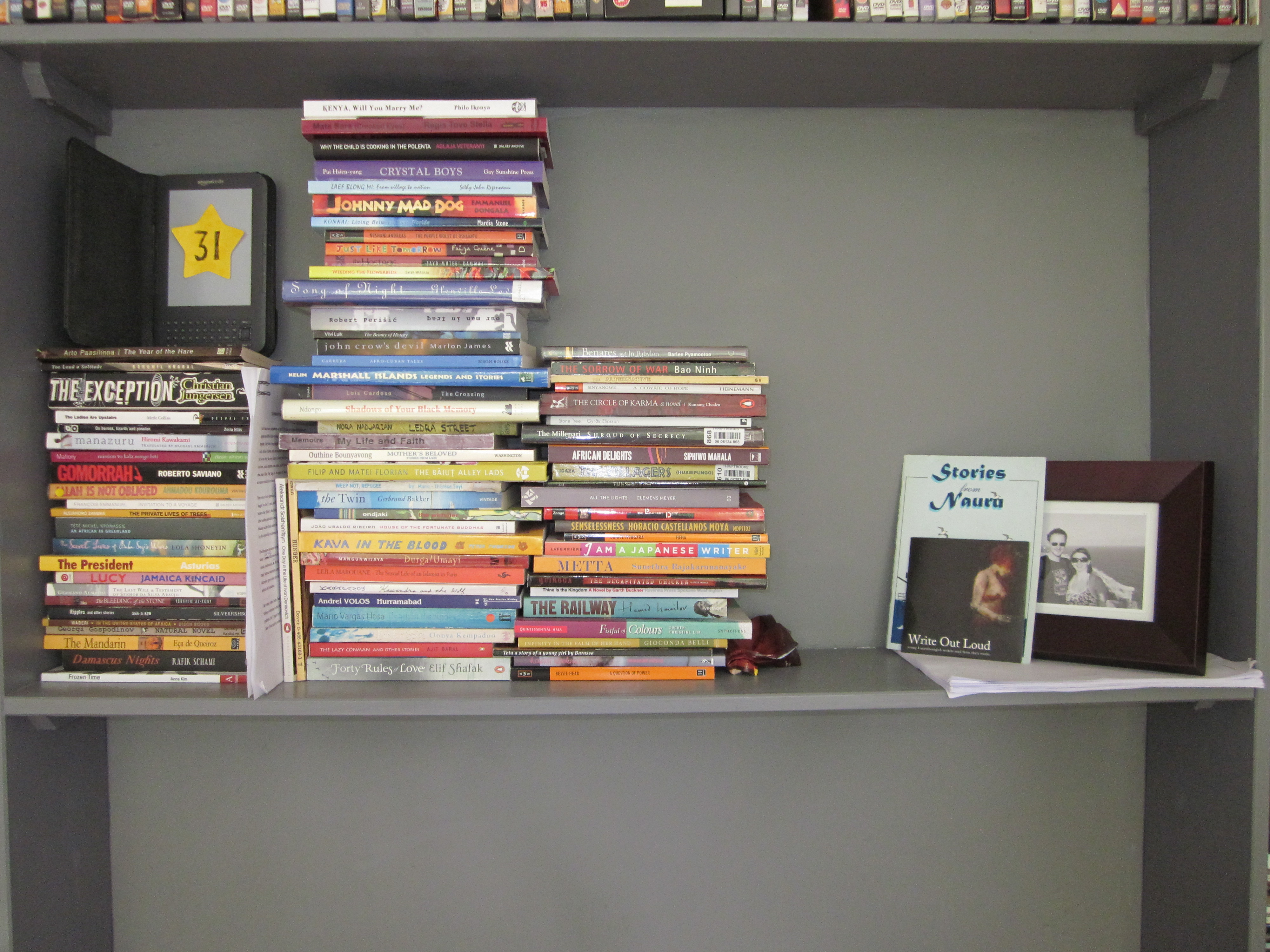
This was another pick from Thomas Slone’s storeroom at Masalai Press in California. Charting Sethy John Regenvanu’s memories of his early life, his experience of being the first boy from Uripiv island to go away to school, his work towards his country’s declaration of independence in 1980 and his time as a minister in its new government, Laef Blong Mi (or My Life) documents a key period in Vanuatu’s history. It weaves together political events and Regenvanu’s own story, with the help of the author’s photographs, to reveal the personal and social impact of gaining sovereignty and what it means to build a nation from the ground up.

The narrative brims with cultural insights, particularly in the early sections. From learning the lost art of fishing with black sea slugs to discovering the rituals of a Vanuatuan circumcision ceremony, the reader encounters a whole host of information about traditional life on the islands. Despite having a total population of fewer than 250,000 people, the archipelago is divided into a series of communities that differ enormously from one another – so much so that when Regenvanu went away to school on mainland Efate he was the only pupil there who spoke his language.

However, perhaps most striking of all is the revelation that Regenvanu, having no official birth date and finding himself obliged to ‘pinpoint when [he] had begun’ by the Franco-British colonial administration, plumped for the date 1 April 1945, both from a sense of lightheartedness – because this is the Western April Fools’ Day – and because this is the day the UN was founded.

This sense of the interconnectedness of his own story with national and international events is a theme throughout the book. From a young age, as the possibility of independence beckoned, Regenvanu felt the desire to use his education to help lead his compatriots ‘out of our former status of being non-persons in our own land to becoming proud citizens of the new nation of the independent Republic of Vanuatu’. He writes passionately about his belief in the state and its potential, as well as the importance of holding to the ‘spirit of struggle and unity of purpose’ that fired the early years.

Nevertheless, Regenvanu, who is also a church minister, is clear-eyed about the challenges the new nation faced. Contending with everything from black magic practised by opponents  to a widespread lack of self-belief engendered by decades of colonialism – not to mention the interference of the occasional American millionaire set on using his wealth to create his own ‘Utopian dream’ from the fragile, new nation – Regenvanu likens his task in some of the ministerial posts he held to ‘trying to force the negative and positive ends of an electric pole together’. Sometimes this was almost literally the case, as when Regenvanu found himself in a tug of war with the representative of a rebel faction, who was trying to hoist an illegal flag in the midst of an attempted coup.

Inevitably for an autobiography Regenvanu’s views are partial and shaped by his political standpoint and beliefs. Some of the later chapters also get a little too caught up in technicalities that clearly still rankle for the writer but mean little to a reader at this remove of time and distance.

However it is hard not to be impressed by Regenvanu’s integrity and evident desire to work for the good of his people and nation. Coming from a country where politics can often seem to be more about the advancement of personal agendas and careers than about effecting meaningful change, it was humbling to read the words of someone who saw his time in power as a chance to improve the lives of his compatriots. His story is a powerful reminder of what aspiration, education and determination can achieve.

Laef Blong Mi: From village to nation by Sethy John Regenvanu (Institute of Pacific Studies and Emalus Campus, University of the South Pacific, 2004)

Uganda: tough choices

I was in two minds about this one. Everyone I’d spoken to about Ugandan literature, from writer Musa Okwonga to the folks at the University of Iowa’s International Writing Program, had come back with the same recommendation: Okot p’Bitek’s Song of Lawino (or Defence of Lawino, depending on which translation you read).

The only issue was that the work was a narrative poem, rather than a prose piece. While I was planning to consider narrative poetry from countries where novels, short stories and memoirs in English were in short supply, I found the idea of opting for poetry when there were prose options available difficult.

In the end, flying in the face of one of the most unanimous recommendations I’ve had so far this year, I decided to add the p’Bitek to the list but to choose a novel. Oh God, I thought as I spiralled Abyssinian Chronicles by Moses Isegawa down on to my Kindle, please be good.

Set in the 1970s and 1980s, this ambitious novel tells the story of post-independence Uganda’s turbulent struggle for peace and identity through the eyes of Mugezi. Growing up in an abusive household before, during and after the Amin years, he witnesses the impact of national events on those around him and, through the choices he makes, reveals how individuals internalise and play out the currents of politics in their own lives.

The idea of a single person or part of something standing for the whole is a running theme in the novel. Whether it’s Mugezi’s parents’ disastrous wedding night, during which the happy couple have to be helped to consummate their union by the bride’s aunt, which ‘in many ways typified the whole of their marriage’, or Mugezi’s emulation of ‘St Amin’ in his stealth campaign to take revenge on his violent mother by a series of unpleasant pranks planned with military precision and despotic flair – at least in the days before his admiration of the dictator is ‘killed by the murderous light of truth’ – synecdoche is the order of the day.

Unusually for a novel written in English, the book was first published in translation – in Holland, where Isegawa has lived since 1990. This is particularly striking  when you consider the author’s love of putting language through its paces. From the very first sentence – ‘Three final images flashed across Serenity’s mind as he disappeared into the jaws of the colossal crocodile’ – he reaches for creative forms and tropes to surprise, intrigue and emote.

Perhaps the most striking example is his description of Mugezi’s aunt’s gang rape by soldiers, in which the clinical report of the duration of the event, the precise number of thrusts and touches she endured and the quantity of bodily fluids produced communicates the emotional toll the ordeal took far more effectively than any subjective description could.

Now and then, the ambitious scope of the novel causes problems. There is so much context to explain that the work is hi-jacked by odd passages of socio-political exposition and the narrative feels distended by this, like a python that has swallowed but not yet fully digested a large meal. Similarly, the expansive cast of characters woven through Mugezi’s experiences give parts of the novel a baggy feel.

But the positives far outweigh the negatives. The book is funny, shocking and vibrant by turns, throbbing with anger and hope. Isegawa has made history his story, and that is no mean feat. How the work compares with Song of Lawino, I’ve no idea – I’ll have to read that next year and find out…

Abyssinian Chronicles by Moses Isegawa (Picador, 2011)

Cyprus: double vision

Royal Mail nearly scuppered this one. When Haris Ioannides, director of Cypriot publisher Armida Publications kindly offered to send me a selection of titles in English, I waited with excitement for the package.

And waited. And waited. A delivery card appeared telling me there was a parcel at the sorting office for me, but when I trotted off to collect it I was met with blank faces. Computer said no.

Eventually, I received an email from Ioannides telling me that the three books, having travelled to London and back, were now in Nicosia again. Could he send me the ebook pdfs instead?

By this stage, buoyed by British-Cypriot writer Lorna V’s enthusiasm for the writers on Ioannides’s list, I had already ordered a copy of Nora Nadjarian’s Ledra Street. However, given past form, I thought I’d play safe and get the ebook version too. Ioannides emailed me the files, whereupon the print volume arrived. I now had two copies: one for each eye.

As it turns out, this doubled reading experience was particularly appropriate for Ledra Street, a short story collection set in Nicosia, the last divided capital city in the world. Terse, jagged and sometimes fragmentary, Nadjarian’s tales capture moments in lives and psyches sundered when the island was split in two during the Turkish invasion of 1974. Ledra Street, once a bustling thoroughfare, is now a blind alley populated by people yearning for things they can never attain: an estranged son, a perfect love, or simply ‘a time when Ledra Street was whole, non-pedestrianised, and we still called Turkish coffee, Turkish’.

Nadjarian’s attention to detail and use of the mundane to capture the extraordinary experience of seeing your homeland torn in half make the book. Whether she’s describing politicians rambling on a TV chat show, a disastrous haircut or a trip to a museum, the writer portrays the irreconcilable rifts in perspective that leave people isolated and sad. One of the most successful stories in the book, ‘Guided Tour’, for example, sees a woman leading a group of tourists around the city’s sites, and portrays the gulf between their casual absorption of the  neat list of facts she reels off and the turbulent emotions behind the events:

‘Everything makes perfect sense. Of course, of course, history when it becomes history, when it can be read in history books, when it can be talked about by tourist guides, makes perfect sense. The only way out.

[…]

‘What a strange thing, a rare pain, to be trapped in your own country.’

This packing of meaning into street signs and small talk, combined with the brevity of many of the pieces, gives them a poetic quality. At times, it almost feels as though they are poems that have been stretched like canvasses across the page to fill the space of stories. This impression is enhanced by Nadjarian’s creative use of language, which sees metaphors blurred and spread over paragraphs like watercolour paints.

Occasionally, the fragmentary nature of the pieces is too stark. I wasn’t sold on the ‘Ten Nights at the Movies’ vignettes, which ended the book and felt faintly contrived. Similarly, one or two of the ‘Ten Little Stories of Love and Hate’ were so stripped back as to teeter into the banal.

On the whole though, this is a powerful series of pieces that harnesses violent gusts of emotion in taut writing, pulling the collection along at an exhilirating pace. Familiar and yet strange, European and yet not, Nadjarian’s voice reveals what word artists can achieve, creating a lively collection that intrigues, delights and challenges. I’m very glad my copies found their way to me in the end.

Ledra Street by Nora Nadjarian (Armida Publications, 2006)

Burkina Faso: true lies

The line between truth and fiction is often blurry. And, as Norbert Zongo discovered in 1981, the distinction can be a matter of life and death.

In what is probably one of the most gripping prefaces ever written, the journalist and novelist describes his interrogation by the Burkinabé special police about his novel The Parachute Drop. The ordeal, which marked the start of three months of solitary confinement and a career of persecution and assassination attempts, was, he says, ‘like the beginning of time for me, the day my life began to melt like butter on a hot skillet’.

Zongo’s maltreatment was testament to the incendiary power of his work. Set in the fictional African state of Watinbow (which has striking parallels with Blaise Compaoré’s Burkina Faso), the novel draws a complex portrait of a tyrannous dictator as he scrabbles to retain his power in the face of growing unrest. Paranoid, fickle and vain, ‘Founding President and Clairvoyant Guide’ Gouama is prepared to sanction anything from the assassination of his most loyal followers to barbaric witchcraft rituals involving the severed body parts of his subjects if he can be persuaded it will keep him in control.

His advisers take full advantage of this, manipulating the president into actions that bring about his downfall and send him into hiding in the rural extremities of his land where he is helped by many of the activists he treated most harshly when in power. Chastened and challenged, the deposed president resolves to mend his ways, but as he attempts to begin assembling forces to mount a counter-coup, it becomes clear that his fleeting remorse is far too little too late.

The novel’s comments on the mechanics of establishing and maintaining a dictatorship are fascinating. From the ‘politics of drinking’, whereby subjects are distracted from their dissatisfaction with Bacchanalian festivals timed to coincide with the feast days of the old calendar, to Gouama’s cynical instruction to his speech writer to ‘pay lip-service to liberation movements throughout the world’ and include ‘whatever will help our image on the outside’ in his address to an international convention, Zongo’s portrait is terrifying and damning.

However, far more extraordinary than this is the humanity that the writer is able to reveal in his protagonist, despite the anger he feels at this representative of ‘Africa’s moral cripples’ and the ‘world of intolerable paradox’ and cruelty that he and his peers perpetuate. This comes to the fore when Gouama is thrown on the mercy of the farmers, fishermen and dissidents in the bush, but it matures into something approaching dignity towards the end. As Gouama faces his demise, we are in the extraordinary position of pitying and even occasionally admiring him.

This capacity to evoke empathy and celebrate the humanity of his enemies demonstrates Norbert Zongo’s outstanding qualities as a writer, journalist and human being. It makes his death in a car bombing (one of the Compaoré regime’s favoured methods of silencing its critics) in 1998 all the more tragic. I am ashamed not to have heard of him before.

The Parachute Drop by Norbert Zongo, translated from the French by Christopher Wise (Africa World Press, Inc, 2004)

Zimbabwe: cut and dried

I first heard about this novel when I stopped by the African Books Collective’s stall at the London Book Fair last month. Acting as a non-profit distribution outlet for 124 independent African publishers from 21 countries, the organisation has its finger on the pulse of much of the continent’s best contemporary work. So when they tipped me off about Weaver Press in Zimbabwe and recommended The Hairdresser of Harare by new talent Tendai Huchu, I knew I had to give it a go.

The novel follows single mother and hairdresser extraordinaire Vimbai as she struggles to keep her head above water in the swirling currents and rip tides of contemporary Zimbabwe. Challenged by the arrival in the salon of gifted male colleague Dumisani, Vimbai feels her reputation as the city’s best hairdresser slipping and battles to retain her position as ‘Queen Bee’. However, enmity quickly turns to love when Dumisani moves in as her lodger and life would be all-but perfect, were it not for the swelling tide of political unrest and Dumisani’s secret that must eventually tear Vimbai’s dreams apart.

The witty, conversational tone is what makes the book. Reading Vimbai’s comments about the one-upmanship between Harare’s salons, where ‘destroying a competitor’s reputation was all part of the game’, and her top tips on pleasing customers, feels like being an apprentice standing beside her as she initiates you into her art snip by snip. There is a deliciously bitchy, back-room-gossip flavour to some of the observations too, as when Vimbai describes the salon owner and her daughter: ‘neither mother nor daughter had necks. Shame’.

The liveliness of the voice and the strength of the characters mean that Huchu succeeds in foregrounding them against the extraordinary societal collapse that normally dominates the stories we in the West hear about Zimbabwe. While details – such as the bricks of money needed to buy the simplest things, the street children who make a living from selling their places in interminable queues, the corpses disinterred for their clothes, and the packs of tampons regarded as precious gifts – provide stark reminders of the sinister politics at work, the novel is about people who, far from being faceless victims, are determined to live to the full.

When national events do come crashing into the narrative, as in the case of the salon’s supplier and long-term friend Trina who is hounded out of the shop and told ‘Go back to Britain, you white pig’ by a VIP customer, they do so through personal encounters and become all the more powerful for it.

The cultural differences between Britain and Zimbabwe mean that the revelation of Dumisani’s secret (which I’ll try not to ruin for you) will probably have contrasting effects on many readers from the two countries. The book itself corroborates this, with several often very funny comments about the difference in attitudes the two countries have towards the issue.

While this may mean many British readers struggle to empathise with all Vimbai’s thought processes (and may realise the truth long before she does), it does nothing to lessen the fascination of watching her grapple with a social taboo. Huchu handles this nicely with the help of  Vimbai’s ex-philosophy student brother, who enables him to rehearse several involved arguments without them sounding too forced in this otherwise light narrative. Nevertheless, I did find Vimbai’s shift in stance towards the end a little abrupt.

I could also have done with fewer cliffhanger ends to chapters. As it stands, every section ends with a titillating sentence where Huchu leans out of the book, thrusting the next chapter at readers as though he is anxious they will wander off and try something different if he doesn’t keep up the hard sell.

He should trust the strength, wit and engaging power of his work more. The novel is addictive, funny, thought-provoking and brave. If you’re looking for engrossing, funny summer reading with more depth than the average bear, the answer’s right here.

The Hairdresser of Harare by Tendai Huchu (Weaver Press, 2010)

Sweden: fellow globetrotters

I’m not the only one trying to read the world. Since I launched this project to explore a novel, short story collection or memoir from every UN-recognised country in 2012, I’ve heard from people engaged in a whole range of international literary quests.

One of the latest ventures I’ve come across is by Swedish blogger Fredrika, who stopped by this blog ten days ago to tell me about a project she started in November to read a book from every country. Much more organised than me, she got a pretty comprehensive list together before she started and is working her way through it over the course of the next few years. Her criteria are different to mine, in that she is taking on some historical and anthropological books too, however there are also some fascinating fiction and biography choices on her list.

Fredrika has clearly done a massive amount of thinking about world literature, so when she recommended a Swedish title for me, I decided I’d be mad not to give it a try.

The book was Montecore by Jonas Hassen Khemiri, an award-winning novel exploring the experience of immigrants in Sweden. Told through a correspondence between one Jonas Khemiri and Kadir, who claims to be an old family friend, the book is a daring, powerful and often hilarious attempt to unfold the story of the struggle of Dads, Jonas’s estranged father, to make a life for himself in Scandinavia after he left Tunisia as a young man.

The novel is rich with comedy as the overbearing Kadir wrestles with the author in an attempt to guide and direct the narrative as he sees fit. This manifests itself in a variety of ways, from Kadir’s ‘glissades of truth’ to his patronising asides to the author about writing techniques and instructions for how he should handle particular events – ‘this scene must be filled with great dramatic gunpowder and symphonic basses’, he writes at one point.

Best of all are Kadir’s odd expressions and similes, which had me laughing on nearly every page of the first half of the book. Among the most sparkling examples are his descriptions of Jonas’s paternal grandmother as ‘a powerfully strong woman who grappled with her context like the wrestler and actor Hulk Hogan’, his confession of his suspicion ‘that [Jonas’s father] had become infected with homosex’ at one point and his later remark that ‘the tooth of time had munched a festive breakfast on his exterior’.

That translator Rachel Willson-Broyles is able to convey the linguistic quirks of Kadir’s Arabicised Swedish is testament to her great skill. This skill is essential to getting the subtleties of the book across as the narrative delves deeper into Dads’s battle to shrug off the label of ‘immigrant’ and establish himself in a society that becomes ever more hostile to outsiders or ‘blatte’ as Jonas grows up.

This battle, which sees Dads reject his origins in an effort not to ‘infect [his] son with being an outsider’, takes place as much on the linguistic as on the physical level and leaves deep scars. For much of the book, Jonas writes about himself in the second person, as though cut off from his identity, and his consciousness of the losing linguistic battle his father had to fight is acute:

‘One single wrong preposition is all it takes. A single en word that should be an ett. Then their second-long pause, the pause they love, the pause that shows that no matter how much you try, we will always, ALWAYS see through you. They enjoy taking the power and waiting waiting waiting until just when Dads think they are defeated. Then they point out the right way with vowels that are quadrupled as if they were talking with a deaf imbecile. STRAAAAAIGHT AHEEEEAD, then to the LEEEEEEEEEEEFT, okay, then RIIIIIIGHT. You’re welcome. And Dads say thanks politely and bow and you’re standing alongside and feeling how something is bubbling inside.’

Even with Willson-Broyles’s superlative translation, I can only imagine the effect of reading the book’s moving dissection of the politics of the Swedish language in the non-standard Swedish of the original. In English it is riveting, wise and sad. A towering achievement of a book. Thank you, Fredrika.

Montecore by Jonas Hassen Khemiri, translated from the Swedish by Rachel Willson-Broyles (Knopf, 2011)

Burundi: diaspora power

The chances of finding a Burundian book in English were looking slim. There were novels and non-fiction books out there, but they were all in French. None of them seemed to have made it through the translation net into the English-language market.

Having exhausted my googling powers, I decided to turn to the Burundian diaspora for help and fired off an email to the United Burundian-American Community Association in the hopes that its members might be able to point me in the direction of some literature that fitted the bill.

I got quite a few emails back. Several suggested analytical books by Western academics charting the causes and consequences of the civil war that ravaged Burundi for much of the mid-late twentieth century. Interesting though I’m sure these are, they weren’t quite what I was looking for. Others mentioned books in French – again, close but no cigar.

One person even asked me to help them finish a book they were writing about their own experiences in Burundi. As I have slightly less than two days to get through each book for this project, I thought this might be pushing it slightly and had to decline.

Then I had an email from Edouard. An old classmate of his from Burundi had published two novels in English. Her name was Marie-Thérèse Toyi. He hoped this helped.

It certainly did. After a bit more searching, I found contact details for Toyi, who is now based at Benson Idahosa University in Nigeria, and emailed her to ask how I might be able to get hold of one of her books as they were not commercially available online. She kindly offered to courier one to me. A few days later, I was holding a battered copy of her novel Weep Not, Refugee complete with a greeting from the author written inside the cover.

Following the fortunes of Wache Wacheke Watachoka, a Burundian boy growing up in a refugee camp because of the ethnic war between the Hutus and Tutsis in his homeland, the novel explores ‘the overpowering burden of forcing oneself to live in a foreign land where you are most undesirable’. As Wache grows up and has to confront the absurdity of the ‘nose complex’ (a widespread belief that the shape of the nose distinguishes Hutus from Tutsis) that has torn his country apart, the narrative reveals the cruel partiality that governs much of everyday life for the most vulnerable and exposes the injustices against which displaced people have to fight simply to stay alive.

The episodic narrative comes across with freshness and immediacy, at times reaching out of  the pages of the book to grab the reader by the scruff of the neck:

‘Just for you to have an idea what it was like, take a cup of ground red pepper, pour it on your bleeding wound and you will have a little idea what it was like. If you have no wound, well, we cannot discuss again, because there are things which you will never be able to understand.’

This can be very compelling, particularly when it comes to reflections on the powerlessness of refugees in lands where their rights exist ‘only in the heart of the person [they are] dealing with’, the indignity of living on handouts, the injustice of imprisonment and the cruel arbitrariness of ethnic conflicts. The section where Wache at last returns to Burundi and, at the age of 26, enrols in school only to find that he has become an alien in his own land is particularly memorable.

At times, the declamatory style and the heaping of tragedy upon tragedy (while no doubt true to many people’s experiences) is hard to swallow. However, this may say more about me as a privileged Westerner than it does about the book.

All the same, I couldn’t help wishing that Toyi had trusted her story and characters to speak for themselves throughout rather than feeling the need to harness them to drive home her appeal to the reader to help improve the lot of displaced peoples at the end. This is the only part of the book that feels forced and it stands out because the experiences and reflections narrated in the rest of the novel are far more persuasive than the closing rhetoric.

Nevertheless, this is a fascinating and valuable insight into a situation most of us cannot begin to imagine. It gives a voice to people whose stories we mostly hear second-hand from Western charity appeals and reporters. It was a great privilege to read it and it will stay with me for a long time. Many thanks to the UBACA, Edouard and Marie-Thérèse Toyi.

Weep Not, Refugee by Marie-Thérèse Toyi (Emhai Printing & Publishing Company, 2007)

Angola: the meaning of life

The names of certain countries seem bound up with the conflicts that shaped them. For many in the West words such as Bosnia, Sudan and Libya will conjure up the images of death and destruction that flickered on our TV screens throughout recent decades.

The magnitude of these events and the time it takes to translate and distribute books mean that many of the most powerful translated novels still coming out of these countries deal directly with war and its legacy. So we find a harrowing portrait of the expulsion of ethnic Russians from Tajikistan in Andrei Volos’s Hurramabad and a startling child’s-eye view of the Bosnian War in Sasa Stanisic’s How the Soldier Repairs the Gramophone.

However, as I discovered when I read my Angolan choice for this project, not all literature from recent war zones strikes a mournful note.

Published in 2008 by now sadly defunct Aflame Books, Ondjaki’s The Whistler, the slender first novel from the author who made his name on the world literature stage with Good Morning Comrades, brims with joy and belief in rejuvenation.  It chronicles the arrival of a man with a haunting whistle in a sleepy village. Taking up residence in the church, the mysterious visitor fills the neighbourhood with his tunes, which are so beguiling they even charm the pigeons.

The effect of the music on the village’s human inhabitants is more impressive still. Cutting through the ‘general torpor’, the melodies unsettle and invigorate the largely elderly residents so that each in his or her way breaks free from the predictable patterns of daily life. The narrative culminates in an orgy of sensation, colour and delight, leaving behind a changed community where the inhabitants have a fresh appreciation of their own potency and the rich possibilities of life.

Ondjaki has a great eye for the contrary details that create character. The novel bustles with intriguing individuals who loom from the page: from the town oddball with his penchant for defecation in the open air to the put-upon gravedigger who refuses to leave his post at the cemetery despite no-one having died for years.

Zany and dream-like, the narrative almost takes flight into poetry on several occasions. This creates some extraordinary images, although it can make the throughline of the plot hard to follow.

The novel is so exuberant, however, that this hardly matters. As Ondjaki’s letter to his friend poet Ana Paula Tavares (published at the end of this edition) makes clear, his main concern is with creating a powerful impression rather than a conventional story.

He achieves this. The book is imaginative, passionate and extraordinary. And, when considered in the context of the 500,000 people killed during Angola’s 27-year civil war, it’s peculiarly moving too.

The Whistler by Ondjaki (translated from the Portuguese by Richard Bartlett). Aflame Books, 2008

Fiji: no man is an island

Regime change seems to be the theme of the moment. No sooner had I finished YB Mangunwijaya’s satirical portrait of post-independence Indonesia than it was time to start Peter Thomson’s Kava in the Blood, an account of the coups that shook Fiji in 1987.

I was particularly intrigued to read the book because Dr Chakriya Bowman, Director of the Pacific Islands Forum Secretariat’s  Economic Governance Programme, found it for me after stopping by this blog. She very kindly visited the University of the South Pacific’s bookshop and emailed me the details and pictures of all the books she found that fitted the AYORTW criteria. Thomson’s EH McCormick Prize-winning memoir was one of these.

In fact, as Thomson acknowledges in his 1999 Foreword, Kava in the Blood contains not one story but two. Alongside his ‘account of what happened at Government House’, where he worked as Permanent Secretary of Information during 1987, he tells the poignant story of his love affair with the country his family emigrated to from Scotland four generations before he was born.

The question of what constitutes nationality and national identity is at the heart of the book. Not only is this the catalyst for the coups, sparked after Fiji’s first non-indigenous-dominated government came to power, but it also forms a powerful theme in Thomson’s personal life.

Despite having been born and brought up in Fiji, Thomson is forced to confront the fact that he has not been completely accepted into the ‘closed shop’ of Fijian society when the indigenous community closes ranks against ‘outsiders’ in the wake of the first coup. ‘I felt a creeping sense of delusion at being part of a country which, because of my European forbears, was now pointing a finger at me and saying “vulagi” — the Fijian word for visitor, or in this sense, foreigner’, he explains, going on to write wistfully of the ‘sense of oneness’ his indigenous peers must feel with the landscape and culture he loves.

This love is apparent throughout the book. It shows itself in Thomson’s humorous accounts of some of Fiji’s more bewildering traditions — ‘to those not used to it, a kava [Fiji’s national drink] session can have similarities to Chinese water torture,’ he writes — his deep knowledge of the nation’s culture, plants and animals and history, and his lyrical descriptions of life under the ‘arching starscape of our southern skies’.

The narrative is packed with fascinating and affectionate insights into Fijian society, including reflections on everything from Fijian patois through to the island’s prison system and the after effects of British colonial rule. Thomson’s recollection of establishing a polling station on Naqelelevu in 1976 in his capacity as district officer the day only one of the six eligible villagers turned out to vote is particularly memorable:

‘With absolutely no sense of the ridiculous the polling station was declared open. The voter went through the identification process and then turned to the little audience of seated villagers, ballot paper in one hand […]. Grinning self-consciously, he stood there long enough for the audience to take their mental snapshots of his moment of importance, and then another official guided him to the white wooden polling booth we had shipped with us.

‘The booth had been set up some distance from the table, giving the event an added sense of space and time. The official politely advised the protagonist to take his time with his vote. Inside the booth he did just that, while the rest of us on Naqelelevu that day looked on solemnly. Finally the booth started wobbling as he went through the motions of pacing his mark on the ballot paper. He emerged. Everyone pointed to the ballot box, and he went over to it and dropped the paper into its slot. He then stood for a while in front of the box like someone whose [sic] just won a TV gameshow, with a sheepish grin and not knowing quite where to put his hands.

[…]

‘With [the] lonely ballot paper… inadvertently eliminating the principle of the secret ballot, we packed up our gear, and bade farewell, sailing off to the south and leaving the islanders to their thoughts on the wonderful machinery of democracy.’

These rich recollections, along with Thomson’s exquisite accounts of his childhood on the islands, which read like extracts from a tropical Swallows and Amazons, more than make up for the jerky and episodic nature of the book, which sometimes feels more like a series scrapbook notes and jottings than a memoir. The addition of Thomson’s photographs into the 2008 edition heightens this impresion, giving the whole thing an immediate and personal quality. At points reading it feels as though you are sitting with Thomson under the giant rain trees outside his Waijevo residence, looking at his family album and waiting for the kava cup to come round.

Although writing in exile, after the second 1987 coup and four days of unlawful incarceration, during which he says ‘the umbilical cord to my homeland was cut’, Thomson’s love for Fiji clearly persists. As his two Afterwords suggest, his story of his island homeland is one from which he finds it hard to tear himself away. I did too.

Kava in the Blood by Peter Thomson (Booksurge, 2008)

PACIFIC APPEAL: do you know any good novels, short stories, memoirs, writers or even oral storytellers from other Pacific nations? Do you have friends or relatives in the region who might be able to suggest stories? Leave a comment or email ann’at’annmorgan.me and let me know.

Guatemala: divide and rule

‘I think with the President’s mind, therefore I exist.’

Looking down the list of books from the 196 sovereign states I’m trying to read my way round this year, I’m struck by how many of them are by senior government figures. Coming from the UK, the concept of the politician-novelist is not something I’m very familiar with. In fact the last major work of fiction I can think of by a British prime minister (Tony Blair’s A Journey aside) would have to be Benjamin Disraeli’s Sybil, which came out around 140 years ago.

All the more striking, then, that so many notable 20th century political players elsewhere in the world should have won acclaim for their literary efforts. However, I suspect few of them can have engaged with the question of governance more directly and passionately in fiction than journalist-turned-congressman-diplomat-turned-Nobel-prize-winner Miguel Ángel Asturias.

First released in Mexico in 1946, Asturias’s most famous novel The President portrays the sharp end of life in a totalitarian state. Beginning with a random killing among a group of beggars that spirals into a witch hunt, the narrative reveals how truth, bodies and even life itself are maimed and distorted to suit the needs of the great ‘protector… who watches over us with a father’s love’.

Violence, both real and imagined, pervades the text, which stitches together a series of personal tragedies and outrages as families, friendships, faith and integrity smash against the intransigence and inhumanity of the state and are destroyed. Many of them stand as synecdochic metaphors for the plight of the people – from the lawyer left struggling in the dark to read and make a case against the lengthy false indictment that will cost him his life to the blind beggar woman ‘dreaming that she was covered in flies and suspended from a hook like a piece of meat in a butcher’s shop’.

These moments of extremity are thrown into relief by a series of cruel juxtapositions with festivals and celebrations and even bursts of humour that emphasise the ‘grotesque farce’ in which all the characters are trapped and the cold indifference to the suffering of others that terror breeds.

At the centre of this web of fear sits the shadowy figure of the President. Mentioned in every chapter, he nevertheless has a strangely absent quality, and is far removed from the daily realities of his people (he only appears in person a handful of times). This renders his fickle decisions all the more chilling, engendering the same sense of uncertainty in the reader that causes half the guests at a state ceremony to wet themselves in fright when a bandsman drops his drum.

Asturias’s satire is made rich by his use of language and the extraordinary panoramic descriptions with which he brings his nightmare state to life. Eliot glimmers in some of the linguistic effects – ‘Doors and doors and doors and windows and doors and windows flashed past him’ – and he anticipates Beckett in surreal exchanges such as the haunting chapter ‘Conversation in the Dark’. There are even the early outriders of magical realism in some of his more vivid passages.

The result is a compelling manifesto against the mechanisms that enable tyrants to seize and maintain supreme power and a passionate treatise on the fragile beauty of the human spirit. It is a call to arms in the defence of freedom and independent thought more stirring than any keynote speech. Western politicians may not be writing so much any more, but I hope they are reading this book.

The President by Miguel Angel Asturias (translated from the Spanish by Frances Partridge). Publisher (this edition): Waveland Press (1997). First published in Mexico in 1946