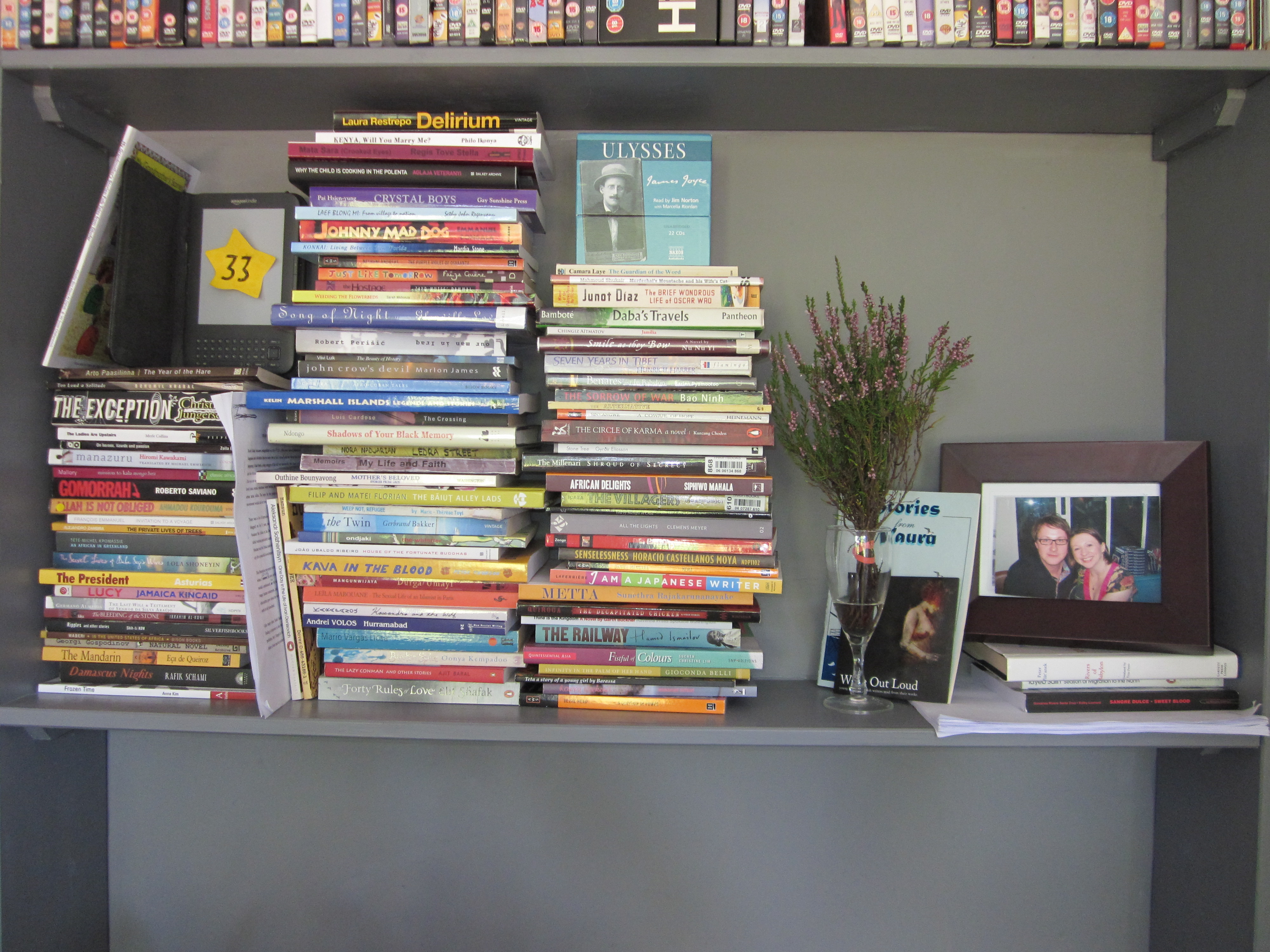
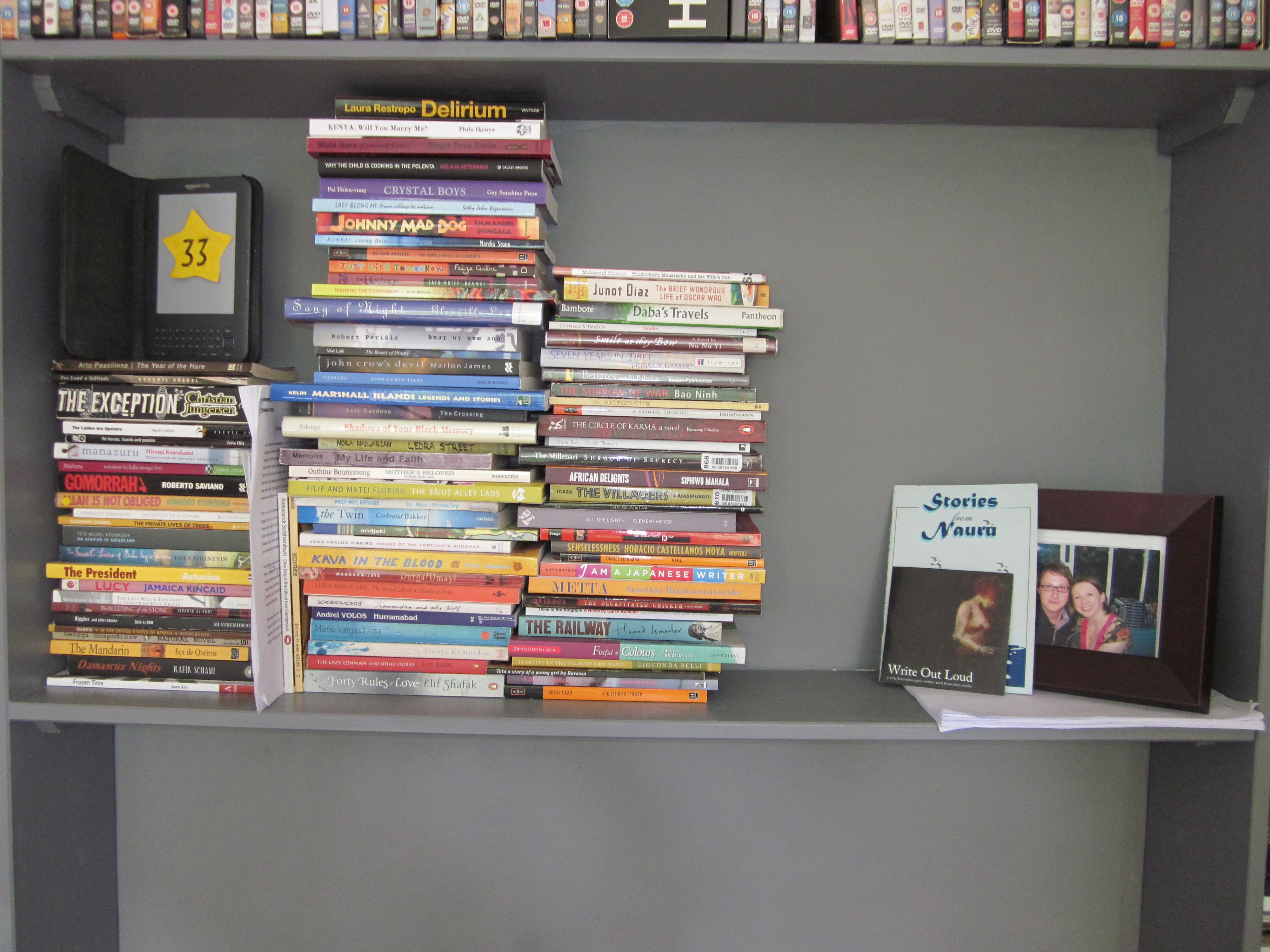
Rest of the World: vote now!

There are just four days left for you to have your say about which book I should read from the rest of the world (territories and peoples not represented on my main list).

Taking part is easy: just check out the shortlist below (drawn up from your nominations) and vote for the title that tickles your fancy in the poll. I’ll read the book with most votes for my penultimate post of the year. Can’t wait to see what you’ll choose…

Shortlist

  • Basque Country Bernardo Atxaga Seven Houses in France – a historical novel (first published in 2009) about a French army captain who sets out to make his fortune in the jungles of Congo
  • Bermuda Brian Burland The Sailor and the Fox – a 1973 novel about the island’s first ever mixed-race prizefight by one of Bermuda’s most notable and controversial writers
  • Catalonia Jaume Cabré Winter Journey – a collection of interlinked short stories (first published in 2001) based on the structure of a Schubert song cycle
  • Faroe Islands Heðin Brú The Old Man and His Sons – a novel depicting the transformation of the fishing industry, voted ‘Book of the 20th Century’ by the Faroese
  • Kurdistan Jalal Barzanji The Man in Blue Pyjamas – a literary memoir by a journalist imprisoned and tortured under Saddam Hussein’s regime
  • Native America Louise Erdrich The Round House – a novel about racial injustice, which won the US National Book Award in November 2012

Poll closes at 23.59 on Friday 30 November (UK time).

Picture courtesy of the_sprouts.

Tuvalu: how to make it rain

There’s tough and then there’s Tuvalu. The number of messages I’ve sent about this place –the third least populous nation on Earth after Vatican City and Nauru – over the past year is probably nearing the 50 mark. And though many of the people I contacted were willing to help, there was no getting round the fact that there was simply very little to suggest.

Somewhere along the way, however, I got in touch with scholar, writer, photographer, restorer of antique radio equipment, and community volunteer Peter McQuarrie. Though based in New Zealand, McQuarrie is married to a Tuvaluan and has connections with the Tuvaluan community in Auckland. He promised to ask around and duly came back with the suggestion of Tuvalu: a history, a book written by 17 Tuvaluans and published in 1983, a few years after the nation declared its independence.

As I explained to McQuarrie, I have tended to disregard history books so far during this quest, regarding them as being some way out of the scope of literature. However, the collaborative nature of the work, and the fact that it chimed in with the genre of national-identity stories I’d already discovered in Pacific works like Luelen Bernart’s The Book of Luelen and Sethy John Regenvanu’s Laef Blong Mi, made me hesitate. In the end, I decided to give it a go.

Written by people drawn from all walks of life on the nation’s nine islands during a series of workshops run by the University of the South Pacific, this collection of essays and personal accounts paints a picture of Tuvaluan life stretching back as far as folklore, hearsay and patchy historical records allow and reaching up to the time of writing. The pieces are divided by subject, with the writers tackling different aspects of the country’s culture, such as creation, religion, land, singing and dancing, and independence, in an effort to tell the story of their newly minted nation.

As in several other Pacific Island works I’ve read this year, the writers often make little distinction between factual and symbolic truth. The accounts rove back and forth between myth and history, mingling tales about cannibals and magical eels with maps, diagrams, and explanations about the islands’ names, geography and politics. Indeed, the fantastic and the factual sometimes seem to blend together, with anecdotal accounts about chiefs who could charm fish and the story of the old woman who knew how to make it rain:

‘Taia Teuai, an old woman who died in 1982, was generally recognised as having inherited from her grandparents the power to make it rain. Shortly before her death she explained how she did it:

‘”If there is a long drought then I will make the rain fall. First I go to the bush to gather coconut leaves and flowers with which to weave myself a garland. Later, towards sunset, I put oil over my body and wearing a clean dress and with a garland on my head go down to the beach to meet a team of ‘rain-makers’. These are little clouds sailing towards the setting sun. I look at them and dance, and sing a song such as this one:

‘”Little clouds, little clouds!/Bring rain to me,/To moisten my body.

‘”In about three days time there would be heavy rain. This sort of rain can easily be recognised because the drops are much thicker than those of ordinary rain.”‘

This blending of anecdote and historical research gives rise to some wonderful insights into Tuvaluan life. We learn, for example, how to hitch a ride on a turtle’s back – apparently the trick is to hang on without getting your fingers jammed between the neck and the shell or too near the mouth – as well as the islanders’ rather alarming traditional methods of dealing with troublemakers, which involve a leaky canoe without a paddle. We also discover the toll that Western influences have taken on the nation, from the blackbirders who came to kidnap people to work in the Peruvian mines in the 19th century, through to the suppression of dancing and singing by the missionaries, and the ravages of world war two – during which the Americans destroyed 22,000 of Nanumea’s 54,000 coconut trees building their defensive airfield.

The subject matter may be varied, but through all the accounts runs a sense of the gravity of the task the writers are undertaking. This is established from the first page, with the foreword from prime minister Tomasi Puapua, who describes the book as being of ‘considerable significance in the history of the young nation of Tuvalu’ because the accounts are, for the first time, ‘written by Tuvaluans interpreting events as they themselves see them’. This is perhaps most movingly borne out in Enele Sapoago’s brief essay ‘Today and Tomorrow’ at the back of the book, which describes in fresh and passionate terms what independence means.

That said, it’s hard not to feel the hand of the non-Tuvaluan workshop leaders on the shoulders of the writers at points. The essay form becomes stilted and awkward at times, and the later chapters dealing with events leading up to independence feel very dutiful and dense, and are often hard to read. In addition, it is difficult to ignore the fact that most of the historical source material the writers have to work with necessarily comes from the jottings of Western visitors to the archipelago. I sometimes found myself wondering who exactly the writing – carried out in English – was intended for.

Nevertheless, there’s no question that this is an important book. As the first concerted effort of Tuvaluans to tell their story, it is informative, passionate and sometimes surprising. Nearly 30 years on from its publication, it’s surely time we had some more.

Tuvalu: A History by Simati Faaniu, Vinaka Ielemia, Taulu Isako, Tito Isala, Laumua Kofe (Rev), Nofoaiga Lafita, Pusineli Lafai, Kalaaki Laupepa (Dr), Nalu Nia, Talakatoa O’Brien, Sotaga Pape, Laloniu Samuelu, Enele Sapoaga, Pasoni Taafaki, Melei Telavi, Noatia Penitala Teo, Vaieli Tinilau, ed Hugh Laracy (Institute of Pacific Studies, 1983)

Egypt: breaking boundaries

This was another recommendation from Roger Allen, Professor Emeritus of Arabic & Comparative Literature at the University of Pennsylvania. His number-one tip for Egypt was Nobel Prize-winner Naguib Mahfouz – and he should know as he met the great man several times and translated several of his books. However if I were looking for something other than work by the nation’s leading literary giant, he had several more suggestions up his sleeve from among the thousands of excellent Egyptian writers on the market today. Ain Shams University professor Radwa Ashour was one of these.

I thought about it for a while. On one hand, I was very tempted by Mahfouz: several visitors to this blog had written highly of his work and I was sure I’d be in for a treat with practically any of his books. On the other hand, though, I couldn’t help feeling that Mahfouz was a safe choice. This journey was about discovery, after all, and I was eager to see what else was out there by writers I hadn’t heard of before – so I went for Ashour and chose her book Spectres.

Interlacing the lives of two Cairo academics, history lecturer Shagar and literature expert Radwa Ashour, this part-novel, part-autobiography and part-documentary explores the frontiers of storytelling. The two women are born on the same day and grow up during the mid-20th century, witnessing the Suez Crisis and the protests that shook the capital in the decades after it. As each runs up against the limitations of her gender, political sphere and the medium within which the author allows her to exist, the women seek to shape their own narratives out of the shards and fragments that litter their lives.

This is a courageous and often angry book. Whether it deals with the prejudice against women that causes Shagar’s great-grandmother to be viewed with suspicion because she refuses to marry again and Radwa’s children to be held up at passport control, or the political manoeuvres at the university that see one of Shagar’s colleagues hounded out, Ashour’s writing is indignant and powerful.

This is particularly the case when it comes to the central issue that runs through the book and, to a certain extent, shapes the women’s lives: Palestine. Marshalling sources ranging from Mahatma Gandhi’s 1938 claim that ‘Palestine belongs to the Arabs’ through to testimonials from villagers and Israeli officers about the Deir Yassin massacre, Ashour compiles a compelling  array of evidence to support her character’s forthright attacks on Zionist writers such as Elie Wiesel, ‘who wrote volumes against silence and described in detail the ordeal of the Jews in the Holocaust, of which he himself was a survivor, [but] did not see the contradiction in his own total silence in the face of what was happening to the Palestinians’.

However, as Shagar discovers when she attempts to present a paper at a conference organised on the 25th anniversary of Zionist Martin Buber’s death, the Palestinian perspective is one that struggles to find a platform. Vulnerable to accusations of bias and partiality – and the indifference of a West so far removed from Arab concerns that in 1991 an announcer on CNN is able to compare Baghdad under fire to ‘a huge Christmas tree […] “It’s a magical, thrilling sight!”‘ – the issue remains caught in the perennial paradox that in order for Palestinians to debate on equal terms with their opponents they must already have won the argument and proved their sovereignty to those who refuse to accept it.

Faced with the difficulty of constructing a narrative in the face of such powerful counter-narratives, the novel challenges and interrogates itself, oscillating between fact and fiction in search of a middle path that can carry the truth of both. Ashwour’s voice breaks into the text repeatedly, questioning the decisions she has made about characters, discussing her work in relation to her other books, and revealing the dizzying possibilities open to her as a weaver of stories – a sentiment she finds echoed in a translation of Aristotle cited in the text:

‘The work of the poet is not to narrate that which has happened, but rather that which might happen or is possible in accordance with probability or necessity’.

Seen in this light, this novel, first published in 1998, is in the extraordinary position of being able to enter into dialogue not only with the past but also with the future. With its telescoping of time, that sees, for example, Shagar simultaneously engaged with the events of 1946 and 1972 in Tahrir Square – and its swoops into and out of the future tense – the book seems to extend a line forward to the momentous events that shook the country only last year and takes on an eerily prophetic quality.

Entwining these themes, Ashwour delivers a challenging and complex read that tests the boundaries of communication. Bursting with references and the sheer volume of the ideas it explores and conveys, the novel strains at its seams, spilling out into the world beyond its pages and compelling the reader to engage with what it has to say. The result is passionate, rigorous and shaming.

Spectres by Radwa Ashour, translated from the Arabic by Barbara Romaine (Arabia Books, 2010)

Slovenia: expect the unexpected

Guernica Press may not have been able to help with my Latvian query in time for the end of the year, but it came up trumps for Slovenia. As Mike explained when I emailed to ask about Nora Ikstena’s work, the company was just in the process of publishing a novel by Slovene author Luka Novak. It was called The Golden Shower or What Men Want – would I be interested in seeing a copy?

Not only was the title intriguing (if a little disconcerting), but Luka Novak sounded like quite a character in his own right. The co-host of a popular Slovenian TV cookery show and programme director of the Slovenian Book Fair, he ran a publishing house for 20 years, as well as launching what is apparently Eastern Europe’s first ever concept store. He also ran for Mayor of Ljubljana in 2006, speaks six languages, and has translated 20 books, including Julian Barnes’s Flaubert’s Parrot, into Slovenian.

Phew. I had to see what this one-man cultural extravaganza’s novel was like.

The book starts when a middle-aged psychiatrist and his younger actress girlfriend arrive in Provence, France, for a holiday, which he intends to spend writing a book of cultural essays. It’s not long, however, before their plans start to go awry and the couple, along with Orada, the doctor’s Bosnian masseuse neighbour back in Ljubljana, and a German mythology professor, find themselves caught up in a covert cultural, religious and political movement that aims to take over and remake the world in its own image.

Novak is great at making his characters reveal their inconsistencies through their actions and the stories they tell about themselves. From the brilliant portrait of procrastination in the early chapters, where the psychiatrist is always on the point of sitting down to write his essays but finds himself forced to seek refuge in glass after glass of rosé, to the constant shifting of ground that characterises his arguments with Larisa  during which the pair wander miserably around picturesque French towns, neither getting to do what they want to, with the fact of their childlessness only a Freudian slip away – the novel is full of instances of self-deception and people interacting at cross purposes.

This is helped greatly by Novak’s witty voice. Whether his characters are asserting the opinion that ‘in Ljubljana they’re incapable of making a coherent croissant’ or expressing home truths about the Bosnian War there is a pithiness to his writing that makes for absorbing reading. This is coupled with a series of great cameo characters. I particularly enjoyed the German couple at Ducasse’s country inn, who have planned out every minute of their holiday, barring the ‘five percent spontaneity they generously afford themselves on every trip’.

The humour is important because it buys Novak considerable slack when the narrative rises into the realms of the surreal, tugging at its moorings like a hot air balloon. Watching the plot move into farce after 80 pages or so  with kimono-sporting monks, religious SWAT teams, gender-morphing musicians and the President of Slovenia all dropping in under the watchful eye of the mysterious aesthete, Contractor  is disconcerting and would no doubt be off-putting if the novel weren’t so enjoyable to read.

The same is true of the clamour of philosophical and religious references in the narrative. These centre around Contractor’s desire to reconstruct religious tableaux for the modern age in an effort to create what is variously described as ‘a commercial for a better world’, a ‘pornographic invitation to rebellion’ and the basis for the ‘alteration of people’s very sensibility’. The whole thing might be unbearably pretentious in another writer’s hands, but in Novak’s it’s quirky, intriguing and odd.

That said, the book is not without its frustrations. Even with the general rule of thumb (broken occasionally with the story of the German mythology professor) that the chapters alternate between the experiences of the psychiatrist and Orada, it’s often hard to know where you are. I spent the beginning of several sections straining to catch a familiar reference so that I could work out who I was reading about  a tricky extra complication when you’re dealing with a plot that embraces randomness. In addition, there are some abrupt shifts that leave us scrabbling to catch up. In one paragraph, for example, Orada is watching the Venezuelan police seize an accomplice on the beach; in the next, Contractor is stopping his motorbike in some woods. It’s left to us to infer that Orada hopped on behind him.

All in all, though, this is an enjoyable and surprising novel. No doubt the plot and the subject matter will be too wacky for some readers, but if you give yourself over to it, the narrative sweeps you along, delivering a good helping of insights, thrills, spills and laughs along the way. Apparently, Novak is working on a second novel, this time about the mysterious death of an eccentric pianist-performer in 1980s Paris. I’m intrigued to see what that will entail…

The Golden Shower or What Men Want (Zlati Dez ali Kaj Hoce Moski) by Luka Novak, translated from the Slovenian by Urska Charney (Guernica Editions, 2012)

Latvia: living with the enemy

Lasītāja emailed me back in April. There wasn’t much Latvian prose available in translation, she said, but she did have a few suggestions: the Latvian Literature Centre had a small database of translations I could search and Guernica Press in Canada had got a grant to publish a short story collection by Nora Ikstena which might be out in time for me to include it in the project (sadly not by the looks of it). However, my best hope was probably European Parliament Member for Latvia Sandra Kalniete’s With Dance Shoes in Siberian Snows, a work of literary non-fiction published in English translation by Dalkey Archive Press in 2009.

When I looked it up, I discovered it also happened to be the most translated Latvian title since the work of Vilis Lācis, who died in 1966. What was it, I wondered, that had made the book such a run-away success?

Ranging across the 20th century, With Dance Shoes in Siberian Snows reveals the impact of the deportation of Kalniete’s parents from Latvia to Siberia, where Kalniete was born in 1952. One of countless Latvian families to suffer displacement, bereavement and extreme hardship on account of the Soviet occupation of their country, the Kalnietes had to develop great resourcefulness simply to survive decades of persecution that saw many of their closest friends and relatives killed. Through their story, Kalniete traces the history of modern Latvia and reveals the dark mechanisms driving an atrocity that is rarely ever mentioned in the West.

Kalniete sets out her intention to present the facts as openly and honestly as she can from the very first page. Starting with a series of stark potted histories and vignettes, she sketches the circumstances of her relatives’ lives and deaths, together with hints of the long-term impact of their experiences – such as the fact that 44 years after her mother returned from Siberia she was still unable to watch bread being carried away from the table without feeling a degree of panic.

The book that follows reveals the context of these short pieces, both in terms of personal stories and the history of Latvia and its neighbours. As you might expect from a politician (well, some politicians, anyway) Kalniete is rigorous when it comes to state affairs. She provides valuable and detailed accounts of the three successive occupations of Latvia in the early 20th century (twice by the Soviet Union and once by Germany), as well as a chilling insight into how a once-free society can be subjected and controlled by an external power. For the Western reader, there are also some surprising observations which bear witness to how little most of us know of events that took place on the other side of Germany during the world wars: I was staggered to read, for example, that Finland managed to hold out on its own against the Soviet invasion for 105 days in 1939-40, while the accounts of how the Nazi soldiers were initially welcomed by Latvians as liberators are testament to the harshness of the Communist regime.

However, it is her relatives’ stories that bring out Kalniete’s most telling writing. Sparing herself nothing in the effort to get to the heart of what happened, Kalniete reveals the hardships suffered by her parents and grandparents: the deportation train packed with people that sat in a station for three days; the cold, brightly lit cellar where her grandfather was forced to sleep on his back with his hands by his sides in between spells of interrogation; the moss and grass her mother and grandmother had to eat to survive the Siberian ‘Island of Death’; and the tyranny by bureaucracy that saw people trapped in limbo for want of the correct form, condemned for crimes they did not commit, and sentenced to permanent exile from their homeland for owning property or being related to an enemy of the state.

Most moving of all are the moments when the composed demeanour of the professional writer-turned-investigative journalist slips and we see what the telling of this story means to its author. Kalniete’s description of her excitement at holding her grandfather’s case file and putting her hand on his fingerprint, for example, is touching, while her reflections on what allowing their daughter to be indoctrinated with Soviet propaganda for her own safety must have cost her dissident parents are fascinating. And when she recounts the impact of an interview with her mother about what it is like to starve, the full force of emotion breaks through:

‘When I later listened to the taped conversations, their calm flow seemed unbearable to me, so abnormal was their content. The sad story told in my mother’s everyday voice singed me with sudden waves of pain. My body shook and I had to hang onto my desk to contain my uncontrollable sobs. I could not listen to my practical voice repeating a question about how a rat tastes or wondering how mother had not died from eating a horse cadaver.’

Despite its devastating content, the book contains much that is uplifting too. From love stories and small triumphs, to Kalniete’s mother’s dogged-to-the-point-of-irrational determination to dress and educate her daughter in preparation for a return to Latvia – a return that looked impossible for many years, given that the family had been sentenced to exile for life – the book reveals how dignity and the human spirit can endure in the most appalling circumstances. As the dance shoes of the title suggest – which refers to the flimsy shoes in which Kalniete’s mother was arrested and forced to travel to Siberia at the age of 14 – sometimes the smallest details can become a symbol of identity and resistance in the face of those who would extinguish hope. Outstanding.

With Dance Shoes in Siberian Snows (Ar balles kurpem Sibirijas sniegos) by Sandra Kalniete, translated from the Latvian by Margita Gailītis (Dalkey Archive Press, 2009)

Pakistan: the long view

There were lots of choices for Pakistan – and lots of visitors to this blog with opinions about which book I should go for. Writers such as Daniyal Mueenuddin, Musharraf Ali Farooqi and Bapsi Sidhwa came up several times in discussion and I had plenty of possibilities to check out when it came to choosing the work for this post.

However, when I started to research the suggestions, there was one book with such a fascinating story behind it that, when I discovered how it came to be published, I knew I would have to read it. Recommended by both Waqas and blogger Fay, who kindly shared her personal Man Asian Literary Prize shortlist with me, The Wandering Falcon by Jamil Ahmad might never have made it into print. In fact, the first draft of the book, which Ahmad wrote in the early seventies, was locked in a trunk for 30 years and presumed lost by its author after it failed to find a publisher in Pakistan. Luckily, as the novelist told Publisher’s Weekly last year, Ahmad’s wife Helga kept the key, and when Ahmad’s brother heard about a literary competition the work was brought out once more and quickly passed to Penguin.

Framed around the life of Tor Baz, an enigmatic nomad living in the border hills of Iran, Pakistan and Afghanistan meet during the mid-20th century, the novel reveals a volatile and fragile world. Orphaned young when his parents are killed by their tribe because of their elopement, Baz passes through a range of groups and guardians, eventually carving out a living by selling information to rival factions in the region. Along the way he crosses paths with lonely soldiers, a mad mullah, people traffickers, prostitutes, a naive European in search of his roots and a wife fleeing the tyranny of travelling with her husband’s performing bear. And, as the British Empire retreats and the borders of the region’s newly declared nations take shape and harden, a desperate struggle emerges between the old ways of life and the modern order.

Ahmad’s depiction of the border region’s landscape is extraordinary. Wild, haunting and treacherous, this ‘tangle of crumbling weather-beaten and broken hills’ and the plains beyond it seem to have as much character and agency as the people who make their lives there. The landscape even moulds their personalities, teaching them ‘to be deliberate in their actions and slow in responding to emotions’ with its silence, harsh beauty, 120-day winds, and wide, open spaces across which pursuers can be spotted from miles away.

Yet for all its magnificence and antiquity, the landscape is in many ways little more than a rumpled blanket that can be shaken by external powers, tumbling those upon it into confusion. As a result of the closing of the borders and the political changes in the region in the late fifties, many of the local tribespeople run up against unfamiliar forces with which they must do battle in order to survive. Sometimes, tradition and ancient wisdom gain the upper hand, as when the nameless foreigner ventures into the off-limits Afridi territory of his father’s youth only to die a bewildered death, or the local official sent to challenge the Bhittani tribe over colluding in a kidnapping finds himself locked in a ‘battle of wits’ with the tribesmen and is obliged to give up because ‘he could offer no story to counter the old man’s logic’.

More often though, the traditional ways and those who practise them are warped and broken by the weight of a modern system that leaves no room for ambiguity. As the nomadic, stateless Kharot people discover when they attempt to cross the border to the pastureland their tribe has used for centuries and which their animals need to survive, ‘the pressures were inexorable. One set of values, one way of life had to die’ – and die in the most brutal of circumstances.

Such tragedies bring out Ahmad’s most passionate and beautiful writing. In these moments, his disarmingly stripped-back style – characterised by insights such as ‘hope does not die like an animal – quick and sudden. It is more like a plant, which slowly withers away’ and the description of a murdered Mengal tribesman sliding ‘down in small jerks like a broken doll from the saddle to the ground’ – concentrates itself into powerful direct appeals. Perhaps the most moving of these concerns the execution of seven Baluch tribesmen, who, when asked to explain the murder of some rivals, find that their lengthy discourse on the history of tribal relations in the region holds no power to impress the court. ‘Fables have no use here. They are not evidence,’ says the judge, going on to sentence them to death and paving the way for Ahmad’s most memorable pronouncement on what such decisions cost:

‘What died with them was a part of the Baluch people themselves. A little of their spontaneity in offering affection, and something of their graciousness and trust. That too was tried, sentenced and died with these seven men.’

This is that rare breed of writing that springs from deep love and knowledge of a place and the people who live there. It is not saccharine, picture-postcard sentimentalism, all rose-tinted nostalgia; nor is it explorer’s obsession, tripping over itself in its eagerness to analyse and explain. No: it is a love that has been forged and tempered by years of living in and absorbing a region in all its beauty, brokenness, brutality and brilliance. Astonishing – and well worth the wait.

The Wandering Falcon by Jamil Ahmad (Penguin, 2011)

Armenia: another side

It’s rare that a writer advises you against reading his or her work. But that’s what happened when Armand Inezian stopped by this blog back in August. Seeing that his collection of short stories, Bringing Ararat, was listed under Armenia, Inezian very honestly said that he didn’t feel his connection with the country was strong enough as, although he comes from an Armenian family, he grew up in Boston and can’t write in Armenian. He added that his work has not been translated into Armenian either.

It was great to have Inezian’s perspective, as the question of exactly where the boundaries of national literatures lie has been a recurring theme in this project. I’ve encountered people who think hugely differently about this: while some are happy to regard books by an author whose parents come from a country as being part of that nation’s literature, others claim that the writer must be born, raised and still living in that country to qualify. There are even those who insist that a book must also be set in the country in question to count.

Personally, I’ve found my perspective on this issue shifting over the year with each tricky dilemma I’ve encountered and I’m still not entirely sure where I stand on it. Still, if Inezian didn’t feel his book was an Armenian work, perhaps I should listen to him.

Nevertheless, I was keen to involve Inezian in some way. If I wasn’t going to read his book (and let’s face it the choice of Armenian literature available in English is not massive), then perhaps I could pick his brains instead. Were there any Armenian writers whose work he could suggest? The answer came in the form of a link to information about Armenian Golgotha by Grigoris Balakian on Goodreads.

I have to confess that my heart sank when my copy arrived. Not only was this, judging by the title and subtitle (A memoir of the Armenian Genocide, 1915-1918), a very serious book, it was also a very long one. Its 500 or so large pages were covered with dense and relatively small print. The first sentence, too, with its earnest consideration of the political atmosphere of Europe in the wake of the assassination of Archduke Franz Ferdinand, filled me with foreboding. What had Armand Inezian let me in for?

The book records Armenian priest Grigoris Balakian’s experiences during World War I. Having finished his divinity studies at the University of Berlin just as the conflict began, Balakian travelled home to Constantinople in the hope that he could be of service to the Armenian population there. But as the eyes of the world turned to the trenches in Western Europe, Balakian witnessed the Ottoman regime beginning to target the 2 million ethnic Armenians within present-day Turkey’s borders, deporting hundreds of thousands of people to die barbaric deaths along the lonely mountain roads and plains of Asia Minor.

Caught up in this forced exodus, Balakian spent three years travelling and working in constant fear of being executed like the thousands of corpses he encountered en route. With only his ingenuity, determination and faith to guide him, he attempted to shield, hearten and save his Armenian peers, all the while holding on to the hope that he would one day be able to share their story with the rest of the world.

Balakian was an extraordinary individual, whose character shines through on nearly every page. Following the dry political summary of the opening lines, the narrative quickly becomes personal and detailed, bearing witness to its author’s great presence of mind in the face of extreme events. Whether he is using an anti-war rally he attended as an ‘opportunity to study up close the psychology of the organized German working class’, bargaining with the authorities for the lives of his companions, or talking to an official guilty of the deaths of thousands of his countrymen, Balakian displays an uncommon ability to keep his head.

This detachment means that he is able to embark on ‘a process of harrowing mental record-keeping’, remembering and relating details that would be lost to most people and delivering reams of compelling and historically significant descriptions. From his rare, foreigner’s-eye-view  of Berlin in 1914, through to the ‘whirlwind of blood’ he encountered in Asia Minor, Balakian’s accounts are meticulous. He spares nothing in his effort to convey the horrendous sufferings of his friends and compatriots, many of whom he claims were tortured and hacked to death by mobs bearing household and farmyard implements to save the authorities the cost of bullets. ‘If all the seas were ink and all the fields were paper, still it would be impossible to describe, in detail, the reality of the endless tortures of hundreds of thousands of them,’ he writes.

For Balakian, recounting these events is a sacred act. As he explains in his author’s preface, he regards his work as a ‘holy book’ for Armenia, which was first founded in around 600 BC. It is also the fulfilment of a promise made to some of his massacred compatriots and the bedrock of his decision ‘not to die’ during the genocide, which he believes kept him alive.

Inevitably, with so much emotional freight to carry, the narrative occasionally gets bogged down. Some of the writing is overblown and hyperbolic – the author’s repeated laments over the ‘martyrology of Armenian virgins’, for example, stick in the craw. The storytelling also comes second to Balakian’s desire to include everything he remembers, meaning that the latter stages of the book can be hard going and repetitive. In addition, for a reader with no contextual knowledge like me, it’s hard to know how much of the often very anecdotal and partisan accounts to trust.

Nevertheless, this is an important and impressive memoir. It not only opens up a much-neglected chapter in history and challenges Westerners like me to rethink our version of the events of the early 20th century, but it also presents a moving portrait of one man’s survival, patriotism and faith. If you’ve ever questioned the point of storytelling, the answers are in this book.

Armenian Golgotha by Grigoris Balakian, translated from the Armenian by Peter Balakian with Aris Sevag (Vintage, 2010)

Slovakia: the other side

Mona responded to my Halfway Appeal for countries I have yet to find books from with several interesting ideas. When it came to Slovakia, she suggested Peter Pišťánek’s Rivers of Babylon. There was a good interview with him, in which he talked about the reasons not many Slovak writers have been translated into English, on Three Percent, she said.

This grabbed my attention because I had been puzzling for some time over the scarcity of Slovak writers with work available in English, as compared to the relative plethora of Czech authors who have been translated. Given the disparity, an English-language reader might be forgiven for thinking that nearly all the writers ran east when Czechoslovakia split at the end of 1992.

Personally I’m not sure I buy Peter Pišťánek’s theory that the lack of Slovak literature in translation is down to a perception that the nation is ‘not as exotic. Not “Eastern” enough’. Still, I was intrigued to find the problem that I’d run up against acknowledged by this leading Slovak man of letters, widely claimed as the nation’s most flamboyant and fearless writer. His first work to have made it into English would do nicely for me.

Much like my Czech book, Bohumil Hrabal’s Too Loud a Solitude, the 1991 novel Rivers of Babylon begins with an institutionalised old man, Donath, who has spent his life slaving away in a punishing and solitary physical job until his very thought processes have become warped and shaped by the machines he serves. There, however, the similarities end. Because, unlike Hrabal’s paper compacter Hanta, who is ultimately destroyed by his work, the young man Racz who comes to take over from Donath in the boiler room of the Hotel Ambassador is not easily crushed. Instead of regarding his work heating the building and surrounding businesses through the cruel winter as a moral duty, Racz recognises it as a lever that he can use to raise his own position. Before long, he is holding the luxury hotel and the town around it to ransom, with hilarious, outrageous and deeply disturbing results.

Pišťánek is a master of manipulation. Whether he is describing the embarrassment of international guests who allow themselves to be extorted by the stoker out of fear of committing a cultural faux pas, the preening of the prostitute who falls for a hustler’s story that he is a wealthy doctor, or Racz’s wilful self-delusion that he is working hard for the good of all, the writer reveals how perception is the key to control.

He combines this insight with sharp wit that enables him to deliver killer one-liners and farcical set pieces beneath which sinister currents twist and drag. There is the car-park attendant whose trailer is towed to the middle of nowhere while he sleeps inside it by gypsies bent on fleecing him, the deranged manager forced to camp out in his freezing office and survive on dead dogs, and the former secret policeman who blacks up as part of an attempt to infiltrate Racz’s operation but ends up leaving dirty finger marks everywhere. And every so often there is a line or an image that takes your breath away with its inventiveness – I particularly like the early description of Racz’s thoughts being ‘scattered all over the place like an egg smashed against a wall’, after he has suffered the humiliation that sparks his takeover bid.

But it doesn’t stop there. There is an anarchic side to Pišťánek’s writing that makes it overflow the boundaries of conventional storytelling and flood beyond the limits of the book. This is a story that is undaunted in its ambition to take on and pull apart the corrupt structures of the new Slovak democracy for which the vice-riddled Hotel Ambassador is often only a thinly veiled metaphor – as the tongue-in-cheek quote on the cover suggests:

‘[Expletives deleted] Prime Minister Mečiar of Slovakia

And if we non-Slovaks think we can sit back comfortably and enjoy the ride, we’ve got another thing coming. In the personage of the slimy Swedish sex tourist Gunnar Hurensson, we are forced to confront all the common Western prejudices about eastern and central Europeans that are too often allowed to slip by unchallenged.

The result is a furious, hilarious and important book that is among one of the most engrossing things I’ve read all year. Three cheers for Garnett Press for publishing this, the first part of a trilogy. I look forward to reading the rest.

Rivers of Babylon by Peter Pišťánek, translated from the Slovak by Peter Petro (Garnett Press, 2007)

Palestine: shifting boundaries

When I started this project, I wasn’t expecting to read a book from Palestine. The list of 196 sovereign states I was working from did not include the Middle Eastern nation, which has received only partial international recognition since the declaration of the state of Israel in 1948.

However, in June I decided to change from my original Western-influenced list to a list of countries that have received some degree of acknowledgement from the United Nations as a more global measure of statehood. In practice, this simply meant swapping Kosovo for Palestine – although it is not a UN member, Palestine is recognised as a non-member entity by the UN and has permanent observer status at all UN meetings.

To this end, I got in touch with Naela Khalil, a leading Palestinian journalist and winner of the prestigious Samir Kassir Award for Freedom of the Press whom I was lucky enough to interview earlier this year. She very kindly contacted many writers on my behalf to find out who had work in translation. A lot of the people she wrote to did not have books available in English, but in July she emailed to tell me that she had had a reply from Mahmoud Shukair, whom she describes as ‘one of the best writers living in Jerusalem’, with information about his first major publication in English: a collection of short fiction entitled Mordechai’s Moustache and his Wife’s Cats.

Bustling with eccentrics, Shukair’s short stories – and the ‘Vignettes’, ‘And Vignettes’, ‘And More Vignettes’ that make up most of the second half of the book – reveal a world where joy and tragedy hinge on tiny details and casual remarks. There is the chancer who tries to exploit a distant family connection with the pop star Shakira to win special treatment at the Israeli Ministry of the Interior, the football-fanatic taxi driver whose tall stories about his friendship with Ronaldo get him beaten up for harbouring spies, and the Israeli border guard of the title who makes a line of people wait for hours because he is paranoid they are laughing at his moustache.

Politics and partition are everywhere, even in the words and images people use in conversation, yet Shukair puts the individuality and humanity of his characters first. He does this by filling his narratives with quirks, tics and details that bring home the personality of those he describes. Often the effect of this is very funny and even surreal, but it can be devastating too, as in ‘The Room’, where the mention of a child’s toys makes the actions of the killer brutally real:

‘He could have been a well-mannered murderer so that we could have found some excuse for him. He could have been a murderer with a good argument, so that we could have had a little admiration for him. But he was pathetic and ugly. Testimony to this was the child’s bedroom, which was ripped apart, his bed, which was burnt, the rabbit, the elephant, the giraffe, the duck and spatters everywhere of his blood. They posed a risk to that ugly murderer who did not have a good argument so that we could have had a little admiration for him.’

There is so much to say about the content of the stories and the window they provide on a world where everything, from getting an education to getting to work, is fraught with difficulty and danger that it is easy to forget the quality of the writing itself. Ranging from bald and stark statements, as in the extract above, to the absurdist and occasionally cryptic tropes of some of the vignettes, many of which read more as extended metaphors than as literal descriptions, Shukair’s prose is urgent and engrossing. He writes interestingly about the influence of Hemingway on his work in the final section, ‘Talking About Writing’, and it is possible to recognise something of that stripped-back style in this translation, although Shukair has many other techniques up his sleeve, not least a masterful sense of the role of humour in heightening poignancy.

He certainly had me enthralled. I hope it isn’t long before we see more of works coming out in English – I want to read on.

Mordechai’s Moustache and his Wife’s Cats by Mahmoud Shukair, translated from the Arabic by Issa J Boullata, Elizabeth Whitehouse, Elizabeth Winslow and Christina Phillips (Banipal Books, 2007)

Kenya: a momentous proposal


Say the words ‘Kenyan writer’ to most world literature fans and they will come back with one name: Ngũgĩ wa Thiong’o. Imprisoned for speaking out against injustice and corruption, the author of such landmark books as A Grain of Wheat and Wizard of the Crow abandoned English to write in his first language Gikuyu in the late seventies. He is revered around the world for his work and his passionate advocacy and has been given many awards, seven honorary doctorates and held numerous visiting professorships.

It seemed a no-brainer that I would read one of this literary giant’s novels as my Kenyan choice. But then I heard about Philo Ikonya. Arrested repeatedly for her human rights activism and living in exile in Norway since 2009, the poet and novelist is an avid blogger and journalist, as well as a keen linguist. She is also president of PEN Kenya.

Intrigued though I was to read the work of Kenya’s great man of letters, Ikonya and her oddly titled novel Kenya, Will You Marry Me? piqued my interest. I decided to give it a go.

In a nutshell, the novel is a love story. It gives an account of a life-long passion for and relationship with the country Kenya in all its exuberance and raw pain. Growing up in a village near Nairobi, the young narrator uses dolls to act out and embody some of the conflicts she sees around her, while flashes forward and backward in time and stories from other relatives and friends bring home the personal consequences of such traumatic events as the attempted coup of 1982 and the humanitarian crisis in the wake of the rigged election of 2007, as well as the long shadow of colonialism. Hurt but not discouraged by all that she has seen, the young woman transforms herself into the embodiment of Change during the course of the narrative, urging her fellow countrymen and women to get behind her and appealing to the nation she loves to unite itself with her.

Nationhood and what it means to belong to a country bind the narrative like the spine of the book. Frequently speaking about Kenya as a person, the narrator emphasises that ‘history and politics live in homes’, showing how events in parliament pervade even the bed sheets and the cooking pots of the most remote villages. This sense of the interconnectedness of national and domestic events is coupled with a great love and celebration of the beauty of the land and, as the narrator’s grandfather explains, a ‘greater love [which] is to realise that these are only ours for some time and that your children must find them still here’.

As a result of her intense connection with her country, the narrator feels every threat to its wellbeing as a personal attack. This leads to a barrage of righteous anger against the injustice of colonial rule, the heartlessness and corruption of politicians, the cruel rapes suffered by many of the country’s women and children, and the fact that ‘people gifted with melanin continued to be left out of the game’. Often, this takes the form of powerful, rhetorical addresses in which the narrator apostrophises various groups in her effort to galvanise them into positive action, taking in everyone from her dolls and her compatriots, to corrupt politicians and even Western readers:

‘You, most of you, in the West have the comfort of analyzing what you call deception, we are grateful for the small straws of hope we see near us. We cannot afford to shun all.’

Ikonya’s poetic sense comes through strongly in the narrative, adding subtle layers of meaning. Whether she’s playing with rhymes to make deeper points – ‘I have never been able to hear the word “bribe” without seeing “tribe”. Vice like lice lives in families too’ – or stripping back the etymology of place names and sexual terms to reveal the power struggles that lie beneath, she uses words richly, milking them for every last drop of significance.

Readers unfamiliar with Kenyan history and politics, as I was, will sometimes struggle to follow the narrative, which is often essentially a stream of consciousness ‘crisscross[ing] years, beating arrangements in books’. In addition, the novel’s fragmented and free-flowing nature means that there is often very little to drive it forward other than the narrator’s passion. The fingers begin to itch to flick in the last third where earlier polemics on corruption and women’s rights are reprised without much development.

Nevertheless the commitment and fervour of the narrator carry the day. As a portrait of patriotism, this stands in stark contrast to the rather anaemic if not downright cynical expressions of national pride we tend to hear in the UK. It is an urgent reminder of the importance of politics and the influence that individuals can have on events larger than themselves. No wonder the people in power felt threatened.

Kenya, Will You Marry Me? by Philo Ikonya (Langaa Research & Publishing Common Initiative Group, 2011)