Dominican Republic: home and away

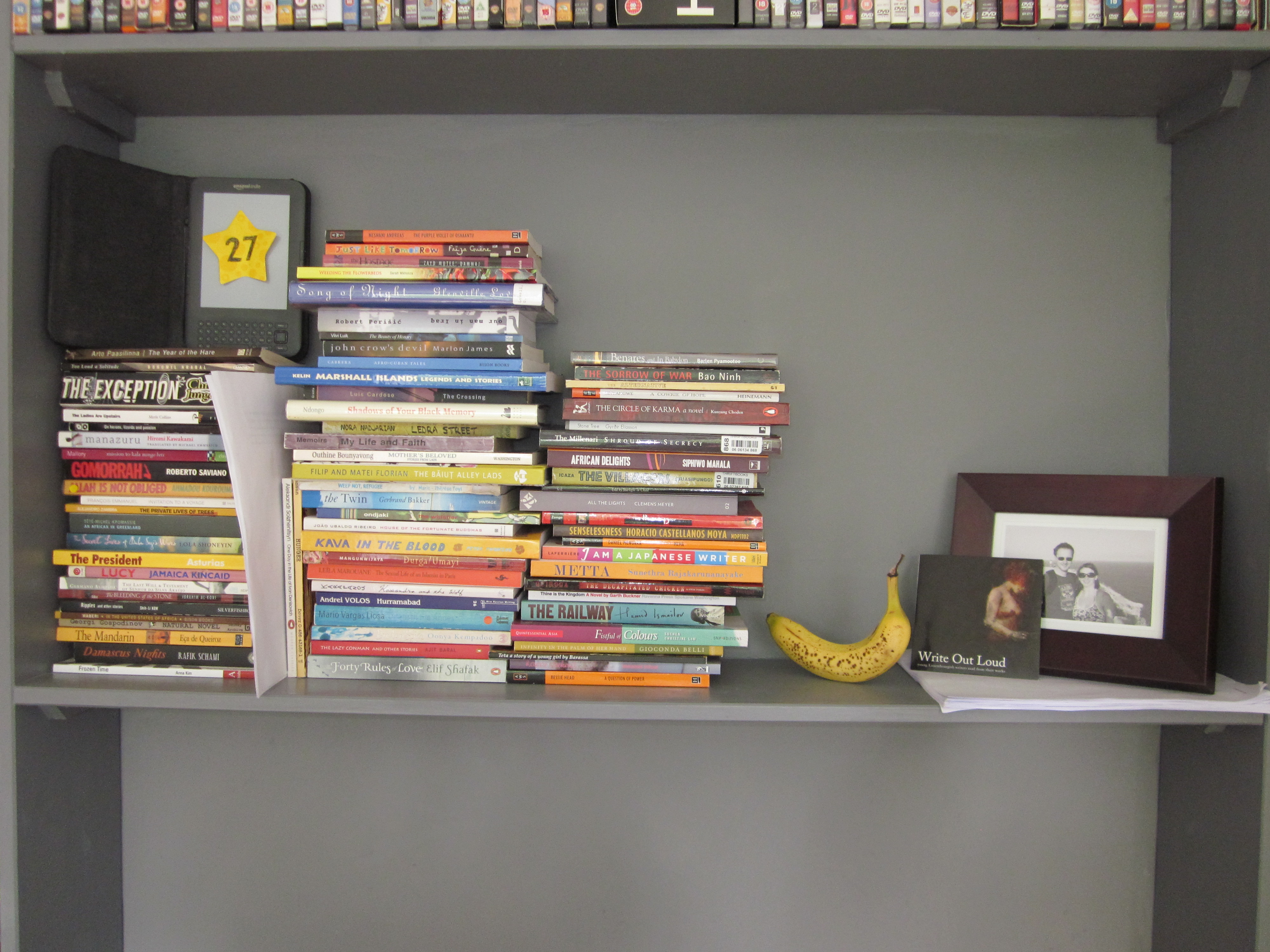
This book was given to me by Jimena, a Mexican woman who attended the English PEN ‘Free Speech: found in translation’ night-class course I finished a few weeks back. She looked apologetic as she got The Brief Wondrous Life of Oscar Wao out of her bag and handed it over.

‘I’m not sure if you’ll want to include it,’ she said. ‘You see, he writes in English.’

A discussion ensued about whether Junot Diaz, now a creative writing professor at MIT, was an acceptable Dominican Republic choice. My classmates wanted to know where he was born (Santo Domingo, the Dominican Republic), where he lived now (the US), and how much of his childhood he’d spent in the country (four years plus holiday visits to relatives from what I can make out). It seemed each one of us had slightly different criteria for judging Diaz’s pedigree.

Personally, I wasn’t sure I would include Diaz. I had several other names in the frame for the Dominican Republic and, excellent though I was sure the Pulitzer prize-winning novel was, I was intrigued to find out about them.

Then two things happened: quite by chance, our course leader Sophie Mayer referred to Diaz’s novel during the session, a coincidence which appealed to my sense of serendipity, and I discovered that the prose work of the other Dominican Republic writers on the list, including Arambilet and Pedro Mir, was by no means readily available in English. Time being of the essence, I decided to give the Diaz a go. It would be a sort of test of where that mysterious boundary line of nationality goes in literature, I thought.

Roving back and forth between the US and the Dominican Republic, the novel follows Oscar, a sci-fi and fantasy nerd and son of a Dominican mother, growing up in the eighties in a rough neighbourhood in New Jersey. Overweight, lonely and desperate for attention from girls, Oscar embarks on a series of excruciating attempts to win the favours of the local beauties, watched first by his rebellious sister Lola and later his college room-mate Yunior.

But it turns out that Oscar’s misery is by no means a one-off. As he unfolds his family’s backstory, Diaz reveals an intricate tale of torture, betrayal, murder and shattered dreams that stretches all the way up to the Dominican Republic’s erstwhile dictator Trujillo and will, quite literally, blow Oscar’s mind.

It’s interesting that a discussion of nationality nearly turned me off reading this book, because the relationship of the individual to cultural identity is one of its central themes. Right from its Derek Walcott epigraph, ending ‘either I’m nobody, or I’m a nation’, the novel explores how heritage informs, shapes and constrains our choices. Everything from the family fear of being under an old Fuku (curse) and the fact that ‘in Santo Domingo a story is not a story unless it casts a supernatural shadow’, through to Lola’s fraught relationship with her mother and Oscar’s relatives’ scorn at his failure with girls can be traced back to a sense of what Dominican life is or should be.

The threads weaving together the personal and national are further tightened by a series of zestful footnotes that run through the book, giving the narrator’s personal gloss on history. Describing aspects of Trujillo’s reign of terror, ‘one of the longest, most damaging US-backed dictatorships in the Western Hemisphere (and if we Latin types are skillful at anything it’s tolerating US-backed dictators, so you know this was a hard-earned victory, the chilenos and the argentinos are still appealing)’, they present a furiously witty engagement with the way politics impacts on individual lives. Feisty, shocking and only occasionally annoying, they grab the predominantly American readers Diaz clearly has in mind by the scruff of the neck and make them acknowledge what has happened, often giving them a parting jab in the ribs – ‘You didn’t know we were occupied twice in the twentieth century? Don’t worry, when you have kids they won’t know the US occupied Iraq either’.

Although Jimena was worried that the fact the  novel was written in English rather than Spanish might weaken its DR claims, the language of the book is shot through with a sense of Dominican heritage. Packed with Spanish slang and even complete sentences in the language, the narrative is raucous with the richness of its cultural references and the conflicts and contradictions these create.

The result is a powerful, irreverent and thoroughly engrossing exploration of identity and how the particular time and place we are born and grow up in shape who we are. If anything, Diaz’s exposure to both US and Dominican society sharpens his perception of the DR. It is as though for both him and his characters, the transition between the two cultures is only truly possible once they have immersed themselves in, understood and made peace with their Dominican heritage. As Lola puts it, ‘you can never run away. Not ever. The only way out is in.’

The Brief Wondrous Life of Oscar Wao by Junot Diaz (Faber, 2009)
Central African Republic: tales of yore

I knew this was going to be tricky when Catherine Teya, president of the Central African Republic Association of Europe (SEWA Europe), struggled to suggest a book from CAR that I could read in English. However, it wasn’t until I did a bit more detailed research into the state that I began to understand quite what the challenges were.

Riddled with unrest and pockets of lawlessness since it gained independence from France in 1960, CAR is one of the planet’s least developed and most isolated countries. Indeed, as award-winning photojournalist Spencer Platt explains in his 2008 dispatch from the country, it has to all intents and purposes been abandoned and forgotten by the rest of the world. With frequent coups and attempted coups forcing crisis after crisis on its impoverished citizens, most of whom will not live to see their 45th birthdays,  it’s small wonder that very few books by writers in the country have made it into print in recent decades, let alone been translated into English.

However, although she was unable to recommend anything directly, Catherine Teya was nothing if not helpful. She sent me a number of links that might assist me in my quest, among them the website of Solidarité Franco Africaine, which features an overview of Central African writers. Perhaps one of these might have been translated in to English, she suggested.

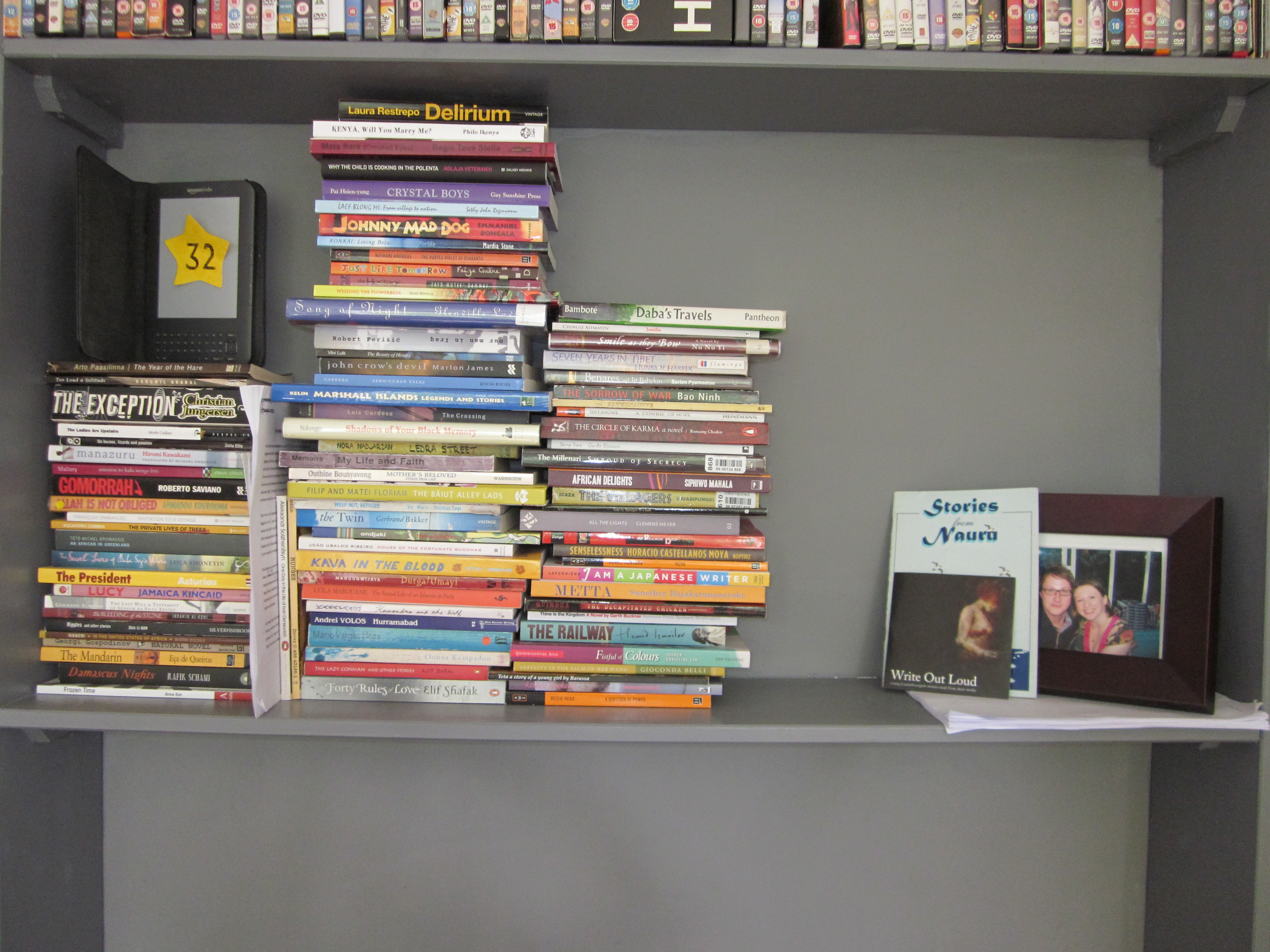
As luck would have it, sloshing about in Amazon’s dankest recesses, I stumbled on a 1970 translation of a novel by Pierre Makombo Bamboté, one of the writers on Solidarité Franco Africaine’s list. There was no information, no summary and no picture. The book was in an ‘unknown binding’ and I could tell nothing about it beyond the date the English version was published, its title and the number of pages it had. Still, given the lack of anything else to go on, it had to be worth a shot.

First published in French in 1966, Les Randonnées de Daba (or Daba’s Travels from Ouadda to Bangui as the English version has it) follows young Daba as he leaves his parents’ village to visit friends and relatives around CAR and further his education. Moving between the Westernised milieu of his French boarding school and the rich rural traditions of the communities he stays with during his holidays, Daba develops a love for his country, as well as a desire to explore the rest of the world – and has some gripping adventures along the way.

Daba’s is a culture where storytelling is part of the furniture. From the very opening lines, in which Daba’s mother tells the tale of the will-o’-the-wisp bird, fielding her son’s comments and chiding him for questioning her skill as a narrator, the power of the oral tradition is clear. This comes across in the novel too: the text is frequently interspersed with stories told by adults the boy meets and the narrative itself has an organic feel, as though Bamboté is sitting just across from us, developing the story as he goes along.

This instinct for storytelling also manifests itself in the evocative descriptions that fill the book. Whether he is describing the ‘sparkling white wings of insects, looking like thousands of stars, [that] glittered in the headlights’ on a drive through the jungle, the way a crocodile’s tail ‘would suddenly spank the water and send a great sheet of white spray up into the air’, or Daba’s eerie sense of being followed when returning home from a day spent tracking lions with his friends, Bamboté is a master of transporting his readers into the midst of the places he describes.

Indeed, for all its exotic crocodile hunts and days off school because of prowling panthers, the book has a profoundly nostalgic feel. This is partly down to the author’s skill, which makes us yearn for a place we have probably never been (the presence of Daba’s French penfriend Guy throughout much of the book suggests that it was probably aimed at a European rather than a CAR readership), but it is also because of the look and feel of the book. With its illustrations sprawling over the pages like jungle creepers and the smell of its old pages, it reminded me of the books my mother gave me from her own childhood.

Now, 42 years after it was published, Daba’s Travels from Ouadda to Bangui and the handful of Bamboté’s other translated novels offer a rare window on a much-neglected and surely now much-changed corner of the globe. I wonder how long it will be before English-language readers get a chance to take another look.

Daba’s Travels from Ouadda to Bangui (Les Randonnées de Daba) by Pierre Makombo Bamboté, translated from the French by John Buchanan-Brown (Pantheon, 1970)

Myanmar: all that glitters…

One of the great things about embarking on a world literature adventure like this is all the fellow literary globetrotters you meet along the way. There are lots of projects out there and each of them is slightly different, shaped by the personality and interests of the reader behind them.

Some people are only reading books set in particular countries; others are including poetry, plays and factual history books. Some are travelling from state to state as you would on a map, while others are leaping around all over the shop. And in addition to the hardcore nutters among us who set ourselves numerical and, in my case, time limits, there are many people who intend that the adventure should take them several years, if not decades.

It’s always a pleasure to hear from other literary explorers, not least because they can often be a great source of ideas for countries I’ve yet to tackle. So when Paul in Canada responded to my Halfway Appeal with some suggestions from his own Reading Around the World project, I was intrigued to hear about them. In particular, his Myanmar choice, Smile As They Bow by Nu Nu Yi – the first novel by a writer living in the country to have been translated and published in the US, and shortlisted for an international literary prize, despite the best efforts of the Myanmar authorities to suppress it – sounded fascinating. I decided it was the book for me.

Set around the Taungbyon Festival, a massive celebration of nats (spirits) that happens in a small village near Mandalay three times a year, the novel follows Daisy Bond, one of the event’s most famous transgender natkadaws (spirit mediums), as he sets out to make the most of the extravaganza. A master at parting gullible and superstitious visitors from their money, the aging dancer puts on the performance of his life, ably assisted by his very much younger bodyguard and lover Min Min. But when his partner begins to fall for a beggar girl at the festival, Daisy’s precarious existence looks as though it may be about to crumble once and for all.

Yi’s sensuous descriptions of the hurly-burly of the event are a joy to read. Bustling with the interior monologues of a whole host of people – from the rich woman seeking spiritual guidance on what to do about her husband’s mistress and the elderly devotee fretting about the cost of the flowers she has had to offer, to the pickpockets moving through the crowds – the narrative bumps and jostles the reader so that you feel as though you are in the midst of the action.

Into this vibrant scene bursts the voice of Daisy Bond, easily one of the most irreverent and fabulous literary creations you are ever likely to meet. Buzzing with expletives, contradictions and fears, his distinctive interior monologue paints a complex and moving picture of a lifestyle that is at once based around a sham and yet a source of fulfillment and meaning. Bluntly honest about the fact that natkadaws such as he ‘deal in lies and pushing people to offer animals’ and ‘cook up crazy hopes ’cause we have to eat’, Daisy’s descriptions of his love of performing and the self-expression he finds as a transgender medium reveal that for all the cynicism of the cons he peddles, what he is doing has surprising value and significance – much like the festival itself, which though reinstated by the British ‘to create a diversion’ in colonial times has become a source of hope and a way of making a living for thousands of people.

This duality is particularly apparent in Daisy’s illicit relationship with Min Min (homosexuality is still illegal in Myanmar). Despite his frequent abuse and humiliation of the youth whom he bought as a teenager seven years previously, Daisy’s dependence on and feelings for the young man are clear. It is testament to Yi’s skill as a writer that, even though we want to see Min Min break free and follow his own desires, we cannot help feeling pity for Daisy, for whom ‘the gay life carries such heavy karma’ and who is perpetually haunted by the thought that his love is ‘going to leave [him] for a real woman’.

The result is a powerful, moving and memorable work that more than deserves its place on the Man Asia Literary Prize 2007 shortlist. It is an insight into a world of extremes, where conflicting truths weave together and catch the eye like spangles on a spirit dancer’s costume. Highly recommended.

Smile as they Bow by Nu Nu Yi, translated from the Burmese by Alfred Birnbaum and Thi Thi Aye (Hyperion, 2008)

Colombia: the crazy truth

When it comes to South American literature, Colombia is definitely one of the hot spots. Birthplace and stomping ground of the great Gabo (Gabriel García Márquez to you and me), the country boasts a talented crop of writers, despite a tradition of rigorous government censorship – according to the File Room100 Years of Solitude was itself banned by the Colombian authorities in the 1970s.

Among this group of authors, Laura Restrepo caught my eye. An outspoken political journalist, Restrepo spent six years in exile in Mexico after receiving death threats because of her work. Her novels, which have won numerous awards, are known for mixing the insights she gained into Colombia’s criminal underworld as a reporter with elements of the fantastic or uncanny. It sounded like a compelling combination.

Restrepo’s 2004 novel Delirium starts with a bang. Middle-aged lecturer-turned-dog-food-delivery man Aguilar arrives home from a short trip to see his children to find that his young wife Agustina has gone mad. The rest of the novel – which weaves together four narratives and draws the reader through a involving in Bogota’s drug-trafficking network, clairvoyance, sadism, murder, and a tortuous family history stretching back two generations – pieces together the reasons why.

If you want an example of lean, powerful storytelling, then Restrepo is the writer for you. Working dramatic irony, time shifts, character voice and objective correlatives the way a gymnast moves through positions on the parallel bars, she delivers a mesmerising performance that will have you gripped right from the realisation that ‘something irreparable had happened’ in the first sentence to the breathtaking dismount of the final chapters.

Restrepo couples this narratological agility with a dexterous empathy that enables her to present both the inner workings of mental breakdown and the toll such events take on those closest to the sufferers. Whether she is leading us through the dark lair of Agustina’s childhood demons or Aguilar’s uneasiness about her sudden unpredictability and sense of ‘not knowing what bubbles are bursting inside her, what poisonous fish are swimming the channels of her brain’, the writer is committed to finding new routes by which to bring us close to the experiences she portrays. Her description of Aguilar’s fears about how Agustina’s illness has affected her feelings for him is particularly vivid and inventive:

‘I was afraid that if I could enter into her head, like a doll’s house, and walk through the compressed space of the various rooms, the first thing I’d see, in the main room, would be candles the size of matches lit around a little coffin holding my own corpse, me dead, forgotten, faded, stiff, a Ken-size doll in Barbie’s all-pink house, a ridiculous Ken abandoned in his tiny moss-green living room, I myself moss-green, too, because I’ve been dead for a while.’

The author’s talent for presenting thoughts and emotions in striking ways pays dividends when it comes to tracing the twisted strands of family history that have led to the tangle of the present. What might be an unwieldy and dry chronicle in the hands of another writer is immediate, troubling and strange in Restrepo’s work, with each character, no matter how peripheral, picked out in arresting detail. There is the obsessive musician grandfather who goes out walking wearing two hats and the mother who speaks to Aguilar on the phone as if he is a care assistant rather than her daughter’s partner.

The result is a compelling novel about consequence; about the way what we think of as our private quirks and imperfections can bounce and ricochet off others sending them careening down a giddy slope to their ruin. It is a gripping and haunting piece of work. Oh, and it’s a jolly good yarn too…

Delirium (Delirio) by Laura Restrepo, translated from the Spanish by Natasha Wimmer (Vintage, 2008)

Papua New Guinea: novel techniques

This was one of several recommendations from Bernard Minol at the University of Papua New Guinea Press and Bookshop. Although I had not found many Papuan books in my initial searches, he was keen to stress that there is a thriving publishing scene on PNG – and the large number of recommendations that he and his colleagues gave me certainly seems to bear this out.

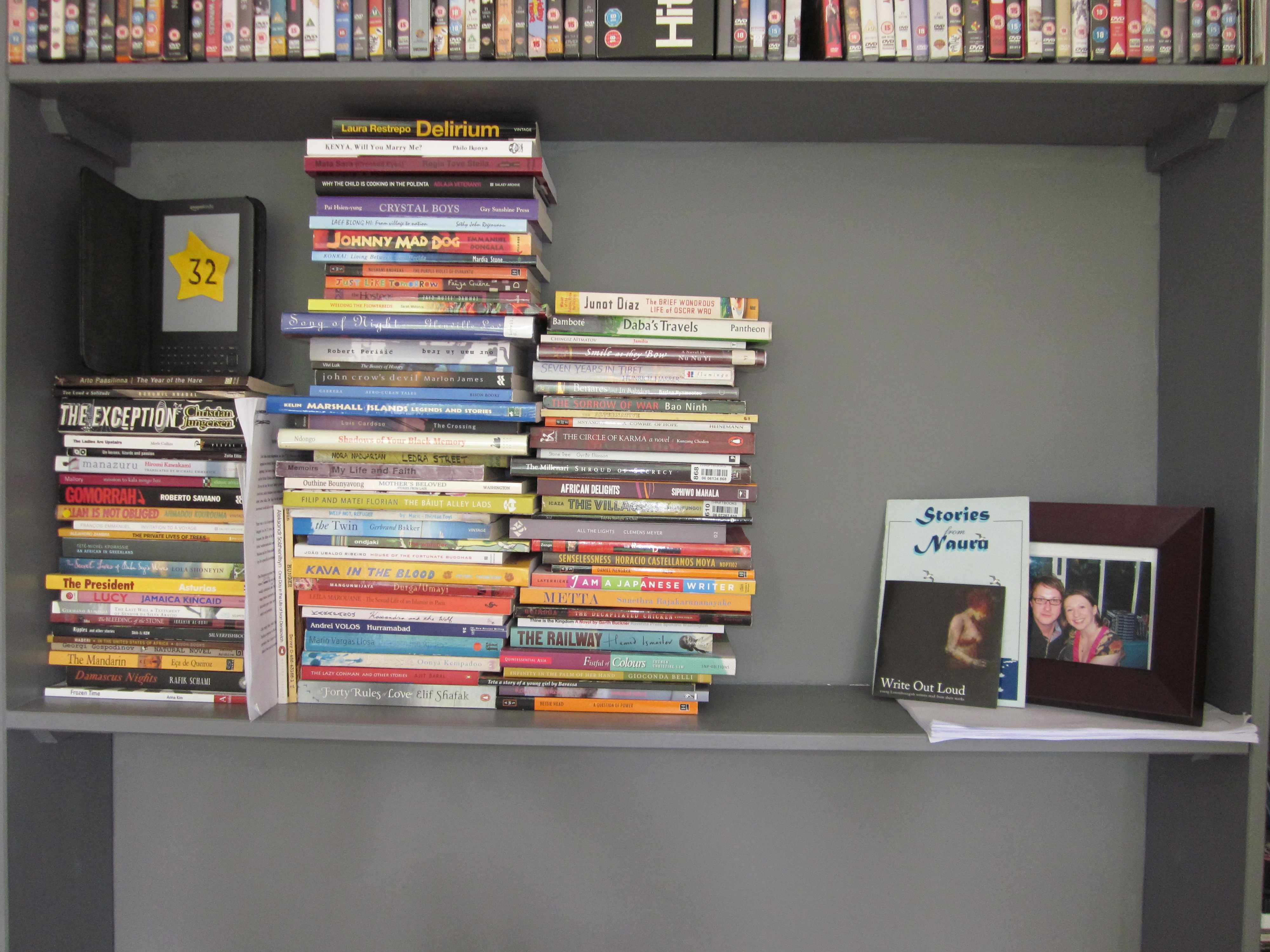
Mata Sara (Crooked Eyes) by Regis Tove Stella follows Perez, a young Papuan man, as he arrives in the Australian capital to take up a postgraduate scholarship. Disorientated and homesick, he sets up home with three other wantoks (literally ‘one talks’ – speakers of the same language in Tok Pisin) and the friends set about making a new life in a culture very different from their own.

But as the days go by, they become increasingly uneasy. Ghostly presences in their flat and rumours of a murder there in years gone by set them on edge. More suspicious still, there seems to be an odd connection between the dimdim (white person) Kate who befriends Perez, her friend Wilmott and life back home…

The clash between Western culture and traditional Papuan life is the central theme of the book. Coming from a place where ‘the belief in ghosts and spirits is part of daily existence’ and ‘women fly at night’ to 21st century Sydney – where CCTV cameras capture every move, homosexuality is accepted and immigrants are treated with suspicion and sometimes downright racism – the students discover much to challenge, unsettle and alarm them. Sometimes this can be very funny, as when Perez dreads meeting an anthropologist because of his memories of the Western academics he encountered back home:

‘Since a child, I had always dreaded anthropologists with their long white beards, round-shaped glasses which conjured up an image of a white monster, watching every move ready to pounce on you. Whenever I saw photos of Father Christmas, I immediately connected them to anthropologists and gradually I also dreaded Father Christmas.’

Such light-hearted observations, however, are indicative of a much deeper sense of disenfranchisement born of a conviction that Papuan culture is treated as little more than a specimen by much of the rest of the world – something to be prodded at, picked over and interpreted in Western terms. ‘It is through their eyes that the world sees us, not our own eyes’, says Perez, explaining to Kate: ‘Many outsiders have written about my country out of their private visions […]. They just want their friends to believe they are great explorers and discoverers.’

This leads to a great deal of resentment, which is articulated through lengthy passages of conversation between the friends in which they frequently express (sometimes unjustified) criticisms against the Western world. While Stella tries to balance this by having Perez emphasise that the concept of ‘crooked eyes’ – or skewed perspective – is common to all people, and therefore likely to be true of them too, the lack of characters or events to counteract the accusations is problematic. The dialogue is also frequently repetitive and stilted, as though the friends are talking purely for the benefit of the reader peering in on their cosy world.

It’s a shame, because when events drive the narrative forward, the book is compelling. The early section, where Perez moves into the flat on his own and experiences some uncanny occurrences is gripping. Sadly, though, this momentum is not carried through into the latter half of the book. Here, the increasingly labyrinthine plot, which takes in tribal chiefs, lesbian abuse, long-lost relatives and a paedophile ring, becomes ever more difficult to buy into. This is not helped by shaky motivation for some of the characters’ decisions. Some readers will also find the male characters’ casual expressions of misogyny and homophobia difficult, although they may of course be further evidence of the young men’s ‘crooked eyes’.

Perhaps the issue goes back to the central theme of the book. By using the Western novel form to tell a Papuan story, Stella may have highlighted the limitations of the ‘dimdim  way of doing things’ when it comes to cultures where storytelling is predominantly oral. Significantly, as has been the case in several other novels I’ve read from countries that were colonised by Western powers in the past, Stella puts some of the dialogue in the latter stages of the book in the characters’ mother tongue, Tok Pisin, thereby shutting the English-language reader out from these exchanges. It’s as though the novel form itself is an imperialist throwback, which exerts rules and constraints that writers from countries where it is not the traditional form of storytelling may prefer to disobey or subvert.

‘That’s what’s wrong with you dimdims. You don’t believe in other cultures,’ says Perez. Perhaps he’s got a point.

Mata Sara by Regis Tove Stella (University of Papua New Guinea Press and Bookshop, 2010)

Hungary: lost in transit

This was a recommendation from Stewart of booklit.com. As the driving force behind not only booklit.com but also the World Literature Forum, Stewart knows a thing or two about global literature, so I was keen to see what his suggestion would be like.

Written in 1970 but not translated into English until 2008, Ferenc Karinthy’s Metropole tells the story of Hungarian linguist Budai who inadvertently gets on a flight to the wrong destination and, instead of arriving at the conference he is due to speak at, finds himself stranded in a mysterious country where he cannot make himself understood. Bewildered and increasingly desperate, he must bring all his knowledge, academic training, cunning and instincts to bear in an attempt to crack the cryptic language of the citizens and find his way home.

Karinthy is a skilful storyteller. Sweeping the reader along over the obstacles to credibility – the absence of anyone with knowledge of any of the two dozen languages Budai speaks and the apparent indifference of the hotel staff to his plight, not to mention the whole business of getting there in the first place – he creates a compelling work.

He does this by embracing the unbelievable nature of the story and stretching its boundaries even further: the office block under construction near the hotel grows at an impossible rate, for example, and the city seethes in a ‘never-ending rush hour’. As a result, like the protagonist, we are never quite sure where we are and find ourselves wondering with Budai whether he is ‘on planet earth at all or in some other part of the cosmos’ – or indeed in an imaginary world where the rules are different from our own.

This sense of disorientation is heightened by Budai’s linguistic expertise. Watching a man used to navigating his way between cultures as easily as most of us get around our houses try and fail to achieve even the most basic level of communication is gripping.

At times it can be very funny, as when the hero is ‘all but dancing with rage […], his arms threshing the air’, but as the book goes on and Budai retreats into reticence as a result of the continual rebuffs he encounters it becomes increasingly tragic and disturbing. The unmaking of his confidence and sense of identity develops into a chilling parable about the rapidity with which all of us can be made to abandon our skills and self-belief in the face of sustained rejection and frustration.

If I had to name a gripe, it would be that the pacing is a little odd towards the middle of the book. As Budai circles the communication problem, returning again and again to the same doubtful solutions like someone trying to break into a locked house, the narrative becomes a touch repetitive.

But this is nitpicking. Overall this is a thoroughly engrossing and masterful work about the potentially life and death consequences of not being able to communicate. It is the only book I’ve read where all dialogue bar the words spoken by the protagonist is gobbledygook, yet it is also one of the most thorough and powerful celebrations of language in all its forms. A joy.

Metropole (Epepe) by Ferenc Karinthy, translated from the Hungarian by George Szirtes (Telegram Books, 2012)

Amended on July 30 2018 to correct the spelling of the protagonist’s name.

Republic of Congo: war of words

There are some titles that seem to tell you everything you need to know about what’s inside a book. In the case of Johnny Mad Dog, a novel by academic Emmanuel Dongala who fled his native Republic of Congo for the US in 1997 during the civil war, I was pretty clear about what to expect: violence, unpleasantness, people being killed in cruel and unusual ways and possibly an incident with a vicious canine, depending on how literal a writer Dongala was. Just as well then that I’m not a great believer in taking things at face value, because if I had done so I might have bypassed this novel and missed out on a whole lot more.

Set during the civil war, the book follows two characters as they struggle to survive and succeed in the midst of a humanitarian crisis. While scholarly Laokolé tries desperately to get herself, her younger brother Fofo and their disabled mother out of the city as looters descend for 48 hours of mayhem, 16-year-old rebel soldier, rapist and looter Johnny Mad Dog battles for supremacy among his peers, never more than moments away from the next senseless confrontation that could end his life. At last, drawn together into the heart of the vacuum as society implodes around them, the teenagers come face to face.

Yes, violence features heavily. There are sickening killings and assaults. There is the child shot by Johnny and his cronies on the roadside and the television star raped in the studio in front of her camera crew in the minutes before she is due to go on air. What stops these episodes from being gratuitous, however, is Dongala’s insight into the processes by which we justify unforgivable actions to ourselves. Tuned into Johnny’s thoughts as he commits these crimes, we hear his paranoid delusions that his victims are somehow from rival factions – or even Chechen spies – and his bizarre conviction that the women he abuses enjoy what he is doing.

Dongala’s ability to inhabit the minds of his characters also gives rise to some unexpected flashes of comedy. We witness the bathos and confusion of the rebels as they try to dream up a nom de guerre for their breakaway faction and find themselves repeatedly suggesting the names of cars and football teams, and the ludicrous exceptions they make to the dictates of their leaders in this land where there is ‘no longer any logic’.

There are some passages of powerfully empathetic writing too. Dongala’s portrait of Laokolé’s struggles, taking in everything from her thwarted desire to study engineering to the shame and discomfort of having to do without sanitary towels amid the crowds fleeing on the roads, is quite extraordinary.

Inevitably for so humane a writer, the targets of the greatest scorn and anger are not the bungling kids perpetrating violence but the organisations and authorities that dehumanise killers and victims alike. Of these, the UN representatives and rich Westerners at the embassy where Laokolé goes to seek shelter come in for the greatest vitriol – although Dongala is careful to include a sympathetic American who tries to rescue Laokolé and so avoids slipping into the same generalisations that make him angry. Perhaps most scathing of all is the scene in which a convoy of UN vehicles sent to rescue the Western nationals knocks down a young Congolese girl begging for a place in the cars and then halts to allow one woman to run back and collect her ‘little one’, which turns out to be a lap-dog.

Dongala’s impatience to relate these intense experiences means that occasionally his plotting can be a little abrupt. The American’s offer of adopting Laokolé, for example, seems to come a bit out of nowhere, although the extremity of the circumstances might excuse it. In addition, a few of Laokolé’s turns of phrase, such as her claim at one point to have been ‘yielding to an atavistic human instinct’, are a little hard to swallow even for a bright and well-educated 16-year-old.

Overall, though, this book delivers a lot more than its fierce title promises. Subtle and surprising, it takes readers by the hand and leads  us through the chaos of civil war, finding meaning amidst the madness. A powerful work.

Johnny Mad Dog (Johnny chien méchant) by Emmanuel Dongala, translated from the French by Maria Louise Ascher (Picador, 2005)

Namibia: marital ties

I started reading this book while sitting in a television studio waiting to be interviewed about A Year of Reading the World by Isha Sesay for her NewsCenter show on CNN International. I was quite nervous and sitting at the newsreader’s desk with lots of cameras and screens with my face on them leering down at me wasn’t the most relaxing of places to be reading, so it’s a testament to the power of Neshani Andreas’s storytelling that The Purple Violet of Oshaantu managed to draw me in all the same.

Published in 2001 and already considered a classic, the novel follows Mee Ali and her friend Kauna as they struggle against the patriarchal structures of society in rural northern Namibia. When Kauna’s abusive and unfaithful husband Shange dies suddenly, the women feel the full force of the way society is weighted against them and it is left to Mee Ali to help her companion rise above the waves of prejudice, avarice and cruelty that threaten to wash her away.

Andreas excels at capturing the little details that tell us everything we need to know about a character’s emotional state. From the incongruous reactions that show mental turbulence, as when Kauna laughs hysterically in the wake of discovering her husband’s body, to the flashes of insight that strike through everyday conversations, shedding light on secrets and fears, the narrative is full of riches. I particularly liked Mee Ali’s description of Kauna’s in-laws’ responses to her sensible suggestion that they should wait for doctors to determine the cause of Shange’s death instead of jumping to conclusions: ‘They looked at me as if I had another head, that of a cow perhaps. Did I look foolish?’

These insights make Andreas’s portrayal of the injustice of women’s lot very powerful. Interspersing the narrative with accounts of the extreme suffering inflicted on wives in the community, such as the public breakdown of Mee Namutenya when her husband takes a second wife and Mee Sara’s persecution by witch doctors on the death of her husband, Andreas presents a controlled and compelling argument against the practices that have so long been justified as tradition. Perhaps the most memorable of these concerns Mee Ali’s indignant reaction to the way her own happy marriage to Michael is viewed by her community:

‘Now this. “Oh, he doesn’t beat you? You are lucky.” I am really tired of it all. Yes, Michael is a good man and I am grateful for that. I just don’t know what people want me to do. Kneel down at his feet and say, “Thank you, Michael, for marrying a low class”? I am not lucky. I simply do not deserve to be treated like a filthy animal.’

Yet although the village women police and persecute each other through gossip, there is nevertheless an underlying sense of community and mutual support that erupts to the surface now and then with joyous results. Chief among these moments is the time when Kauna screws up her courage to ask her neighbours to come and do okakungungu [join together to work on her land] so that she can get her field dug before the rains come. The subsequent scene when the women respond to her call is incredibly moving.

Occasionally the time shifts can be a little disorientating. In addition, the long chunks of dialogue sometimes make the narrative feel more like a play script than a novel.

As a whole though, this is a powerful and important work by a writer who deserves her place among Africa’s literary greats. It certainly helped to calm my nerves.

The Purple Violet of Oshaantu by Neshani Andreas (Heinemann, 2001)

Thailand: watching the watchers

Chart Korbjitti caught my eye on Wikipedia’s list of Thai writers. Not only is he a two-time recipient of the Southeast Asian Write award, but he was named a National Artist in Literature in 2004. He made his career through self-publishing his work and is one of that hardy breed of full-time writers who commit to doing nothing but waking up and spinning stories all day long. I also like his glasses.

This is fitting because, as it turns out, vision is a central theme in the book I chose to read. Set in a theatre, the novel records the reactions of a 62-year-old filmmaker as he watches a show dubbed ‘the most boring play of the year’ by Thailand’s drama critics. As the action unfolds in an old people’s home, the protagonist finds himself drawn into the slow drift of events, pausing now and again to imagine how he would represent the action if he were portraying it in a film. Distanced from his everyday routine by the strange suspension of reality the theatre affords, he reflects on the sad events of his life and in the end takes a great deal from the drama playing out in front of him – although whether what he infers is what the play’s director intends remains a mystery.

The novel is one of the most structurally innovative books I’ve read. Jumping between the action on stage, the protagonist’s interior monologue and his imagined shooting script for the scenes he witnesses, the narrative tests the limits of the written medium while exploring the visual arena of stage and screen. The filmmaker’s watching and commenting makes even the most mundane of onstage actions – washing, feeding and entertaining the frail and largely bedridden inhabitants of the home – come alive.

This is particularly true when what he sees encourages the protagonist (if that is the right word for someone who is essentially watching the actions of others) to look for parallels in his own experience. These reflections range from pettish and sometimes funny reflections on the selling of lottery tickets through social issues such as child labour to admissions of his own fears and loneliness. Indeed, the narrative is frequently startling in its stark reflections on ‘the pain of being left alone in the world’. ‘To tell you frankly, when I see something like this, I’m scared. Scared to have to lie on a bed like this. I’m thinking of my wife –’ says the narrator, striking a balance of honesty and reticence that means the narrative never tips over into wallowing.

Yet Korbjitti pushes the boundaries even beyond the trope of a man sitting in an auditorium watching a play. As the show progresses, we find the thoughts of the characters on stage beginning to spill into the narrative, forcing us to question where these recollections and preoccupations come from. In addition, the nagging smell of urine that irritates the filmmaker throughout the show invites us to wonder exactly where the boundary between the real and the imagined lies.

The result is a masterful dissection of the experience of consuming art. At times, I had to stop myself from turning round to see Korbjitti watching me read, constructing a story about a blogger reading a book about a filmmaker watching a play. But perhaps he’s already written it…

Time: a Thai Novel by Chart Korbjitti, translated from the Thai by Marcel Barang (Thai Fiction Publishing, 2010)

Vietnam: war of words

I first heard of this book in a comment at the bottom of an article on the Guardian books website. Opinionated, witty and weird, these reader discussions can often say more about the people writing the comments than the literature they are debating. However, every now and then someone adds something that really makes you think.

In this case, the topic was books about the Vietnam War. Journalist Mark Hooper had posted his top ten but, as the first commenter remarked, had neglected to include any books by Vietnamese authors. Hooped responded to say that the article was about Vietnam books that claim to be ‘the best book on the Vietnam War you’ll ever read’. He had of course read The Sorrow of War by Bao Ninh, but the book jacket only said sober things like ‘a classic’ and ‘a triumph’ and so it didn’t qualify for the list.

I hadn’t read The Sorrow of War so I decided to give it a go. Given Hooper’s comments, I was surprised when my edition arrived to find the cover sporting a quote from the Independent saying that the novel ‘takes its place alongside the greatest war novel of the century, All Quiet on the Western Front‘ – surely by default that meant it was claiming to be the best Vietnam War book you’ll ever read?

I wondered briefly about popping up to the books department to try and track down this Mark Hooper and ask him what he thought he was playing at. But the article was more than four years old and besides I still had nearly 100 books to get through before the end of the year. I decided I’d better get on with the reading.

Drawing on Bao Ninh’s own horrific experiences during the conflict (he was one of only 10 survivors out of a brigade of 500), the novel tells the story of Kien, a war veteran struggling to piece his life together after 11 brutal years on the front line. Haunted by the memories of what he has seen and thoughts of his teenage life before the war, Kien wanders through the city of Hanoi and a society he no longer recognises. But until he finds a way to express and work through his experiences, peace will remain another world.

Ninh’s writing is exceptional. Blowing apart clinical descriptions of battle procedure with violent blasts of extreme experience, he captures the mixture of detachment and horror that characterises Kien’s mental state. The episodes he recounts – among them the violent rape and murder or three young girls by US troops and the drowning of a wounded man in a flooding ditch – are among the most graphic and shocking I’ve come across but they are never gratuitous and, even after more than 10 years of embedded reporting from the frontlines in Iraq and Afghanistan, they are startlingly fresh. Working with the eerie descriptions of phantoms and monsters that mark the protagonist and his terrified comrades’ ‘drift over the edge from logic’ after months in the Jungle of Screaming Souls, they capture ‘how cruelly [the young soldiers] were twisted and tortured by war’.

For all its anger and violence, however, the novel contains striking moments of beauty. The most bewitching of these involve Phuong, Kien’s childhood sweetheart, who, like him, is irrevocably altered by the conflict. Wistful and raw, these evocations of first love break in upon the narrative like rays of sunshine through the jungle canopy, making their surroundings seem all the more dark and threatening.

The chronology of the novel is complex, with the storyline shifting ground repeatedly so that the past and present all seem to inhabit a sort of formless now, reflecting Kien’s imprisonment in his vivid memories. In the hands of another writer, this might be frustrating, but in Ninh’s it is extraordinary, particularly in the final third, where the way events spiral in on Kien’s most painful recollection draws the book to a devastating close.

If we needed an argument for the importance of translation, it is here in this subtle, gripping, angry and tender depiction of the personal consequences of war. Striding across the arbitrary fronts of race and nationality, Bao Ninh speaks to the heart of human loss and longing. In a world where western journalists write lists of novels that tell only one side of this bitter story, his work should be read much more.

The Sorrow of War (Than Phan Cua Tinh Yeu) by Bao Ninh, English version by Frank Palmos from translation by Phan Thanh Hao (Minerva, 1994)