Serbia: cultural exchange

Colleagues are wonderful things: you can have a casual conversation in passing one morning and suddenly discover that the person you catch sight of every so often in the canteen or say hello to on the stairs is an expert in a whole host of subjects you know nothing about. Over my time freelancing at newspaper and magazine offices in and around central London, I’ve shared water coolers with salsa dancers, filmmakers, fell runners, actors, poets, and many more besides.

In a place like London, colleagues can also be a great source of information about books from other countries. And so, when I discovered that Tijana who sat behind me for a time at the Guardian was Serbian and a booklover to boot, I lost no time in asking her for suggestions.

Tijana went one better than simply giving me a list of recommendations. On a trip home a few months later, she picked out a translation of a book she had enjoyed and posted it to me. And so it was that I found myself clutching a copy of Srđjan Valjarević’s intriguingly titled Lake Como.

The novel follows a Serbian writer who takes up a Rockefeller scholarship for a month-long residency at the luxurious Villa Maranese by Lake Como in Italy. Surrounded by academics, thinkers and artists on similar bursaries, the protagonist, who is there on the pretext of writing a novel, spends his days sleeping, getting drunk, watching football and chatting up a waitress in a local bar. He seems destined to fritter his time away, yet as the weeks pass his observations and interactions with the people around him take on a meaning that in many ways transcends the work he might have done on his own.

Frank, irreverent and at ease with his shortcomings, Valjarević’s protagonist is an extremely likeable character. Whether he is describing his part in the application process for the scholarship – ‘I was drinking beer as I wrote a short outline of the novel, I made it all up, and my friend Vlada translated it into English and then corresponded with them for a while instead of me’ – or the fabrications he uses to get out of the centre’s dreary cultural evenings and concerts, the hero is refreshingly honest and often very funny.

Such humour is just the tool Valjarević needs to puncture the earnestness of the Villa Maranese and reveal the absurdity of much that goes on there. Whether he is dodging the fierce questions of the Kyrgyz literature expert determined to press-gang him into giving a lecture, sympathising with the Nigerian poet who has travelled all the way from Africa only to spend his residency laid up with back pain, or taking advantage of his peers’ simplistic assumptions about the horror of his life back in Belgrade, the hero’s interactions show up the surreal elements and contradictions that lie beneath the worthy veneer of life at the Villa Maranese. Perhaps most telling of all is the chapter where the writer invites the waitress and his other friends from the village to dinner at the house and discovers that, despite living next door to the fabulous grounds, they have never before been able to go inside.

Yet the novel is far from a hatchet job on pompous cultural schemes. Indeed, the paradox at the heart of the book is that, despite his ostensible abuse of the terms of his scholarship, the writer gains much of value during his residency: he makes meaningful connections, both with people in the village and with several fellow guests; he has moments of transcendent experience, from seeing a golden eagle to hearing the tune of bells in a town he can no longer visit played by another resident; and he begins to re-evaluate the way he lives.

The result is a moving and surprisingly searching consideration of nationality, art, identity, culture and human endeavour. It is at once one of the funniest books I’ve read this year and one of the most profound. If you can get your hands on a copy, it’s well worth the effort.

Lake Como (Komo) by Srđjan Valjarević, translated from the Serbian by Alice Copple-Tošić (Geopoetika Publishing, Belgrade, 2009)

The Gambia: a clamour of voices

I learnt a valuable lesson during the hunt for this title: if you’re looking for suggestions of books to read, contacting national writers’ associations may not always be the wisest option. No sooner had Cherno Omar Barry, general secretary of the Writers’ Association of The Gambia, kindly sent my request out to the organisation’s members than my inbox was flooded with emails from writers advising me to read their books. One person even asked if I was in The Gambia at the time of writing as, if so, he would hand deliver me a manuscript to make sure I got it safely.

Excellent though I’m sure many of the suggestions were, the fact that they were being recommended by the authors themselves meant that I had no reliable way of choosing between them. In my experience, it’s rare that you find an author who doesn’t think you should read his or her book, and the enthusiasm with which writers advocate their creations is often no indicator of the quality of the work.

However, in amongst the flood of messages, there was one apparently impartial suggestion. It was from Joy, who recommended Folk Tales and Fables from The Gambia by Dembo Fanta Bojang and Sukai Mbye Bojang. I googled the book and, finding it was also championed by the African Books Collective – whose publications I have enjoyed consistently throughout this project – I decided to give volume one a go.

Written in response to a realisation that traditional fireside storytelling is dying out in The Gambia, the work brings together stories told by the authors’ grandmother and great-grandmother, as well as tales from friends and neighbours, in a lively anthology. Magic and myth jostle with creative explanations of rituals and natural phenomena to create a fascinating world, in which hares and hyenas can be brothers-in-law, cats go on pilgrimage to Mecca, and severed heads boss heroes about from the branches of trees.

There are some mind-bending events and images along the way. From the marvellous depiction of a herd of violin-playing goats descending on the field of the helpless landowner in ‘The obstinate farmer of Njaiyen’ to the drowned boys who are transformed into a pumpkin and served up by their unwitting mother in ‘The Hassan half brothers’, the stories are frequently surprising. Indeed, many of them are shocking in the cruel and unusual violence they portray – in ‘Lolly the Witch’, for example, we hear about how a cunning boy outwits a cannibal enchantress, who takes delight in tricking and devouring her daughters’ suitors, with a pile of human faeces and a bag of eyes. Similarly, the stories don’t hold back from outrageous, physical humour, with farting playing a pivotal role in several tales – Waahou is even knocked dead by another character’s legendary flatulence in ‘The three men of Tangana’.

The tales are so diverse, ranging from naturalistic human stories through to outlandish, magical fables, that it’s hard to generalise about them. However, if I had to pick a recurring theme it would be the idea that it is impossible to transcend your nature for ever. We see this in the first story, ‘Burr Njai takes another wife’, in which the donkey queen, having transformed herself into a woman to marry a human king, is at last forced to change back and rejoin the herd. The idea also drives the plot in ‘Samba Becomes Friends with Gaindeh Njiai’, in which a lion and a man realise it is impossible to maintain a childhood friendship, and ‘The Cow, Hyena, Lion and Hare Share a Home’, in which an attempt at a peaceful, cross-species community fails.

Interestingly for a work inspired by traditional local storytelling, this book is perhaps the most international and modern I’ve read to date in terms of the way it was put together. As Bojang and Bojang explain in their introduction, the final version was shaped by comments from fellow Creative Writing and New Media Google group members and readers on the peer-review writers’ site Authonomy.

For all the feedback, however, there are still one or two editorial choices that jar. The decision to include stock photographs of some of the animals mentioned in the stories is a strange one. In addition, although Bojang and Bojang have clearly made an effort to make the narratives read well, there are some abrupt endings, changes of direction and omissions that leave the reader foundering. The blunt, pragmatic language of the stories, while often adding to the humour, also sometimes misses the mark. Waahou’s fatal pondering as to whether Fusall has ‘any bad odour left in his anal system’, for example, raises a laugh for the wrong reasons.

All in all, though, this is an entertaining and illuminating collection. It is sad to think that many of these stories, which surely would be even richer in the hands of a skilled narrator around the fireside one Gambian night, are now rarely told.

Folk Tales and Fables from The Gambia (volume 1) by Dembo Fanta Bojang and Sukai Mbye Bojang (Educational Services, Gambia, 2011)

Federated States of Micronesia: his story

I was running out of ideas for the FSM. I had been in touch with a whole range of Pacific Island literature experts and academics based at universities in Hawaii, Australia, New Zealand and Guam. I had emailed cultural associations, community radio stations and local celebrities. And I had left messages on every sort of blog to do with Oceania that I could find.

Everyone who got back to me said the same thing: if I was looking for poetry, there would be no problem. There were lots of Micronesian poets knocking around. There was even a Micronesian Poets Club. And of course Emelihter Kihleng represented the country at Poetry Parnassus in London this summer.

But as for prose. Well… from a nation that size I’d be very lucky to find anything at all.

Beginning to despair, I looked Emelihter Kihleng up on Facebook. Perhaps she might be able to suggest something?

Kihleng very kindly replied: there was a creative history of the island of Pohnpei by Pohnpeian Luelen Bernart. It was out of print, but if I dug around online I should be able to find a copy.

I looked the book up. My heart sank slightly when I found that it had been published posthumously in 1977, two years before the formation of FSM’s constitutional government and nine years before the country declared independence from the US. Could it really count as literature from FSM?

However, as I read more about village chief Bernart, who died in 1946, having grown up before the island came under foreign control, I began to feel that there might be a case for relaxing my rule that literature must have been written since the foundation of the country in this instance – particularly as, as an island nation, the boundaries of Pohnpei have in one sense not shifted for hundreds of years. Besides, I was intrigued about what was inside.

Containing spells, songs, legends, lists of plants, tools and star names, and even a potted history of the deaths of the apostles, The Book of Luelen sets out to tell the story of life on Pohnpei from the dawn of creation up until the time of writing. Part mythology, part history and part personal testimony, with a smattering of biblical tropes and stylistic techniques thrown in for good measure, the work is one of the most eclectic and ambitious pieces of prose going.

Bernart’s writing is richest in its handling of lore and mythology. Whether he is describing the underworld beneath the sea, the second heaven or ‘place for people who had poor voices in singing’, or the development of civilization on the land in between, the author is engaging and often surprising. We hear of the battles between the Arem (humans) and the Liat (cannibals), the story of the magic man Taimuan who drops his defects off on surrounding islands in order to trick a woman into marrying him, and the spirit who travels the world and writes a song about his adventures, not to mention a whole host of recipes, tips and explanations for why certain plants, rituals and ceremonies sprang up.

Exhilarating though the sheer scope of the work is, it can also be problematic. Bernart, who worked on the book for 12 years and dictated the closing chapters to his daughters shortly before his death, clearly feels a pressure to get as much down as he can, sometimes at the expense of narrative coherence. As he explains in his preface, the point of the exercise as he sees it is to get the information written in the first place – ‘let those who know hear and correct this later’, he writes.

This impatience manifests itself in a number of ways. From repeated assertions that there is not enough time to explain certain concepts in the text, to pat generalisations that ‘the people of this age are better than those of olden times’, which the author seems to expect us to take on trust, Bernart bustles us along with a briskness that can make for rather bewildering reading. In addition, the sudden introduction of historical dates and statistics when the narrative comes to the events of the 19th century feels rather startling.

It is perhaps only when we understand the context of the work that such anxious haste makes sense. When he penned the book, Bernart was not only up against his own mortality but also the fact that, apart from translations of The Bible and a few religious tracts, no stories had been written in his language (he spoke a Kiti dialect). Using a written system that had itself been developed by American missionaries in the 1850s, his book was the first complete record of the nation’s history according to a Pohnpeian. It was a political act as much as an act of conservation.

And the importance of that act showed: although the work was only formally published in 1977, it was circulated in numerous manuscript versions around the island after Bernart’s death. Even in this edition, with numerous forewords, introductions and notes by Western academics (who even published a supplementary volume of annotations to convey their full interpretation of the text to the English-language reader) the passion of the writer to tell his story his way shines through. In many ways it is an attempt to contain not just a nation but also an entire universe. Marvellous.

The Book of Luelen by Luelen Bernart, translated from the Pohnpeian dialect and edited by John Fishcer, Saul Riesenberg and Marjorie Whiting (Australian National University Press, 1977)

PALAU APPEAL: Do you know anyone who might be able to help me find a book or prose manuscript from Palau, the final Pacific Island nation to solve on my list? Any ideas of writers, bloggers, friends, relatives or other contacts in the region would be brilliant. Leave a comment and let me know…

Poland: big decisions

When I met Magda Raczyńska, head of literature at the Polish Cultural Institute, through an English PEN course I attended a few months ago, I knew she would be the person to help me pick this book. In fact, Magda did much more than recommend one book, posting a whole host of fascinating-sounding suggestions on the A Year of Reading the World Facebook page. Delighted, I added them to the list.

But this left me with another dilemma: how on earth was I going to choose just one book from this torrent of tempting titles? Realising that I was a bit overwhelmed, Magda stepped in again. She would give me her top two choices: if I was looking for a pageturner, she recommended the forthcoming translation of Grażyna Plebanek’s Illegal Liaisons. If I was after a challenging read, Dorota Masłowska’s Snow White and Russian Red would be her number-one pick.

While I was agonising between the two, I got an email from Joanna at Stork Press. She wanted to let me know about a Polish book they were publishing in October, Illegal Liaisons by Grażyna Plebanek. Would I be interested in seeing an advance copy? I decided to let serendipity make the decision for me. Illegal Liaisons it would be.

Set in Brussels in the late 2000s, the novel follows Polish father and fairy-tale writer Jonathan as he tries to juggle family life and an extramarital affair. Overshadowed by his wife Megi’s impressive career at the EU, he finds a new sense of purpose in the arms of her colleague Simon’s girlfriend, Andrea. But as the risk of discovery and the expectations of their respective partners, friends, colleagues and relatives exert ever greater pressure on the covert relationship, Jonathan finds himself forced to examine the decisions that have led him to this point in life and, ultimately, to choose what sort of man he wants to be.

Plebanek is exceptionally good at depicting the dynamics of relationships. Whether she is describing the ‘crop rotation of work-family’ or the subtle power play that leaves Jonathan agonising over Andrea’s texts in the small hours, the author captures the minute shifts in the way we relate to one another that force us to renegotiate our place in the world every day, if not every hour. Much of the interaction described in the novel is so natural and well-observed that reading the book often feels more like eavesdropping on a private conversation than consuming a published work.

As a consequence, the sex scenes – which I as a British reader, raised on the mixture of vague, apologetic descriptions and dutiful blow-by-blow accounts that characterises much UK writing about physical intimacy, generally regard with dread and impatience – feel effortless. There is also a nice extra dimension in the exploration of the way an artist’s emotional life spills into his creations, as reflected by the wilful characters in the story Jonathan struggles to write over the course of the book and the work of the students on his creative writing course.

The depiction of the international community in Brussels is interesting too. In this no man’s land where mothers of all nationalities jostle Jonathan at the school gates and job titles involve intangible, nebulous things like leasing, auditing, PR and human resources, it is hard to foster a sense of identity and belonging. As a result, Megi and Jonathan frequently find themselves running up against their Western European counterparts’ clichéd perceptions of Poles. Plebanek writes well about this and about the legacy of ‘communist schizophrenia, where one thing was said at school and another at home’ that still at times dominates Megi and Jonathan’s thinking.

However, such fine observations can only carry the book so far. Although Plebanek is careful to raise the stakes over the course of the narrative, the plot does feel a little static in the latter half of the book. As Megi, Jonathan, Simon and Andrea rotate around the same narrow spiral of dinner parties and drinks receptions, it’s tempting to wonder whether a few scenes might have been amalgamated in the interests of keeping the momentum up. In addition, the title, which seems to promise a romp through the criminal underworld rather than an extramarital affair (not illegal in Europe), is problematic.

However this does not detract from the fact that the book is, by and large, a very good read.  As a chronicler of domestic dynamics, Plebanek is up there with the best of them. This, the first of her novels to be translated into English, deserves to do well.

Illegal Liaisons (Nielegalne związki) by Grażyna Plebanek, translated from the Polish by Danusia Stok (Stork Press, 2012)

Niger: a great saga

I knew Niger was going to be a tough nut to crack when, in response to my searching for ‘Nigerien literature’, Google asked me whether I meant ‘Nigerian literature’ instead. Although I did eventually track down the names of several Francophone authors from the country, among them Abdoulaye Mamani, Amadou Ousmane and Idé Oumarou, none of their work seemed to have been translated into English.

This may be because, as AS Kindo Patengouh argues in his 2005 paper Literary production in Niger: The case of the novel, in this very ethnically diverse country only 30 percent of the population read and write French, meaning that the audience for works in the country’s official language, in which most if not all Nigerien novels are written, is relatively small. As such, it is probably difficult for the works to make enough of an impact to attract notice from further afield.

There was an outside possibility in the shape of Harmattan, a novel about child marriage in Niger, by Belfast-born Gavin Weston, who lived and worked in the country for several years during the mid-eighties. However, any whisper of an argument that the book might count as Nigerien literature for my purposes was silenced when my copy arrived bearing an endorsement from Kellie Chambers at Ulster Tatler, declaring it the harbinger of ‘a new era in Northern Irish literature’.

Reluctantly, I added the book to next year’s to-read mountain. There had to be something out there available in English by a storyteller more closely linked to Niger itself.

Then a colleague volunteered to see what he could turn up. Clearly, his research skills are better than mine because, within a couple of hours he was back with a possible solution. It wasn’t a Nigerien novel. But in many ways it was something even more exciting: the transcription of an epic story told by a Nigerien griot over the course of two evenings in the appropriately named village of Saga at the beginning of the 1980s.

Ten years in the transcribing, translating and annotating, Nouhou Malio’s account of The Epic of Askia Mohammed tells of the life and times of Mamar Kassaye (also known as Askia Mohammed), who ruled the Songhay empire between 1493 and 1528. Switched for his mother’s servant’s child when he is born to protect him from his uncle, who has killed all his older siblings because of a prophecy that one of them will kill him, Mamar grows up in a brutal and brilliant society. He dedicates himself to spreading Islam and prosecutes a holy war across the region, fathering a dynasty and leaving a legacy of brave and bloodthirsty deeds that ensures his life is the stuff of legend six centuries after his death.

Mamar’s world is at once strange and oddly familiar. Levitating cities and uncanny enchantments fill the text, while shocking deeds, such as cutting a horse’s tendons in a fit of pique and laying a trap to bury a rival alive, are narrated so matter-of-factly as to feel distant, as though the emotional compass of the epic is calibrated very differently from our own. Yet, every so often a line, image or event will strike a surprising parallel with the modern Western world. I particularly liked the description of the group of griots spreading rumours about Amar Zoubami’s prowess in the run up to a competition to win the hand of the richest woman in Gao – by the sound of it, it would have given the snappiest PR team a run for its money.

Throughout the narrative, the meticulous work that editor and translator Thomas Hale and his team of transcribers and scholars have done to preserve the character of Malio’s performance as faithfully as possible is clear. This comes across in the unusual use of repetition, both of individual words and complete phrases, which creates a strong sense of the rhythm and drama of the rendition. It is also clear in the ellipses, which mark words and lines that could not be made out on the recording.

Rather than give in to the temptation to create a polished, complete work at the expense of absolute fidelity to the original account, as I suspect Camara Laye may have done in The Guardian of the Word (my Guinean pick), Hale and his team present exactly what they heard. When it works best, it is as though we are sitting in Malio’s hut, moving up to let someone past and so missing the odd line. The flip side, of course, is that certain passages can be quite fragmented and hard to make sense of, although Hale has done his best to make up for this with a plot summary at the beginning.

Overall, this is a fascinating, if occasionally frustrating, read. At times bewildering and shocking, it is also enthralling. And despite the incompleteness of the text and the cultural mores that can leave the Western reader fumbling for the meaning, there are moments of magic where the pages seem to be stripped away and we are transported to sit in that village two miles south of the Nigerien capital Niamey, listening to a story told more than 30 years ago.

The Epic of Askia Mohammed recounted by Nouhou Malio, translated from the Songhay by Thomas A Hale (Indiana University Press, 1996)

Morocco: feminine endings

Shafiqah1 put a comment on the blog earlier this week. ‘Please read Tahar Ben Jelloun, any of his works, if you are enjoying Francophone Literature, I promise you won’t regret it!’ she wrote.

It was as if she’d read my mind. In fact, I’d just finished Tahar Ben Jelloun’s The Sand Child and was preparing to post on it when her comment came in.

Shafiqah1 wasn’t the only Ben Jelloun fan to have visited the blog. Back when I first asked the world’s book lovers to tell me what I should be reading late last year, litlove also put in a vote for the writer.

However, what finally made me pick The Sand Child from the cluster of fascinating-sounding Moroccan titles on the list was a recommendation of a very different kind, from a person who doesn’t technically exist.

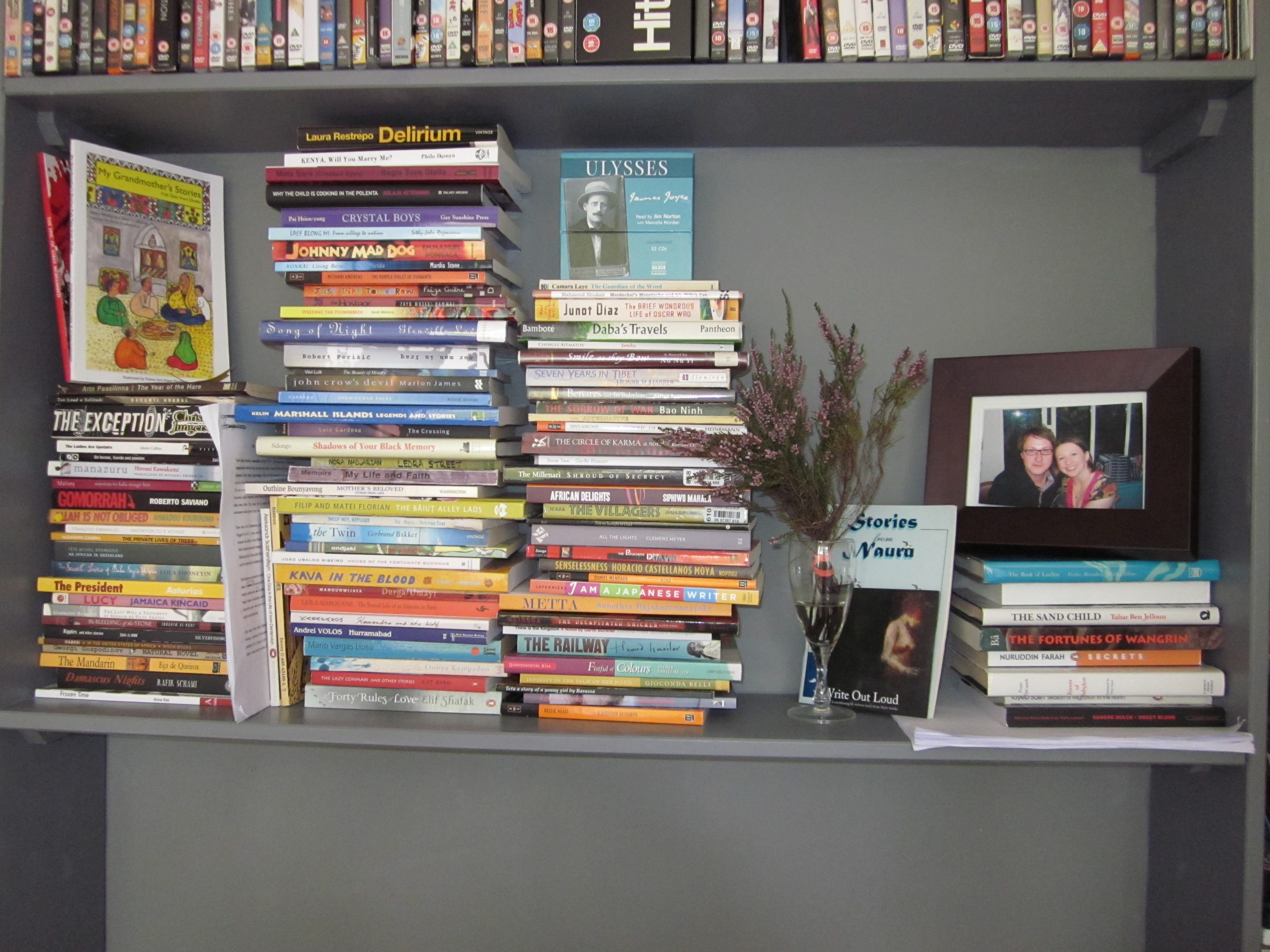
The Sand Child is the novel Doria, the gutsy teenage heroine of my French choice Just Like Tomorrow, is reading when we first stumble into her tough life on the Paradise Estate in a part of Paris the guidebooks never mention. As I liked Doria, I thought I would probably get on well with a book she enjoys. I also loved the idea of books talking to and about one another, signposting me from one to the next like clues on a massive literary treasure hunt.

And if I needed anything else to persuade me, Doria’s pithy précis of the book was more than enough to make me want to read it:

‘It’s about a little girl who got brought up as a boy because she was the eighth daughter in the family and her father wanted a son. Plus, at the time when it was set, you didn’t have ultrasound or contraception. No kids on sale or return, you get me.’

As Doria suggests, gender issues are at the heart of the novel. Like several other stories I’ve read from relatively conservative Islamic countries, the book is startling in its explicitness and the fearless way it tackles taboos. Focusing on the lonely and troubled Ahmed, who was raised to despise femaleness as a ‘natural infirmity’ that threatens the family’s future because women are forbidden by law to inherit more than a third of their father’s wealth, the narrative presents a complex picture of gender dysphoria that reveals the narrowness of society’s definitions. As Ahmed him/herself explains, ‘the huge ordeal through which I am passing has meaning only outside those petty, psychological schemata that claim to know and explain why a woman is a woman and a man a man’.

Even more engrossing, however, is the picking apart of storytelling that Ben Jelloun weaves through the text. Frequently interrupted by a tour guide-cum-storyteller and various listeners, characters and even literary figures from other tales, the narrative becomes a battleground of interpretations, speculation and suspicion. Just as Ahmed is both male and female, victim and aggressor, transgressor and conformist, so the story veers between truth and falsehood as a range of would-be narrators squabble over its meaning, providing alternative endings and even, at one stage, burning the original text. It is as though plurality and ambiguity are the only things of which we readers can be sure, a sentiment explored by the Blind Troubadour, who weighs in towards the end:

‘Besides, a book – at least that’s how I see it – is a labyrinth created on purpose to confuse men, with the intention of ruining them and bringing them back to the narrow limits of their ambitions.’

Such elusiveness might be maddening in the hands of another writer, but in Ben Jelloun’s it is intriguing, amusing and even beautiful. In fact certain images, such as the description of adopting another identity being like putting on ‘a wonderful magic jellaba, a cloak cut out of the sky and studded with stars’, reach out from the hubbub of the novel’s voices to stop you in your tracks, like rare treasures mixed in among the knick-knacks at a bustling bazaar.

The overall effect is rich, engrossing and challenging. Readers wanting a quiet meander along well-trodden paths are probably best advised to steer clear. But if you don’t mind being pushed, jostled, pulled in all directions, spun round and tumbled into the odd ditch, then this is the book for you.

The Sand Child (L’enfant du sable) by Tahar Ben Jelloun, translated from the French by Alan Sheridan (Quartet Books, 1988)

Brunei: reading between the lines

Brunei was looking tricky. Try what combination of search terms I would, there seemed to be no literature in translation from this small, oil-rich nation on Borneo in the South China Sea. The only suggestion I heard of came in the shape of a collection of Dusun folk tales compiled and translated by UK academic Eva Maria Kershaw. It was recommended by Canadian blogger Paul, who said it was the only Bruneian work he had been able to find for his own global literary quest.

I was on the point of buying the book, but something held me back. Nagging away at me was the thought that there must be someone out there who could help me find a written work by a Bruneian author that I could read in English. It was just a question of tracking them down. What I needed was a group of enthusiastic, English-speaking Bruneians who were passionate about promoting their culture and would have the time to circulate my query and, if I was lucky, do a bit of research on my behalf.

The solution came in a flash: students. A quick bit of googling revealed a surprisingly large number of Bruneian students’ associations dotted around the world’s Anglophone countries. I fired off emails to several of them, hunted down a couple of others through Facebook, and sat back to wait.

It didn’t take long. The very next day I got a message from Zuliza, media communications officer at the Bruneian Students’ Association, New Zealand. She wanted to help and asked for more details about the sort of book I was looking for. I answered as best I could.

The weeks went by. I found myself keying ‘Dusun folk tale collection’ into Google in idle moments. Then, at the beginning of August, Zuliza got back to me. She had some good news: she had found a story in the Brunei Times about a Bruneian author who had taken the step of publishing a novel in English in an effort to attract a wider readership for his work. It was available to buy on Amazon. Would it do?

One air punch and a vigorous Highland jig of delight later, I downloaded the novel on to my Kindle and began to read.

Set in France, Four Kings by Christopher Sun (aka Sun Tze Yun) follows American archaeology professor James Hale as he sets out to solve the murder of his best friend. Accompanied by his friend’s distraught and yet disturbingly attractive daughter, the academic plunges into the dizzying world of fine-art investment in an effort to track down a killer with a penchant for priceless artefacts and a habit of leaving playing cards next to each of his victims. But as riots grip the country and the president is forced to consider extreme measures to prevent anarchy, it becomes clear that the deaths may be part of a conspiracy that goes all the way to the top.

This is a book with a clear idea of what it wants to be. From the sensationalist, blood-smattered cover picture, right through to the vital clue that drops out of a copy of The Da Vinci Code halfway through the novel, Sun makes no secret of the fact that he is out to take on the global blockbusters with this, the first in a pentalogy following the adventures of James Hale. There is even a wry dig at the bestselling US author when, picking up the novel with a laugh, detective Darley remarks: ‘It’s nice to know that even sociopathic killers don’t mind reading trash now and then.’

Sadly, though, I don’t think Dan Brown has much to worry about. Although Sun may have big ambitions, his execution is lacking. The plotting is loose, improbable and heavily derivative, with unlikely religious relics such as ‘Jesus’s denarius’ and ‘the Spear of Longinus’ passed around between shadowy figures who materialise and disappear almost randomly. At times, even the characters themselves seem to feel that there is a ludicrous air to events, as when Hale grumbles to himself: ‘This is crazy […]. Why the hell am I the one finding all the damned bodies around here?’

As in QuixotiQ, my Bahraini pick, the Western setting is problematic. Although Sun has made an effort to ground the novel in France, unlike the mid-Atlantic no-man’s-land of QuixotiQ, the context lacks authenticity. Characters with names like Bruno Culruthers, Hugh Jetter and the unfortunately spelled Rouseeau strut around a faceless world that feels more like an airport terminal than a French city.

As with QuixotiQ, however, there is a serious point here. For the second time this year, I have found that the only work I am able to read from a nation with a written tradition is one by a writer who feels he has no option but to try and write a Western novel in English if he is to reach an audience outside his country. According to his Brunei Times interview, Sun has written and published books, cerpen (short stories) and sajak (poems) in his first language, Bahasa Melayu. Now those I really would like to read.

Four Kings by Christopher Sun and Jimmy Chan (CreateSpace, 2011)

Mali: truth to tell

This book has been on the list since I started preparing for this project. First published in 1973, Amadou Hampâté Bâ’s The Fortunes of Wangrin won the 1974 Grand prix littéraire d’Afrique noire and has long been hailed as one of the classics of Francophone African literature. Nearly 40 years later – as far as I can make out – it is still one of the few Malian prose works available in English translation (although I’d love to hear about others if you know of more books that should be added to the list).

The narrative purports to be an account of the life and times of teacher-turned-civil servant and all-round hustler Wangrin, as told to Bâ by the man himself shortly before his death. Working in Mali during the first half of the 20th century – when the country was under French rule – Wangrin quickly learns to play his peers and colonial employers off against one another for his own ends. Deft, resourceful and at times maddeningly slick, Wangrin rises to prominence and prosperity, until at last his ambition, enemies and the prophecy of ruin spoken on his birth conspire to bring him low once more.

Wangrin is an extraordinary creation. Presented as an almost mythic figure in the way his birth is portrayed and declaimed, this ‘profoundly strange human being with so great a mixture of good qualities and faults that, at a mere glance, it was impossible to describe him’, as Bâ writes in his Foreword, fascinates and bewilders his contemporaries and the reader alike. Whether he is undercutting the European millet trade, capitalising on the guilt of two brothers eager to give their relative a proper burial, outsmarting a corrupt official in the courtroom, or beating thugs in a fight, Wangrin is mesmerising. Indeed, his influence extends even to his author, who, whenever Wangrin’s antics teeter on the callous, is quick to leap to his protagonist’s defence, reminding us of his humanity to the poor and weak and the fact that in the Mali of the time ‘it was either destroy or perish, play tricks on others or be their helpless victim’.

The narrative’s colonial setting bears this assertion out. Ranging from wry jabs at the French administration, such as the list of ‘mannerisms that adorn French utterances’ and must be learnt by Malians if they are to converse with ‘white-Whites’, through to scathing portraits of cruelty and prejudice – among them the official who ‘would have been a blessing if he hadn’t had the unfortunate habit of cracking his whip across the backs of a couple of people and taking two or three others to jail who were guilty of the terrible crime of not having saluted their Commandant from twenty-five yards’ – Bâ’s criticism of the regime is unrelenting. Small wonder that in this compromised society, where educated Malians like Wangrin are recruited to spy on and cheat their peers for their European masters, canny citizens play the French at their own game and put their personal interests first.

Yet perhaps the biggest conflict of all lies not within the narrative itself, but on its margins. Sniping at each other across the body of the text are Bâ’s dogged insistence on the veracity of the account and the prevailing critical opinion that the work is largely fictional, embodied in my edition in Abiola Irele’s Introduction, which argues that ‘the essential consideration here must surely be not the exactitude of the recollection but the evocative power of the account’.

That would just about stand had Bâ not been needled into writing an impassioned Afterword in response to his book’s initial reception, in which he insists on the truth of what he has written:

‘Although the existence of the man who chose to call himself Wangrin is generally accepted as a historical fact, they [critics] think I “romanticized” his life somewhat and even added a subtle sprinkling of oral tradition and supernatural events of my own making in order to flesh out the story and give it a patina of symbolical significance.

‘I’ll repeat once more, then, for anyone who still might be in doubt, that I heard everything relating to the life of the hero […] from Wangrin himself, in a Bambara often poetic, full of verve, humor, and vigor, to the soft musical accompaniment of his griot Dieli Maadi. To this very day I recall with emotion Wangrin’s voice against the background of a guitar.’

There may very well be more to this than meets the eye. If I had more knowledge of the context of the work and Bâ’s writing, I might discover that, far from the impassioned appeal it appears, this is yet another turn of the screw on the part of a witty author who is every bit as ingenious as the character he describes.

As it stands, though, for the reader coming to the text with no prior knowledge as I did, the clash between the Introduction and the Afterword is deeply uncomfortable. It was enough to make me refrain from using the word ‘novel’ when talking about the book. To do so felt as though I would be favouring an imposed and largely Western reading of the work at the expense of its author’s intentions. It left me troubled. But perhaps that’s precisely what Bâ set out to do.

The Fortunes of Wangrin (L’Etrange destin de Wangrin) by Amadou Hampâté Bâ, translated from the French by Aina Pavolini Taylor (Indiana University Press, 1999)

Eritrea: heart and home

This was a recommendation from an Eritrean friend of mine. She had read Sulaiman Addonia’s The Consequences of Love not long after it came out in 2008 and enjoyed it. If I was looking for Eritrean literature in English, this was her top tip.

I had my reservations: a brief scan of Addonia’s biography revealed that, although he was born in Eritrea to an Eritrean mother, he has spent very little of his life there, having fled to Sudan and subsequently Saudi Arabia as a young child. He now lives and writes in London – could his work really be counted as Eritrean?

Then I thought about my friend’s own story. Like Addonia, she was driven from Eritrea, which has long been in the grip of a regime so oppressive that Reporters Without Borders ranks the country below North Korea for press freedom. The danger is such that my friend has been unable to visit her family there since she left, and her mother has never met her son-in-law and grandchild as a result. I began to wonder if such stories of separation and displacement were not as much a part of Eritrean life as the experiences of those who’ve stayed put.

Exile is also central to Addonia’s novel, which is set in the late 1980s, towards the end of Eritrea’s bitter 30-year war with Ethiopia. Like its author, the central character, 20-year-old Naser, has spent his teenage years in Saudi Arabia. Yet, although he has escaped the perils of conflict, he finds himself hemmed in by a whole range of other restrictions in Jeddah, where religious police scour the streets for people who break the strict behaviour codes, lovers are flogged and executed in Punishment Square and the vitriolic sermons of the blind imam blare through the city.

Lonely and anxious for the mother he left behind in Eritrea, Naser faces a life of isolation, until a mysterious, veiled woman drops a love letter at his feet one day. But in a society where communication between unmarried men and women is banned, it will take all Naser and his secret admirer Fiore’s courage and ingenuity if they are to give their happiness a chance.

Naser’s world is one where direct emotional expression is outlawed. Whether they are yearning for their homelands or pining for lovers, he and his cronies must shroud and sublimate their feelings so as to avoid chastisement at the hands of the ever-watchful authorities.

Such repression in this ‘world of black and white’ can have surprising results as blocked emotions and impulses play out through other means. There is Jasim’s café – where wealthy older men coerce the waiters, including Naser, into being their sexual partners until they get married and have a legitimate outlet for their libido – and there is the thriving trade in banned books, including Tayeb Salih’s Season of Migration to the North (my Sudanese pick), through which the characters live vicariously from inside the country Jasim describes as ‘the biggest prison in the world’. In addition, creativity blossoms, in the shape of Fiore’s drawings, the lovers’ impassioned letters, and the inventive means by which they get messages to one another. As Naser puts it, ‘caged emotions make poets out of all of us, even the illiterate’.

Caged emotions also make for a compelling story. In this tale of ‘love before sight’, the scene where Fiore is finally able to remove her hijab and the lovers come face to face after months is very moving. The sky-high stakes also make for a nail-biting conclusion, although, for my money, the final unravelling is too heavily foreshadowed to come as a surprise. However other readers may feel the dramatic irony creates a tension all its own.

Taken as a whole, though, this is a thoroughly engrossing and often beautifully written portrayal of what happens when regimes and laws run counter to human needs and emotions. As Naser puts it, it is the story of an individual’s struggle to ‘do what it takes to get a life that is rightfully [his]’ – a struggle that, by the sound of it, many Eritreans know all too well.

The Consequences of Love by Sulaiman Addonia (Vintage Digital, 2008)

Somalia: digging deep

This novel has been sitting on my to-read pile since January. It was one of the books that Steve and I picked out on a frenzied afternoon in New York City when the reality of what this project would involve was just sinking in. That day, we descended on indie bookshop McNally Jackson and, under the bewildered gaze of the staff, spent several hours rifling through the world-literature section and building big piles of possible prose works I could read from some of the most far-flung destinations on the map.

Several of the books I bought that holiday became blog posts earlier in the year, others were shuffled on to my ‘2013-and-beyond’ pile when more intriguing recommendations came in, and yet others still sit biding their time on one of the many heaps of undecided books dotted around our living room as I write. In fact, when I picked up Nuruddin Farah’s Secrets the other week, I couldn’t remember anything about it. It was only when I cast an eye over the blurb that the reason the book appealed to me that blundering January day came flooding back.

Having been exiled from Somalia since the 1970s, multi-award-winning author Farah was finally able to return to his homeland in 1996. Secrets, which came out the year its author won the Neustadt International Prize for Literature, is his first novel since that trip.

The book tells the story of Kalaman, a self-made computer company owner in Mogadiscio, who is forced to confront some devastating home truths when his childhood sweetheart Sholoongo returns from America and elbows her way back into his life. Outside Somali society is crumbling as the civil war takes hold, but inside the tried and tested structures of family and friendship are cracking too, as Kalaman, Sholoongo, his mother and grandfather dredge up recollections and revelations that will shake his sense of identity to the core.

Right from the very first sentence, which is hurled out with the flair of a master magician adept at winning the attention of the crowd – ‘One corpse, three secrets!’ – we know we are in the hands of a great storyteller. Yet, as the novel unfolds and the narrators cut in, querying, contradicting and rubbishing one another’s words, Farah reveals himself as not simply a conjuror, but an alchemist, aware of the conditions that transform the essence of stories and truth into startlingly different forms.

Whether ‘shapeshifter’ Sholoongo is picking Kalaman up on his account of their relationship, which he presents as being dominated by her but she portrays quite differently, or Nonno is unmaking and remaking his grandson’s recollections of his childhood, there are always conflicting and often diametrically opposed versions of events that must be assimilated. Secularism jostles with spiritualism; Islamic teachings rub shoulders with folklore; and the contemporary, naturalist novel finds itself hijacked by superstition, sorcery and a woman with the power to will herself into people’s dreams. As Kalaman reflects, ‘truth, after all, has its dynamism, and memory its momentary lapses’. It is up to each person to ‘inquire into the meaning of truth, and how to distinguish our find from other categories of truth’.

In the face of such multivalency, there is no place for trite simplifications. The inadequacy of the assumptions by which we all too often navigate our way through the world is perhaps most keenly shown in Kalaman’s reflection on common perceptions of the Somali conflict:

‘I let it go as I often have let go foreigners’ throwaway remarks spoken in ignorance, foreigners who held the view that “Somali politics is clan politics”. It would take me years to convince them otherwise.’

The novel does come with a health warning, though: its continual deconstruction of truth and reality can be tiring. Occasionally in the ‘Interlude’ chapters, which feature some of the book’s densest and most opaque writing, I found myself feeling as though I were waiting by the door at a party where an intense philosophical debate had erupted late in the evening, when I was ready to get my coat.

But this probably says more about me than it does about the novel. Overall, this is a rigorous, gripping and intriguing work. It challenges, shocks, delights and entertains in equal measure. An excellent find.

Secrets by Nuruddin Farah (Penguin, 1999)