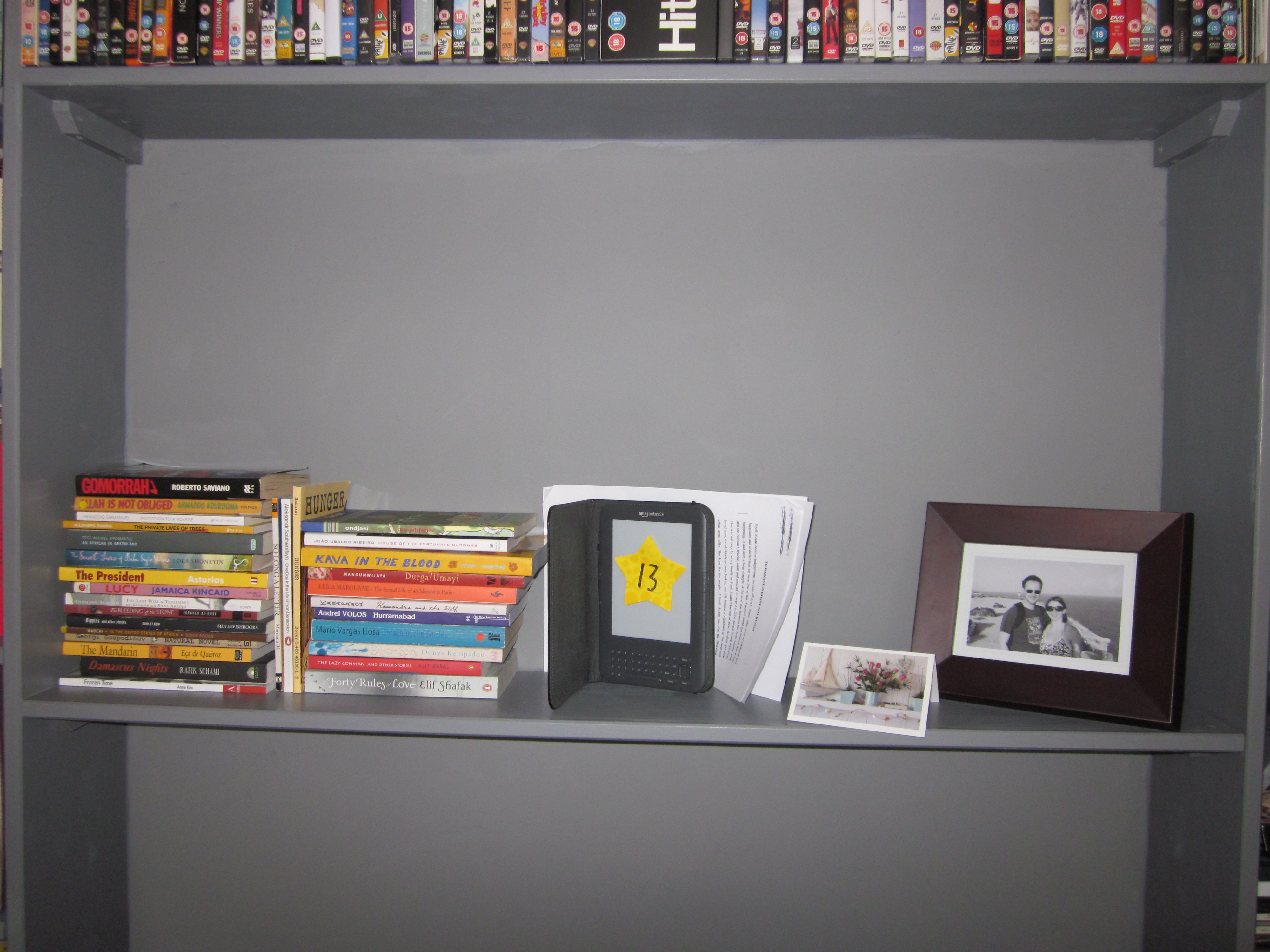
Uzbekistan: banned books

A frequent dilemma when you’re trying to read a book from every country in the world is deciding which of the many perspectives in each nation to choose literature from. This is particularly tricky in the case of states that ban books on certain topics or viewpoints and so have two literatures: the official stories and the books released underground or outside, away from the reach of the law enforcers.

The journalist in me tends to be drawn to the illicit, banned books, partly because they’re more intriguing but also because I tend to assume that they will somehow be more authentic and truthful. However, as I found with my North Korean book (My Life and Faith by ardent patriot Ri In Mo), this tendency to favour marginalised voices over the official line can have the paradoxical effect of excluding the authorized stories and making them the ostracized, radical accounts on the world literature stage.

But what about a book written with a view to mainstream publication in the author’s home country but banned at the last minute? That was the situation Hamid Ismailov faced when the Uzbek translation of his Russian-language novel The Railway was due to be published in Tashkent. The first half of the novel had already appeared in a journal in 1997 when the Uzbek government, jumpy about the work’s irreverent attitude to authority, pulled the plug.

The book spans the first 80 years of the 20th century and is set in the small town of Gilas, a settlement on the old Silk Route and now a stop on the railway line ploughing its way across Central Asia. Presenting a portrait of the myriad narratives woven through this remote backwater, which has seen Uzbeks, Russians, Persians, Jews, Koreans, Tartars, gypsies, mullahs and Bolsheviks pass through and make their marks, it bombards the reader with a host of extraordinary, grotesque and often hilarious tales. There are the pregnant twins in a race to give birth after a town official promises to marry the first-born’s mother, the landowner bankrupted by paying off his pugnacious son’s blood debts, the Kirghiz teacher driven to absurdity by his desire to fit in and the orphaned boys who assume prominent positions in the town’s music scene despite one of them being deaf.

Translator Robert Chandler describes his work on the book as being like ‘restoring a precious carpet’ in his excellent preface and it’s easy to see why. Not only is the book structurally elaborate with a cast of more than 100 named characters, but it is linguistically and culturally complex too. Labyrinthine sentences thread themselves through clause after clause, teasing the reader with puns, digressions and asides, and the narrative bristles with references to events, ceremonies, bureaucratic formalities and rites of passage that will be unknown to most Western readers.

At its best, the humour and brilliance of this chronicle of ‘the inhabitants of Gilas: that lost and ill-assorted tribe of the debauched and depraved’ shines through. The puns are witty and the narrative glitters with insights – in particular it presents us with a ruddier and much more jovial face of Islam than we are used to seeing in the West.

Chandler manages to smuggle a lot of the linguistic jokes across in one guise or another. The scene early on in the book, for example, where Ivan the train driver misunderstands Umarali’s prison Russian and gives him fuel instead of alcohol is great.

However, there’s no denying the fact that this book is hard work. Even with the list of characters and Chandler’s end notes, it’s impossible to keep track of everything and everyone, at least on a first attempt. At times reading it felt like being at a lively party where people batted around in-jokes I could only half understand.

The narrative expresses this sense of being on the outside looking in too. One of the most striking moments in the book, where a nameless boy blows a kiss to an unknown girl on a passing train, evokes a sense of extreme  wistfulness.  For this book, shut out from the readers who would appreciate its subtleties without referring to the footnotes, it seems a powerful metaphor: a connection attempted but somehow missed.

The Railway by Hamid Ismailov, translated from the Russian by Robert Chandler (Vintage, 2007)

Singapore: no man’s land

This was one of the books picked out for me by Rafidah and the bookseller at Silverfish Books in Kuala Lumpur. Part of the Quintessential Asia series published by Singporean company SNP, it’s the sort of thing I would have been very unlikely to have found sitting in my south London flat googling ‘Singapore+writer’ (even though it won the Singapore Literature Prize in 1992).

The novel follows art teacher Suwen as she struggles to break out of the bland routine into which her life has settled since she returned home from studying in the UK. Eager to create something significant, she embarks on a project to ‘marry history and art’ in one ambitious installation that will capture the character of her complex and multifaceted homeland. But as Suwen researches ‘the strands of different histories and cultures woven into [Singapore’s] modern fabric of many hues and textures’, she finds that the conflicts and contradictions in society are sewn into her own personality too, and is forced to confront the reasons for her withdrawal from the world.

Suchen Christine Lim’s great talents are her abilities to evoke experiences, conjure voices and tells stories from a wide variety of perspectives. Whether she’s describing the crushing hardships endured by Singapore’s rickshaw coolies 100 years ago or the existential crises of art students, she has the knack of making the reader live and breathe the narrative with her.

This large empathy enables her to enter into complex cultural issues more fully than many other writers manage to do. And in Singapore, a land jostling with Eurasians and Chindians where Singlish is the most common language, the search for identity and common ground is a particularly rich seam.

As a British reader, I was especially interested by the presentation of the UK and its colonial legacy in the book. While some of it, such as references to ‘those patronising asses from the British Council’, made me smile, there was a lot to ponder and be challenged by and I was intrigued by the difference in thinking Suwen identifies between people who studied in the Eastern education system and ‘English-educated malcontents’ like her. Perhaps most thought-provoking of all was her angry accusation to Scottish colleague Mark, the man she secretly loves:

‘You British always pride yourselves as playing cricket and being fair. But deep down, you’re all racists to the bone.’

The British nationality is by no means the only one to be dissected in the novel. Malaysians, Indians and Chinese, among others, all have their turn in relation to the no-man’s-land of mid-20th-century Singapore and are all shown to be riddled with conflicts and compromises.

Shifting between so many perspectives, timeframes and stories – not to mention Suwen’s own personal history – requires some fancy footwork on Lim’s part. This is usually well-handled, although the scenery for the next act does occasionally come crashing down abruptly before the characters have quite left the stage.

Similarly, while the many complex discussions of nationality, identity, art and history succeed in feeling natural nearly all the time, people do once or twice step away from the action to deliver a Brechtian monologue.

Overall, though, this is a fearless and engrossing book that goes to the heart of human fears and insecurities. While presenting a picture of a specific place in a particularly rich and turbulent period of its history, it throws the door open to shed light on humanity all over the world. I loved it.

Thanks Rafidah and Silverfish Books. If I’m ever in Kuala Lumpur, I’ll definitely be stopping by.

Fistful of Colours by Suchen Christine Lim (SNP Editions, 2003)

Angola: the meaning of life

The names of certain countries seem bound up with the conflicts that shaped them. For many in the West words such as Bosnia, Sudan and Libya will conjure up the images of death and destruction that flickered on our TV screens throughout recent decades.

The magnitude of these events and the time it takes to translate and distribute books mean that many of the most powerful translated novels still coming out of these countries deal directly with war and its legacy. So we find a harrowing portrait of the expulsion of ethnic Russians from Tajikistan in Andrei Volos’s Hurramabad and a startling child’s-eye view of the Bosnian War in Sasa Stanisic’s How the Soldier Repairs the Gramophone.

However, as I discovered when I read my Angolan choice for this project, not all literature from recent war zones strikes a mournful note.

Published in 2008 by now sadly defunct Aflame Books, Ondjaki’s The Whistler, the slender first novel from the author who made his name on the world literature stage with Good Morning Comrades, brims with joy and belief in rejuvenation.  It chronicles the arrival of a man with a haunting whistle in a sleepy village. Taking up residence in the church, the mysterious visitor fills the neighbourhood with his tunes, which are so beguiling they even charm the pigeons.

The effect of the music on the village’s human inhabitants is more impressive still. Cutting through the ‘general torpor’, the melodies unsettle and invigorate the largely elderly residents so that each in his or her way breaks free from the predictable patterns of daily life. The narrative culminates in an orgy of sensation, colour and delight, leaving behind a changed community where the inhabitants have a fresh appreciation of their own potency and the rich possibilities of life.

Ondjaki has a great eye for the contrary details that create character. The novel bustles with intriguing individuals who loom from the page: from the town oddball with his penchant for defecation in the open air to the put-upon gravedigger who refuses to leave his post at the cemetery despite no-one having died for years.

Zany and dream-like, the narrative almost takes flight into poetry on several occasions. This creates some extraordinary images, although it can make the throughline of the plot hard to follow.

The novel is so exuberant, however, that this hardly matters. As Ondjaki’s letter to his friend poet Ana Paula Tavares (published at the end of this edition) makes clear, his main concern is with creating a powerful impression rather than a conventional story.

He achieves this. The book is imaginative, passionate and extraordinary. And, when considered in the context of the 500,000 people killed during Angola’s 27-year civil war, it’s peculiarly moving too.

The Whistler by Ondjaki (translated from the Portuguese by Richard Bartlett). Aflame Books, 2008

Australia: neighbours

For almost any British child of the eighties, Australia feels like a home from home. Sanitised and unreal though they may have been, Erinsborough and Summer Bay were the favourite after-school hangouts in the days before cable and satellite TV and the characters that lived there were our friends. We flicked our sentences up at the end to fit in with them, talked Alibi in the playground and devised elaborate make-believe games involving Madge, Harold and Mrs Mangel. When I was lucky enough to have the chance to drive round the coast from Perth to Sydney a few years back, it really did feel like being both home and away.

I was excited to read my Australian choice for another reason too: this was the book that started this crazy venture to read a story from every country in the world. Last year, fellow blogger Jason Cooper stopped by my A year of reading women blog and said that he really wanted me to read Tim Winton’s Cloudstreet. I pointed out that Tim Winton didn’t fit with my theme, but Cooper was adamant: I would have to do another blog in 2012 and find a theme to fit round the book.

‘What about reading books from different countries?’ he suggested.

‘What about reading books from every country?’ I countered.

And so A year of reading the world was born.

Luckily, I can see why Cooper loves this book. Charting the story of two hard-up families forced to live together in a tumbledown house on the outskirts of Perth in 1943, the novel creates a world every bit as absorbing as the soap operas of my childhood — and which bears more than a passing resemblance to them: the narrative is divided up into neat little in-between-the-ad-breaks-size chunks, the story has an episodic quality as it pans round the large cast of characters and stretches out across 20 years, and there is even a relative who disappears off to Adelaide when times get tough.

But Cloud Street is more than a literary version of Ramsay Street. Against the backdrop of the war and its fallout, Winton unfolds the tribulations, rivalries and neuroses of the debt-ridden Pickles family and their tenants the Lambs, who move into town after a shrimping accident leaves their eldest brain-damaged and strips them of their faith. These he uses to test the boundaries of conventional wisdom on fate, personhood, evil and luck, charting the gradual coming together of the two clans as each of their members seeks some sort of peace with his or her lot.

It sounds like a recipe for mawkishness. What saves it is Winton’s extraordinary facility for crystallising delicate images and emotions in the bluff language of the everyday. Whether he’s describing ‘chooks racked along their perch like mumbling hats’ or someone’s reaction to the revelation of the human side of a serial killer — ‘There’s no monsters, only people like us. Funny, but it hurts’ — he manages to shuck the feeling he wants from the husk of bluster and ostentation that most writers never succeed in losing completely.

That said, Winton could have done with taking a leaf out of the soapwriters’ scripts in one respect: the last 10 per cent (in Kindle terms), where final cadence after final cadence ripples through the text, could have done with some serious cutting. Without the pressure of the six o’clock news to focus his mind, Winton gives in to the temptation to linger in the world he has constructed with the characters he loves longer than they need him.

All the same, I can’t say I blame him terribly much. It is a marvellous creation. And, hey, they tell me Neighbours is still going on Channel 5…

Cloudstreet by Tim Winton. Publisher (Kindle edition): Picador (2011).

Lithuania: women’s work

I stumbled across this anthology while on the trail of Lithuanian writer Laura Sintija Černiauskaitė. She was one of the inaugural winners of the European Union Prize for Literature, which, according to its website, was launched in 2009 ‘to promote the circulation of literature within Europe and encourage greater interest in non-national literary works’, and I assumed this meant I would be able to find her novels in translation.

I was wrong. In fact, the only piece of Černiauskaitė’s work I could find was the extract of her 2008 novel, Benedict’s Milestones, featured alongside the work of 19 other Lithuanian women writers in this collection.

Published by the Lithuanian government’s International Cultural Programme Centre, the anthology is the second in a series of books designed to introduce Lithuanian writers to an English-speaking readership. It is available on Kindle for the princely sum of 59 pence. I was intrigued.

As it turned out, Černiauskaitė’s piece, which opens the collection, is something of a disappointment. The choice of a sex scene may have been unfortunate (if unsurprising given that the first volume in the series was called Sex, Lithuanian Style). As the list of nominees for the Literary Review‘s annual Bad Sex in Fiction Award goes to show, even the most accomplished of writers can come a cropper (if you’ll pardon the pun) trying to describe goings on behind closed doors. Nevertheless, the descriptions of breasts ‘pointing like cannons’ and an erect ‘stamen’ had me cringing more than once and wondering what I’d let myself in for.

Černiauskaitė’s piece is by no means the only damp squib. But there are several firecrackers along the way. My interest was first piqued by Birutė Jonuškaitė’s rough and raw account of a love affair gone sour told through a letter one of the lovers leaves behind. Ugnė Barauskaitė’s earthy and funny account of giving birth also had me giggling and cringing (this time in a good way). And if any English-language publishers are looking to broaden their lists Edita Nazaritė, Laima Vincė and Paulina Pukytė deserve attention.

One of the most powerful pieces, an extract from Ruta Sepetys’s Between Shades of Gray relating a family’s violent arrest by the Soviet Police is already available through Philomel Books. I also really liked the extract from Giedra Radvilavičiūtė’s Tonight I Will Sleep by the Wall, an incendiary toast delivered by the groom’s cousin on the occasion of a couple’s twentieth wedding anniversary.

It can be reductive to look for common themes in collections like this, as though women’s writing is somehow a subset of literature proper and not every bit as diverse and creative as the stuff the big boys produce, but it would be difficult to ignore the role that migration plays in nearly all the pieces. The characters in these extracts are people who leave or people who are left behind to regret the absence of relatives living and working among the ‘synthetic’, white-bread people of the West. Emigration it seems, is such a commonplace in Lithuania, that it has almost become a cultural characteristic.

All the more surprising, then, that a nation that is so widely travelled and that seems to have one foot of its identity planted in the diaspora should be so poorly represented in the translation stakes. Who knows? Maybe e-anthologies will succeed where the European Union Prize for Literature has so far failed in raising the nation’s literary profile. Only time will tell.

No Men, No Cry (“Collective” series). Original language: Lithuanian. Publisher: International Cultural Programme Centre (2011)

Norway: reality bites

Before Coetzee’s Youth and Orwell’s Aspidistra; before Amis’s Jim got lucky and the artist revealed himself as a young man; even before Somerset Maugham wrote Of Human Bondage, there was Knut Hamsun ‘s Hunger. Published in Norway in 1890 and only translated into English 30 years later, this slight novel might have long sunk into the eternal slush pile, were it not for its extraordinary power and the fact that it contains the essential ingredients of many of the great 20th century bildungsromans to come – at times surpassing them all.

The story is simple enough: an unnamed and destitute writer wanders around the nation’s capital, railing against the cruel circumstances that make him unable to earn enough to eat. Half-mad with hunger, he goads himself into fruitless attempts at scribbling and doomed schemes to raise a penny or two, struggling along the edge of existence and endurance until he is at last forced to find some escape.

Chief among the problems that writing such coming-of-age novels throws up (as I discovered to my cost when I had a bash at one a few years ago) are the issues of making such a self-obsessed protagonist likeable and dealing with the fact that his (it usually is a he) main problem is often that he doesn’t have enough going on. Humour is the common get-out-of-jail-free card for writers such as Coetzee, Amis, Salinger and even Orwell, but Hamsun jumps another way.

Delving into the wounded psyche of his anti-hero he uses the likeability problem as an opportunity for generating poignancy, holding his character hostage to a self-imposed chivalry code that sees him unable to accept help and unable to walk past someone in need. The result of these repeated bungled encounters is a maddening, perverse and yet pitiable figure, for whom we can’t help feeling sympathy, even as he blunders on into the territory of the deranged, far beyond what most of the later greats dare to try – at one stage even toying with autocannibilism.

The endings are often another problem in such novels. Necessarily involving some sort of rebellion, transformation or shift in relation to all that has gone before, they can often have the wriggling, impatient feeling of a child scrawling ‘The End’ and scampering off to the next thing, bored now he has said all he had to say.

Does Hamsun get past this with his final solution? I’m not sure. I think he and Coetzee could have had a rewarding chat about the options here.

But, of course, Coetzee wasn’t even a glint on his grandfather’s ink stand when Hamsun was writing this and wouldn’t be for another 50 years. None of the great, modernist stream-of-consciousness works and bildungsromans of the 20th century had been realised when Hamsun created the paranoid interior monologue he spins out so skilfully in his first translated book.

I wonder how many of them would have existed in their present forms if Hamsun hadn’t picked up his pen.

Hunger by Knut Hamsun (translated from the Bokmål by George Egerton). Publisher (this edition): Dover (2003)

Nepal: tall tales


Reading a book from every country in the world would be nigh on impossible without the schemes and initiatives that exist to promote the work of emerging authors on the global literary stage. The University of Iowa’s International Writing Program is one of the most established of these, and it was on the list of its alumni, who hail from more than 140 countries, that I came across Ajit Baral.

Even with the exposure from IWP, Ajit Baral’s English language collection of Nepalese folk tales was not easy to come by. In fact, I had to get it shipped from India via Penguin when the usual online retailers drew a blank.

Luckily Baral’s lively retelling of 31 largely oral folktales never before rendered in English is worth the effort. Illustrated by Nepalese cartoonist Durga Baral, they present a vibrant picture of some of the myths, legends, themes and cultures that have shaped the Himalayan nation.

Irreverent, funny and occasionally disturbing, the stories evoke a world full of contradictions, frustrations and marvels. Gods walk the earth, bickering and betting, ghosts steal people’s coats, rats get married and tigers talk.

Some of the tales, like the story about the old man who tries to cheat death and learns the hard way why endless life is not a good thing or the yarn about the vain Uttis tree that falls over a cliff in shock when it is insulted and is left clinging on for all eternity, have an Aesopian quality and seem to serve to explain some of life’s mysteries.

Others, like the story about the scheming barber who ends up being burnt to death when his plans backfire, seem more calculated to raise a laugh at a crook getting his just deserts.

Yet these are largely not moral tales. In fact it is rare that the good win out over the bad. If there is a common theme, it is the punishment of short-sightedness, dullness and stupidity and the rewarding of cunning and quick-wittedness — that and pushing coins up animals’ bottoms to make them appear to pass money, which happens in a surprisingly high number of these tales and which I’m at a loss to explain. If anyone from Nepal (or elsewhere for that matter) can offer a reason for this I’d be intrigued!

All in all, though, it’s the qualities that make for a good storyteller that carry the day — as must have been the case for the people who first told these tales, those who passed them down, and for Baral, who opens them up to a new audience today.

The Lazy Conman and Other Stories by Ajit Baral, illustrated by Durga Baral. Publisher: Penguin India (2009)

Turkey: mystic union


You could be forgiven for thinking that Turkey has only produced one writer in recent years: bestseller and Nobel Prize-winner Orhan Pamuk. He was certainly the top tip in the Turkish recommendations I got for this blog and, never having read him before, I was very tempted to join the party.

Then I stumbled upon a copy of Elif Shafak’s latest novel in Foyles and, intrigued by the biog’s claim that she is the most widely read woman writer in Turkey, I decided to leave Pamuk to his adoring public (at least for this year) and give Shafak a go instead.

It cost me a bit of googling to be sure that Strasbourg-born Shafak qualified as my Turkish entry. Having lived in the US, UK and Turkey, the feminist-leaning writer — whose second English-language novel The Bastard of Istanbul led to her being charged with ‘insulting Turkishness’ (the case was dropped before trial) — seems more of a citizen of the world than of any particular country. According to her website, she prides herself on writing that feeds off ‘journeys and commutes between cultures and cities’.

Shafak’s latest book reflects this. Weaving together the story of non-practising Jew Ella, a housewife-turned literary agent’s assistant in Massachusetts, and a novel about the friendship between Sufi poet Rumi and wandering dervish Shams of Tabriz in 13th century Anatolia that she is given to assess, the narrative tests modern Western culture against medieval Muslim mysticism and finds it wanting. As Ella becomes engrossed in the text and in a correspondence with its author, she finds herself forced to re-evaluate her assumptions and priorities, with dramatic results.

There’s a lot to like about the book: it’s well-written, it’s insightful, and it’s painstakingly researched. It raises some interesting points about the fundamental commonality of world religions — religious wars, the novel-within-the-novel’s author Aziz suggests at one point, may arise from nothing more than ‘mistranslation’.

But there is an uneasiness at the narrative’s heart that is hard to ignore. As Ella and, especially, the 13th century mystics become increasingly absorbed in their quest for spiritual perfection and the true, muscular love of the title, there is insufficient weight given to the sacrifices their quest entails — the child bride left to curl up and die in a corner, the son whose loyalty is curdled into bitterness by neglect.

In addition, the perspective leaps between characters, particularly inside Aziz’s novel, necessitate some awkward repetition of events. This can be irritating, as can the character of Shams of Tabriz, who trots out one parable too many on occasion.

Nonetheless this is an enjoyable read and — judging by the sales figures and rave reviews elsewhere — clearly one that has struck a chord with many readers. Drop me a line if you’re one of them. I’d love to hear your thoughts.

The Forty Rules of Love by Elif Shafak. Publisher (this edition): Penguin (2011)

Saudi Arabia: girl power

When I started this project to read a book from each of the world’s 196 sovereign states in 2012, I knew that translation would be one of the key issues I would encounter. But I little imagined that the process might cause the sort of public row that blew up around Rajaa Alsanea’s Girls of Riyadh.

First published in Lebanon in 2005 (the book was banned in Alsanea’s home country until 2008), the novel was written in a range of Arabic dialects, each reflecting the background of the different characters portrayed. The difficulty of rendering this in English and getting across some of Saudi Arabia’s cultural idiosyncrasies led to a three-way tug of war between translator, author and publisher, resulting in translator Marilyn Booth seeing her version reworked against her will.

Given the furore, it might have been simpler to leave Girls of Riyadh on the e-shelf and go for one of the more universally accepted translations on my list. But I was intrigued: the more I heard about this book, the more I wanted to read it and when I came across a rash of online reviews hyping the book as a ‘Saudi-style Sex and the City, I knew I was going to have to try it out for myself.

The reviews were half right. Written in the form of weekly emails by an anonymous female narrator, who is two parts Carrie Bradshaw, one part Belle de Jour and one part Mary Wollstonecraft, the book follows the lives, loves and liaisons of four young women in Saudi Arabia’s wealthy elite or ‘velvet class’. Moneyed and manicured, the girls are nevertheless bound by the tight social, religious and legal codes of their society, in which women are forbidden from revealing, expressing or asserting themselves outside their own all-female circles.

Faced with a world in which they are often not permitted so much as to sign their names or have coffee with a male friend without being arrested and interrogated, and yet are able to access all luxuries and comforts, as well as Western cult classics such as Clueless and, yes, Sex and the City, these girls of Riyadh lead schizophrenic lives. They conduct their love affairs in secret and remotely, they create fake personas online and they wear low-cut designer pieces under their abayas, which they queue up to change back into in the toilets on flights back from London, Paris and the States.

Now and then some of the transitions between stories and timeframes are a little clunky and the feisty narrator has a tendency to rant. There are also certain bits of exposition and explanation about Saudi society and culture, which feel shoehorned into the narrative and probably aren’t essential for readers to understand it. I sometimes found myself wishing that Alsanea had trusted her Western readers to follow her a bit more.

All this feels minor, however, when set against Alsanea’s achievement of exploding the single biggest weapon in the armoury of repressive regimes: that of making the oppressed group faceless and voiceless. Here, we are presented with four (five if you count the narrator herself) vivacious, witty, intelligent individuals, who despite the restrictions placed upon them attack life with energy and verve. We see educated girls testing the barriers that hem them in and brokering their own peace, or otherwise, with the codes with which they have been raised. And we see a marginalised group beginning to flex its muscles in the virtual sphere and discover the potential of the internet to help people visualize and effect changes such as those seen across much of the Arab world in 2011.

Isn’t this a tad more meaty and daring than Sex and the City? Yu-huh. Is the English text a pale imitation of its original form? I’m in no position to judge (perhaps you can tell me?). Is it better that this version is available to Western readers than nothing at all? Absolutely.

Girls of Riyadh by Rajaa Alsanea (translated from the Arabic by Rajaa Alsanea and Marilyn Booth). Publisher (Kindle edition): Penguin (2008)

Malaysia: the world wide web


One of the lovely things about trying to find a book to read from every country in the world is the connections you make along the way. I’m continually delighted by the thoughtfulness of the people who stop by this blog and take time to comment and make suggestions of titles I could include or ways that I could find interesting books.

So I was particularly touched when one visitor, Rafidah, offered to go to bookshops in Malaysia and Singapore on my behalf and post me some titles. Intrigued (and a little nervous) to see what she would come up with, I waited for the parcel to arrive.

As it turned out, I had no need to worry. Rafidah could hardly have chosen a more appropriate (or enjoyable) book than Ripples and other stories by English language writer Shih-Li Kow.

Styled as a collection of short stories, and shortlisted for the 2009 Frank O’Connor International Short Story Award, the book is actually more like a novel in which moments in characters’ lives are explored as they weave in and out of each others’ existences, tracing a web of associations that stretches across Malaysian society and out around the world.

The structure reminded me a little of David Mitchell’s Ghostwritten, except that Kow is much fleeter of foot, giving momentary glimpses and snatches of experience where Mitchell offers weighty helpings of exposition. Her supreme talent is her ability to portray voices, which she establishes with gutsy and outrageous Aunty So and So in the opening story ‘One Thing at a Time’ and maintains in various forms throughout.

What comes across is Kow’s great love for and interest in people. This is evident in her painstaking attention to detail and the way she is able to depict the conflicting motivations that send her characters ricocheting off each other throughout the book. So we hear of the hypocrisy of the houseproud woman who looks on dengue fever as a lower class disease, the paranoia of the city worker for whom sanity constitutes a myriad of niggling worries and fears, and the complex reactions of the neglected child who finds a kind of love in the attentions of a paedophile.

Often, in fact, the camera is pointed at some small detail while the major events take place on the edge of the scene, almost out of focus, as in the case of ‘News from Home’, where Josie spends the entire letter to her estranged brother talking about the death (and afterlife) of their mother’s cat.

Also interesting are the shifts between genres. Realism jostles with fairy tales, ghost stories, magical realism and much more. We find stories set in the afterlife and stories where characters have shapeshifting faces or the ability to swallow cats whole, alongside riffs on meetings, walks in the park and the rivalry of street traders. The result is a rich and full picture of human experience in which the doors of perception swing open and closed between reality and the weird landscape of the psyche.

To my mind, the key to the collection is not the title piece ‘Ripples’, which focuses on an encounter with a photographer and a discussion of how you capture a moment, but ‘A Gift of Flowers’, a story in which a bouquet is passed from one person to another until part of it ends up back with the original purchaser, potentially with life and death consequences.

This sense of the way we impact on one another and how minute details can change the world is at the heart of Kow’s work, and is what makes Ripples and other stories an engrossing and memorable read. Thanks Rafidah.

Ripples and other stories by Shih-Li Kow. Silverfish Books (2008)