Book of the month: M.G. Sanchez

This writer came onto my radar thanks to Keith Kahn-Harris, author of The Babel Message: A Love Letter to Language, with whom I did a musical incomprehension experiment a few years back.

He shared some information with me about Llanito, the language of Gibraltar (a British Overseas Territory at the southern tip of the Iberian Peninsula). It was, he told me, an amalgam of Spanish and English with bits of Maltese and Genoese thrown in. In fact, the literary scene in Gibraltar was similarly fascinating, a kind of experiment in answering the question of how small a population you need to establish a literary culture. 

Yorkshire-based M.G. Sanchez is a key player in this, having co-founded Patuka Press, which publishes anthologies of Gibraltarian writing. Indeed, several of Sanchez’s own books feature Llanito and his most recent has both an English and a Llanito edition. The title that caught my eye on his back catalogue, however, was Diary of Victorian Colonial and other Tales, my latest Book of the month.

Originally published in 2008 through Rock Scorpion Books, a now-defunct publishing forum that Sanchez also founded after he struggled to find an outlet for Gibraltarian work, Diary is Sanchez’s second work of fiction. It features one novella and two shorter works that, according to its marketing material centre on ‘themes of emotional and geographical displacement’.

The title work is the most ambitious piece. Chronicling the return of ex-convict Charles Bestman to Gibraltar, the land of his birth, in the nineteenth century, it explores what it means to belong and how history can entrap us in many senses. After this comes ‘Intermission’, a stream-of-consciousness account of a UK-based magazine publisher’s snap decision to give up the world and enter a French monastery. Last and, for my money, least is ‘Roman Ruins’, the story of an Italian lawyer’s attempt to save a homeless Kosovan man.

Voice is one of the key strengths of Sanchez’s writing. The first two pieces lift off the page thanks to compelling, energetic and distinctive first-person narrators. The diary form is not easy to pull off and sustain for a whole work of fiction, and it’s credit to Sanchez that Bestman’s account is engaging, and peppered with telling observations. Meanwhile, the would-be monk of ‘Intermission’ is often extremely funny. His claim that the notorious British serial killer Fred West looked ‘a bit like an ugly Tom Jones’ had me laughing out loud. Although his spiel is occasionally repetitious and tips over into raw ranting on a few occasions, lines like this meant that I was more than happy to stay with him for the ride. There is a rich, mischievous seam to the writing in the first two-thirds of the book that put me in mind of anglophone authors such as Helen DeWitt and C.D. Rose, as well as the Brazilian writer Machado de Assis.

It’s also fascinating to see colonialism and Britishness discussed from fresh angles, as Sanchez does in the first two pieces. There is a Trojan horse element to many of the passages, with certain ostensibly harmless or familiar formulations being used to smuggle in sentiments that challenge the status quo or reframe ideas. Some of these, such as the magazine publisher’s reflections on political correctness gone mad, now feel a little dated, but many are still disconcertingly fresh.

There’s a meta element to the title work too. At the end of the text, an editor’s note informs us of the way in which the diary was discovered and praises Rock Scorpion Books for publishing it after it was rejected by many other outlets. Finding a way to be heard and recognised is, it seems, part of the story.

Language has a big role to play in this. Llanito and Spanish feature in dialogue in the opening piece, while French appears in ‘Intermission’, and Italian and Serbian ring the changes in the final story. Multilingualism and pluralism are part of the fabric of this literary world, with Sanchez rarely choosing to translate on the page. Bewilderment and codeswitching are de rigueur.

All that said, the final story is an odd fit in this collection. Whereas the first two pieces complement each other tonally, stylistically and thematically, ‘Roman Ruins’ feels as though it is out on a limb. From the retail blurb, I see that a story called ‘The Old Colonial’ is listed in its place in the collection, and I wonder if a late need for a substitution has led to this piece being shoehorned in.

Certainly, there is a stilted, slightly unfinished quality to it. Characters often seem to exist to make arguments rather than to act in their own right, with several conversations featuring long expositions of the history of the former Yugoslavia and the atrocities committed during and since its collapse (although as I write this, I’m conscious that numerous literary traditions have a much higher tolerance for political and historical discussion than is generally accepted in anglophone literature – it may be that Gibraltarian literature does too). Coming after the mischievous, subversive antics of the first two pieces, the straightness of ‘Roman Ruins’ is hard to take. I also found the female lawyer less convincing than Sanchez’s male creations. All in all, the story felt uneven.

But then perhaps evenness isn’t necessarily a virtue, or a quality essential to every work or literary tradition. It may be that Sanchez and his fellow Gibraltarian writers are nurturing a literary culture that works according to other standards – one that has no need to appeal to the sensibilities of a citizen of the country that once colonised their homeland. Sanchez has since published numerous works that may have taken his writing in any number of directions. I’m intrigued to learn more.

Diary of a Victorian Colonial and other Tales by M.G. Sanchez (Rock Scorpion Books, 2012)

Picture: ‘Gibraltar’ by John Finn on flickr.com

Book of the month: Kim Leine

This novel was a recommendation from leading English-Danish translator Signe Lyng. After we met at the Dublin Book Festival in November, she generously sent me a list of recent Danish-language novels that she admires, including Niviaq Korneliussen’s Last Night in Nuuk and Solvej Balle’s On the Calculation of Volume.

One of Lyng’s suggestions stood out to me for two reasons: firstly, because it came out twelve years ago and so the English-language version was likely to fit my criteria of only featuring books published pre-2021 on this blog this year. Secondly, because Greenland is a big focus of the plot, and as anyone who knows about my admiration for the Togolese explorer Tété-Michel Kpomassie will realise, Greenland is a place that particularly captures my imagination. (Indeed, 2025 promises to bring some exciting news on that front – watch this space!)

Kim Leine’s award-winning and bestselling The Prophets of Eternal Fjord, translated by Martin Aitken, tells the story of Morten Falch, an eighteenth-century Danish missionary who travels to Greenland to spread the gospel to the Inuit. Ambitious and earnest, yet riddled with doubts and secret desires (and fixated on Rousseau’s observation that ‘Man is born free, and everywhere he is in chains’), Falch finds himself tested in the colony’s harsh physical and social climate. Principles crumble in the face of insurmountable inequalities, corruption and human frailty, with gut-wrenching results.

This is a truly absorbing novel. One of those rare fat books you wish was even longer. The writing is at heart of this. There is a wonderful dexterity to Leine and Aitken’s prose, which takes us inside Morten’s most intimate thoughts (as well as those of a number of characters he encounters), laying bare his blind spots, idiosyncracies, vulnerabilities and desires.

Part of the work’s power comes from the attention to detail and physical sensations. The writing excels at delineating the minute shifts in power dynamics that accompany crucial moments and decisions, showing how easily things might turn in another direction, and yet simultaneously making us feel the inevitability of what transpires.

The most powerful example of this involves a protracted rape scene, which shows the ebb and flow of control, and captures the absurdity, humanity and even wrongheaded moments of tenderness, humour and connection in the midst of the cruelty and brutality being inflicted. ‘I’m sure it’s not as bad as it feels,’ the attacker tells their victim at one point, revealing the self-deception underlying all the worst suffering depicted in the book. Leine presents a powerful anatomy of objectification, showing the way skewed power dynamics warp thinking, feeding off our struggle to conceive of others as having interior lives that are as rich and nuanced as our own.

Interestingly, the book starts with a brief translator’s note, explaining that using the third person pronoun to address someone was a feature of polite discourse in eighteenth-century Danish and that Aitken has chosen to retain it in the English version. This feels like a risky decision – distancing and potentially confusing. Yet Aitken makes it work, establishing a new variant of formal speech that quickly feels natural to the world of the novel. This and the numerous virtuosic descriptions and assertions often couched in deceptively simple terms are testament to the skill of this writer-translator pair.

Take my favourite line, used to describe an infested mattress on the ship on which Morten sails: ‘The lice seep forth like water.’ How horrifyingly marvellous is that? It captures the action so simply and so precisely. You can see the lice rising out of the fibres. It is absolutely the right formulation to bring that moment to life. And if I sat at my desk for half a year it would never occur to me.

And of course it is in this ingenuity, this care, this attention to detail, that the hope of this majestic novel lies. Because although he depicts characters enchained by their own perspectives and desires, Leine reveals by the world he creates for us that we can transcend our small, partial viewpoints. We can look further, we can feel beyond the boundaries of our own experience. The best storytelling allows us to to do this. And it is by making this possible that books like The Prophets of Eternal Fjord live beyond their moment.

And so I come to the end of my year of reading nothing new for this blog. What have I learnt? Well, although my other writing projects and work chairing events at literature festivals mean I haven’t been able only to read books published pre-2021, turning down the volume on the hype around newly published works over the past twelve months has proved instructive.

There are many books that make a big splash when they appear and there are others that echo more loudly with the passing of the years. Sometimes there is a correlation between the two, as with The Prophets of Eternal Fjord. But often books that are big when they come out fall away in time: many of the literary stars of previous eras are barely remembered now.

While big publishers have a fair bit of influence over which titles are visible at first, it is readers who dictate what will be remembered and what will speak beyond its moment. It is the books that stay with us, that we continue to recommend and return to that will live on.

This is exciting and encouraging. It means we all have a say in shaping our literary culture. And it means that small presses that don’t have the marketing fire power of the big houses may still produce work that finds a large audience and reverberates down the years.

Thanks to everyone who has shared their suggestions of older books that stay with them this year. Here’s to many more wonderful literary encounters (and a possible trip to Greenland) in 2025!

The Prophets of Eternal Fjord by Kim Leine, translated from the Danish by Martin Aitken (Atlantic Books, 2016)

Picture: ‘Old Church in Upernavik’ by David Stanley on flickr.com

Guinea-Bissau: unheard voices

IMG_0379

It’s official (well, as official as these things can ever be): there are no novels, short story collections or memoirs by writers from Guinea-Bissau available in English translation. I know, because I checked. In fact, it wasn’t just me checking, but a whole army of people, working in, living in or studying the country – as well as several others with no particular connection to it – who kindly helped me with the search.

These included Professor Peter Aaby, director of the Bandim Health Project, who has lived and worked in the country for 35 years; Yema Ferreira, a bilingual Angolan writer and blogger, who spent ages sifting through Portuguese-language sites and other sources (she found a couple of titles that had been translated into French, but none that had made it into English); and a PhD student doing a doctorate on Guinea-Bissauan literature who I bumped into on Twitter and who assured me that there was nothing translated – although she might well consider translating something in future.

All the same, in amongst the barrage of queries that have flown back and forth from my computer bearing the words ‘Guinea-Bissau’ in recent months, one translated title kept cropping up: Unity and Struggle by Amilcar Cabral.

When I first heard about this collection of speeches and writings by the leader of the Guinea-Bissauan and Cape Verdean independence movements, I discounted it. I didn’t really see how an anthology of this type could be counted as a story and, besides, Cabral was assassinated some eight months before Guinea-Bissau declared its independence, making the book’s claim to be counted as a Guinea-Bissauan work problematic.

However, in this case circumstances made the decision for me. In the absence of any other available G-B literature in English, I decided I would have to give it a go and see what sort of story – if any – might emerge from the pages of this book.

Bringing together Cabral’s writings from a period of more than 25 years, right up to his death in 1973, the collection sets out the author’s vision for a free and vibrant Lusophone Africa. Including everything from funeral tributes to notable African leaders and rousing speeches to his countrymen and women, to addresses to the UN and circulars directed at different factions among the Portuguese colonialists, the anthology reveals the damage that occupation does to a country and sets out the, often radical, steps the writer believes will lead to liberation.

Cabral’s passion shines through on every page. A master of rhetoric, he speaks rousingly against the racist ideology that led to the subjection of his people – ‘this tradition of scorn for the African and of belief in the congenital incapacity of this “big child”‘ – as well as against the sexism and petty divisions that initially hampered his compatriots’ attempts to band together against their oppressors. He pulls no punches when it comes to the Portuguese either, whom he dismisses as coming from ‘a small country, the most backward in Europe’.

At times, his words take on a Messianic register, as when he enjoins his listeners to refrain from the distractions of getting married and having children until the struggle for independence is won. However, his belief in violence as being central to the restoration of his people’s sense of agency is perhaps more Old Testament than New, as his ‘Homage to Kwame Nkrumah’ demonstrates: ‘For us, freedom fighters, the finest flowers with which we can garland Kwame Nkrumah’s memory are the bullets, the shells, the missiles of every kind that we fire against the colonialist and racist forces in Africa’. In addition, some of Cabral’s observations on culture are questionable. While arguing strongly that art, literature and philosophy are central to a nation’s expression of its identity, he seems embarrassed by some aspects of African culture and occasionally seems to be apologising for the ‘staggering simplicity’ of his compatriot’s proverbs and traditions – perhaps demonstrating how entrenched the colonial mindset can be, even in those seeking to root it out.

Cabral’s passion for his work is only one side of the coin. Meticulously researched and reasoned, his arguments rest on a robust and largely watertight foundation. This sometimes takes the form of pages and pages of statistics about the economics, education systems and healthcare facilities of certain regions under Portuguese rule as compared with those of other countries. However there are also some memorable soundbites that leap out to shock and outrage the reader, such as his observation on the double standards operating in fellow Portuguese colony Angola:

‘The setting up of each European family costs Angola one million escudos. For an African peasant family to earn that much money, it would have to live for a thousand years and work every year without stopping.’

Inevitably, such weighty helpings of data mean that the book can be heavy-going. In fact, reading it through from beginning to end is in many ways perverse, as Cabral probably never envisaged these very immediate and time-specific addresses would be collected in such a way.

However, for those who persevere, a powerful picture emerges of a man who gave his life, in every sense, to a cause. His collection stands as a Bible for all subjected peoples around the world and a monument to the activist behind it, who never got to see the realisation of his dream. It is a sobering thought that, nearly 40 years after Guinea-Bissau gained its independence, the literature that its greatest champion regarded as key to its expression of national identity is not available to readers in much of the world. We still have a long way to go.

Unity and Struggle: speeches and writings of Amilcar by Amilcar Cabral, translated from the Portuguese by Michael Wolfers (Monthly Review Press, 1982)

Tanzania: family politics

When one publisher recommends the work of another, you know you’re likely to be on to a good thing. And so, when Lynette Lisk, commissioning editor of the Heinemann African Writers Series, told me that she admired the work of Bloomsbury-published Abdulrazak Gurnah, I lost no time in looking him up.

Spanning 100 years, Gurnah’s 2005 novel Desertion weaves together the threads that lead a young Tanzanian man, Rashid, to leave his homeland in the early sixties and make his life in England. It starts in the dying months of the 19th century, with the scandalous love affair of Rashid’s grandparents – an unconventional English traveller and a shy local woman – before darting forward to Rashid’s childhood in the mid-20th century and on past the declaration of Tanzania’s independence to his lonely and wistful middle age. Steered by Rashid himself, who writes much of the story, with an interjection from his brother Amin and a poem from his sister Farida, the narrative brims with questions and observations about identity, nationality, belonging and love.

Gurnah is a writer with an eye for the thousand little human foibles that can combine to clog up and alter the course of a life. Whether he is describing Rashid’s great-grandfather Hassanali’s hesitance and self-effacement, born out of the ridicule he recognises in the eyes of those who visit his shop, the double-think that allows the British colonisers to despise corruption in others and yet practise it themselves, or the rituals and cruelty that stand in for intimacy between siblings, Gurnah is forever revealing the processes that mould and set personalities.

This perceptiveness extends to larger social structures too. Through the patterns Gurnah traces, we learn the limitations of the social codes surrounding courtship marriage that stymie Rashid’s grandmother’s life and the effect of the gross under-provision of schools for girls. Crucially, however, these observations are not delivered through authorial tirades but lived and enacted by the characters so that it is only when we sit back and think about the story that we realise the wider implications of what we are reading.

Alongside this runs a lively discussion about storytelling, which erupts into the narrative as Rashid begins to question the version of events he presents. Speculating, contradicting himself and imagining where he does not know, Rashid rehearses his family’s history, increasingly aware of the possibilities in fiction, both in the choices he makes as a writer and in the scope the form offers to process, assimilate and remake the past.

Fiction also presents Gurnah with the opportunity to unpack the legacy of colonialism in a far more inventive and impactful way than essays might afford. While his portrait of the British Victorians sitting on the veranda swapping racist ideology well into the night ‘to make themselves feel significant and present in the world’ is compelling, his description of Rashid’s lonely arrival in a Britain leaves a lasting impression. It also buys him the leverage to reach forward in time and challenge assumptions that still underpin much of social interaction today:

‘In time I drifted into a tolerable alienness. Living day to day, this alienness became a kind of emblem, indeterminate about its origins. Soon I began to say black people and white people, like everyone else, uttering the lie with increasing ease, conceding the sameness of our difference, deferring to a deadening vision of a racialised world. For by agreeing to be black and white, we also agree to limit the complexity of possibility, we agree to mendacities that for centuries served and will continue to serve crude hungers for power and pathological self-affirmations.’

For all its sociological and historical observations, though, this is first and foremost an engrossing and deeply moving novel. It is a book to get lost in, led by an expert storyteller, who wins our trust and piques our interest from the very first page. I’ll be looking up more of Gurnah’s works when this year’s literary adventures are over. Wonderful.

Desertion by Abdulrazak Gurnah (Bloomsbury, 2005)

Mali: truth to tell

This book has been on the list since I started preparing for this project. First published in 1973, Amadou Hampâté Bâ’s The Fortunes of Wangrin won the 1974 Grand prix littéraire d’Afrique noire and has long been hailed as one of the classics of Francophone African literature. Nearly 40 years later – as far as I can make out – it is still one of the few Malian prose works available in English translation (although I’d love to hear about others if you know of more books that should be added to the list).

The narrative purports to be an account of the life and times of teacher-turned-civil servant and all-round hustler Wangrin, as told to Bâ by the man himself shortly before his death. Working in Mali during the first half of the 20th century – when the country was under French rule – Wangrin quickly learns to play his peers and colonial employers off against one another for his own ends. Deft, resourceful and at times maddeningly slick, Wangrin rises to prominence and prosperity, until at last his ambition, enemies and the prophecy of ruin spoken on his birth conspire to bring him low once more.

Wangrin is an extraordinary creation. Presented as an almost mythic figure in the way his birth is portrayed and declaimed, this ‘profoundly strange human being with so great a mixture of good qualities and faults that, at a mere glance, it was impossible to describe him’, as Bâ writes in his Foreword, fascinates and bewilders his contemporaries and the reader alike. Whether he is undercutting the European millet trade, capitalising on the guilt of two brothers eager to give their relative a proper burial, outsmarting a corrupt official in the courtroom, or beating thugs in a fight, Wangrin is mesmerising. Indeed, his influence extends even to his author, who, whenever Wangrin’s antics teeter on the callous, is quick to leap to his protagonist’s defence, reminding us of his humanity to the poor and weak and the fact that in the Mali of the time ‘it was either destroy or perish, play tricks on others or be their helpless victim’.

The narrative’s colonial setting bears this assertion out. Ranging from wry jabs at the French administration, such as the list of ‘mannerisms that adorn French utterances’ and must be learnt by Malians if they are to converse with ‘white-Whites’, through to scathing portraits of cruelty and prejudice – among them the official who ‘would have been a blessing if he hadn’t had the unfortunate habit of cracking his whip across the backs of a couple of people and taking two or three others to jail who were guilty of the terrible crime of not having saluted their Commandant from twenty-five yards’ – Bâ’s criticism of the regime is unrelenting. Small wonder that in this compromised society, where educated Malians like Wangrin are recruited to spy on and cheat their peers for their European masters, canny citizens play the French at their own game and put their personal interests first.

Yet perhaps the biggest conflict of all lies not within the narrative itself, but on its margins. Sniping at each other across the body of the text are Bâ’s dogged insistence on the veracity of the account and the prevailing critical opinion that the work is largely fictional, embodied in my edition in Abiola Irele’s Introduction, which argues that ‘the essential consideration here must surely be not the exactitude of the recollection but the evocative power of the account’.

That would just about stand had Bâ not been needled into writing an impassioned Afterword in response to his book’s initial reception, in which he insists on the truth of what he has written:

‘Although the existence of the man who chose to call himself Wangrin is generally accepted as a historical fact, they [critics] think I “romanticized” his life somewhat and even added a subtle sprinkling of oral tradition and supernatural events of my own making in order to flesh out the story and give it a patina of symbolical significance.

‘I’ll repeat once more, then, for anyone who still might be in doubt, that I heard everything relating to the life of the hero […] from Wangrin himself, in a Bambara often poetic, full of verve, humor, and vigor, to the soft musical accompaniment of his griot Dieli Maadi. To this very day I recall with emotion Wangrin’s voice against the background of a guitar.’

There may very well be more to this than meets the eye. If I had more knowledge of the context of the work and Bâ’s writing, I might discover that, far from the impassioned appeal it appears, this is yet another turn of the screw on the part of a witty author who is every bit as ingenious as the character he describes.

As it stands, though, for the reader coming to the text with no prior knowledge as I did, the clash between the Introduction and the Afterword is deeply uncomfortable. It was enough to make me refrain from using the word ‘novel’ when talking about the book. To do so felt as though I would be favouring an imposed and largely Western reading of the work at the expense of its author’s intentions. It left me troubled. But perhaps that’s precisely what Bâ set out to do.

The Fortunes of Wangrin (L’Etrange destin de Wangrin) by Amadou Hampâté Bâ, translated from the French by Aina Pavolini Taylor (Indiana University Press, 1999)

Sudan: the outsider

There were several great contenders in translation for Sudan. What swung it for Tayeb Salih’s Season of Migration to the North was the fact that it was named the most important Arab novel of the 20th century by a panel of Arab writers and critics in 2001.

My curiosity was further piqued by the author’s introduction in my Penguin Modern Classics edition. Far from the usual mixture of modest thank yous and self-deprecation, his discussion of ‘this onerous and not entirely felicitious [sic] pursuit of novel writing’ was more than a little disgruntled in tone.

Salih had good cause for feeling peeved: despite the recognition his novel has received in recent years, its journey into the world-literature canon was by no means straightforward. Banned in many Arab countries because of its graphic scenes, the 1966 book got a patchy reception – the Times Literary Supplement ‘haughtily dismissed the novel as “episodic” which the reviewer said was a common weakness in all Arab writing’. Worse still for Salih’s purposes, the book was published in many countries without a single royalty being paid to the author. A million copies were printed in Russia, for example, but, because the country was not a signatory to the Berne convention at the time, the writer did not see a single rouble of the profits.

Not surprisingly, such injustice left Salih with a rather ambivalent attitude to the experience of being published:

‘And so the book went on its way, as books do, almost separate from me. It gets banned from time to time in this country or that and then it is unbanned; it is permanently banned in all the Gulf States. It is loved and hated and attacked and praised. It is taught in universities and doctoral and masters theses are written on it. That ought to make me happy and so it does in a way.’

Beginning with the return home of a young Sudanese man after seven years studying English literature in Europe, the novel tells the story of Mustafa Sa’eed, a strangely charismatic figure who has moved into the village while the narrator was away. Claiming to come from humble beginnings somewhere near Khartoum, Mustafa displays unusual astuteness in village affairs. But it isn’t until the narrator hears him let slip a line of English poetry late one night that he begins to uncover Mustafa’s mysterious past, unfolding a tale of murder, passion, alienation and rootlessness that will consume him and shake the village to its core.

Salih is one of those rare writers who can combine the specific and the universal in a single, compelling whole. Whether he is sending up the villagers’ naive questions about the cultural quirks of Europeans or capturing the arrogance of the young narrator, convinced that ‘the 10 million inhabitants of the country had all heard of [his academic] achievement’, he constructs characters and situations that are at once individual and yet recognisable to readers everywhere.

This comes to a head in Mustafa Sa’eed, an extraordinary creation who is at once a product of his time and influences and a unique person, moving through the world and making his own sometimes brutal and perverse choices. Indeed, the narrative is careful to resist any pat generalisations the reader may be tempted to draw from the story about the interaction of Arab and Western culture. ‘Whatever my life has been it contains no warning or lesson for anyone,’ says Mustafa, recalling how he wanted to jump up to contradict his advocate’s conclusion at his Old Bailey murder trial that he was ‘a noble person whose mind was able to absorb Western civilization but it broke his heart’.

In fact this human tendency to read people of other cultures too simplistically is something Mustafa boasts of having exploited during his many liaisons with women in London. He reveals that he encouraged them to think of him as Othello and related ‘fabricated stories about deserts of golden sands and jungles where non-existent animals called out to one another’. ‘My store of hackneyed phrases is inexhaustible,’ he tells the narrator.

Ironically, of course, while pulling the stuffing out of the quest for the essence of a culture, the novel is hugely evocative of both 20th century Britain and Sudan. Whether he is describing a student party in Chelsea or an impromptu desert feast on the road to Khartoum, Salih’s writing is arresting, inventive and rich. In addition, the insights the book provides into issues such as female circumcision, delivered during an earthy discussion with the fearless village gossip Bint Majzoub, and the legacy of colonialism which has turned the population into ‘lies of [their] own making’, are fascinating.

Occasionally the time shifts and narration-within-narration mean that it is hard to locate yourself in the flow of the story. However, far from seeing this as the ‘episodic’ problem that so irritated the TLS reviewer, I found it complemented the sense of rootlessness that colours many of Mustafa’s choices.

Put simply, this is a towering achievement: a mirror-world where lies are truth, destruction is tenderness, and home is alien territory. It’s the sort of book that makes you wish the author were still alive so that you could go and find him and shake his hand. Brilliant.

Season of Migration to the North by Tayeb Salih, translated from the Arabic by Denys Johnson-Davies (Penguin, 2003)

Saint Lucia: a formidable legacy

Look up the words ‘Saint Lucia’ in any work on world literature and you’ll find the name Derek Walcott somewhere nearby. Celebrated as one of the Caribbean’s foremost literary figures, the Nobel prize-winning poet and playwright is the go-to writer for literature from and about his island home. For my purposes, Walcott’s epic poem Omeros would technically have fitted the bill – when I set out on this quest, I planned to allow myself to include narrative poetry if prose stories were hard to find, although I have not done so as yet.

But I was curious to see what else Saint Lucia had to offer. What other literary flowers flourished in Walcott’s formidable shadow? And what prose stories might this nation famed for its poetry have to offer me?

After a few fruitless searches, I was delighted to stoogle upon an article on the website of Jako Productions, an organisation seeking to promote the artistic expression of Saint Lucian culture. Written by Modestes Downes and Anderson Reynolds, ‘A Synthesis of Three St Lucian Novels: Neg Maron: Freedom Fighters, Season of Mist, Death by Fire is essentially a potted history of Saint Lucian novel-writing. The island’s prose works are by no means as numerous or celebrated as its poetry, the article’s authors acknowledge, but they do exist. Indeed, the early 21st century apparently saw a relative explosion in Saint Lucian prose publishing, with the three novels named in the piece’s title expanding the country’s prose canon to nine works.

Of these, I decided that Neg Maron: Freedom Fighter by Saint Lucia’s former director of culture Michael Aubertin was the book for me. Taking place in the space of a single trip to the cinema, the novel records 19-year-old history enthusiast James’s daydream vision of the events that rocked Saint Lucia more than two centuries ago. With the British and French battling over the island and slavery rife, the only hope for the nation’s black population lies in joining the Neg Maron, a community of escaped slaves in the heart of the rainforest. But when Golang runs away to live with them, he realises that existing in secret is not enough: if his people are ever to achieve real freedom they must take back  their independence by force and with it the pride, self-esteem and dignity that have been denied them for so long.

Aubertin’s writing is best when it is passionate. This comes across most strongly in the passages where Golang realises the danger of his fellow slaves internalising false assumptions about their own inferiority and sets out to rally them. In particular, a speech in which fellow revolutionary La Croix exposes the hypocrisy of their colonial masters in light of the French Revolution fizzes with rhetoric:

‘We must challenge the veracity of their watch-words. They cannot cry “Liberté!” and have us in chains. They cannot cry “Egalité!” and feel we are not equal. They cannot cry “Fraternité!” and not realise the truth about the brotherhood of all men. The true testing ground of the revolution is not France, but right here in the colonies! They have no option but to make us free!’

In addition to such stirring speeches, Aubertin engineers several moments of great tension in the narrative. The sections where Golang hides and protects a British deserter and where the Neg Maron set out to capture the governor’s canoe are gripping.

The plotting isn’t consistently taut, however. The time shifts are awkward and Aubertin neglects to round out some of the lesser characters in his impatience to tell the story. There is also a degree of self-consciousness in the writing, which makes some of the exchanges, particularly those involving the British soldiers, rather stilted.

All in all, though, I was glad I read it. As one of nine published novels produced by this nation of fewer than 180,000 people, at least up until 2005 (if you know of any more, I’d love to hear about them), it provides a thought-provoking insight into the island’s past and how it might inform its society today. I’d be intrigued to see how the other works compare. Ah well, maybe next year…

Neg Maron: Freedom Fighter by Michael Aubertin (Caribbean Diaspora Press, 2000)

Kenya: a momentous proposal


Say the words ‘Kenyan writer’ to most world literature fans and they will come back with one name: Ngũgĩ wa Thiong’o. Imprisoned for speaking out against injustice and corruption, the author of such landmark books as A Grain of Wheat and Wizard of the Crow abandoned English to write in his first language Gikuyu in the late seventies. He is revered around the world for his work and his passionate advocacy and has been given many awards, seven honorary doctorates and held numerous visiting professorships.

It seemed a no-brainer that I would read one of this literary giant’s novels as my Kenyan choice. But then I heard about Philo Ikonya. Arrested repeatedly for her human rights activism and living in exile in Norway since 2009, the poet and novelist is an avid blogger and journalist, as well as a keen linguist. She is also president of PEN Kenya.

Intrigued though I was to read the work of Kenya’s great man of letters, Ikonya and her oddly titled novel Kenya, Will You Marry Me? piqued my interest. I decided to give it a go.

In a nutshell, the novel is a love story. It gives an account of a life-long passion for and relationship with the country Kenya in all its exuberance and raw pain. Growing up in a village near Nairobi, the young narrator uses dolls to act out and embody some of the conflicts she sees around her, while flashes forward and backward in time and stories from other relatives and friends bring home the personal consequences of such traumatic events as the attempted coup of 1982 and the humanitarian crisis in the wake of the rigged election of 2007, as well as the long shadow of colonialism. Hurt but not discouraged by all that she has seen, the young woman transforms herself into the embodiment of Change during the course of the narrative, urging her fellow countrymen and women to get behind her and appealing to the nation she loves to unite itself with her.

Nationhood and what it means to belong to a country bind the narrative like the spine of the book. Frequently speaking about Kenya as a person, the narrator emphasises that ‘history and politics live in homes’, showing how events in parliament pervade even the bed sheets and the cooking pots of the most remote villages. This sense of the interconnectedness of national and domestic events is coupled with a great love and celebration of the beauty of the land and, as the narrator’s grandfather explains, a ‘greater love [which] is to realise that these are only ours for some time and that your children must find them still here’.

As a result of her intense connection with her country, the narrator feels every threat to its wellbeing as a personal attack. This leads to a barrage of righteous anger against the injustice of colonial rule, the heartlessness and corruption of politicians, the cruel rapes suffered by many of the country’s women and children, and the fact that ‘people gifted with melanin continued to be left out of the game’. Often, this takes the form of powerful, rhetorical addresses in which the narrator apostrophises various groups in her effort to galvanise them into positive action, taking in everyone from her dolls and her compatriots, to corrupt politicians and even Western readers:

‘You, most of you, in the West have the comfort of analyzing what you call deception, we are grateful for the small straws of hope we see near us. We cannot afford to shun all.’

Ikonya’s poetic sense comes through strongly in the narrative, adding subtle layers of meaning. Whether she’s playing with rhymes to make deeper points – ‘I have never been able to hear the word “bribe” without seeing “tribe”. Vice like lice lives in families too’ – or stripping back the etymology of place names and sexual terms to reveal the power struggles that lie beneath, she uses words richly, milking them for every last drop of significance.

Readers unfamiliar with Kenyan history and politics, as I was, will sometimes struggle to follow the narrative, which is often essentially a stream of consciousness ‘crisscross[ing] years, beating arrangements in books’. In addition, the novel’s fragmented and free-flowing nature means that there is often very little to drive it forward other than the narrator’s passion. The fingers begin to itch to flick in the last third where earlier polemics on corruption and women’s rights are reprised without much development.

Nevertheless the commitment and fervour of the narrator carry the day. As a portrait of patriotism, this stands in stark contrast to the rather anaemic if not downright cynical expressions of national pride we tend to hear in the UK. It is an urgent reminder of the importance of politics and the influence that individuals can have on events larger than themselves. No wonder the people in power felt threatened.

Kenya, Will You Marry Me? by Philo Ikonya (Langaa Research & Publishing Common Initiative Group, 2011)


Vanuatu: a global village

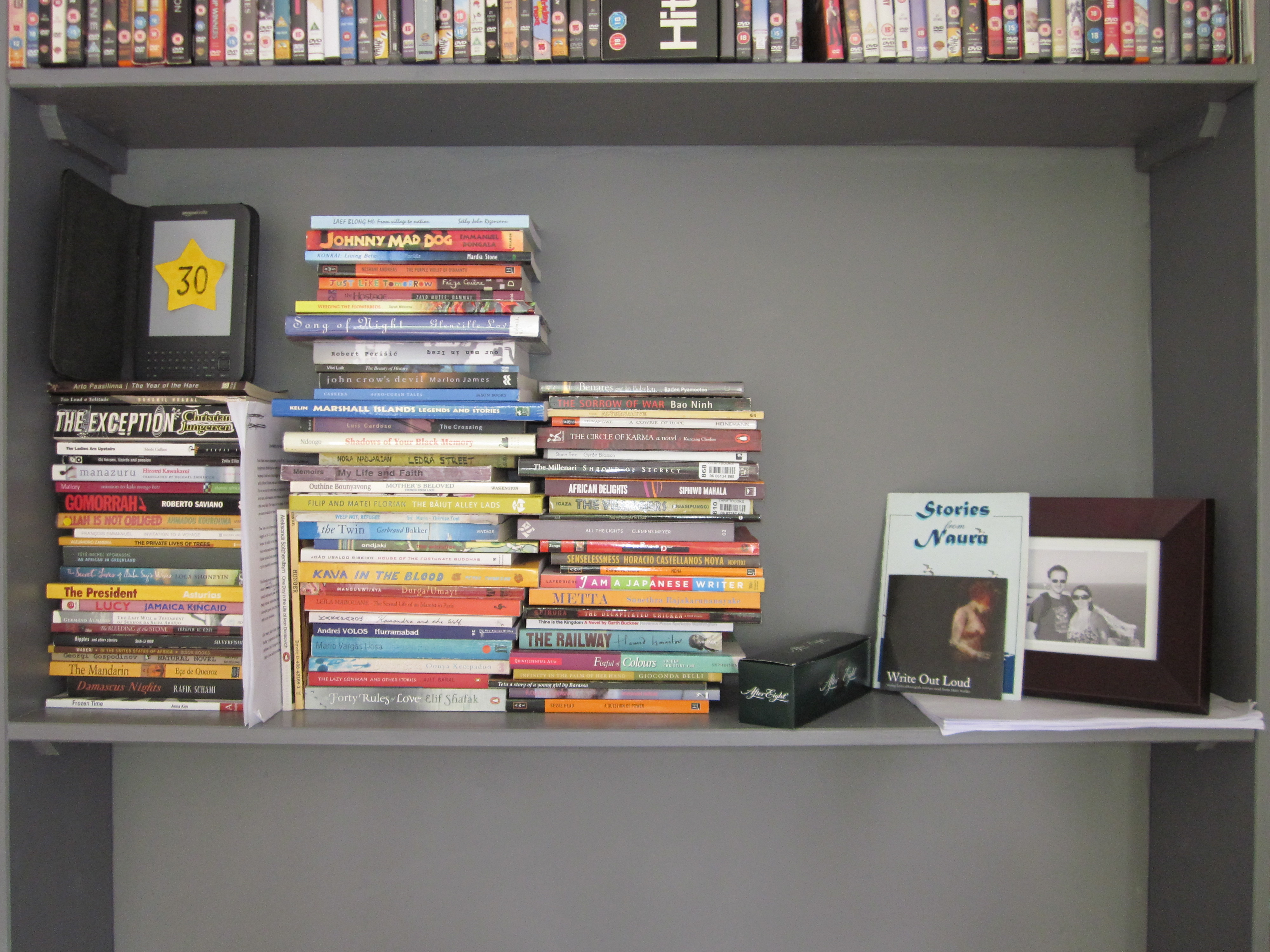
This was another pick from Thomas Slone’s storeroom at Masalai Press in California. Charting Sethy John Regenvanu’s memories of his early life, his experience of being the first boy from Uripiv island to go away to school, his work towards his country’s declaration of independence in 1980 and his time as a minister in its new government, Laef Blong Mi (or My Life) documents a key period in Vanuatu’s history. It weaves together political events and Regenvanu’s own story, with the help of the author’s photographs, to reveal the personal and social impact of gaining sovereignty and what it means to build a nation from the ground up.

The narrative brims with cultural insights, particularly in the early sections. From learning the lost art of fishing with black sea slugs to discovering the rituals of a Vanuatuan circumcision ceremony, the reader encounters a whole host of information about traditional life on the islands. Despite having a total population of fewer than 250,000 people, the archipelago is divided into a series of communities that differ enormously from one another – so much so that when Regenvanu went away to school on mainland Efate he was the only pupil there who spoke his language.

However, perhaps most striking of all is the revelation that Regenvanu, having no official birth date and finding himself obliged to ‘pinpoint when [he] had begun’ by the Franco-British colonial administration, plumped for the date 1 April 1945, both from a sense of lightheartedness – because this is the Western April Fools’ Day – and because this is the day the UN was founded.

This sense of the interconnectedness of his own story with national and international events is a theme throughout the book. From a young age, as the possibility of independence beckoned, Regenvanu felt the desire to use his education to help lead his compatriots ‘out of our former status of being non-persons in our own land to becoming proud citizens of the new nation of the independent Republic of Vanuatu’. He writes passionately about his belief in the state and its potential, as well as the importance of holding to the ‘spirit of struggle and unity of purpose’ that fired the early years.

Nevertheless, Regenvanu, who is also a church minister, is clear-eyed about the challenges the new nation faced. Contending with everything from black magic practised by opponents  to a widespread lack of self-belief engendered by decades of colonialism – not to mention the interference of the occasional American millionaire set on using his wealth to create his own ‘Utopian dream’ from the fragile, new nation – Regenvanu likens his task in some of the ministerial posts he held to ‘trying to force the negative and positive ends of an electric pole together’. Sometimes this was almost literally the case, as when Regenvanu found himself in a tug of war with the representative of a rebel faction, who was trying to hoist an illegal flag in the midst of an attempted coup.

Inevitably for an autobiography Regenvanu’s views are partial and shaped by his political standpoint and beliefs. Some of the later chapters also get a little too caught up in technicalities that clearly still rankle for the writer but mean little to a reader at this remove of time and distance.

However it is hard not to be impressed by Regenvanu’s integrity and evident desire to work for the good of his people and nation. Coming from a country where politics can often seem to be more about the advancement of personal agendas and careers than about effecting meaningful change, it was humbling to read the words of someone who saw his time in power as a chance to improve the lives of his compatriots. His story is a powerful reminder of what aspiration, education and determination can achieve.

Laef Blong Mi: From village to nation by Sethy John Regenvanu (Institute of Pacific Studies and Emalus Campus, University of the South Pacific, 2004)

Solomon Islands: between two worlds

This was another recommendation from The Modern Novel  – and a welcome one too, given that the list entry for the Solomon Islands was ominously blank. There just seemed to be nothing out there from this tiny archipelago hovering some way above Australia in the big, blue Pacific.

So when my copy of John Saunana’s 1980 novel The Alternative arrived from a bookseller in Spain, I was interested to see that when it was published it had been held up as the great white hope of literature in the region. ‘At a time when contemporary Solomon Islands writing is growing in scope and depth, this novel will stand as a signal achievement, as a challenge to other Solomon Islands writers,’ proclaims the blurb, while the flyleaf boasts the support of a range of illustrious organisations.

I couldn’t help wondering where the fruits of this apparent late 20th century burgeoning of Solomon Islands writing had got to. As far as I’d been able to find out, those looking for written work in English from this Commonwealth nation would find very little alternative to, er, The Alternative.

Exploring the effects of colonialism, the novel tells the story of Maduru, an intelligent boy forced to inhabit two universes. Singled out for education at an exclusive, British-style boarding school, dubbed the ‘Eton of the Pacific’, he finds himself pulled between the culture he was born into and the one that has been imposed on his island home. At last, as British decolonisation sets in and old certainties begin to crumble, he is forced to choose between his place in the world and his sense of self.

The novel is strong on its depiction of the way colonialism seeps into and warps an individual’s sense of identity. Portraying Maduru’s moments of wishing to be white and his contempt for the ‘bush kanakas’ in his home village, as well as his internalisation of Western attitudes, Saunana is skilled at showing how subjection spreads its roots through everyday life. Perhaps the most powerful example of this comes in the early chapters, when Maduru, indignant at being cast as the Virgin Mary in a school play, rebels against his teachers in his mind: ‘if I were Samson I’d tear you to pieces like the lion, and pull down this chapel like the Temple and kill everybody in it,’ he thinks, unaware that his choice of imagery betrays exactly how deep into his consciousness Western culture has sunk.

Saunana’s anger at the injustice and discrimination of the colonial regime comes across clearly too. At times, this takes the form of highlighting the absurd reality of living in a ‘colonial relic’, subject to decisions taken by penpushers in a drab, rainy country on the other side of the world. Elsewhere, it is expressed more extremely, as when the headmaster, driven to distraction by Maduru’s unionisation of the student body to get a teacher removed, gives vent to a rant about ‘this God-forsaken place’, which lays his prejudices bare. There is also the interesting decision to put some of the later dialogue in Maduru’s mother tongue, excluding English language readers from understanding the full meaning.

Without doubt, this is a novel of its time. Some of the attitudes, in particular Maduru’s unashamed sexism, read oddly in 21st century London.

There are also some pacing problems in the narrative. Saunana has a strange habit of spending the last pages of a chapter building a dilemma for his hero, only to diffuse it and sweep it away in the final paragraph, leaving the reader nonplussed. Digressions – some delightful, some downright odd – are rife and there are moments of hyperbole, which teeter on the verge of the ridiculous in the school context, although they work better if understood as metaphors for a wider national struggle.

Nevertheless, this is a fascinating, strange and engrossing book. Anyone with an interest in colonial and post-colonial literature will find much to chew on here.

And if you do know what happened to all those other Solomon Islands writers of the early eighties, leave a comment and let me know  – it’d be great to hear of any more works out there.

The Alternative by John Saunana (University of the South Pacific, 1980)