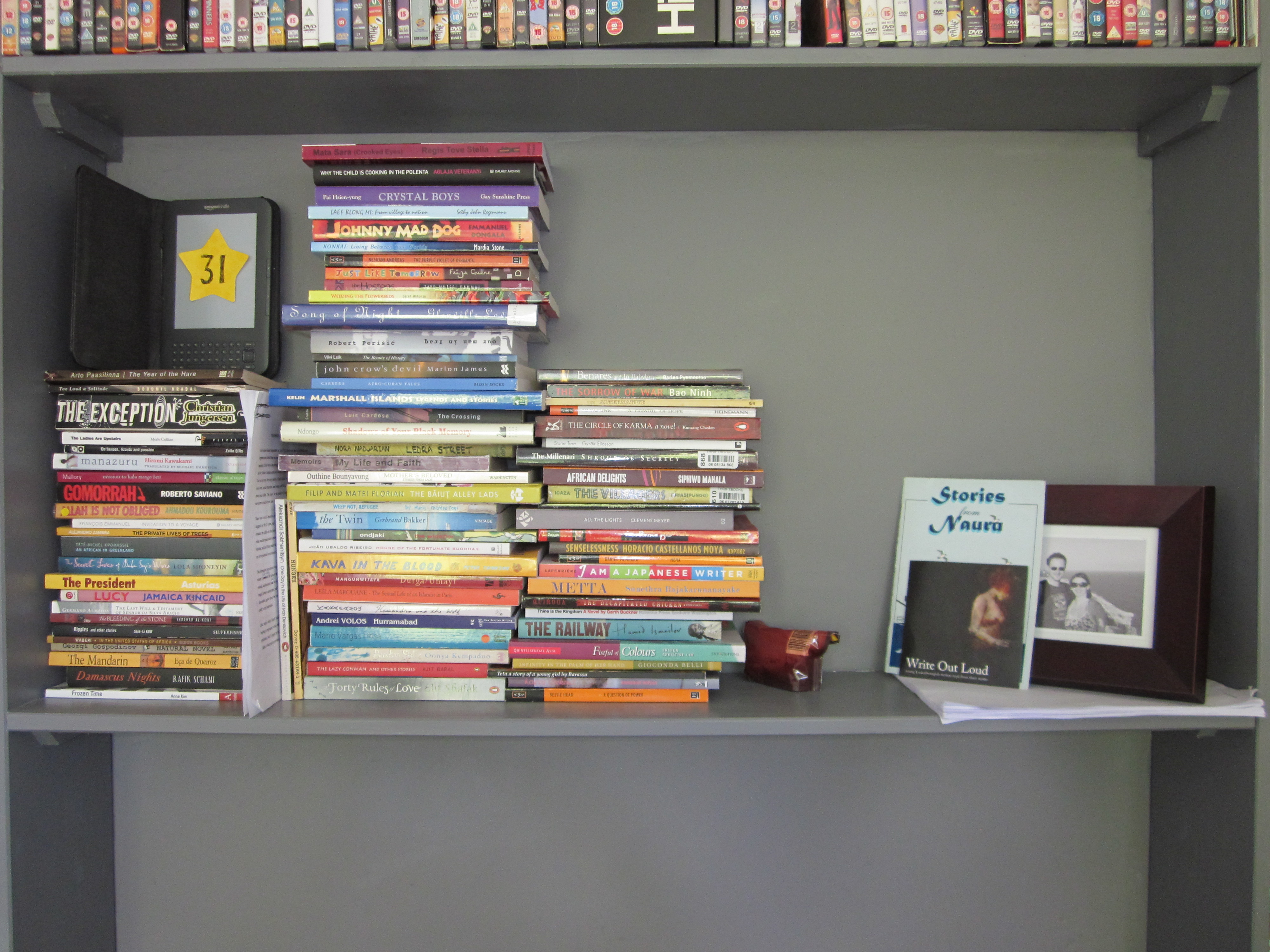
Papua New Guinea: novel techniques

This was one of several recommendations from Bernard Minol at the University of Papua New Guinea Press and Bookshop. Although I had not found many Papuan books in my initial searches, he was keen to stress that there is a thriving publishing scene on PNG – and the large number of recommendations that he and his colleagues gave me certainly seems to bear this out.

Mata Sara (Crooked Eyes) by Regis Tove Stella follows Perez, a young Papuan man, as he arrives in the Australian capital to take up a postgraduate scholarship. Disorientated and homesick, he sets up home with three other wantoks (literally ‘one talks’ – speakers of the same language in Tok Pisin) and the friends set about making a new life in a culture very different from their own.

But as the days go by, they become increasingly uneasy. Ghostly presences in their flat and rumours of a murder there in years gone by set them on edge. More suspicious still, there seems to be an odd connection between the dimdim (white person) Kate who befriends Perez, her friend Wilmott and life back home…

The clash between Western culture and traditional Papuan life is the central theme of the book. Coming from a place where ‘the belief in ghosts and spirits is part of daily existence’ and ‘women fly at night’ to 21st century Sydney – where CCTV cameras capture every move, homosexuality is accepted and immigrants are treated with suspicion and sometimes downright racism – the students discover much to challenge, unsettle and alarm them. Sometimes this can be very funny, as when Perez dreads meeting an anthropologist because of his memories of the Western academics he encountered back home:

‘Since a child, I had always dreaded anthropologists with their long white beards, round-shaped glasses which conjured up an image of a white monster, watching every move ready to pounce on you. Whenever I saw photos of Father Christmas, I immediately connected them to anthropologists and gradually I also dreaded Father Christmas.’

Such light-hearted observations, however, are indicative of a much deeper sense of disenfranchisement born of a conviction that Papuan culture is treated as little more than a specimen by much of the rest of the world – something to be prodded at, picked over and interpreted in Western terms. ‘It is through their eyes that the world sees us, not our own eyes’, says Perez, explaining to Kate: ‘Many outsiders have written about my country out of their private visions […]. They just want their friends to believe they are great explorers and discoverers.’

This leads to a great deal of resentment, which is articulated through lengthy passages of conversation between the friends in which they frequently express (sometimes unjustified) criticisms against the Western world. While Stella tries to balance this by having Perez emphasise that the concept of ‘crooked eyes’ – or skewed perspective – is common to all people, and therefore likely to be true of them too, the lack of characters or events to counteract the accusations is problematic. The dialogue is also frequently repetitive and stilted, as though the friends are talking purely for the benefit of the reader peering in on their cosy world.

It’s a shame, because when events drive the narrative forward, the book is compelling. The early section, where Perez moves into the flat on his own and experiences some uncanny occurrences is gripping. Sadly, though, this momentum is not carried through into the latter half of the book. Here, the increasingly labyrinthine plot, which takes in tribal chiefs, lesbian abuse, long-lost relatives and a paedophile ring, becomes ever more difficult to buy into. This is not helped by shaky motivation for some of the characters’ decisions. Some readers will also find the male characters’ casual expressions of misogyny and homophobia difficult, although they may of course be further evidence of the young men’s ‘crooked eyes’.

Perhaps the issue goes back to the central theme of the book. By using the Western novel form to tell a Papuan story, Stella may have highlighted the limitations of the ‘dimdim  way of doing things’ when it comes to cultures where storytelling is predominantly oral. Significantly, as has been the case in several other novels I’ve read from countries that were colonised by Western powers in the past, Stella puts some of the dialogue in the latter stages of the book in the characters’ mother tongue, Tok Pisin, thereby shutting the English-language reader out from these exchanges. It’s as though the novel form itself is an imperialist throwback, which exerts rules and constraints that writers from countries where it is not the traditional form of storytelling may prefer to disobey or subvert.

‘That’s what’s wrong with you dimdims. You don’t believe in other cultures,’ says Perez. Perhaps he’s got a point.

Mata Sara by Regis Tove Stella (University of Papua New Guinea Press and Bookshop, 2010)
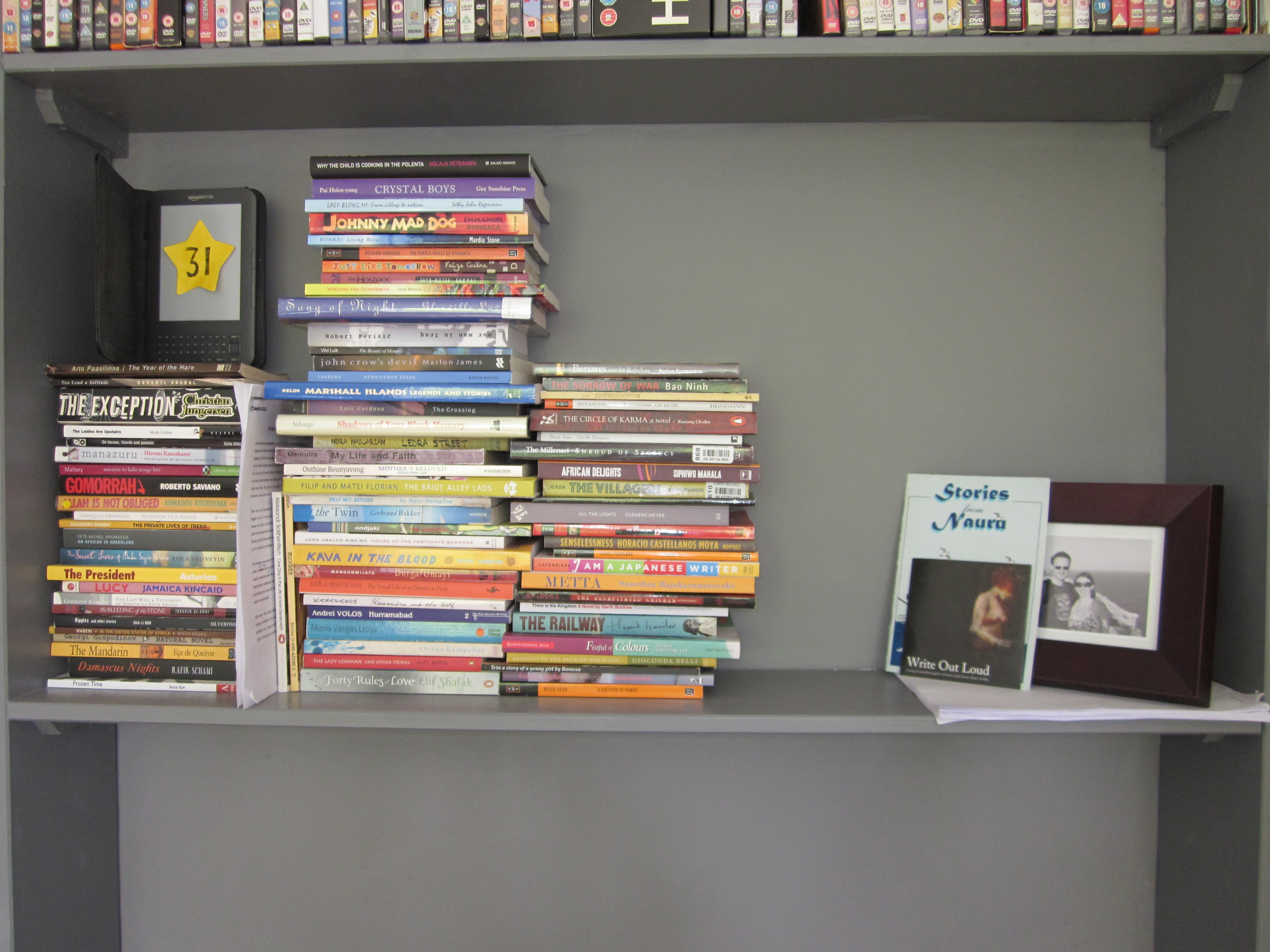
Switzerland: a secret recipe

The internet has been a breeding ground for weird and wonderful literary ventures since it stretched its tentacles into most of our homes somewhere around the mid nineties. Whether you want to talk about, swap, write or analyse books – or even cut them up and make them into something else entirely – there is a site out there for you.

Few people, however, have been more dedicated to exploring the possibilities of marrying web and paper pages than Swiss networker and literary critic Beat Mazenauer. Having been involved with arts projects on the internet since the early days of the information superhighway, he is the driving force behind such collaborations as the literature platform Readme.cc and the recent Imaginary Museum of Migration, which collects and displays the migration stories of its users. He is also General Secretary of the Swiss Ministry of Culture, a daring project that capitalises on the fact Switzerland has no official ministry of culture (as its government members are known as federal councillors instead) to highlight the power of domain names.

Mazenauer gave me a fascinating list of Swiss titles I could read for this project. Several of the books on it were so tempting that I had to ask a colleague to help me choose. In the end, what made us decide on Why the Child is Cooking in the Polenta was the intriguing and tragic life story of its author, Aglaja Veteranyi.

Born into a family of Romanian circus performers, Veteranyi spent her childhood travelling Europe performing tricks until she and her relatives were granted asylum in Switzerland, the country she came to adopt as her home. Illiterate because of her nomadic life, the teenage Veteranyi taught herself to read and write German before embarking on a career as a freelance writer in 1982. However, the abuse and exploitation of her early years had taken a lasting toll and the author drowned herself in Lake Zurich in 2002.

Why the Child is Cooking in the Polenta is an autobiographical novel in which a child narrator describes the life of her itinerant circus family. In addition to walking the tightrope of childhood and adolescence, she must also negotiate the nightly fear that her mother, ‘THE WOMAN WITH THE STEEL HAIR,’ will fall from the winch from which she hangs in the big top, as well as the violence and sexual menace of her father and the risk that the family may be identified and sent back to Romania to be executed. She and her sister do this by masking one horror with another, creating a gruesome story about a child cooking alive in a vat of polenta, which they tell themselves for comfort when the world becomes too frightening.

The subject matter sounds grim, yet the narrative voice is light-hearted and even funny for much of the book. Filled with quirky insights and descriptions that capture the cadences and preoccupations of childhood to a tee, the novel fizzes with life. There is the car trip that ‘lasted several years’ and musings on knotty problems such as whether God speaks other languages, all of which make the succinct expressions of suffering all the more telling when they come: ‘I don’t scream. I’ve thrown my mouth away,’ says the narrator at one point, expressing more in eight words than pages of description could do.

The narrator’s striking perspective on the world is enhanced by the bold structural and formatting choices that run through the book. There are phrases picked out in capital letters, lists of repeated words, one-sentence chapters and even blank pages, which make the work feel more like a baggy poem at points and underline perfectly the disconcerting nature of a childhood where nothing can be relied upon and the most basic of rules do not apply.

At the root of this unease is the search for home and identity. To the narrator, ‘every country is in a foreign country’, and the family’s history and allegiances shift depending on who they are speaking to:

‘OUR STORY SOUNDS DIFFERENT EVERY TIME MY MOTHER TELLS IT.

‘We’re Orthodox, we’re Jewish, we’re international!

‘My grandfather owned a circus arena, he was a salesman, a captain, traveled from country to country, never left his own village and was a locomotive engineer. He was a Greek, a Romanian, a farmer, a Turk, a Jew, an aristocrat, a Gypsy, an Orthodox believer.

‘My mother was appearing in circuses even as a child so she could feed her whole family.

‘Another time she runs away to the circus with my father against her parents’ wishes.’

Out of this melting pot of conflicting accounts, Veteranyi concocts a rich and subtle meditation on childhood, belonging, nationality and truth. Wistful, tart and witty, the book achieves that fine balance of pathos and humour that only the very best childhood narratives share. It left me wanting more.

Why the Child is Cooking in the Polenta (Warum das Kind in der Polenta kocht) by Aglaja Veteranyi, translated from the German by Vincent Kling (Dalkey Archive Press, 2012)

Hungary: lost in transit

This was a recommendation from Stewart of booklit.com. As the driving force behind not only booklit.com but also the World Literature Forum, Stewart knows a thing or two about global literature, so I was keen to see what his suggestion would be like.

Written in 1970 but not translated into English until 2008, Ferenc Karinthy’s Metropole tells the story of Hungarian linguist Budai who inadvertently gets on a flight to the wrong destination and, instead of arriving at the conference he is due to speak at, finds himself stranded in a mysterious country where he cannot make himself understood. Bewildered and increasingly desperate, he must bring all his knowledge, academic training, cunning and instincts to bear in an attempt to crack the cryptic language of the citizens and find his way home.

Karinthy is a skilful storyteller. Sweeping the reader along over the obstacles to credibility – the absence of anyone with knowledge of any of the two dozen languages Budai speaks and the apparent indifference of the hotel staff to his plight, not to mention the whole business of getting there in the first place – he creates a compelling work.

He does this by embracing the unbelievable nature of the story and stretching its boundaries even further: the office block under construction near the hotel grows at an impossible rate, for example, and the city seethes in a ‘never-ending rush hour’. As a result, like the protagonist, we are never quite sure where we are and find ourselves wondering with Budai whether he is ‘on planet earth at all or in some other part of the cosmos’ – or indeed in an imaginary world where the rules are different from our own.

This sense of disorientation is heightened by Budai’s linguistic expertise. Watching a man used to navigating his way between cultures as easily as most of us get around our houses try and fail to achieve even the most basic level of communication is gripping.

At times it can be very funny, as when the hero is ‘all but dancing with rage […], his arms threshing the air’, but as the book goes on and Budai retreats into reticence as a result of the continual rebuffs he encounters it becomes increasingly tragic and disturbing. The unmaking of his confidence and sense of identity develops into a chilling parable about the rapidity with which all of us can be made to abandon our skills and self-belief in the face of sustained rejection and frustration.

If I had to name a gripe, it would be that the pacing is a little odd towards the middle of the book. As Budai circles the communication problem, returning again and again to the same doubtful solutions like someone trying to break into a locked house, the narrative becomes a touch repetitive.

But this is nitpicking. Overall this is a thoroughly engrossing and masterful work about the potentially life and death consequences of not being able to communicate. It is the only book I’ve read where all dialogue bar the words spoken by the protagonist is gobbledygook, yet it is also one of the most thorough and powerful celebrations of language in all its forms. A joy.

Metropole (Epepe) by Ferenc Karinthy, translated from the Hungarian by George Szirtes (Telegram Books, 2012)

Amended on July 30 2018 to correct the spelling of the protagonist’s name.

Taiwan: living on the edge

Taiwan is the country with the most tenuous claim to be included on the list of independent countries I’m reading books from this year. It was a member of the UN until 1971, when the dispute between its government, the Republic of China, and the Chinese government, the People’s Republic of China, led to the UN voting to withdraw its recognition of the ROC and thus Taiwan. From that time onwards, although Taiwan governs its internal affairs independently and many countries around the world maintain informal diplomatic relations with it (the UK government sent a parliamentary delegation to visit the country in 2011, for example), the nation has officially been part of China. Only 22 UN members recognise it as a separate sovereign state.

I was curious to see what literature from this disputed land might be like, so when @markbooks suggested Pai Hsien-yung’s Crystal Boys, I was quick to add it to the list.

Claiming to be ‘the first modern Asian gay novel’, the 1983 book portrays the lives of a group of young male prostitutes in Taipei’s underworld. Following A-Qing, a teenage run-away who was expelled from school and thrown out of home for being found in a compromising position with a supervisor, the narrative explores the precarious lives of these young men, peeling back the layers to show the tenderness, vulnerability and hurt within.

The subject matter and suggestive cover picture of a half-naked Taiwanese youth set up an expectation of explicitness that is actually quite misleading. In fact, beyond passing references, the book doesn’t feature a single sex scene. Instead, all the drama and extreme experience is played out in the dialogue between the characters, in which cruel insults and desperate appeals are laughed off in a welter of banter. There is the boy Wu Min who talks about his plans for suicide only for his friends to think he is joking until he goes home to slash his wrists and the chief who pushes the youngsters into encounters with seemingly heartless abandon.

Yet, beneath the hard shell that nights around the lotus pond in Taipei’s New Park and later at the Cosy Nest café force them to develop, the boys possess a great deal of warmth and tenderness that often expresses itself in surprising ways. When Wu Min is in hospital and unable to meet his medical bills, the boys all donate blood to keep him alive – ‘what we share in common are bodies filled with aching, irrepressible desire and hearts filled with insane loneliness’, observes A-Qing, articulating the bond that ties him to his friends. In addition, A-Qing, who misses his younger brother Buddy, is forever adopting and protecting younger boys who remind him of home.

Indeed, by far the most daring and subversive aspect of the book is not its presentation of sexuality and prostitution but its use of those things to express ideas about nationhood, sovereignty and identity. As homosexuality was illegal in mainland China until 1997, it is effectively off-limits, out-of-bounds and dangerous territory in the book. This enables Pai Hsien-yung to use the crystal boys’ world as a powerful metaphor, as the opening lines of the novel show:

‘There are no days in our kingdom, only nights. As soon as the sun comes up, our kingdom goes into hiding, for it is an unlawful nation; we have no government and no constitution, we are neither recognised nor respected by anyone, our citizenry is little more than rabble. […] It’s as though our kingdom were surrounded and hidden by a tightly woven fence – cut off from the outside world, isolated for the time being. But we are always keenly aware of the constant threat to our existence by the boundless world on the other side of the fence.’

At times, the narrative becomes a little stilted and episodic, with too many characters crowding in one after the other. Pai Hsien-yung’s tendency to stress the emotional suffering of the boys can also be a little repetitive and could have done with some tighter editing.

However, none of this detracts from the fact that this is a courageous and fascinating work from a writer not afraid to speak out against the majority. The book is a gripping insight into a fragile and contested world. Powerful stuff.

Crystal Boys (Nieh-Tzu) by Pai Hsien-yung, translated from the Chinese by Howard Goldblatt (Gay Sunshine Press, 1995)

Vanuatu: a global village

This was another pick from Thomas Slone’s storeroom at Masalai Press in California. Charting Sethy John Regenvanu’s memories of his early life, his experience of being the first boy from Uripiv island to go away to school, his work towards his country’s declaration of independence in 1980 and his time as a minister in its new government, Laef Blong Mi (or My Life) documents a key period in Vanuatu’s history. It weaves together political events and Regenvanu’s own story, with the help of the author’s photographs, to reveal the personal and social impact of gaining sovereignty and what it means to build a nation from the ground up.

The narrative brims with cultural insights, particularly in the early sections. From learning the lost art of fishing with black sea slugs to discovering the rituals of a Vanuatuan circumcision ceremony, the reader encounters a whole host of information about traditional life on the islands. Despite having a total population of fewer than 250,000 people, the archipelago is divided into a series of communities that differ enormously from one another – so much so that when Regenvanu went away to school on mainland Efate he was the only pupil there who spoke his language.

However, perhaps most striking of all is the revelation that Regenvanu, having no official birth date and finding himself obliged to ‘pinpoint when [he] had begun’ by the Franco-British colonial administration, plumped for the date 1 April 1945, both from a sense of lightheartedness – because this is the Western April Fools’ Day – and because this is the day the UN was founded.

This sense of the interconnectedness of his own story with national and international events is a theme throughout the book. From a young age, as the possibility of independence beckoned, Regenvanu felt the desire to use his education to help lead his compatriots ‘out of our former status of being non-persons in our own land to becoming proud citizens of the new nation of the independent Republic of Vanuatu’. He writes passionately about his belief in the state and its potential, as well as the importance of holding to the ‘spirit of struggle and unity of purpose’ that fired the early years.

Nevertheless, Regenvanu, who is also a church minister, is clear-eyed about the challenges the new nation faced. Contending with everything from black magic practised by opponents  to a widespread lack of self-belief engendered by decades of colonialism – not to mention the interference of the occasional American millionaire set on using his wealth to create his own ‘Utopian dream’ from the fragile, new nation – Regenvanu likens his task in some of the ministerial posts he held to ‘trying to force the negative and positive ends of an electric pole together’. Sometimes this was almost literally the case, as when Regenvanu found himself in a tug of war with the representative of a rebel faction, who was trying to hoist an illegal flag in the midst of an attempted coup.

Inevitably for an autobiography Regenvanu’s views are partial and shaped by his political standpoint and beliefs. Some of the later chapters also get a little too caught up in technicalities that clearly still rankle for the writer but mean little to a reader at this remove of time and distance.

However it is hard not to be impressed by Regenvanu’s integrity and evident desire to work for the good of his people and nation. Coming from a country where politics can often seem to be more about the advancement of personal agendas and careers than about effecting meaningful change, it was humbling to read the words of someone who saw his time in power as a chance to improve the lives of his compatriots. His story is a powerful reminder of what aspiration, education and determination can achieve.

Laef Blong Mi: From village to nation by Sethy John Regenvanu (Institute of Pacific Studies and Emalus Campus, University of the South Pacific, 2004)

Canada: inside story

This book had lots going for it. The British Centre for Literary Translation’s director Dr Valerie Henitiuk, a Canadian national, told me it was one of the best translations she’d come across. In addition, as a Quebecois classic, it would be the first French-Canadian novel I’d ever read. And it was feminist literature – something I’ve had a fascination with ever since my year of reading women opened my eyes to some of the riches in this frequently overlooked field of writing. Nevertheless, even with all this promise, I could not have imagined the treat I had in store.

Split into three parts, Nicole Brossard’s Mauve Desert takes storytelling and translation apart from the inside. The first section follows 15-year-old Mélanie as she speeds across the Arizona desert in her mother’s car, ‘moving forward in life, wild-eyed with arrogance’, while also fleeing the insecurity, awkwardness and tenderness of life at her lesbian mother’s motel. Next, the middle part catalogues the experience of Maudes Laures, who finds Mélanie’s story in a second-hand bookshop and spends two years obsessing over its meaning and the actions of its characters and author, Laure Angstelle. The final section is Maudes Laures’s translation of Mauve Desert, which is at once similar to and very different from the original text.

Rich, ambiguous and fluid, Brossard/Angstelle’s writing sweeps the reader into the heart of teenage longing, using fine details to evoke intense experience. Long, sultry afternoons around the pool consist in the glint of wet tiles and the snaking of a hose pipe, while the rush of speeding through the desert shimmers on the horizon and in the dizziness of dehydration. Deliberately ambiguous, ‘both in focus and out of the frame’ as Mélanie describes her driving experiences, the narrative opens up a vast landscape of multivalency so that we can often never be sure exactly what is taking place. ‘Reality had a meaning, but which one?’ reflects Mélanie at one point.

As Maude Laures discovers, this confusion is precisely the point. While she strives to get to the heart of the text that has obsessed her, picking apart places, characters and events, and even at one stage imagining an encounter with Laure Angstelle herself in which she berates and interrogates the author over her treatment of one character, she finds herself dazzled by ‘the inexorable light that transforms lives of flesh into the bare bones of narrative’. As she records and analyses conflicting assertions that she finds in the text and her discourse with it, some sort of truth emerges like a line drawn through a cluster of points on a graph, tying trends and outliers together into a kind of coherent whole.

Yet, as Laures’s translation in the final section shows, this whole will not be the same for any two readers. Filtered through her consciousness and the result of her interaction with the novel, Laures’s rendering of the text (here of course given another layer by virtue of having been translated in reality by Susanne de Lotbinière-Harwood), is a new work. It picks up fresh angles and possibilities in the story and even adds things not in the original, as well as sometimes making passages awkward and stilted. Mélanie’s brush with some aggressive road-users is a good example:

Original: ‘At the junction of Route 10 and Route 25 are dozens of motorcycles, guys smoking as they look at the sky. Two girls are talking. One of them flashes me a peace and love sign while the other one, barely set back in the spatial plane, gives me a violent f**k with her finger, then with her fist. I press on the accelerator. I know reality. Fear, it doesn’t matter when you accelerate; fear vanishes like a dark spot in the rearview mirror.’

Translation: ‘At the junction of Route 10 and Route 25, a gang of bikers are smoking with their noses in the air. Two girls are talking, a bottle of beer in hand. One of them flashes me a victory sign and the other one, barely set back in the spatial plane, violently “up-yours” me with her middle finger, then the whole fist up. I accelerate. I know reality. Fear is nothing, it’s nothing when one is fast so fast. Fear faints dark spot in the rearview mirror.’

This exploration of the mysterious alchemy of translation and the anxieties around the authenticity of such renderings – as Laure Angstelle puts it in her imaginary dialogue with Maude Laures: ‘How am I to believe for a single moment that the landscapes in you won’t erase those in me?’ – is utterly engrossing. It is without question one of the most innovative things I’ve ever read.

However, it does come with a health warning for e-reader fans. While normally a Kindle enthusiast, I would encourage anyone planning to read this to do so on paper. Flicking back and forth between the third and first sections to compare the two versions of the novel is maddening on-screen, whereas it would be a breeze in a hard copy.

Alternatively, of course, you could buy yourself an e-version and a paperback and read it like that. It’s certainly worth it.

Mauve Desert (Le Désert Mauve) by Nicole Brossard, translated from the French by Susanne de Lotbinière-Harwood (Coach House Books, 1990, 2010)

Republic of Congo: war of words

There are some titles that seem to tell you everything you need to know about what’s inside a book. In the case of Johnny Mad Dog, a novel by academic Emmanuel Dongala who fled his native Republic of Congo for the US in 1997 during the civil war, I was pretty clear about what to expect: violence, unpleasantness, people being killed in cruel and unusual ways and possibly an incident with a vicious canine, depending on how literal a writer Dongala was. Just as well then that I’m not a great believer in taking things at face value, because if I had done so I might have bypassed this novel and missed out on a whole lot more.

Set during the civil war, the book follows two characters as they struggle to survive and succeed in the midst of a humanitarian crisis. While scholarly Laokolé tries desperately to get herself, her younger brother Fofo and their disabled mother out of the city as looters descend for 48 hours of mayhem, 16-year-old rebel soldier, rapist and looter Johnny Mad Dog battles for supremacy among his peers, never more than moments away from the next senseless confrontation that could end his life. At last, drawn together into the heart of the vacuum as society implodes around them, the teenagers come face to face.

Yes, violence features heavily. There are sickening killings and assaults. There is the child shot by Johnny and his cronies on the roadside and the television star raped in the studio in front of her camera crew in the minutes before she is due to go on air. What stops these episodes from being gratuitous, however, is Dongala’s insight into the processes by which we justify unforgivable actions to ourselves. Tuned into Johnny’s thoughts as he commits these crimes, we hear his paranoid delusions that his victims are somehow from rival factions – or even Chechen spies – and his bizarre conviction that the women he abuses enjoy what he is doing.

Dongala’s ability to inhabit the minds of his characters also gives rise to some unexpected flashes of comedy. We witness the bathos and confusion of the rebels as they try to dream up a nom de guerre for their breakaway faction and find themselves repeatedly suggesting the names of cars and football teams, and the ludicrous exceptions they make to the dictates of their leaders in this land where there is ‘no longer any logic’.

There are some passages of powerfully empathetic writing too. Dongala’s portrait of Laokolé’s struggles, taking in everything from her thwarted desire to study engineering to the shame and discomfort of having to do without sanitary towels amid the crowds fleeing on the roads, is quite extraordinary.

Inevitably for so humane a writer, the targets of the greatest scorn and anger are not the bungling kids perpetrating violence but the organisations and authorities that dehumanise killers and victims alike. Of these, the UN representatives and rich Westerners at the embassy where Laokolé goes to seek shelter come in for the greatest vitriol – although Dongala is careful to include a sympathetic American who tries to rescue Laokolé and so avoids slipping into the same generalisations that make him angry. Perhaps most scathing of all is the scene in which a convoy of UN vehicles sent to rescue the Western nationals knocks down a young Congolese girl begging for a place in the cars and then halts to allow one woman to run back and collect her ‘little one’, which turns out to be a lap-dog.

Dongala’s impatience to relate these intense experiences means that occasionally his plotting can be a little abrupt. The American’s offer of adopting Laokolé, for example, seems to come a bit out of nowhere, although the extremity of the circumstances might excuse it. In addition, a few of Laokolé’s turns of phrase, such as her claim at one point to have been ‘yielding to an atavistic human instinct’, are a little hard to swallow even for a bright and well-educated 16-year-old.

Overall, though, this book delivers a lot more than its fierce title promises. Subtle and surprising, it takes readers by the hand and leads  us through the chaos of civil war, finding meaning amidst the madness. A powerful work.

Johnny Mad Dog (Johnny chien méchant) by Emmanuel Dongala, translated from the French by Maria Louise Ascher (Picador, 2005)

Iran: gender politics

I was tempted to choose Nasrin Alavi’s We are Iran as my Iranian book. Compiled from a series of blogs translated from Farsi, this book – or blook – caused a great deal of controversy when it burst on to the literary scene in 2005, purporting to provide Western readers with an unprecedented survey of contemporary Iranian thought. However, the book had had a fair bit of attention in the media and something about the way the texts in it had been curated for the Western eye made me hesitate – probably entirely unfairly, given that arguably every text in translation has been selected and prepared with English-language readers in mind.

Then I heard about Shahrnush Parsipur. Something of a trailblazer throughout her life, from being one of the first female students at the University of Tehran through to becoming one of Iran’s best-known and most innovative novelists, Parsipur captured my imagination. Her epic novel Touba and the Meaning of Night, which was published in 1989 just three years after Parsipur’s release from prison, caused controversy for its exploration of religion and gender power relations, as well as its departure from the literary style common before the 1979 Iranian Revolution. It finally became available in English translation in 2006, the year after the much-vaunted We are Iran. I was going to have to take a look.

Spanning the late nineteenth and early twentieth centuries, the novel presents an alternative reading of the history of Iran through the eyes of one woman, Touba, who grows up, marries, divorces, remarries and grows old during the course of it. As dynasties rise and fall and the world moves towards its bloodiest war, Touba embarks on a struggle for supremacy in her own life, finding herself drawn towards Sufism as a possible escape from the oppressive rules and judgments of a society that increasingly forces her to be a prisoner within the walls of her house.

Right from the opening passage, in which a scantily clad teenage Touba cleans the courtyard pool under the disapproving gaze of her tenant’s wives, Parsipur sets out the limitations imposed on women as a central theme in the book. Sometimes, as when Touba’s father reflects that bringing strange women into his home to work might be dangerous because ‘they might participate in some perverse activities with one another’, this is done with wry humour.

More usually, however, it has a much darker side. This initially reveals itself when 14-year-old Touba narrowly escapes a beating from her first husband for going out for a walk alone and later becomes painfully obvious in the story of the raped girl who, on revealing she is pregnant, is killed by her uncle Mirza Abuzar and buried under a tree in the garden. Touba’s reaction to the news is telling:

‘She was filled with the sense of guilt. She wanted to ask Mirza Abuzar why he had not discussed the matter with her. Then she thought, if he had mentioned it, would she have done anything? A living girl who has a bastard child in her is hateful and defiled. The same girl, however, if she is killed like this, will be chosen to be among the Pure Ones. She was realizing that she probably would have done nothing for the girl, or could have done nothing. She tried to put herself in Mirza Abuzar’s place. She truly felt sorry for him.’

Parsipur’s ability to think her way inside her characters like this means that the narrative is far from a one-sided polemic on the oppression of women. Even the most difficult of characters, such as the sinister Prince Gil and the sullen child Ismael who harbours murderous intentions towards Touba because of his anger at the loss of his parents, are presented as rounded and complex individuals with insight and thought processes that often surprise.

This multiplicity of perspectives and Parsipur’s use of elements of magic in her storytelling, give the narrative a sense of plurality that cuts across time and space. Often, in the embedded stories and mini-tales that Parsipur weaves into the novel, it seems as though the author is digging back into the past to gain the depth and distance that will allow her to tell contemporary truths.

The pacing is strange at times, partly due to the sheer scope of the story, which contains so many characters that the editors saw fit to list them all at the start of the book. As a result, the narrative moves in fits and starts, lingering over details only to jerk forward, sometimes skimming over incidents that seem to deserve more attention. This can be frustrating and leaves you glancing back over your shoulder now and then as a major character whizzes past into oblivion, like the stop you expected to get off at the moment you realise you’ve unintentionally caught the fast train.

On the whole, though, there can be no question that this is a towering achievement. Packed with insights, historical detail and rich compelling storytelling, the translation of this epic work opens up a world quite different from the one many English-readers will be used to. A rich addition to anyone’s bookshelf.

Touba and the Meaning of Night (Tuba va ma’na-ye shab) by Shahrnush Parsipur, translated from the Persian by Havva Houshmand and Kamran Talattof (The Feminist Press at the City University of New York, 2006)

Liberia: breaking the taboos

This book was recommended to me by Justin at the African Books Collective when I dropped by the their stall at the London Book Fair back in April. I’m glad he brought it to my attention as the subject matter and cover – which makes the book look a bit like a self-help manual – mean that I probably would never have chosen it on my own.

Written by Dr Mardia Stone, a Liberian obstetrician and gynaecologist living in the US, the book is an account of her homosexual half-brother Konkai’s diagnosis and struggle with AIDS in the late eighties and early nineties. Charting her sibling’s decline and death back in the days when very little was known about the disease, Stone confronts her and her family’s fears and prejudices, weaving in and challenging the attitudes to homosexuality that she and her relatives grew up with in Liberia and discovering a capacity for love that breaks down social barriers.

Stone’s unflinching honesty and direct style make the book. From reflections on death and mortality through to confessions of her and her other siblings’ tendency to laugh at their brother and sweep his sexuality ‘under the carpet’ in the years before his illness, the book is fearlessly frank as well as touching and tender. At times this can make for shocking reading, as when Stone writes about Konkai’s deliberate promiscuity without protection after his diagnosis when his anger and pain were at their peak.

Stone’s frankness  also paves the way for some refreshingly open discussion of the approach to homosexuality in many African countries: ‘You will sometimes hear African people say that Africans, for the most part, are not homosexuals because culturally or traditionally most Africans know nothing about homosexuality. […] It is still taboo in many countries. Yet, I have seen a number of African homosexuals living “in” and “out of the closet” in Africa,’ she writes. Indeed, as Stone explains in her preface and again at the end of the book, a large part of her motivation for writing her brother’s story came from a sense that, because of this reticence, ‘Africans themselves are not writing their stories, everybody else is writing for them’.

In addition to its personal and cultural discussions, the book is also a valuable documentation of a key moment in the history of modern medicine. Having been a hospital doctor in New York during the eighties, Stone writes powerfully about the fear she and her colleagues felt when they first encountered patients with the newly discovered HIV/AIDS virus. Her account of her first exposure to a pregnant woman with the disease is particularly compelling:

‘The woman was immediately isolated. A stack of disposable gowns, masks, shoe covers, gloves and hats were placed in front of her room door. No one dared to enter without being properly suited. We looked like astronauts ready to enter a space shuttle every time we entered her room wearing our protective biohazard suits. Some of us even doubled [sic] gowned, double booted and wore triple hats and masks. We were that fearful. None of us wanted to go into her room alone so we always arranged to see her in pairs or as a group.

‘In the course of caring for our patient, I had to draw her blood. The very thought of this routine procedure was terrifying. […] Terrified, I searched for a fellow resident to assist me, hold my hand and give me encouragement. No one agreed and no one was ‘available’. Even the nurses seemed to be on the snail track to Timbuktu, and because I had a heavy load of over twenty patients that day, I put on my brave face and with a brave heart entered the room alone, in my space suit.

[…]

‘”You people make me feel like a demon,” [the woman] said in response. “Why do you treat me this way? I may have AIDS, but I am a human being. I feel bad enough already and I am hurting because I may lose my baby. Is there no compassion left in any of you?”‘

Occasionally, the directness of the writing leads to assertions that some readers will find uncomfortable. In particular, the discussion of Konkai’s early abuse as a child by a young adult in Liberia and the role this may have played in the development of his identity and sexuality, while no doubt worth exploring, is muddy and at points seems to conflate homosexuality and paedophilia. However, as this seems at odds with Stone’s views elsewhere in the book, it’s possible that this is down to slightly awkward expression of these ideas rather than deliberate intention – it’s interesting to note the disclaimer at the beginning that states the work ‘is not a pronouncement on any debates about the nature of sexual orientation’. The closing sections of the book could also have done with some cutting.

All the same, this does not detract from the fact that this is a brave and often deeply moving book. Few would argue with Stone’s central discovery in the midst of Konkai’s cruel deterioration that ‘compassion is the key to our human experience’. A welcome voice from a part of the world where such subjects rarely get put into words.

Konkai: Living between two worlds by Mardia Stone (Cotton Tree Press, 2011)

Nauru: small triumphs

Every so often on a literary adventure like this, you come across someone who, as if with the wave of a magic wand, is able to solve several of your dilemmas at a single stroke. Thomas Slone is one such written-word wizard. As owner of US-based Masalai Press, a company specialising in work from Papua New Guinea, the Pacific Islands, Australia and Southeast Asia, he knows a thing or two about books from some of the most remote and least published nations in the world – and has a store of rare and out-of-print texts that simply aren’t available through many other sources.

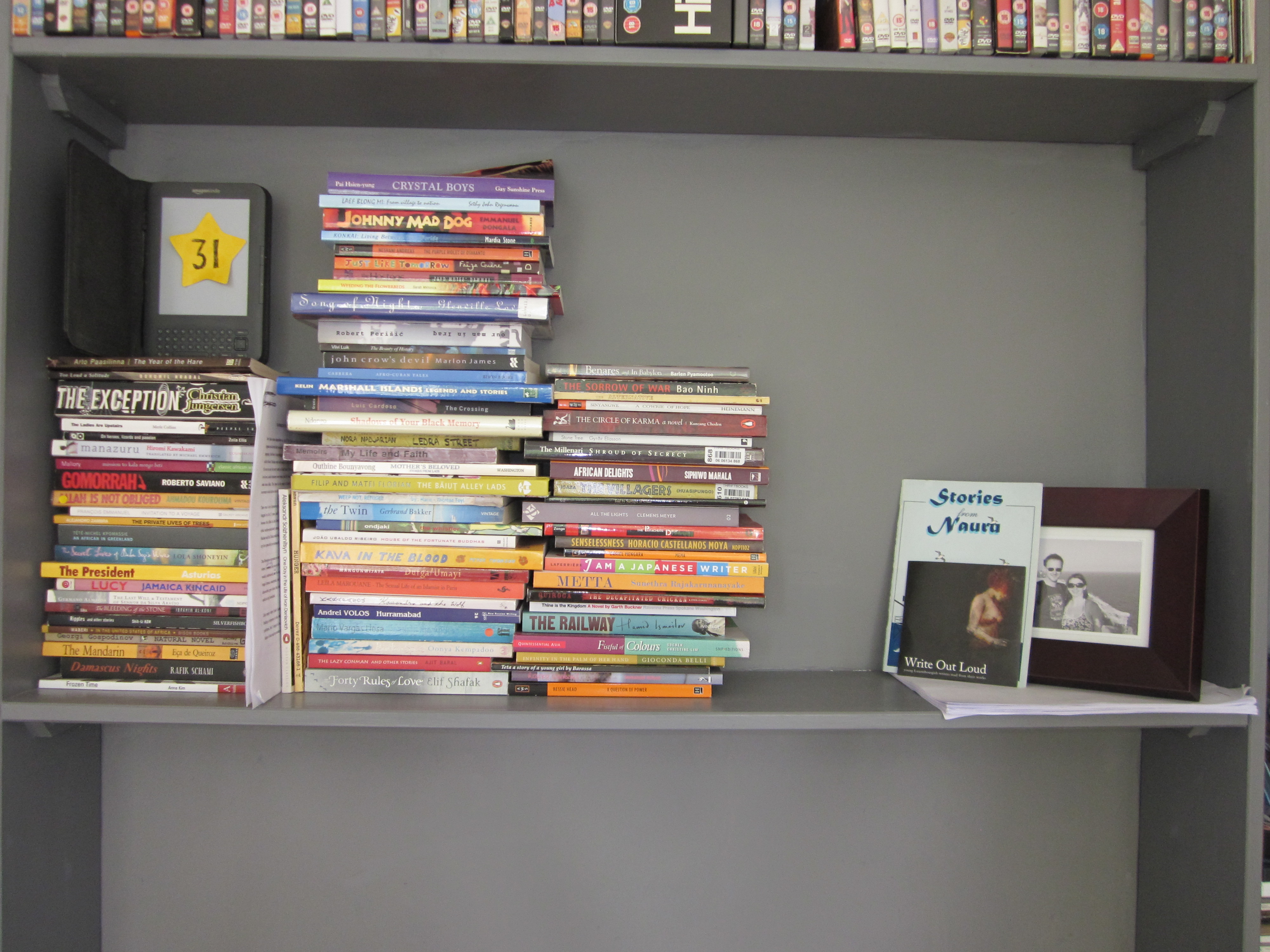
I was put on Slone’s trail by the team at the University of Papua New Guinea Press, which in turn was recommended to me by Kate, who kindly responded to my halfway appeal for help with countries I have yet to find books for. After months of hassling people about Pacific Island literature, it seemed almost too good to be true when Slone not only came back with a list of recommendations for titles from several nations in the region, but also looked out some works that I could buy right there and then, among then Stories from Nauru.

Perhaps fittingly for a book from the world’s smallest island country, Stories from Nauru is a tiny work. Weighing in at just 20 pages, it looks at first glance as though it might sit more comfortably in pamphlet territory rather than trying to fight its corner among volumes ten times its size. The books dated cover design and yellowed pages also make it seem as though it hails from another era altogether, rather than from 1996, the year my edition came out.

The book’s slight appearance, however, belies the scale of its ambitions. Published off the back of a University of the South Pacific workshop on Nauru in 1990, ‘organised so that a conscious effort would be made to encourage Nauruans to write and to record their folklore in the attempt to build up a Nauruan literature’, as the Foreword explains, the collection has grand aims.

However, unlike other short story anthologies I’ve seen from the region, this book is not merely an attempt to document the island’s traditional tales. Instead, it is a collection of fresh creative writing, informed by but not confined to folklore. While some stories, such as Ben Bam Solomon’s ‘The Origins of Nauru’, which features three giants, clearly draw on local mythology, others like Jerielyn Jeremiah’s ‘The New School’, a tale of one girl’s experience of prejudice at  boarding school, deal with the practicalities of modern-day life.

Perhaps most startling of all is ‘A Plea for Help’ by Elmina Quadina, which is about a 30-year-old woman who is losing her hearing. It is impossible to know whether Quadina and her narrator are one and the same, but the piece’s plain language and simple power act like a hand reaching out from the text to draw you into the bleak existence facing disabled people in this remote corner of the world in a way that feels almost too personal to be anything other than real:

‘People, including my colleagues, think I’m stupid. They think I’m just a silly, stupid creature because I cannot hear properly. I don’t blame them for thinking of me in this way because I know it’s hard to talk to someone who is deaf. It’s like talking to a brick wall or a naughty little child who does not wish to listen. But it’s not like this with me because I have my brain and I wish to listen, hear and learn, But how? There is no-hearing [sic] aid or any other aid to help me.’

What the collection does have in common with other texts I’ve seen from the region is a recurring concern about the erosion of traditional culture and the encroachment of the Western world. Indeed, there is a slightly panicky air about some of the pieces, such as Roy Degoregore’s ‘Nauru: The Way it Used to Be’, which feels like a kind of literary Kim’s Game in which he tries to get down everything he remembers about the old customs before time runs out. Other stories, like Lucia Bill’s striking ‘Egade’ have a more wistful, haunting air.

As you would expect from stories produced in workshop conditions, a few of the pieces lack polish and there is a fragmentary, unfinished quality to some of the writing. However, the overall effect of this varied and surprising collection is impressive. The storytelling is, on the whole, fresh and immediate – far from the dry and earnest exercise in cultural preservation the Foreword might lead you to expect. I’d be very interested to know whether the book spawned further such workshops as Nauru clearly boasts some good writers among its 9,378 residents.

Stories from Nauru by Ben Bam Solomon et al (The University of the South Pacific Nauru Centre & Institute of Pacific Studies, 1996)