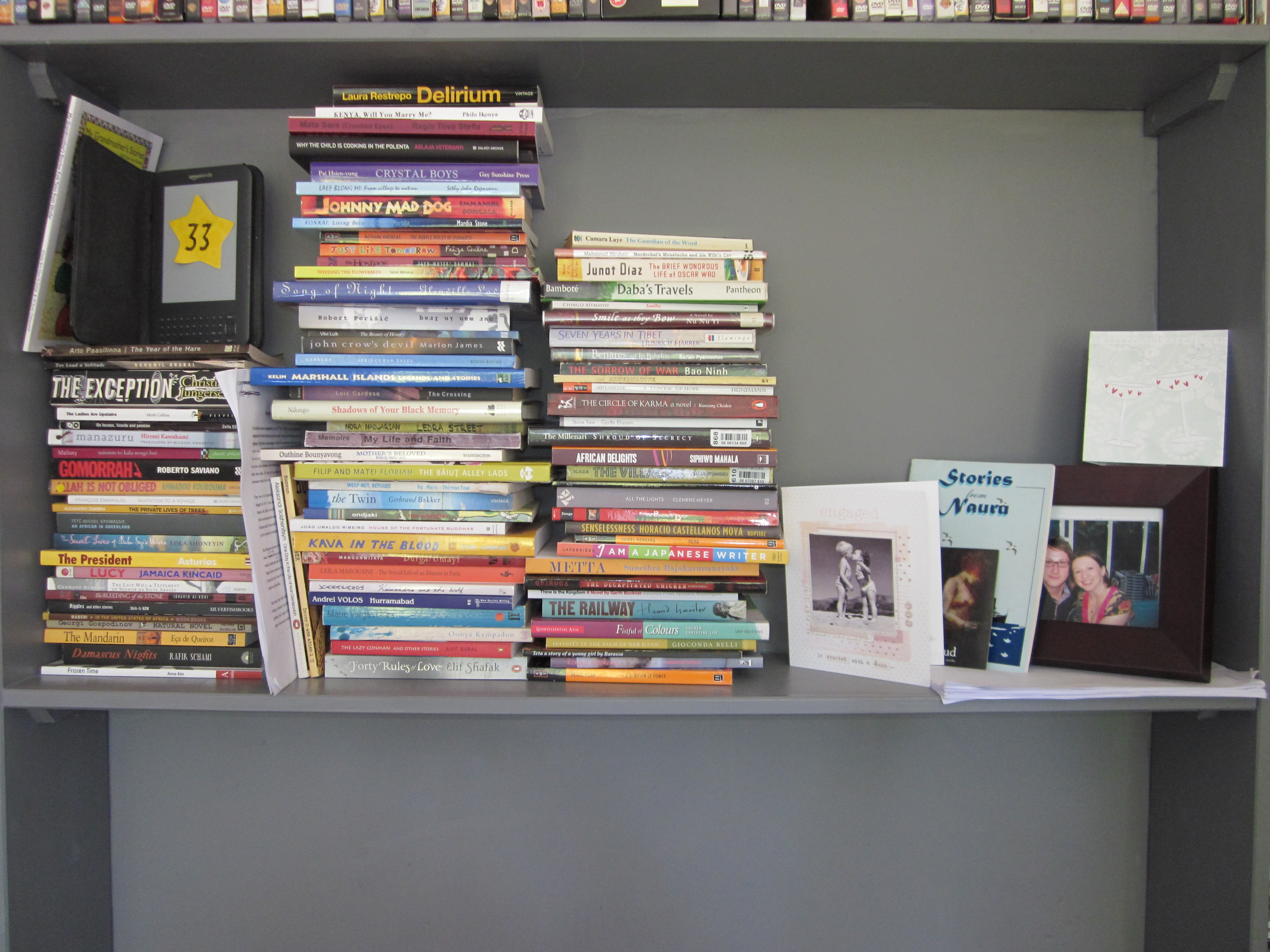
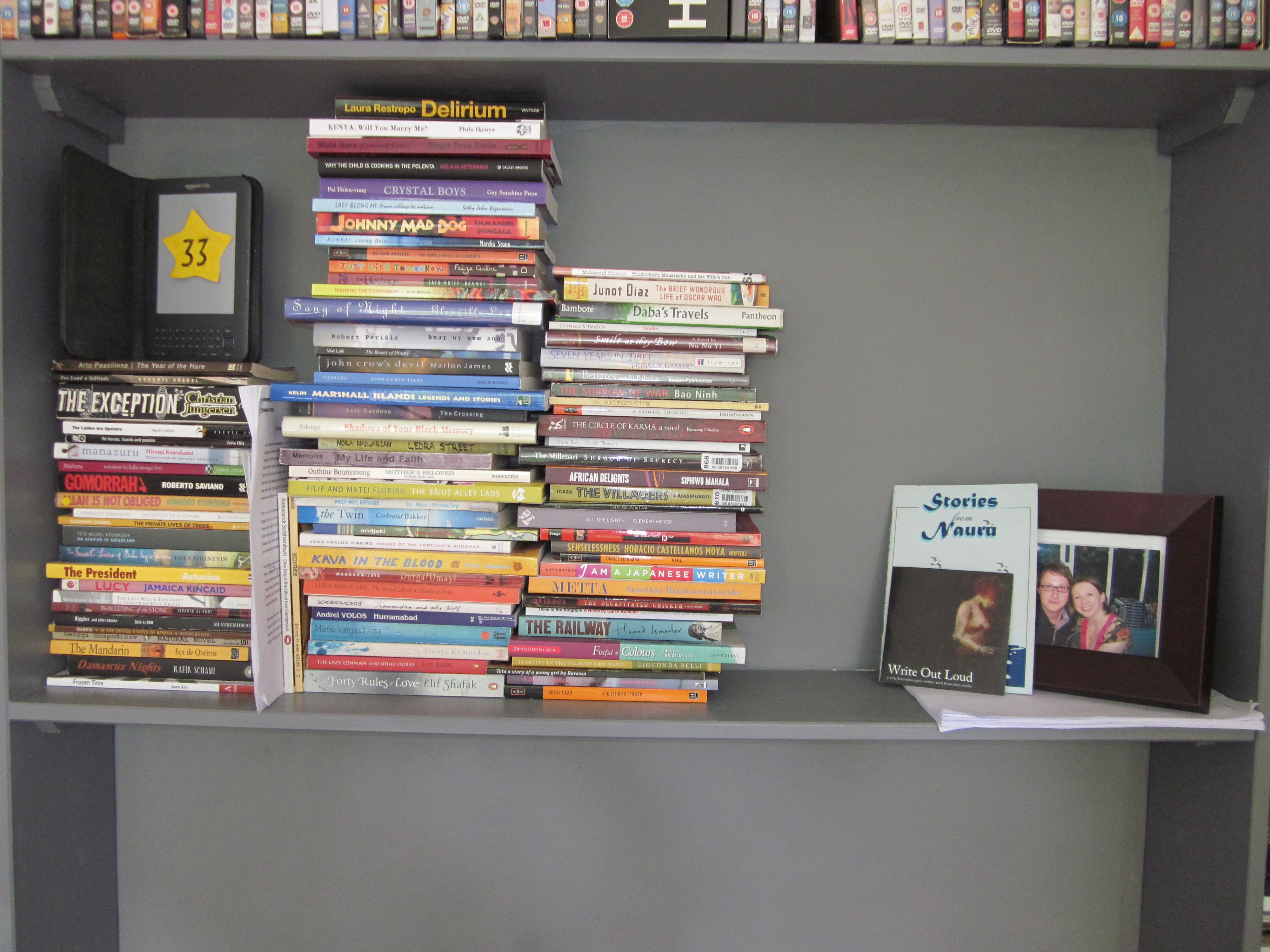
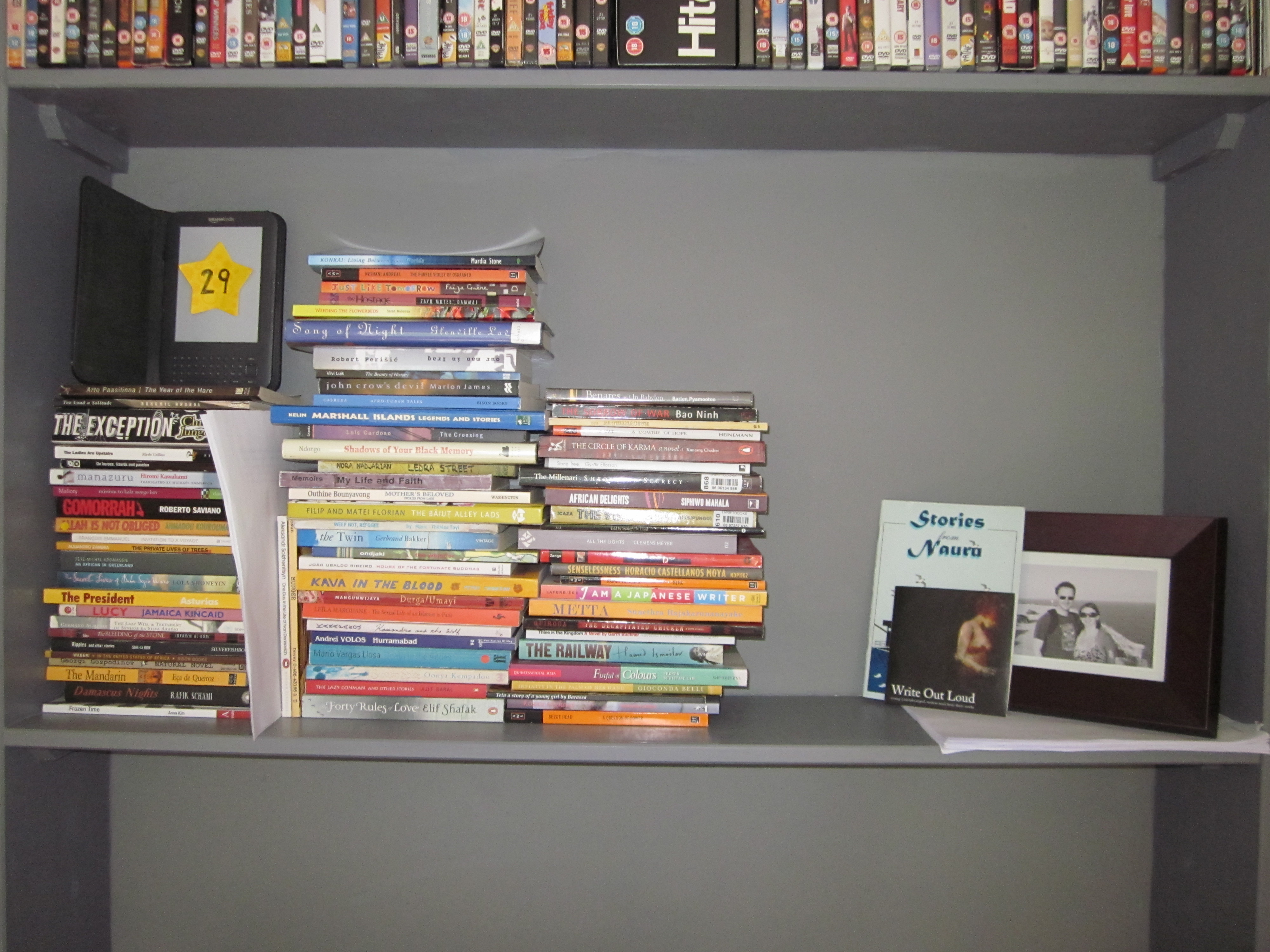
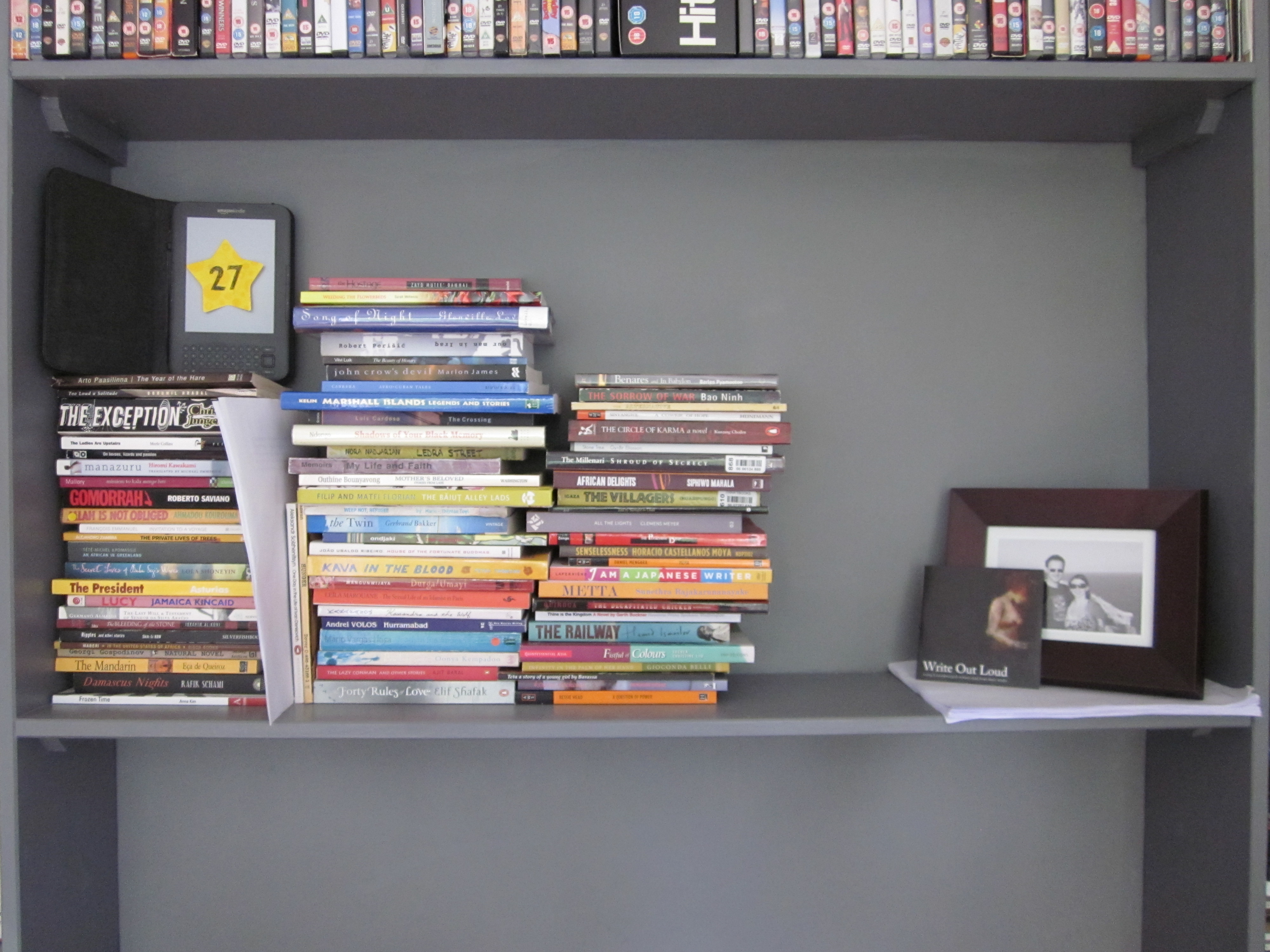
Egypt: breaking boundaries

This was another recommendation from Roger Allen, Professor Emeritus of Arabic & Comparative Literature at the University of Pennsylvania. His number-one tip for Egypt was Nobel Prize-winner Naguib Mahfouz – and he should know as he met the great man several times and translated several of his books. However if I were looking for something other than work by the nation’s leading literary giant, he had several more suggestions up his sleeve from among the thousands of excellent Egyptian writers on the market today. Ain Shams University professor Radwa Ashour was one of these.

I thought about it for a while. On one hand, I was very tempted by Mahfouz: several visitors to this blog had written highly of his work and I was sure I’d be in for a treat with practically any of his books. On the other hand, though, I couldn’t help feeling that Mahfouz was a safe choice. This journey was about discovery, after all, and I was eager to see what else was out there by writers I hadn’t heard of before – so I went for Ashour and chose her book Spectres.

Interlacing the lives of two Cairo academics, history lecturer Shagar and literature expert Radwa Ashour, this part-novel, part-autobiography and part-documentary explores the frontiers of storytelling. The two women are born on the same day and grow up during the mid-20th century, witnessing the Suez Crisis and the protests that shook the capital in the decades after it. As each runs up against the limitations of her gender, political sphere and the medium within which the author allows her to exist, the women seek to shape their own narratives out of the shards and fragments that litter their lives.

This is a courageous and often angry book. Whether it deals with the prejudice against women that causes Shagar’s great-grandmother to be viewed with suspicion because she refuses to marry again and Radwa’s children to be held up at passport control, or the political manoeuvres at the university that see one of Shagar’s colleagues hounded out, Ashour’s writing is indignant and powerful.

This is particularly the case when it comes to the central issue that runs through the book and, to a certain extent, shapes the women’s lives: Palestine. Marshalling sources ranging from Mahatma Gandhi’s 1938 claim that ‘Palestine belongs to the Arabs’ through to testimonials from villagers and Israeli officers about the Deir Yassin massacre, Ashour compiles a compelling  array of evidence to support her character’s forthright attacks on Zionist writers such as Elie Wiesel, ‘who wrote volumes against silence and described in detail the ordeal of the Jews in the Holocaust, of which he himself was a survivor, [but] did not see the contradiction in his own total silence in the face of what was happening to the Palestinians’.

However, as Shagar discovers when she attempts to present a paper at a conference organised on the 25th anniversary of Zionist Martin Buber’s death, the Palestinian perspective is one that struggles to find a platform. Vulnerable to accusations of bias and partiality – and the indifference of a West so far removed from Arab concerns that in 1991 an announcer on CNN is able to compare Baghdad under fire to ‘a huge Christmas tree […] “It’s a magical, thrilling sight!”‘ – the issue remains caught in the perennial paradox that in order for Palestinians to debate on equal terms with their opponents they must already have won the argument and proved their sovereignty to those who refuse to accept it.

Faced with the difficulty of constructing a narrative in the face of such powerful counter-narratives, the novel challenges and interrogates itself, oscillating between fact and fiction in search of a middle path that can carry the truth of both. Ashwour’s voice breaks into the text repeatedly, questioning the decisions she has made about characters, discussing her work in relation to her other books, and revealing the dizzying possibilities open to her as a weaver of stories – a sentiment she finds echoed in a translation of Aristotle cited in the text:

‘The work of the poet is not to narrate that which has happened, but rather that which might happen or is possible in accordance with probability or necessity’.

Seen in this light, this novel, first published in 1998, is in the extraordinary position of being able to enter into dialogue not only with the past but also with the future. With its telescoping of time, that sees, for example, Shagar simultaneously engaged with the events of 1946 and 1972 in Tahrir Square – and its swoops into and out of the future tense – the book seems to extend a line forward to the momentous events that shook the country only last year and takes on an eerily prophetic quality.

Entwining these themes, Ashwour delivers a challenging and complex read that tests the boundaries of communication. Bursting with references and the sheer volume of the ideas it explores and conveys, the novel strains at its seams, spilling out into the world beyond its pages and compelling the reader to engage with what it has to say. The result is passionate, rigorous and shaming.

Spectres by Radwa Ashour, translated from the Arabic by Barbara Romaine (Arabia Books, 2010)

United Arab Emirates: on the money

One thing this quest has taught me is that there’s no harm in trying. You can never predict whether someone will help you from reading their biography or studying their tweets. The worst that can happen when you fire off an email asking for suggestions of books from far-flung corners of the planet is that you receive a grumpy message in reply (rare) or you hear nothing back (more common and completely understandable). But every so often, if you type really nicely and wish double hard, you strike gold.

With this in mind, I sent an email to University of Pennsylvania Professor Emeritus of Arabic & Comparative Literature and leading translator Roger Allen back in June this year, asking for advice on some of the Middle Eastern countries I had yet to source books for. As I discovered when I came across an interview with him on the blog Fascinated by the Arab World,  Allen was uniquely placed to help me. Not only does he hold the US’s oldest professorial post for Arabic as a separate language, but he has also translated books by some of Arabic literature’s finest writers, among them Egypt’s Naguib Mahfouz, whom he met many times.

In spite of his busy schedule, Allen replied with several thoughts. All in all, he confirmed, there was very little available in translation from the Gulf states. However, when it came to the UAE, there was one writer he could recommend with some short story collections in translation: his name was Mohammad Al Murr. I lost no time in looking Al Murr up and within minutes his intriguingly titled The Wink of the Mona Lisa and Other Stories from the Gulf was winging its way to me.

Al Murr’s collection spans a cross-section of UAE society. From the businessman flying first-class to the thief rustling camels to please his prostitute girlfriend, Al Murr’s characters are eclectic and often surprising. There is the driving instructor who charms her way into a family circle, the trumpet player with impractical plans for starting a string of businesses, and the middle-aged man who becomes obsessed with owning a talking parrot.

Quirky and intriguing, the stories often deal with the minutiae of existence, showing how a look, a word or even an apparent wink – as in the case of the title work – can change the course of a life. Often these changes centre on small tragedies or victories, as in ‘The Night’s Catch’, in which three boys steal and sell some pigeons from a violent collector in order to pay for a trip to the cinema, but they frequently point to more fundamental shifts. The outstanding ‘Road Accidents’, for example, in which a husband and wife undertake a treacherous drive through fog, testing and exposing the cracks in their relationship along the way, is a masterclass in using small details as chess pieces to play out psychological battles.

In this world where much is left unsaid and people are often at cross purposes to one another – conducting affairs, gossiping about irrelevancies around a sick-bed and, in the case of the children in the collection, bemused by the oddness of the things others take for granted – it is often left to the non-human participants in the stories to act out hidden tensions and desires. While the naughty pet ape Umm Kamil leads her owners a merry dance in ‘Just Standing There, Smiling’, crashing a wedding and at one point even disrupting worship in a mosque, Adoul the monkey becomes the agent of his mistress’s cruel revenge on a servant in ‘The Awesome Lady’.

One or two of the more enigmatic stories, such as ‘The Secret’, in which a boy becomes a mute because of something he witnesses, have an unfinished quality. In addition, the play with dialogue and one-sided conversations, which works brilliantly in stories such as ‘Words, Words, Words’, overwhelms the drive of a few pieces so that occasionally it seems as though Al Murr is more interested in exploring the technical possibilities than developing the action.

Overall, though, this is a fascinating collection. Packed with rich perceptions, it is an intense evocation of people’s lives and concerns. It is also testament to Al Murr’s skill that our faith in the situations he creates does not falter, no matter how bizarre they may be. It will be a long time before I forget the image of Umm Kamil appropriating the bride’s veil during a wedding feast.

The Wink of the Mona Lisa and Other Stories from the Gulf by Mohammad Al Murr, translated from the Arabic by Jack Briggs (Motivate Publishing, 1998)

Oman: a rare treat

Last December, when Cairo-based blogger mlynxqualey wrote a post on her excellent Arabic Literature (in English) blog giving me her recommendations for books in translation, Oman proved to be a stumbling block:

‘Someone help me so Morgan doesn’t end up reading something dreadful like Behind the Veil in Oman. I am not saying there are no Omani writers; I’m just saying that, outside of stories published in Banipal, I don’t know of anything in English,’ she wrote.

In fact, it wasn’t until nearly nine months later that an alternative presented itself in the shape of a recommendation from the Sultan Qaboos Cultural Center in Washington. It had recently published a translation of a collection of Omani fairy tales and was happy to send me a copy if I was interested. I needed no second invitation to take a look.

Much like Camara Laye’s The Guardian of the Word (see the Guinea post below), My Grandmother’s Stories: folk tales from Dhofar is a work with big ambitions. As set out in a variety of introductions and prefatory materials, author Khadija bint Alawi Al-Dhahab intends the collection, which is dedicated to ‘His Majesty Sultan Qaboos bin Said al-Said and the people of Oman’, not only to preserve the tales that she has gathered and transcribed but also to convey the different lifestyles that were traditional across the Dhofar region. In addition, translator W Scott Chahanovich, who undertook the project as a Fullbright Scholar, regards the recording of such stories as essential to ‘cultivating a sense of Omani nationhood’ and hopes the book will help challenge the fact that ‘the contemporary Arab world is, by and large, still represented by mass media almost exclusively as a monolithic idea’.

If that wasn’t enough to take on in 90 pages, there is also the issue of explaining certain cultural traits that bear on the tales, such as the Omani aversion to bragging and the national admiration for astuteness, and the challenges the author faced transcribing stories told in dialects for which no written form exists. This is further complicated when it comes to translation, with even small metaphors proving challenging to convey, as Chahanovich found when he came to the phrase ‘a cut of your hand’:

‘Confused by the phrase, I consulted the Omani student translators [with whom I was working]. “A cut of the hand,” they explained, is a local colloquial adynaton – a figure of speech expressed in hyperbole that conveys an impossibility. At first, “when pigs fly” seemed most suitable for an English children’s fable; but this is both religiously inappropriate and culturally irrelevant. Islam, like Judaism, prohibits the consumption of pork. Also, there are no pigs in Oman. Choosing “when pigs fly” would be insulting to Omanis and would disregard the cultural particularity of this region, the setting represented in the tales.

‘Instead, I chose another popular adynaton in Arabic, the image of which is shared in other Western versions of the English “when pigs fly”: the cow. In Arabic, the expression is, “when cows go to Mecca to perform Hajj [the religious pilgrimage]”. This is too long and culturally dense to include in an English children’s story. […] Therefore I chose the phrase “when cows fly”.’

With so much going on behind the scenes, you might expect the stories to show signs of strain and awkwardness. Not a bit of it. Lively, witty and original, the tales flow as though they are being told as you read by a seasoned storyteller who combines a sound knowledge of Omani traditions with a gift for creative embellishments when the occasion demands. This is a world where foxes make deals with camel traders, wells produce magical rams, and genies transform puppets into living brides for princes.

The stories often have a dark side too. There is Princess Salma, who has her limbs amputated by a jealous genie ‘insistent that he would not leave her alone until she was in the worst pain imaginable’, and the foolish old couple Shaq and Shurambaq, who kill their grandchild because of their ignorance. Even suicidal thoughts make an appearance in ‘The Poor Woodcutter’.

The advantage of this is that the stakes are nearly always high, making for some gripping stories. It also gives rise to some intrepid women characters, who, while they might need to use disguise or ingenuity to overcome the limitations placed on them by society, nearly always carry the day. Hearteningly there is repeated emphasis on the value of women being clever and shrewd and the importance of marriage being a meeting of minds. Even the unfortunate Salma triumphs in the end, though she pays dearly and disturbingly for the privilege of keeping her chastity intact along the way.

Now and again the moral message seems a bit like an afterthought. You can almost feel the adult narrator reaching the end of a graphic tale of derring-do and adding on a neat little observation out of a sense of duty. In addition, some of the tales finish a little abruptly. The book is also not helped by a formatting glitch that means the contents list page numbers do not match up with the stories.

All in all, though, this is a strong, intriguing and welcome taste of a literature that has until now been off-limits to English-language readers. Let’s hope it’s the first of many to come.

My Grandmother’s Stories: folk tales from Dhofar collected and transcribed by Khadija bint Alawi al-Dhahab, translated by W Scott Chahanovich, Munira Al-Ojaili, Fatima Al-Mashani, Muna Al-Mashani, Muna Saffrar, illustrated by Fatima bint Alawi Muqaybil (Sultan Qaboos Cultural Center, 2012)

Palestine: shifting boundaries

When I started this project, I wasn’t expecting to read a book from Palestine. The list of 196 sovereign states I was working from did not include the Middle Eastern nation, which has received only partial international recognition since the declaration of the state of Israel in 1948.

However, in June I decided to change from my original Western-influenced list to a list of countries that have received some degree of acknowledgement from the United Nations as a more global measure of statehood. In practice, this simply meant swapping Kosovo for Palestine – although it is not a UN member, Palestine is recognised as a non-member entity by the UN and has permanent observer status at all UN meetings.

To this end, I got in touch with Naela Khalil, a leading Palestinian journalist and winner of the prestigious Samir Kassir Award for Freedom of the Press whom I was lucky enough to interview earlier this year. She very kindly contacted many writers on my behalf to find out who had work in translation. A lot of the people she wrote to did not have books available in English, but in July she emailed to tell me that she had had a reply from Mahmoud Shukair, whom she describes as ‘one of the best writers living in Jerusalem’, with information about his first major publication in English: a collection of short fiction entitled Mordechai’s Moustache and his Wife’s Cats.

Bustling with eccentrics, Shukair’s short stories – and the ‘Vignettes’, ‘And Vignettes’, ‘And More Vignettes’ that make up most of the second half of the book – reveal a world where joy and tragedy hinge on tiny details and casual remarks. There is the chancer who tries to exploit a distant family connection with the pop star Shakira to win special treatment at the Israeli Ministry of the Interior, the football-fanatic taxi driver whose tall stories about his friendship with Ronaldo get him beaten up for harbouring spies, and the Israeli border guard of the title who makes a line of people wait for hours because he is paranoid they are laughing at his moustache.

Politics and partition are everywhere, even in the words and images people use in conversation, yet Shukair puts the individuality and humanity of his characters first. He does this by filling his narratives with quirks, tics and details that bring home the personality of those he describes. Often the effect of this is very funny and even surreal, but it can be devastating too, as in ‘The Room’, where the mention of a child’s toys makes the actions of the killer brutally real:

‘He could have been a well-mannered murderer so that we could have found some excuse for him. He could have been a murderer with a good argument, so that we could have had a little admiration for him. But he was pathetic and ugly. Testimony to this was the child’s bedroom, which was ripped apart, his bed, which was burnt, the rabbit, the elephant, the giraffe, the duck and spatters everywhere of his blood. They posed a risk to that ugly murderer who did not have a good argument so that we could have had a little admiration for him.’

There is so much to say about the content of the stories and the window they provide on a world where everything, from getting an education to getting to work, is fraught with difficulty and danger that it is easy to forget the quality of the writing itself. Ranging from bald and stark statements, as in the extract above, to the absurdist and occasionally cryptic tropes of some of the vignettes, many of which read more as extended metaphors than as literal descriptions, Shukair’s prose is urgent and engrossing. He writes interestingly about the influence of Hemingway on his work in the final section, ‘Talking About Writing’, and it is possible to recognise something of that stripped-back style in this translation, although Shukair has many other techniques up his sleeve, not least a masterful sense of the role of humour in heightening poignancy.

He certainly had me enthralled. I hope it isn’t long before we see more of works coming out in English – I want to read on.

Mordechai’s Moustache and his Wife’s Cats by Mahmoud Shukair, translated from the Arabic by Issa J Boullata, Elizabeth Whitehouse, Elizabeth Winslow and Christina Phillips (Banipal Books, 2007)

Iran: gender politics

I was tempted to choose Nasrin Alavi’s We are Iran as my Iranian book. Compiled from a series of blogs translated from Farsi, this book – or blook – caused a great deal of controversy when it burst on to the literary scene in 2005, purporting to provide Western readers with an unprecedented survey of contemporary Iranian thought. However, the book had had a fair bit of attention in the media and something about the way the texts in it had been curated for the Western eye made me hesitate – probably entirely unfairly, given that arguably every text in translation has been selected and prepared with English-language readers in mind.

Then I heard about Shahrnush Parsipur. Something of a trailblazer throughout her life, from being one of the first female students at the University of Tehran through to becoming one of Iran’s best-known and most innovative novelists, Parsipur captured my imagination. Her epic novel Touba and the Meaning of Night, which was published in 1989 just three years after Parsipur’s release from prison, caused controversy for its exploration of religion and gender power relations, as well as its departure from the literary style common before the 1979 Iranian Revolution. It finally became available in English translation in 2006, the year after the much-vaunted We are Iran. I was going to have to take a look.

Spanning the late nineteenth and early twentieth centuries, the novel presents an alternative reading of the history of Iran through the eyes of one woman, Touba, who grows up, marries, divorces, remarries and grows old during the course of it. As dynasties rise and fall and the world moves towards its bloodiest war, Touba embarks on a struggle for supremacy in her own life, finding herself drawn towards Sufism as a possible escape from the oppressive rules and judgments of a society that increasingly forces her to be a prisoner within the walls of her house.

Right from the opening passage, in which a scantily clad teenage Touba cleans the courtyard pool under the disapproving gaze of her tenant’s wives, Parsipur sets out the limitations imposed on women as a central theme in the book. Sometimes, as when Touba’s father reflects that bringing strange women into his home to work might be dangerous because ‘they might participate in some perverse activities with one another’, this is done with wry humour.

More usually, however, it has a much darker side. This initially reveals itself when 14-year-old Touba narrowly escapes a beating from her first husband for going out for a walk alone and later becomes painfully obvious in the story of the raped girl who, on revealing she is pregnant, is killed by her uncle Mirza Abuzar and buried under a tree in the garden. Touba’s reaction to the news is telling:

‘She was filled with the sense of guilt. She wanted to ask Mirza Abuzar why he had not discussed the matter with her. Then she thought, if he had mentioned it, would she have done anything? A living girl who has a bastard child in her is hateful and defiled. The same girl, however, if she is killed like this, will be chosen to be among the Pure Ones. She was realizing that she probably would have done nothing for the girl, or could have done nothing. She tried to put herself in Mirza Abuzar’s place. She truly felt sorry for him.’

Parsipur’s ability to think her way inside her characters like this means that the narrative is far from a one-sided polemic on the oppression of women. Even the most difficult of characters, such as the sinister Prince Gil and the sullen child Ismael who harbours murderous intentions towards Touba because of his anger at the loss of his parents, are presented as rounded and complex individuals with insight and thought processes that often surprise.

This multiplicity of perspectives and Parsipur’s use of elements of magic in her storytelling, give the narrative a sense of plurality that cuts across time and space. Often, in the embedded stories and mini-tales that Parsipur weaves into the novel, it seems as though the author is digging back into the past to gain the depth and distance that will allow her to tell contemporary truths.

The pacing is strange at times, partly due to the sheer scope of the story, which contains so many characters that the editors saw fit to list them all at the start of the book. As a result, the narrative moves in fits and starts, lingering over details only to jerk forward, sometimes skimming over incidents that seem to deserve more attention. This can be frustrating and leaves you glancing back over your shoulder now and then as a major character whizzes past into oblivion, like the stop you expected to get off at the moment you realise you’ve unintentionally caught the fast train.

On the whole, though, there can be no question that this is a towering achievement. Packed with insights, historical detail and rich compelling storytelling, the translation of this epic work opens up a world quite different from the one many English-readers will be used to. A rich addition to anyone’s bookshelf.

Touba and the Meaning of Night (Tuba va ma’na-ye shab) by Shahrnush Parsipur, translated from the Persian by Havva Houshmand and Kamran Talattof (The Feminist Press at the City University of New York, 2006)

Yemen: the past is another country

There isn’t much Yemeni prose for curious English-language readers to get their hands on. At first I assumed this was because of a lack of translation – and that is part of it – but after some time researching Yemeni writers and emailing addresses for bookshops and writers associations that, without exception, bounced my messages straight back at me, I realised that there might be a bit more to it.

In fact, the country’s political history, which saw the rigid regime of the Imams give way to decades of war and unrest in the latter half of the 20th century, means that fiction writing and publishing in the country has been pretty thin on the ground. Nevertheless, there have been some pioneers and of these Zayd Mutee’ Dammaj, whose 1984 novel The Hostage was chosen as one of the top 100 Arabic novels of the 20th century by the Arab Writers Union, has to be one of the most celebrated.

Set during the run up to a brief revolution in the 1940s, the book portrays the struggles of a young boy who is taken hostage because of his father’s political activities and is sent to work as a duwaydar [attendant] in the Governor’s palace. Required to service every whim and desire of the men and women of the household, the boy learns the meaning of powerlessness and subjection. Yet, as his political awareness grows and society outside the palace gates begins to stir, his experiences give him the insight he needs to begin to imagine another future.

Interlink Books, the company behind the Emerging Voices series in which this translation was published, were clearly worried that the historical and social context of the novel might be challenging for Western readers. Not only did they include a preface explaining the reasons for translating the book in this edition, but they also added two introductions and footnotes to the Arabic terms in the text.

They needn’t have been so diligent because Dammaj’s skill as a storyteller is more than equal to the task of carrying his readers over his narrative’s sometimes challenging terrain. Indeed, the sense that we are getting a glimpse into the closed, privileged and long-lost world of palace life under the Imams’ rule is one of the novel’s great strengths. This is helped by the protagonist’s position as an outsider, which means that we discover the world with him and watch as he compares the formal processes of power with the way things are done in his own largely illiterate home community.

However, perhaps the most startling arena of discovery is that of the palace’s sexual politics. Women in this closed world are extremely predatory towards the young pubescent boys serving them, as are the soldiers manning the gates, leaving the hero feeling ‘like a rare bird […] put in a golden cage for life’. During a drive back from a state visit, the women’s possessiveness even spills over into a physical fight, with the boy tossed between them like a doll:

‘Then suddenly, she got hold of me and threw me towards them, so that I lost my balance and fell in some of their laps.

‘”You’re simply jealous of me,” she said, “because he’s sitting next to me. Am I jealous of you because he’s in your beds every night?”‘

Humiliation doesn’t get much deeper than this. However for Dammaj’s hero, the extreme pressure of being possessed and passed around in this way is just the force he needs to sublimate his powerlessness into dignity and develop his own desire for self-determination.

This growth of the protagonist from a naive child into a humane and thoughtful young man is what transforms the narrative from an intriguing account of life in a particular period into a timeless, classic tale. Dummaj shows us the human heart beating beneath the strange clothes and outmoded customs. Powerful writing indeed.

The Hostage (Ar-Rahina) by Zayd Mutee’ Dammaj, translated from the Arabic by May Jayyusi and Christopher Tingley (Interlink Books, 1994)

Israel: war wounds

I have a confession to make: I suffer from World War II novel fatigue. There are so many heart-rending, moving and harrowing books set during the years 1939-45 (as well as plenty of not so heart-rending, moving and harrowing ones) that a story in this category has to promise something out of the ordinary to persuade me to pick it up.

So when I heard that the Israeli novel on the 2012 shortlist for the Independent Foreign Fiction Prize was a war novel, I was pretty uninspired. If it hadn’t been for some very enthusiastic comments by members of the judging panel at the London Book Fair, I wouldn’t have given it a second look.

However the premise of Aharon Appelfeld’s novel, which is told from the perspective of an 11-year-old Jewish boy who seeks refuge in a Ukrainian brothel and enters into a sexual relationship with the prostitute who hides him, sounded intriguing. And when it beat the other contenders to the prize, I decided I had to find out whether this book, written by a Holocaust survivor, had something new to say about the events that ultimately led to Israel’s independence.

This is a novel that jumps in and out of the future tense. Starting on the eve of the boy Hugo’s birthday as his mother anticipates their impending separation, the narrative carries a strong sense of foreboding. This works partly through the dramatic irony that comes from the reader’s knowledge of subsequent historical events. Significantly, however, Appelfeld’s descriptions are so subtle and fresh that, were it not for the novel’s marketing, the reader might not even realise that this is a novel set during the war until several chapters in.

This freshness sets the characters free from the accumulated literary baggage of decades of war literature, giving Appelfeld the leeway to present them as individuals first. He does this by foregrounding details in language that is often disarming in its simplicity – the scene where Hugo says goodbye to his mother while trying to keep her for another minute then another, for example, is very touching.

The power of plain language becomes something of a theme in the book, with the prostitute Mariana telling Hugo at one point that ‘a spare way of speaking can also be colourful’. It’s a shame that Appelfeld doesn’t adhere to this when it comes to Hugo’s letters to his mother, which, full of phrases such as ‘the place is feverish’ and ‘in my heart I know that most of the fears are groundless’, have an odd ring to them. Whether these expressions are attempts on Appelfeld’s part to capture the pomposity of intelligent youth or instances of awkward translation, they jar against the subtle immediacy of the rest of the text.

The setting of the novel is very simple too, with much of the action taking place in Mariana’s room and the small closet in which Hugo sleeps. It’s a tribute to Appelfeld’s skill that he is able to sustain an engaging narrative with such a small array of characters and locations. This makes the final section after Mariana and Hugo leave the brothel all the more powerful for its contrast with what has gone before.

Barring one or two slightly repetitious passages, the intensity of the story builds towards the final chapters as a growing awareness of Jewish identity emerges in Hugo’s mind. This is summed up by a woman he encounters helping displaced people towards the end of the book. Her words suggest something of the sense of shared experience and kinship in the face of adversity that would underpin the formation of the future Jewish state:

‘We have to leave together and watch over one another. Brothers don’t say, I’ve already given. Brothers give more, and we have, thank God, a lot to give. One gives a cup of coffee and the other helps a woman bandage her wounds. One gives a blanket, and the other raises the pillow of a person who’s having trouble breathing. We have a lot to give. We don’t know yet how much we have.’

Without doubt, this is a powerful and striking take on the events that shook the world 70 years ago. Even if it wasn’t the pick of the Shadow Independent Foreign Fiction Prize judges, it is an accomplished and beautiful work.

Nevertheless, as the novel ended I found myself impatient to see how the story continued after the state of Israel declared its independence. I was curious about books set in the country in recent years and itched to read something like Sara Shilo’s The Falafel King is Dead or David Grossman’s To the End of Land to see how these narratives played out in light of all that has happened in the region since 1948. Ah well, maybe next year.

Blooms of Darkness by Aharon Appelfeld, translated from the Hebrew by Jeffrey M Green (Alma Books, 2012)

Iraq: getting a perspective

There were quite a lot of contenders available in English for Iraq. Perhaps that’s not a surprise, given that the country has been in and out of Western headlines for more than the last 20 years. Still, it was good to know that the traumatic occurrences of recent decades had not disrupted storymaking in the region – or so I thought until I read this book.

The Madman of Freedom Square – the first commercially published short story collection by Hassan Blasim, co-editor of Arabic literary website Iraq Story – paints a brutal, yet layered picture of the effects of international events on individual lives in and around post-invasion Iraq. Often starting or ending with a mutilated corpse, the tales trace the connections that bind people to one another and reveal the psychological wounds that result when these ties are ripped apart. There are the refugees reduced to animal cruelty when the truck they are locked in is abandoned, the patriotic songwriter turned atheist who wanders the streets railing against God and existence only to meet a gruesome end, and the underground collective that roams Baghdad making art out of its murder victims.

More than anything, this is a book about the function of storytelling. From the very first tale, ‘The Reality and the Record’, in which a traumatised man tries to tell the right story to secure asylum at a refugee centre, the text interrogates the act of narrating, as though trying to identify its weak points and secret guilt.

Sometimes – as in ‘An Army Newspaper’, an account of an unscrupulous editor who gets trapped in his lies when the dead soldier whose work he has passed off as his own continues to submit reams of manuscripts – storytelling takes on monstrous, nightmarish proportions. At other points, as with the sensational anecdotes spread by gossipmongers in the wake of bomb blasts in ‘The Market of Stories’, it seems a low, self-indulgent exercise, a sort of ‘primitive tribal gibberish which tries to hide behind tasteless and gory laughter’.

That story, however, also holds something of a key to the text’s uneasy relationship with its own function. According to the narrator, it may have its roots in Iraq’s history:

‘Since the fall of Saddam Hussein there have been incessant calls for writing to be intelligible, realistic, factual and pragmatic. […] They claim that the writers of the past made the readers defect, whereas in fact for hundreds of years there were no readers in the country, in the broad sense of the word. There were only hungry people, killers, illiterates, soldiers, villagers, people who prayed, people who were lost and people who were oppressed. Our writers seem to have grown tired of writing for each other.’

It’s important to note, of course, that these are the narrator’s words rather than Blasim’s own. Nevertheless, the question of who narrates, who listens and the value of telling at all rankles throughout the book, inviting the reader to look beyond it to the man writing in Arabic in Finland – Blasim’s home since 2004 – and wonder who exactly these words are for.

Underpinning this unease are repeated comments on the world-altering properties of perspective, with many of Blasim’s narrators suffering from mental illness, trauma or profound emotions that render their accounts suspect. The most powerful example, however, comes in ‘The Virgin and the Soldier’, an account of two young lovers doomed to a horrific death when they are accidentally locked in at the sewing factory where they work at the start of a holiday:

‘In reality there was nothing in the factory but army uniforms, but the government’s aim was to make the UN inspectors suspect that the factory was used for prohibited military purposes. […]

On that morning the American satellite pictures could not of course detect the muffled screams on the second floor. The screaming was hardly audible, and desperate. From the end of a world that was dying it reached the sewing room, which was empty and looked like a dreary sunset over an abandoned city.’

Too much distance, Blasim seems to be suggesting, and we become unable to empathise with fellow human beings, like satellites monitoring the Earth from the exosphere. And yet, even as he writes this, the author draws us in to the heart of the events he describes, immersing us in their brutal, bloody and heartbreaking immediacy.

Some of the stories end less successfully than others and there are one or two twists that miss their marks, but overall this is a powerful and thought-provoking work that transports readers to the extremes of human experience – and a mental terrain most of us are lucky enough never to have to  travel through. If Blasim needed proof of the validity of storytelling, he has written it.

The Madman of Freedom Square by Hassan Blasim, translated from the Arabic by Jonathan Wright (Comma Press, 2011)