Thailand: watching the watchers

Chart Korbjitti caught my eye on Wikipedia’s list of Thai writers. Not only is he a two-time recipient of the Southeast Asian Write award, but he was named a National Artist in Literature in 2004. He made his career through self-publishing his work and is one of that hardy breed of full-time writers who commit to doing nothing but waking up and spinning stories all day long. I also like his glasses.

This is fitting because, as it turns out, vision is a central theme in the book I chose to read. Set in a theatre, the novel records the reactions of a 62-year-old filmmaker as he watches a show dubbed ‘the most boring play of the year’ by Thailand’s drama critics. As the action unfolds in an old people’s home, the protagonist finds himself drawn into the slow drift of events, pausing now and again to imagine how he would represent the action if he were portraying it in a film. Distanced from his everyday routine by the strange suspension of reality the theatre affords, he reflects on the sad events of his life and in the end takes a great deal from the drama playing out in front of him – although whether what he infers is what the play’s director intends remains a mystery.

The novel is one of the most structurally innovative books I’ve read. Jumping between the action on stage, the protagonist’s interior monologue and his imagined shooting script for the scenes he witnesses, the narrative tests the limits of the written medium while exploring the visual arena of stage and screen. The filmmaker’s watching and commenting makes even the most mundane of onstage actions – washing, feeding and entertaining the frail and largely bedridden inhabitants of the home – come alive.

This is particularly true when what he sees encourages the protagonist (if that is the right word for someone who is essentially watching the actions of others) to look for parallels in his own experience. These reflections range from pettish and sometimes funny reflections on the selling of lottery tickets through social issues such as child labour to admissions of his own fears and loneliness. Indeed, the narrative is frequently startling in its stark reflections on ‘the pain of being left alone in the world’. ‘To tell you frankly, when I see something like this, I’m scared. Scared to have to lie on a bed like this. I’m thinking of my wife –’ says the narrator, striking a balance of honesty and reticence that means the narrative never tips over into wallowing.

Yet Korbjitti pushes the boundaries even beyond the trope of a man sitting in an auditorium watching a play. As the show progresses, we find the thoughts of the characters on stage beginning to spill into the narrative, forcing us to question where these recollections and preoccupations come from. In addition, the nagging smell of urine that irritates the filmmaker throughout the show invites us to wonder exactly where the boundary between the real and the imagined lies.

The result is a masterful dissection of the experience of consuming art. At times, I had to stop myself from turning round to see Korbjitti watching me read, constructing a story about a blogger reading a book about a filmmaker watching a play. But perhaps he’s already written it…

Time: a Thai Novel by Chart Korbjitti, translated from the Thai by Marcel Barang (Thai Fiction Publishing, 2010)

Vietnam: war of words

I first heard of this book in a comment at the bottom of an article on the Guardian books website. Opinionated, witty and weird, these reader discussions can often say more about the people writing the comments than the literature they are debating. However, every now and then someone adds something that really makes you think.

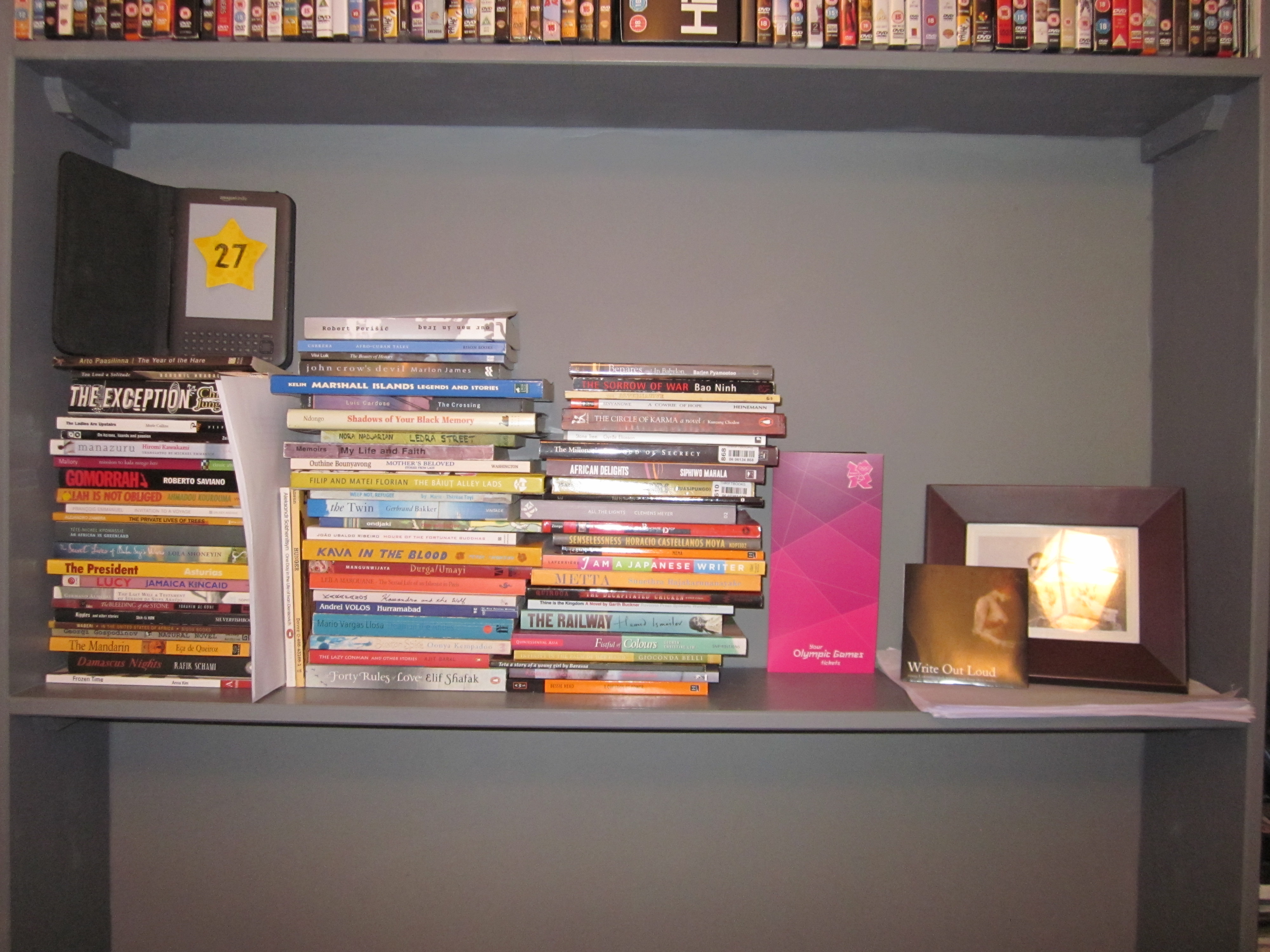
In this case, the topic was books about the Vietnam War. Journalist Mark Hooper had posted his top ten but, as the first commenter remarked, had neglected to include any books by Vietnamese authors. Hooped responded to say that the article was about Vietnam books that claim to be ‘the best book on the Vietnam War you’ll ever read’. He had of course read The Sorrow of War by Bao Ninh, but the book jacket only said sober things like ‘a classic’ and ‘a triumph’ and so it didn’t qualify for the list.

I hadn’t read The Sorrow of War so I decided to give it a go. Given Hooper’s comments, I was surprised when my edition arrived to find the cover sporting a quote from the Independent saying that the novel ‘takes its place alongside the greatest war novel of the century, All Quiet on the Western Front‘ – surely by default that meant it was claiming to be the best Vietnam War book you’ll ever read?

I wondered briefly about popping up to the books department to try and track down this Mark Hooper and ask him what he thought he was playing at. But the article was more than four years old and besides I still had nearly 100 books to get through before the end of the year. I decided I’d better get on with the reading.

Drawing on Bao Ninh’s own horrific experiences during the conflict (he was one of only 10 survivors out of a brigade of 500), the novel tells the story of Kien, a war veteran struggling to piece his life together after 11 brutal years on the front line. Haunted by the memories of what he has seen and thoughts of his teenage life before the war, Kien wanders through the city of Hanoi and a society he no longer recognises. But until he finds a way to express and work through his experiences, peace will remain another world.

Ninh’s writing is exceptional. Blowing apart clinical descriptions of battle procedure with violent blasts of extreme experience, he captures the mixture of detachment and horror that characterises Kien’s mental state. The episodes he recounts – among them the violent rape and murder or three young girls by US troops and the drowning of a wounded man in a flooding ditch – are among the most graphic and shocking I’ve come across but they are never gratuitous and, even after more than 10 years of embedded reporting from the frontlines in Iraq and Afghanistan, they are startlingly fresh. Working with the eerie descriptions of phantoms and monsters that mark the protagonist and his terrified comrades’ ‘drift over the edge from logic’ after months in the Jungle of Screaming Souls, they capture ‘how cruelly [the young soldiers] were twisted and tortured by war’.

For all its anger and violence, however, the novel contains striking moments of beauty. The most bewitching of these involve Phuong, Kien’s childhood sweetheart, who, like him, is irrevocably altered by the conflict. Wistful and raw, these evocations of first love break in upon the narrative like rays of sunshine through the jungle canopy, making their surroundings seem all the more dark and threatening.

The chronology of the novel is complex, with the storyline shifting ground repeatedly so that the past and present all seem to inhabit a sort of formless now, reflecting Kien’s imprisonment in his vivid memories. In the hands of another writer, this might be frustrating, but in Ninh’s it is extraordinary, particularly in the final third, where the way events spiral in on Kien’s most painful recollection draws the book to a devastating close.

If we needed an argument for the importance of translation, it is here in this subtle, gripping, angry and tender depiction of the personal consequences of war. Striding across the arbitrary fronts of race and nationality, Bao Ninh speaks to the heart of human loss and longing. In a world where western journalists write lists of novels that tell only one side of this bitter story, his work should be read much more.

The Sorrow of War (Than Phan Cua Tinh Yeu) by Bao Ninh, English version by Frank Palmos from translation by Phan Thanh Hao (Minerva, 1994)

Bhutan: what goes around…

What people don’t tell you when you set out to read the world is that the research can take almost as many hours as the reading. Googling, emailing groups and individuals for recommendations, checking that suggestions meet the criteria, trying to decide which book to go for – it all takes time. So it’s always a joy when an expert on a particular country’s literature helps me out.

Ngawang at the Writers Association of Bhutan is one of these wonderful people. When I contacted the group through its blog, he sent me a list of five writers, together with four suggestions of titles. Of these, I chose The Circle of Karma by Kunzang Choden, partly because Ngawang described it as ‘one of the best books by a Bhutanese author’, but also because it is the first book by a Bhutanese woman published outside Bhutan, which makes it something of a milestone in South Asian literature. I was very excited when it arrived from India, vacuum-packed in cellophane.

The novel follows the life of Tsomo, a young girl from rural Bhutan who, not content to settle for a life of domestic drudgery, sets out to explore the world. Forced to be an outsider because of a mysterious illness that gives her a permanently distended belly, Tsomo works her way into northern India, drawn by the friendships she makes, a growing fascination with the Buddhist masters and communities that thrive in the Himalayan foothills, and a desire for peace.

The raw deal facing women in rural South Asian society is a major theme. Right from the opening chapters – in which the young Tsomo, unable to convince her father to educate her alongside her brothers, decides that being born a woman must be a punishment for bad karma from previous lives – the book portrays a world in which misogyny, sexual abuse and injustice are daily realities.

Women are by no means passive victims, however. One of the strengths of the book is its portrayal of the series of exuberant and warm friendships Tsomo makes throughout her life with other women. Many of these relationships, such as her bond with Dechen Choki – a young woman Tsomo saves from being raped repeatedly by their supervisor when they are working as manual labourers – are founded on the women’s shared experience of adversity.

This salvaging of positives from suffering is one of the many Buddhist tenets woven through the book. With much of its narrative taking the form of parabolic episodes through which Tsomo learns truths about the world and herself, the novel almost reads like a manual for progression to enlightenment at points.

What makes it work is Choden’s gift for evocation, both of place and of experience. Her descriptions of the rugged spiritual terrain Tsomo covers in her quest for peace and her moments of ecstasy reminded me of other great religious works, such as Sigrid Undset’s Kristin Lavransdatter, particularly in the passages concerning Tsomo’s pilgrimages to sacred sites such as Bodhgaya and Kathmandu:

‘Once there they looked for the Boudhanath chorten, the Great Stupa, the starting point for every Bhutanese pilgrim in Nepal. From the moment they arrived at the chorten, Tsomo felt its awesome presence everywhere. The eyes on the chorten seemed to look deep into her soul and she felt humbled and almost afraid. She felt she could not hide anything from those eyes and yet at the same time, she was drawn to them in a strange way.’

Now and then the narrative gets bogged down in explaining the many religious and social customs that fill the book. This no doubt owes something to Choden’s decision to write her novel in English – a sign that she intended her story to be read outside Bhutan by people who may not be familiar with the country’s culture. Occasionally passages on topics such as why formal marriage is not common in rural communities and the ritual of overfeeding guests can read more like anthropological essays than chapters in a novel.

Mostly, though, this is a fascinating and absorbing book. Reading it drew me into this little-known world even more profoundly than I suspect visiting a hundred Buddhist gompas in the Himalayas would. A rare treat.

The Circle of Karma by Kunzang Choden (Zubaan/Penguin India, 2005)

Iraq: getting a perspective

There were quite a lot of contenders available in English for Iraq. Perhaps that’s not a surprise, given that the country has been in and out of Western headlines for more than the last 20 years. Still, it was good to know that the traumatic occurrences of recent decades had not disrupted storymaking in the region – or so I thought until I read this book.

The Madman of Freedom Square – the first commercially published short story collection by Hassan Blasim, co-editor of Arabic literary website Iraq Story – paints a brutal, yet layered picture of the effects of international events on individual lives in and around post-invasion Iraq. Often starting or ending with a mutilated corpse, the tales trace the connections that bind people to one another and reveal the psychological wounds that result when these ties are ripped apart. There are the refugees reduced to animal cruelty when the truck they are locked in is abandoned, the patriotic songwriter turned atheist who wanders the streets railing against God and existence only to meet a gruesome end, and the underground collective that roams Baghdad making art out of its murder victims.

More than anything, this is a book about the function of storytelling. From the very first tale, ‘The Reality and the Record’, in which a traumatised man tries to tell the right story to secure asylum at a refugee centre, the text interrogates the act of narrating, as though trying to identify its weak points and secret guilt.

Sometimes – as in ‘An Army Newspaper’, an account of an unscrupulous editor who gets trapped in his lies when the dead soldier whose work he has passed off as his own continues to submit reams of manuscripts – storytelling takes on monstrous, nightmarish proportions. At other points, as with the sensational anecdotes spread by gossipmongers in the wake of bomb blasts in ‘The Market of Stories’, it seems a low, self-indulgent exercise, a sort of ‘primitive tribal gibberish which tries to hide behind tasteless and gory laughter’.

That story, however, also holds something of a key to the text’s uneasy relationship with its own function. According to the narrator, it may have its roots in Iraq’s history:

‘Since the fall of Saddam Hussein there have been incessant calls for writing to be intelligible, realistic, factual and pragmatic. […] They claim that the writers of the past made the readers defect, whereas in fact for hundreds of years there were no readers in the country, in the broad sense of the word. There were only hungry people, killers, illiterates, soldiers, villagers, people who prayed, people who were lost and people who were oppressed. Our writers seem to have grown tired of writing for each other.’

It’s important to note, of course, that these are the narrator’s words rather than Blasim’s own. Nevertheless, the question of who narrates, who listens and the value of telling at all rankles throughout the book, inviting the reader to look beyond it to the man writing in Arabic in Finland – Blasim’s home since 2004 – and wonder who exactly these words are for.

Underpinning this unease are repeated comments on the world-altering properties of perspective, with many of Blasim’s narrators suffering from mental illness, trauma or profound emotions that render their accounts suspect. The most powerful example, however, comes in ‘The Virgin and the Soldier’, an account of two young lovers doomed to a horrific death when they are accidentally locked in at the sewing factory where they work at the start of a holiday:

‘In reality there was nothing in the factory but army uniforms, but the government’s aim was to make the UN inspectors suspect that the factory was used for prohibited military purposes. […]

On that morning the American satellite pictures could not of course detect the muffled screams on the second floor. The screaming was hardly audible, and desperate. From the end of a world that was dying it reached the sewing room, which was empty and looked like a dreary sunset over an abandoned city.’

Too much distance, Blasim seems to be suggesting, and we become unable to empathise with fellow human beings, like satellites monitoring the Earth from the exosphere. And yet, even as he writes this, the author draws us in to the heart of the events he describes, immersing us in their brutal, bloody and heartbreaking immediacy.

Some of the stories end less successfully than others and there are one or two twists that miss their marks, but overall this is a powerful and thought-provoking work that transports readers to the extremes of human experience – and a mental terrain most of us are lucky enough never to have to  travel through. If Blasim needed proof of the validity of storytelling, he has written it.

The Madman of Freedom Square by Hassan Blasim, translated from the Arabic by Jonathan Wright (Comma Press, 2011)

East Timor: poetry in motion

This book was recommended by The Modern Novel, a blogger writing about the development of the literary novel worldwide. TMN kindly posted a comment on this site helping me out with a few of the harder to reach destinations (there are still quite a few gaps on that there list and plenty of countries with only one or two titles suggested – go on, have a look and let me know what I’m missing).

Several of the recommendations weren’t available in translation – much more linguistically gifted than I am, TMN reads in French, German, Italian, Portuguese and Spanish, as well as English – however there were some great additions to the list among them. The Crossing by Luis Cardoso was one of these.

In actual fact, The Crossing is not technically a novel, it’s a memoir. Like me, TMN holds the view that the boundaries between these two genres blur the more closely you look at them, which is why we’re both including memoirs in our projects.

Telling the story of Cardoso’s childhood and adolescence in East Timor, the book reveals the nation’s troubled recent history through a small and touchingly precise lens. As waves of Portuguese, Japanese and Indonesian colonialism wash over the country, the author records the tragic impact of these events on the ‘people lost in time’ who have to live through them, caught between the oppressive yet relatively stable patterns of the past and the fragile freedom ahead.

This is a book as much about forgetting as it is about remembering. While Cardoso’s traumatised and exiled father frames the narrative – bumbling about Lisbon where his son is studying trying ‘to recover the memory he had lost’, all his fire and bluster gone – Cardoso himself seeks to reconcile the partial versions of events he encounters with his own fragmentary memories of his homeland.

A nostalgia for Portuguese rule – warmer than any other attitudes to colonialism I’ve read about so far this year – permeates much of the book. For characters like Cardoso’s father the Portuguese administration, despite its enforcement of apartheid, and its rigid and sometimes brutal practices, is ‘the erstwhile mother country […] even though the umbilical cord had been cut in such a way as to make the child bleed and the mother grieve’.

As well  as blending novel and memoir, Cardoso brings in elements of poetry too through his descriptions that conjure places and people as deftly as the briefest of stanzas. Time and again, he captures complex situations in a net woven only of a single sentence, as when he sets out his father’s deluded hopes for his son’s future:

‘He dreamed that, one day, I would take up a post in [an] administration [made up of people educated in Portugal] – the dreams of someone who has built a boat and wants to go on sailing through time, along the lost route of the colonizing caravels’.

The huge cast of walk-on characters and vast catalogue of events mentioned in this relatively slim book mean that occasionally the narrative can jump like a scratched record from one scene to the next. Several times, I found myself having to turn back a page or two, trying to work out how I had been thrust into a storm that seemed to have gusted up out of nowhere. Sometimes, there wasn’t really an explanation.

Taken as a whole, though, this is a touching, lyrical and sometimes playful account of the search for identity in a land you can only fleetingly call your own (East Timor only managed a few months of independence in 1975 before it was conquered by the Indonesians and at last gained its sovereignty in 2002). It makes a compelling artwork out of a shifting kaleidoscope of personal and political allegiances. A great suggestion.

The Crossing: A Story of East Timor (Cronica de uma travessia: A epoca do Ai-Dik-Funam) by Luis Cardoso, translated from the Portuguese by Margaret Jull Costa (Granta, 2000)

Japan: strange coincidences

I was very lucky to have some excellent recommendations for Japan, including a hit parade of must-reads put together by Japanese writer Kyoko Yoshida (see the List for these). However the title of this book was given to me scribbled on the back of a business card at the end of a talk at the London Book Fair.

The card belonged to translator and editor Lucy North, who described Michael Emmerich, the translator of this novel, as her mentor. As I was studying it, I felt a tap on my shoulder and turned round to find myself facing Dr Valerie Henitiuk, director of the British Centre for Literary Translation. Henitiuk was one of the kind and patient people who put up with me asking all sorts of inane and obvious questions when I was researching this project late last year. We’d emailed and spoken on the phone but never met. It turned out she’d been sitting just behind me all the way through the panel discussion.

‘Lucy’s great,’ she said. ‘If she’s given you a recommendation, you should follow it up.’

That decided things. Much like my German book, it felt as though this novel was choosing me.

As it turned out, coincidences and unexpected connections were a very fitting way to come to Manazuru by Hiromi Kawakami. Charting the struggles of Kei to find meaning in her life 12 years after her husband’s disappearance, the book reveals the uncanny links that thread through the past and present, tying us to events that are yet to come.

Disorientation is a big theme in the novel. Drawn again and again to the little seaside resort of Manazuru, Kei wades through a sea of half-memories where time telescopes in on itself and ‘things are vague, unsettled’. Against the relentlessly shifting backdrop of the ocean, she finds the world flooded with otherwordly figures and oddly familiar people and scenes that wash her into a whirlpool of remembering in which she founders, seeking the rock on which she can build a meaningful life.

Kawakami’s spare and precise style works by homing in on details that flash like beacons in the grey mist of Kei’s confusion. From the mended tear in the sleeve of a café cook, to the interaction of bulbul birds in a persimmon tree, she creates a sense of an intricate world balanced by the minute movements of its constituent cogs and wheels.

This attention to specifics gives Kawakami’s work a poetic power, which enables her to write about the contrariness of human emotion and existence with sometimes shocking clarity. Riffing on the theme that ‘disgust and tenderness do not stand in opposition’, she reveals the strange sense of detachment that runs through much of life: ‘however fiercely we hurl ourselves together, it comes to seem that we are only mimicking forms that we have seen before, somewhere’, reflects Kei.

This sense of isolation coupled with gasps of sudden emotion and violence that shudder the text, gives the novel a compelling and often eerie feel. We do not always know where we are or what we are witnessing, but this is the key to the narrative’s power: cast adrift on an ocean of impressions in this striking and subtle work, we come to appreciate the vastness of human experience – and that loneliness may sometimes be the thing that binds us together most of all.

Manazuru by Hiromi Kawakami, translated from the Japanese by Michael Emmerich (Counterpoint, 2010)

Afghanistan: blood and guts

It was harder than I expected to find an Afghan book that wasn’t by Khaled Hosseini. Not that I’ve got anything against Khaled Hosseini, but as he has become the go-to Afghan writer in the UK I was keen to see what else a curious reader could turn up from this much reported and yet strangely mysterious land.

I contacted the Afghan Women’s Writing Project for ideas. They sent back some intriguing suggestions, several of which are on the list, however as most of the books they mentioned were either stories that had been told by women to non-Afghans and written down or accounts by Western journalists and soldiers of their experiences in the country, I didn’t feel they quite met my criteria.

I even had a brief exchange with a Canadian soldier-cum-food blogger who is serving out in Afghanistan at the moment. He told me the writer he’d read in preparation for his trip was… Khaled Hosseini.

In the end, a mixture of googling and reading reviews turned up Prix Goncourt-winning The Patience Stone by French-Afghan writer Atiq Rahimi. Skipping the introduction (by Khaled Hosseini) I plunged right in.

Set ‘somewhere in Afghanistan or elsewhere’, this slender novella portrays the struggles of a nameless woman as she tries to care for her comatose husband in a city torn apart by war. As militants roam the streets, bombs fall and the front line shifts to her neighbourhood cutting her and her children off from basic supplies, she battles to stick to the strict regime of prayer prescribed by the Mullah and to keep the wounded man clean and stable.

But as the days creep by measured out in the names of God she must recite 99 times for each of her 99 prayer beads every day and punctuated here and there by bursts of fear and sudden atrocities nearby, the woman is tested to her limits. With the power dynamics between her and the man who used to control her strangely reversed and the buildings around her crumbling, she begins to assert herself, spewing forth all the bitterness, frustrations and secrets that have walled her in for years.

The novel is stylistically striking. Told through a sort of floating consciousness that remains in the sick man’s room as the woman comes and goes and accords the same attention to the activities of the spider in the roof beams as to the human characters, the narrative has a weirdly detached air, which often makes the descriptions read like stage directions.

This creates a powerful contrast with the volleys of emotion that engulf the woman as she speaks in extraordinarily graphic terms of her physical, mental and sexual sufferings, caught up in tenderness and hate. It also makes for great suspense in the scenes where we wait in the room to discover what is happening outside, beyond our gaze, as in the passage where the woman goes to discover the grisly fate of her neighbour’s male relatives:

‘The women walk off across the rubble. They can no longer be heard.

Suddenly, a howl. From the woman. Horrified. Horrifying. Her footsteps stagger over the flagstones, stumble through the ruins, cross the garden and enter the house. She is still screaming. She vomits. Weeps. Runs around the house. Like a madwoman.’

At first the novel’s stylistic framework makes for moments of awkward exposition. With no omniscient narrator and no first-person thought processes through which to explain the backstory, Rahimi has to rely on the woman rehearsing the events that have led up to the start of the novel out loud to the unconscious man. This jars in the initial pages, but soon becomes natural and, as the woman’s thoughts and emotions become more volatile, even develops into the novel’s central trope.

Rahimi’s transformation of his narrative’s weakness into its strength, mirroring his central character’s journey, is impressive. I was gripped and moved by his ability to make something so telling and immediate out of stylistic constraints that might have been alienating and pedantic in another writer’s hands. It made me very glad I wandered off the beaten track.

The Patience Stone by Atiq Rahimi, translated from the French by Polly McLean (Vintage Digital, 2010)

Sri Lanka: seismic shifts

There was an obvious choice for Sri Lanka. Having won the prestigious DSC Prize for South Asian Literature this January, Shehan Karunatilaka’s cricket novel Chinaman seemed a shoo-in. I’d even bought a copy and added it to the pile of books waiting for me in the corner of my living room before I began to have doubts. After all, shouldn’t I try and get something a little more off the beaten track? Something written in one of Sri Lanka’s official languages rather than the English of the nation’s colonial past?

I went back to the drawing board and fired off an email to DK Agencies, an Indian bookseller that specialises in literature from South Asian countries. It wasn’t long before I was looking at an impressive list of Sri Lankan titles in translation from Tamil and Sinhala. Choosing felt a bit like trying to order a dish from a menu in a language you don’t understand — particularly as, unlike titles released by Western publishers, the books on the list had very little information about them available on the web. Crossing my fingers, I plumped for Sunethra Rajakarunanayake’s Best Sinhala Novel State Literary Award-winning novel Metta.

Three weeks later, the book arrived, wrapped in a makeshift envelope constructed of two A4 sheets of paper. Regular AYORTW visitor @alualuna informs me that this is quite normal, but for me it simply seemed to add to the intrigue of the whole thing – especially as the package had partially ripped open in transit. This novel really did seem to have taken a tortuous route to get to me.

The book tells the story of Varnasi, her mother Manoramya and Sasha, the man who has set them against each other, as an earthquake hits Sri Lanka during a ceasefire in the recent civil war. While normal life crumbles around them, Sasha and the two women are forced to assess the barriers they have put up against each other, unearthing truths and secrets that have kept them apart and seeking a resolution that, for Varnasi at least, draws on the Buddhist concept of Metta – which, as translator Carmen Wickramagamage explains in her Afterword, is commonly inadequately explained as ‘loving compassion’.

The prejudice that separates people is a key theme in the novel. One of its most compelling parts – the opening section which portrays Sasha’s uneasy position as a consultant-cum-liaison officer for international NGOs – reveals the suspicions that divide the community. Viewed as a ‘peacewallah vulture’ by the warring local factions, Sasha is held at arm’s length by the Western workers and is perpetually wary of getting caught up in some cultural misunderstanding that might lead him to be dismissed, had up for sexual harassment, or worse.

Similarly, the foreigners themselves seem trapped in their own bubble, numbed by flitting from one conflict to the next. ‘They don’t feel the pain of our injuries because they have already seen too much pain in the places they have been’, muses Sasha before urging one of the young woman not to remain in her job too long because she’ll ‘never be able to return to a normal life’.

This insight into human fears and insecurities, gives Rajakarunanayake the tools to unfold the subtle shifts in emotion between Varnasi and her mother as they cower beneath a table through the night. It also enables her to reveal some powerful insights into what it is like living through a natural disaster when all the rules about property and propriety are shivered into dust (the references to the prevalence of rapes and sexual assaults in the aftermath of the 2004 tsunami, for example, were particularly disturbing).

The earthquake does more than rearrange the three main characters’ lives: it disrupts the narrative structure too. No doubt a lot of this is intentional. Rajakarunanayake makes much of the metaphorical potential of the earthquake – it even changes the shape of the island – so it’s hardly surprising that the text itself undergoes an abrupt transformation.

That said, the book needs some closer editing. Several ideas are restated too often, particularly as the narrative shifts between the three characters. Some of the practical details of the resolution Rajakarunanayake reaches for are also a little questionable and would probably not stand up to medical scrutiny.

I was also tripped up by the strange Postscript, in which Varnasi claims half the story never happened. I’d be interested to know from Sri Lankan literature buffs whether this and the ‘In a Nutshell’ summary at the start of the book are part of a wider tradition in Sinhala literature or innovations of Rajakarunanayake’s own making.

Nevertheless, I was fascinated by what Rajakarunanayake has achieved here. While creating something very specific and personal, and unlike anything I’ve read before, she expresses broad truths. These reach beyond the Sri Lankan coastline to show people to themselves the world over. The printed copy might have struggled to reach me, but its writer had no trouble at all.

Metta by Sunethra Rajakarunanayake, translated from the Sinhala by Carmen Wickramagamage (The Three Wheeler Press, 2011)

Uzbekistan: banned books

A frequent dilemma when you’re trying to read a book from every country in the world is deciding which of the many perspectives in each nation to choose literature from. This is particularly tricky in the case of states that ban books on certain topics or viewpoints and so have two literatures: the official stories and the books released underground or outside, away from the reach of the law enforcers.

The journalist in me tends to be drawn to the illicit, banned books, partly because they’re more intriguing but also because I tend to assume that they will somehow be more authentic and truthful. However, as I found with my North Korean book (My Life and Faith by ardent patriot Ri In Mo), this tendency to favour marginalised voices over the official line can have the paradoxical effect of excluding the authorized stories and making them the ostracized, radical accounts on the world literature stage.

But what about a book written with a view to mainstream publication in the author’s home country but banned at the last minute? That was the situation Hamid Ismailov faced when the Uzbek translation of his Russian-language novel The Railway was due to be published in Tashkent. The first half of the novel had already appeared in a journal in 1997 when the Uzbek government, jumpy about the work’s irreverent attitude to authority, pulled the plug.

The book spans the first 80 years of the 20th century and is set in the small town of Gilas, a settlement on the old Silk Route and now a stop on the railway line ploughing its way across Central Asia. Presenting a portrait of the myriad narratives woven through this remote backwater, which has seen Uzbeks, Russians, Persians, Jews, Koreans, Tartars, gypsies, mullahs and Bolsheviks pass through and make their marks, it bombards the reader with a host of extraordinary, grotesque and often hilarious tales. There are the pregnant twins in a race to give birth after a town official promises to marry the first-born’s mother, the landowner bankrupted by paying off his pugnacious son’s blood debts, the Kirghiz teacher driven to absurdity by his desire to fit in and the orphaned boys who assume prominent positions in the town’s music scene despite one of them being deaf.

Translator Robert Chandler describes his work on the book as being like ‘restoring a precious carpet’ in his excellent preface and it’s easy to see why. Not only is the book structurally elaborate with a cast of more than 100 named characters, but it is linguistically and culturally complex too. Labyrinthine sentences thread themselves through clause after clause, teasing the reader with puns, digressions and asides, and the narrative bristles with references to events, ceremonies, bureaucratic formalities and rites of passage that will be unknown to most Western readers.

At its best, the humour and brilliance of this chronicle of ‘the inhabitants of Gilas: that lost and ill-assorted tribe of the debauched and depraved’ shines through. The puns are witty and the narrative glitters with insights – in particular it presents us with a ruddier and much more jovial face of Islam than we are used to seeing in the West.

Chandler manages to smuggle a lot of the linguistic jokes across in one guise or another. The scene early on in the book, for example, where Ivan the train driver misunderstands Umarali’s prison Russian and gives him fuel instead of alcohol is great.

However, there’s no denying the fact that this book is hard work. Even with the list of characters and Chandler’s end notes, it’s impossible to keep track of everything and everyone, at least on a first attempt. At times reading it felt like being at a lively party where people batted around in-jokes I could only half understand.

The narrative expresses this sense of being on the outside looking in too. One of the most striking moments in the book, where a nameless boy blows a kiss to an unknown girl on a passing train, evokes a sense of extreme  wistfulness.  For this book, shut out from the readers who would appreciate its subtleties without referring to the footnotes, it seems a powerful metaphor: a connection attempted but somehow missed.

The Railway by Hamid Ismailov, translated from the Russian by Robert Chandler (Vintage, 2007)

Singapore: no man’s land

This was one of the books picked out for me by Rafidah and the bookseller at Silverfish Books in Kuala Lumpur. Part of the Quintessential Asia series published by Singporean company SNP, it’s the sort of thing I would have been very unlikely to have found sitting in my south London flat googling ‘Singapore+writer’ (even though it won the Singapore Literature Prize in 1992).

The novel follows art teacher Suwen as she struggles to break out of the bland routine into which her life has settled since she returned home from studying in the UK. Eager to create something significant, she embarks on a project to ‘marry history and art’ in one ambitious installation that will capture the character of her complex and multifaceted homeland. But as Suwen researches ‘the strands of different histories and cultures woven into [Singapore’s] modern fabric of many hues and textures’, she finds that the conflicts and contradictions in society are sewn into her own personality too, and is forced to confront the reasons for her withdrawal from the world.

Suchen Christine Lim’s great talents are her abilities to evoke experiences, conjure voices and tells stories from a wide variety of perspectives. Whether she’s describing the crushing hardships endured by Singapore’s rickshaw coolies 100 years ago or the existential crises of art students, she has the knack of making the reader live and breathe the narrative with her.

This large empathy enables her to enter into complex cultural issues more fully than many other writers manage to do. And in Singapore, a land jostling with Eurasians and Chindians where Singlish is the most common language, the search for identity and common ground is a particularly rich seam.

As a British reader, I was especially interested by the presentation of the UK and its colonial legacy in the book. While some of it, such as references to ‘those patronising asses from the British Council’, made me smile, there was a lot to ponder and be challenged by and I was intrigued by the difference in thinking Suwen identifies between people who studied in the Eastern education system and ‘English-educated malcontents’ like her. Perhaps most thought-provoking of all was her angry accusation to Scottish colleague Mark, the man she secretly loves:

‘You British always pride yourselves as playing cricket and being fair. But deep down, you’re all racists to the bone.’

The British nationality is by no means the only one to be dissected in the novel. Malaysians, Indians and Chinese, among others, all have their turn in relation to the no-man’s-land of mid-20th-century Singapore and are all shown to be riddled with conflicts and compromises.

Shifting between so many perspectives, timeframes and stories – not to mention Suwen’s own personal history – requires some fancy footwork on Lim’s part. This is usually well-handled, although the scenery for the next act does occasionally come crashing down abruptly before the characters have quite left the stage.

Similarly, while the many complex discussions of nationality, identity, art and history succeed in feeling natural nearly all the time, people do once or twice step away from the action to deliver a Brechtian monologue.

Overall, though, this is a fearless and engrossing book that goes to the heart of human fears and insecurities. While presenting a picture of a specific place in a particularly rich and turbulent period of its history, it throws the door open to shed light on humanity all over the world. I loved it.

Thanks Rafidah and Silverfish Books. If I’m ever in Kuala Lumpur, I’ll definitely be stopping by.

Fistful of Colours by Suchen Christine Lim (SNP Editions, 2003)