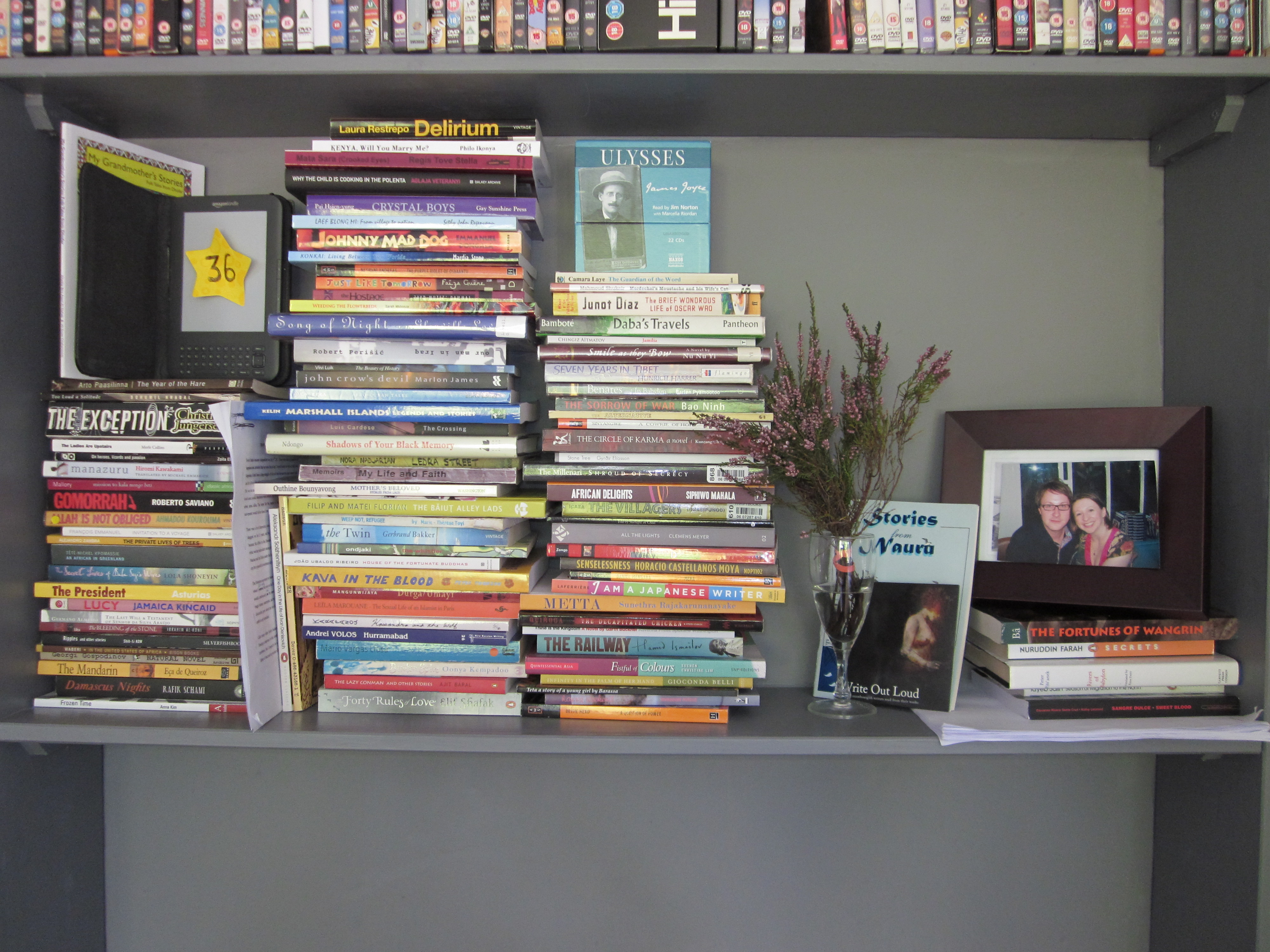
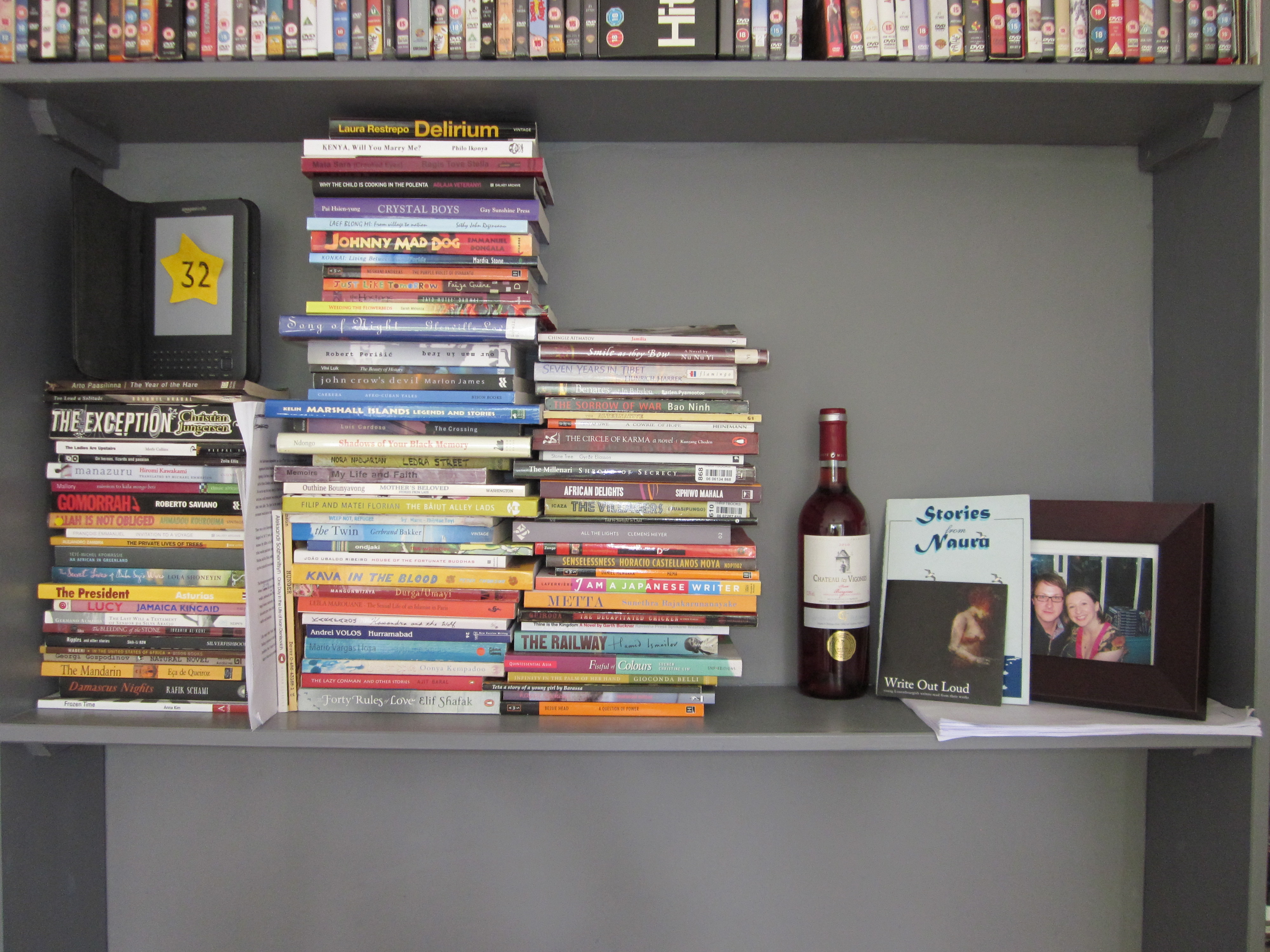
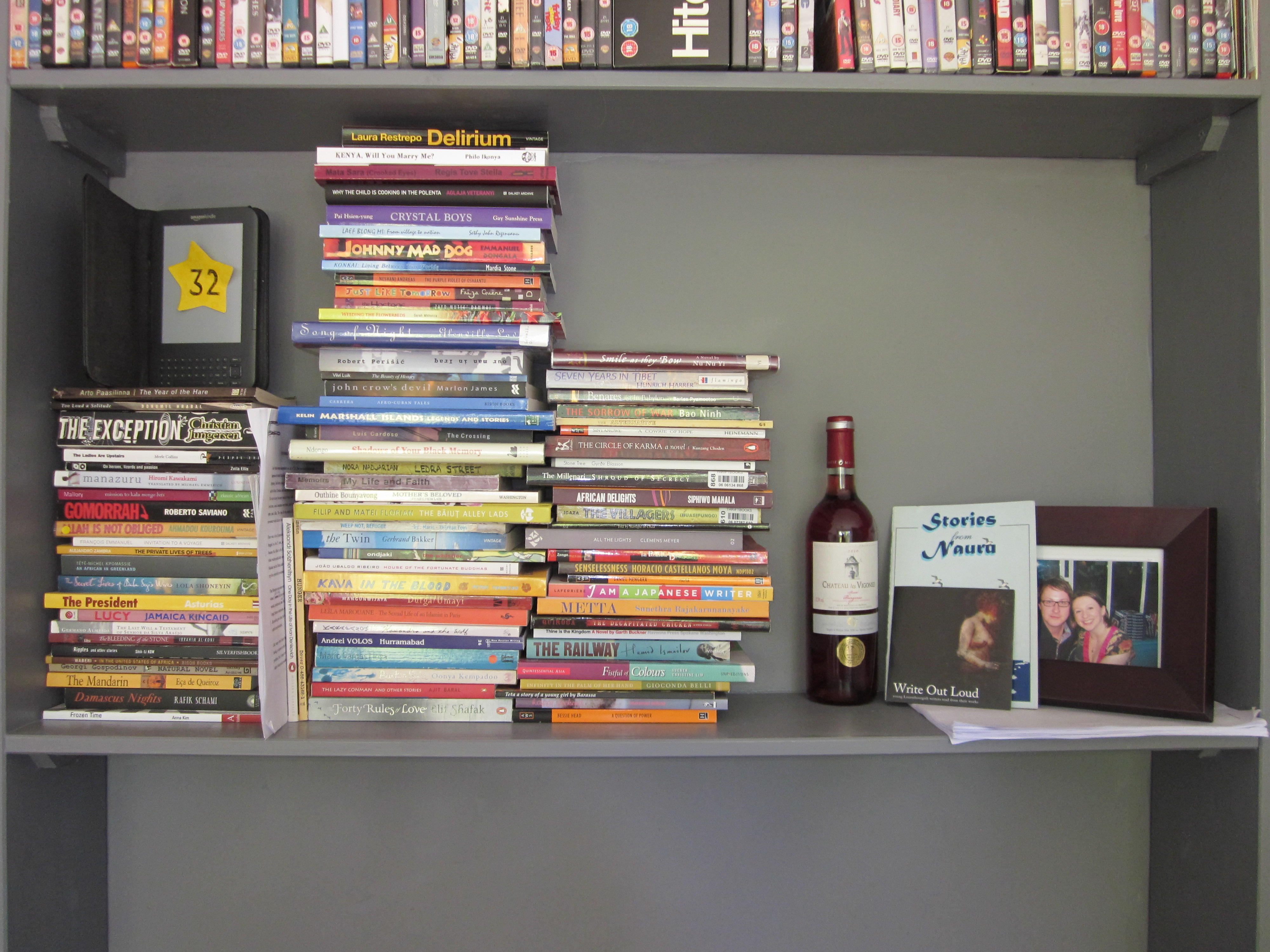
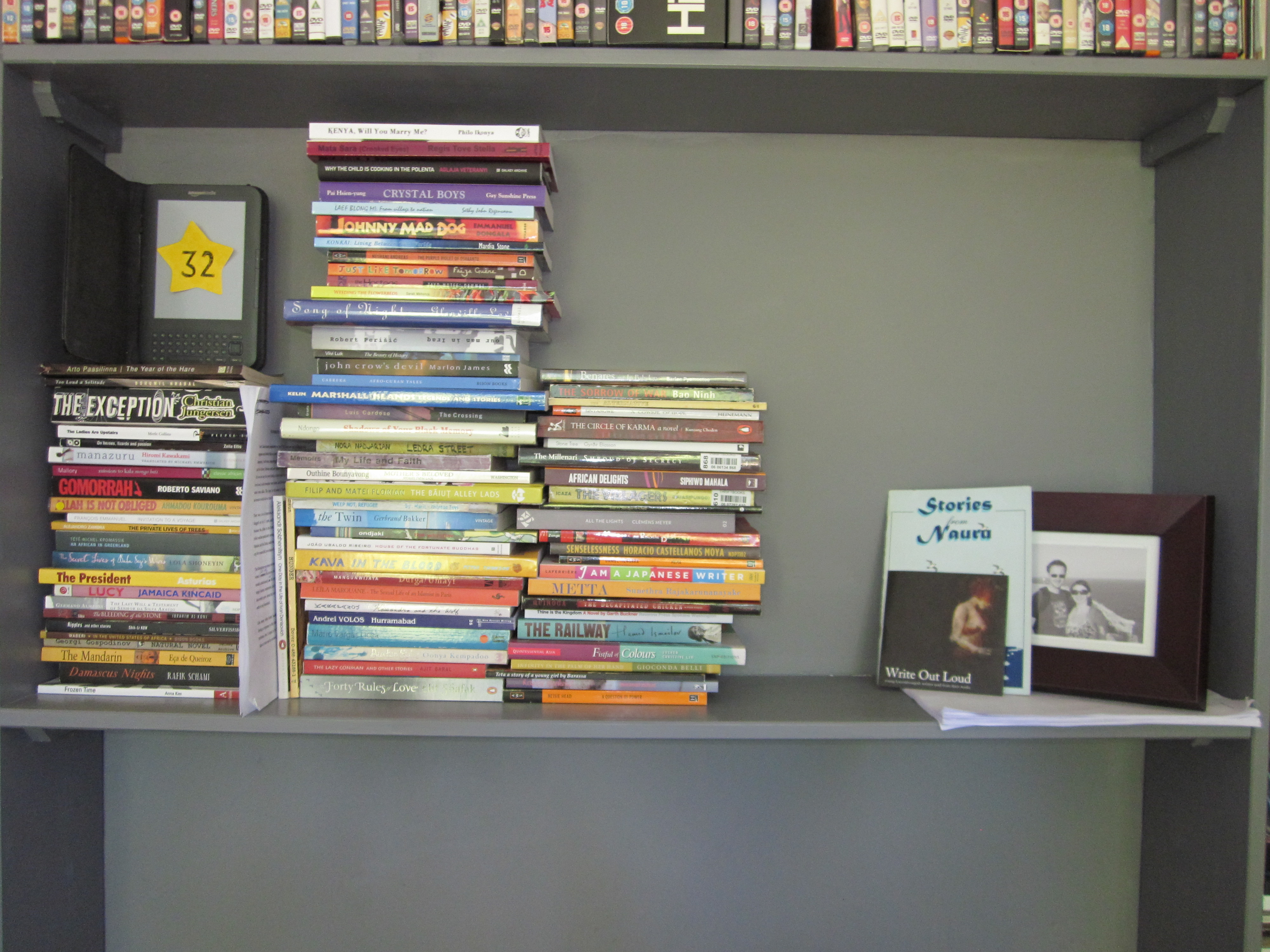
Mongolia: a high point

There were two choices in the frame for Mongolia. One was a collection of folk tales picked up at Chinggis Khaan International Airport in Ulaanbaatar by writer friend Emily Bullock. The other was Galsan Tschinag’s The Blue Sky, a book recommended by fellow literary globetrotter Paul.

The folk tales sounded tempting, particularly as, weighing in at just 119 very small pages and with lots of illustrations, they would probably have taken less than an hour to read. However, when I found out more about Galsan Tschinag’s extraordinary life story, my attention was hooked.

Born as Irgit Schynykbajoglu Dshurukuwaa (his name in Tuvan), Tschinag adopted German as his written language during his time studying at the University of Leipzig in the sixties before becoming a singer, storyteller, poet, shaman and Tuvan chief. Angered by the impact of the Communist regime on his people, he led a huge caravan of Tuvans back to their ancestral home in the Altai Mountains and campaigns for the rights of the group to this day. He also apparently managed to cure himself of a life-threatening heart condition using his shamanic powers.

By the time I’d finished reading about him, I couldn’t help feeling that Galsan Tschinag was running Tete-Michel Kpomassie a close second for the title of ‘writer I’d most like to meet’.

Drawing heavily on Tschinag’s childhood, The Blue Sky is the coming of age story of a young shepherd boy in the Altai Mountains. On the face of it, he and his family pursue the nomadic herding ways of life that Tuvans have practised for generations; yet far away in the interior of Mongolia change is afoot with the influence of the Soviet Union prompting seismic shifts that will ripple out to the farthest corners of the country and alter the boy’s life for ever.

Few writers inhabit their characters’ thoughts as convincingly as Tschinag does. Capturing the wonder and weirdness of childhood, he has a gift for bringing us into his protagonist’s hopes and dreams. We share in the boy’s fantasies of becoming a baj by building up a flock of more than 1,000 sheep and his wacky plan to count to that number by assembling 100 people and ticking off their fingers one by one, and they feel real and immediate, and strangely reminiscent of our own childhood imaginings. In addition, we recognise the quirky literalism of childhood – which leaves the boy watching his relatives in bewilderment for signs of their necks twisting after a comment from his mother that their heads have been turned – and the power of make-believe which transforms an eagle sighting into a full-blown attack when the boy tells his parents about his day.

This sense of recognition helps Tschinag bring us close to customs and practices that might otherwise feel irreconcilably alien and strange. Identifying with the boy, we can inhabit his world, where sniffing people is a way of expressing affection, children smoke pipes and urine is a remedy for sore eyes. As Tschinag describes the family’s formal adoption of the mysterious old lady who declares herself the boy’s grandma and the extraordinary rituals carried out to honour and respect animals and nature, it is as though we are sitting round the fire in the yurt with the characters, swapping stories.

As a result it is impossible not to feel connected to and invested in this world – and to bristle like Arsylang the dog at the approach of the outside influences set to destroy it. From very personal instances – such as the return of the boy’s older brother and sister from boarding school for the holidays and the awkwardness that springs up between the once-inseparable siblings – to news that the Mongolian Old White Man of traditional New Year’s celebrations has morphed into the Russian Father Frost, we see everywhere the erosion of this rare way of life. And when his father’s attempt to embrace modern hunting techniques backfires tragically towards the end of the narrative, we feel the full weight of the boy’s grief, not only for his personal loss, but for the passing of belonging, identity and meaning itself.

Achingly sad and yet passionately life-affirming, this book is up there with the very best. It is an extraordinary achievement by a writer skilled at celebrating both the unique and the universal. To read it is to marvel at the variety, beauty and strangeness of the human race – and to feel privileged to be part of it.

The Blue Sky (Der blaue Himmel) by Galsan Tschinag, translated from the German by Katharina Rout (Milkweed Editions, 2006)

Pakistan: the long view

There were lots of choices for Pakistan – and lots of visitors to this blog with opinions about which book I should go for. Writers such as Daniyal Mueenuddin, Musharraf Ali Farooqi and Bapsi Sidhwa came up several times in discussion and I had plenty of possibilities to check out when it came to choosing the work for this post.

However, when I started to research the suggestions, there was one book with such a fascinating story behind it that, when I discovered how it came to be published, I knew I would have to read it. Recommended by both Waqas and blogger Fay, who kindly shared her personal Man Asian Literary Prize shortlist with me, The Wandering Falcon by Jamil Ahmad might never have made it into print. In fact, the first draft of the book, which Ahmad wrote in the early seventies, was locked in a trunk for 30 years and presumed lost by its author after it failed to find a publisher in Pakistan. Luckily, as the novelist told Publisher’s Weekly last year, Ahmad’s wife Helga kept the key, and when Ahmad’s brother heard about a literary competition the work was brought out once more and quickly passed to Penguin.

Framed around the life of Tor Baz, an enigmatic nomad living in the border hills of Iran, Pakistan and Afghanistan meet during the mid-20th century, the novel reveals a volatile and fragile world. Orphaned young when his parents are killed by their tribe because of their elopement, Baz passes through a range of groups and guardians, eventually carving out a living by selling information to rival factions in the region. Along the way he crosses paths with lonely soldiers, a mad mullah, people traffickers, prostitutes, a naive European in search of his roots and a wife fleeing the tyranny of travelling with her husband’s performing bear. And, as the British Empire retreats and the borders of the region’s newly declared nations take shape and harden, a desperate struggle emerges between the old ways of life and the modern order.

Ahmad’s depiction of the border region’s landscape is extraordinary. Wild, haunting and treacherous, this ‘tangle of crumbling weather-beaten and broken hills’ and the plains beyond it seem to have as much character and agency as the people who make their lives there. The landscape even moulds their personalities, teaching them ‘to be deliberate in their actions and slow in responding to emotions’ with its silence, harsh beauty, 120-day winds, and wide, open spaces across which pursuers can be spotted from miles away.

Yet for all its magnificence and antiquity, the landscape is in many ways little more than a rumpled blanket that can be shaken by external powers, tumbling those upon it into confusion. As a result of the closing of the borders and the political changes in the region in the late fifties, many of the local tribespeople run up against unfamiliar forces with which they must do battle in order to survive. Sometimes, tradition and ancient wisdom gain the upper hand, as when the nameless foreigner ventures into the off-limits Afridi territory of his father’s youth only to die a bewildered death, or the local official sent to challenge the Bhittani tribe over colluding in a kidnapping finds himself locked in a ‘battle of wits’ with the tribesmen and is obliged to give up because ‘he could offer no story to counter the old man’s logic’.

More often though, the traditional ways and those who practise them are warped and broken by the weight of a modern system that leaves no room for ambiguity. As the nomadic, stateless Kharot people discover when they attempt to cross the border to the pastureland their tribe has used for centuries and which their animals need to survive, ‘the pressures were inexorable. One set of values, one way of life had to die’ – and die in the most brutal of circumstances.

Such tragedies bring out Ahmad’s most passionate and beautiful writing. In these moments, his disarmingly stripped-back style – characterised by insights such as ‘hope does not die like an animal – quick and sudden. It is more like a plant, which slowly withers away’ and the description of a murdered Mengal tribesman sliding ‘down in small jerks like a broken doll from the saddle to the ground’ – concentrates itself into powerful direct appeals. Perhaps the most moving of these concerns the execution of seven Baluch tribesmen, who, when asked to explain the murder of some rivals, find that their lengthy discourse on the history of tribal relations in the region holds no power to impress the court. ‘Fables have no use here. They are not evidence,’ says the judge, going on to sentence them to death and paving the way for Ahmad’s most memorable pronouncement on what such decisions cost:

‘What died with them was a part of the Baluch people themselves. A little of their spontaneity in offering affection, and something of their graciousness and trust. That too was tried, sentenced and died with these seven men.’

This is that rare breed of writing that springs from deep love and knowledge of a place and the people who live there. It is not saccharine, picture-postcard sentimentalism, all rose-tinted nostalgia; nor is it explorer’s obsession, tripping over itself in its eagerness to analyse and explain. No: it is a love that has been forged and tempered by years of living in and absorbing a region in all its beauty, brokenness, brutality and brilliance. Astonishing – and well worth the wait.

The Wandering Falcon by Jamil Ahmad (Penguin, 2011)

Cambodia: the end of an era

Newspapers are not what they used to be. If you’ve had anything to do with the media in the last ten years, you’ll have heard a lot about dumbing down, loss of quality, the death of print and so on. In fact, depending on who you speak to, you might be forgiven for thinking that the whole industry is choking and dying right before our very eyes as we all stand round snapping photos and tweeting about its last moments.

But it’s not all doom and gloom. In fact the search for my Cambodian book reminded me of one of the most exciting things to happen to journalism in recent years.

I was whiling away a quiet moment or two on the Guardian Books site when an article about the Cambodian genocide by Madeleine Thien caught my eye. Thien is a Canadian novelist, so I couldn’t include her book, Dogs at the Perimeter, on my Cambodian list, however, given her expertise on the country, I decided to leave a comment asking if she could recommend something I could read.

Less than two hours later, Thien replied with a full list of suggestions. I was delighted and more than a little surprised. Despite having written for various publications myself, I realised I’d been used to thinking of journalists as somehow operating in a different, parallel universe, a world that readers could not reach.

And yet here was one of these mysterious beings replying to me out of the blue. All of a sudden the article flickering on the screen in front of me seemed to switch from being a closed, finished thing, to an ongoing, evolving process. It was as though, instead of publishing something that was fixed and definitive, Thien had given a seminar in cyberspace and thrown the floor open to questions from the world.

Thien seemed particularly passionate about In the Shadow of the Banyan by Vaddey Ratner, a book that was due to come out that very week. ‘I hope this book will find its way to readers everywhere. It is an astonishing novel, brilliant, heartbreaking, and deeply courageous. A truly unforgettable piece of literature,’ she wrote. That was good enough for me.

Inspired by Ratner’s own childhood, the novel tells the story of seven-year-old Raami, a Cambodian princess who is evicted from her luxurious home in Pnomh Penh along with the rest of her family when the Khmer Rouge seize power in 1975. Caught up in the mass exodus from the cities as the regime seeks to eliminate all traces of education, culture, privilege and power, Raami endures four years of hard labour, starvation, abuse and terror in the party’s brutal new rural order – a world where her imagination is her only escape.

Few writers use imagery more richly than Ratner. Whether she is describing the sun yawning and stretching ‘like an infant deity poking its long multiple arms through the leaves and branches’, the gardener covered in butterflies ‘as if he were a tree stalk and his straw hat a giant yellow blossom’, or the way a marsh shimmers ‘as if at any moment it would spit out the sun’, the writer excels at finding arresting ways of bringing experience to her readers. This stands her in particularly good stead when it comes to the darker elements of the story, where the fear and sadness she builds are almost tangible. It also makes the more whimsical passages, particularly the exchanges between Raami and her haunted poet father, marvellous and engrossing where they might be twee and obvious in another author’s work.

Ratner’s consciousness of the value and weight of words is coupled with a profound sense of the importance of storytelling, which runs through the book. Various characters speak about the power of tales to connect people across time and space. Indeed, Raami’s faith in them is such that, in the final moments before he is taken away, she runs after her father begging for one more story, as though the mere act of narrating might be enough to keep him with her and save his life.

Like the novel itself, this belief in the power of telling is rooted in Ratner’s experience. She writes movingly about her motivations for rehearsing her family’s traumatic history through fiction in her ‘Author’s Note’ at the back of the book. The story is, she tells us, ‘in essence, [her] own […], born of [her] desire to give voice to [her father’s] memory, and the memories of all those silenced’.

As such – and given the unrelenting suffering and misery that makes up much of the book – it is perhaps inevitable that the narrative occasionally gets bogged down in emotion. While no doubt true to the experience of many children in such extreme circumstances, Raami’s repeated assertions that she is responsible for all the bad things that happen become a little wearing. There is also a slight problem with the narratological need to keep raising the stakes and ratcheting up the tension when the family has lost nearly everything from day one.

But these are trifling things by comparison to Ratner’s achievement. Looked at as a whole this is a powerful and beautiful debut from a writer committed to finding new ways of telling stories and taking the reader to heart of the matter. The world can always do with more of those.

In the Shadow of the Banyan by Vaddey Ratner (Simon & Schuster, 2012)

Brunei: reading between the lines

Brunei was looking tricky. Try what combination of search terms I would, there seemed to be no literature in translation from this small, oil-rich nation on Borneo in the South China Sea. The only suggestion I heard of came in the shape of a collection of Dusun folk tales compiled and translated by UK academic Eva Maria Kershaw. It was recommended by Canadian blogger Paul, who said it was the only Bruneian work he had been able to find for his own global literary quest.

I was on the point of buying the book, but something held me back. Nagging away at me was the thought that there must be someone out there who could help me find a written work by a Bruneian author that I could read in English. It was just a question of tracking them down. What I needed was a group of enthusiastic, English-speaking Bruneians who were passionate about promoting their culture and would have the time to circulate my query and, if I was lucky, do a bit of research on my behalf.

The solution came in a flash: students. A quick bit of googling revealed a surprisingly large number of Bruneian students’ associations dotted around the world’s Anglophone countries. I fired off emails to several of them, hunted down a couple of others through Facebook, and sat back to wait.

It didn’t take long. The very next day I got a message from Zuliza, media communications officer at the Bruneian Students’ Association, New Zealand. She wanted to help and asked for more details about the sort of book I was looking for. I answered as best I could.

The weeks went by. I found myself keying ‘Dusun folk tale collection’ into Google in idle moments. Then, at the beginning of August, Zuliza got back to me. She had some good news: she had found a story in the Brunei Times about a Bruneian author who had taken the step of publishing a novel in English in an effort to attract a wider readership for his work. It was available to buy on Amazon. Would it do?

One air punch and a vigorous Highland jig of delight later, I downloaded the novel on to my Kindle and began to read.

Set in France, Four Kings by Christopher Sun (aka Sun Tze Yun) follows American archaeology professor James Hale as he sets out to solve the murder of his best friend. Accompanied by his friend’s distraught and yet disturbingly attractive daughter, the academic plunges into the dizzying world of fine-art investment in an effort to track down a killer with a penchant for priceless artefacts and a habit of leaving playing cards next to each of his victims. But as riots grip the country and the president is forced to consider extreme measures to prevent anarchy, it becomes clear that the deaths may be part of a conspiracy that goes all the way to the top.

This is a book with a clear idea of what it wants to be. From the sensationalist, blood-smattered cover picture, right through to the vital clue that drops out of a copy of The Da Vinci Code halfway through the novel, Sun makes no secret of the fact that he is out to take on the global blockbusters with this, the first in a pentalogy following the adventures of James Hale. There is even a wry dig at the bestselling US author when, picking up the novel with a laugh, detective Darley remarks: ‘It’s nice to know that even sociopathic killers don’t mind reading trash now and then.’

Sadly, though, I don’t think Dan Brown has much to worry about. Although Sun may have big ambitions, his execution is lacking. The plotting is loose, improbable and heavily derivative, with unlikely religious relics such as ‘Jesus’s denarius’ and ‘the Spear of Longinus’ passed around between shadowy figures who materialise and disappear almost randomly. At times, even the characters themselves seem to feel that there is a ludicrous air to events, as when Hale grumbles to himself: ‘This is crazy […]. Why the hell am I the one finding all the damned bodies around here?’

As in QuixotiQ, my Bahraini pick, the Western setting is problematic. Although Sun has made an effort to ground the novel in France, unlike the mid-Atlantic no-man’s-land of QuixotiQ, the context lacks authenticity. Characters with names like Bruno Culruthers, Hugh Jetter and the unfortunately spelled Rouseeau strut around a faceless world that feels more like an airport terminal than a French city.

As with QuixotiQ, however, there is a serious point here. For the second time this year, I have found that the only work I am able to read from a nation with a written tradition is one by a writer who feels he has no option but to try and write a Western novel in English if he is to reach an audience outside his country. According to his Brunei Times interview, Sun has written and published books, cerpen (short stories) and sajak (poems) in his first language, Bahasa Melayu. Now those I really would like to read.

Four Kings by Christopher Sun and Jimmy Chan (CreateSpace, 2011)

Kyrgyzstan: a lonely road

I’ve written before about one-author countries: states from which the work of only one writer seems to have been translated into English and/or received recognition on the world-literature stage. But the landlocked country of Kyrgyzstan, which apparently enjoys the distinction of being farther from the ocean than any other state in the world, is certainly up there with the best of them. Anglophone readers wanting to sample Kyrgyz literature will run up against the work of the country’s most famous author Chingiz Aitmatov, whose 1957 novel Jamilia made his name – and not much else.

So far, all my efforts to find translated alternatives to Aitmatov’s books have run into dead ends. If you know of another Kyrgyz writer whose work has been translated (or you know of someone who should be translated and want to get the word out), please leave a comment and tell me about them. In the meantime, partly because I wanted to see what all the fuss was about and partly – I’ll confess – because I really liked the picture on the 2007 Telegram edition, here’s what I thought of Jamilia.

Framed as an artist’s explanation of the story behind one of his paintings, the novel sets out the circumstances of a surprising love affair that springs up between the artist-narrator Seit’s sister-in-law Jamilia and disabled war veteran Daniyar back in Seit’s childhood. Charged with carting grain across the Kyrgyz plains to the railway station because the healthy men, including Jamilia’s husband, are away fighting on the front, Jamilia and Seit amuse themselves by teasing and tormenting the awkward Daniyar. But as time goes by, a deep bond springs up between the three of them that will make it impossible for them to stay in the traditional village that is their home.

A strong sense of obligation pervades the opening section of the book. Everything in the community, where ‘happiness[…] belongs to those who retain their honour and conscience’ and Seit’s father is ‘duty-bound to the spirits of his ancestors’, is codified and ranked, to the point where there are particular forms of address for each relative and even letters to and from the front must be written and read according to a set of rules.

Beneath this rigid and formal surface, however, strong currents surge. From the sinister sexuality of the lone men who eye Jamilia, to the horrors of war that ‘formed a hard clot deep in [Daniyar’s] heart’ and keep him silent, the books is full of unspoken intensity. Often sublimated into passionate outpourings on the beauty of the natural world and haunting singing from Daniyar, these hidden seams of feeling imbue tiny actions with huge significance. A look, a touch, a head rested on a shoulder reverberate like the blasts of the weapons being fired far away across the steppe in this hushed, restrained world.

And so it is that, by observing the silent drama playing out between the two young adults, Seit discovers his passion for expressing unspoken emotions through art. ‘Words were not necessary; besides, words can never quite express a person’s feelings’, he explains, going on to describe his desire to capture ‘the truth, the truth of life, the truth of those two people’, in what is surely one of the most subtle and touching depictions of the development of an artistic sense we have.

Now and then the flashbacks feel stilted. In addition, some of Aitmatov’s more hackneyed tropes wear a little thin. Personally I could have done without the storm the night Jamilia and Daniyar consummate their love.

Overall, though, this is an extraordinarily beautiful book. If this novel is at all indicative of the quality of Kyrgyz writing, it’s definitely time we English-language readers had access to some more.

Jamilia (Djamilia) by Chingiz Aitmatov, translated from the Russian by James Riordan (Telegram, 2007)

Myanmar: all that glitters…

One of the great things about embarking on a world literature adventure like this is all the fellow literary globetrotters you meet along the way. There are lots of projects out there and each of them is slightly different, shaped by the personality and interests of the reader behind them.

Some people are only reading books set in particular countries; others are including poetry, plays and factual history books. Some are travelling from state to state as you would on a map, while others are leaping around all over the shop. And in addition to the hardcore nutters among us who set ourselves numerical and, in my case, time limits, there are many people who intend that the adventure should take them several years, if not decades.

It’s always a pleasure to hear from other literary explorers, not least because they can often be a great source of ideas for countries I’ve yet to tackle. So when Paul in Canada responded to my Halfway Appeal with some suggestions from his own Reading Around the World project, I was intrigued to hear about them. In particular, his Myanmar choice, Smile As They Bow by Nu Nu Yi – the first novel by a writer living in the country to have been translated and published in the US, and shortlisted for an international literary prize, despite the best efforts of the Myanmar authorities to suppress it – sounded fascinating. I decided it was the book for me.

Set around the Taungbyon Festival, a massive celebration of nats (spirits) that happens in a small village near Mandalay three times a year, the novel follows Daisy Bond, one of the event’s most famous transgender natkadaws (spirit mediums), as he sets out to make the most of the extravaganza. A master at parting gullible and superstitious visitors from their money, the aging dancer puts on the performance of his life, ably assisted by his very much younger bodyguard and lover Min Min. But when his partner begins to fall for a beggar girl at the festival, Daisy’s precarious existence looks as though it may be about to crumble once and for all.

Yi’s sensuous descriptions of the hurly-burly of the event are a joy to read. Bustling with the interior monologues of a whole host of people – from the rich woman seeking spiritual guidance on what to do about her husband’s mistress and the elderly devotee fretting about the cost of the flowers she has had to offer, to the pickpockets moving through the crowds – the narrative bumps and jostles the reader so that you feel as though you are in the midst of the action.

Into this vibrant scene bursts the voice of Daisy Bond, easily one of the most irreverent and fabulous literary creations you are ever likely to meet. Buzzing with expletives, contradictions and fears, his distinctive interior monologue paints a complex and moving picture of a lifestyle that is at once based around a sham and yet a source of fulfillment and meaning. Bluntly honest about the fact that natkadaws such as he ‘deal in lies and pushing people to offer animals’ and ‘cook up crazy hopes ’cause we have to eat’, Daisy’s descriptions of his love of performing and the self-expression he finds as a transgender medium reveal that for all the cynicism of the cons he peddles, what he is doing has surprising value and significance – much like the festival itself, which though reinstated by the British ‘to create a diversion’ in colonial times has become a source of hope and a way of making a living for thousands of people.

This duality is particularly apparent in Daisy’s illicit relationship with Min Min (homosexuality is still illegal in Myanmar). Despite his frequent abuse and humiliation of the youth whom he bought as a teenager seven years previously, Daisy’s dependence on and feelings for the young man are clear. It is testament to Yi’s skill as a writer that, even though we want to see Min Min break free and follow his own desires, we cannot help feeling pity for Daisy, for whom ‘the gay life carries such heavy karma’ and who is perpetually haunted by the thought that his love is ‘going to leave [him] for a real woman’.

The result is a powerful, moving and memorable work that more than deserves its place on the Man Asia Literary Prize 2007 shortlist. It is an insight into a world of extremes, where conflicting truths weave together and catch the eye like spangles on a spirit dancer’s costume. Highly recommended.

Smile as they Bow by Nu Nu Yi, translated from the Burmese by Alfred Birnbaum and Thi Thi Aye (Hyperion, 2008)

India: an impossible choice

How do you choose one book from a nation of 1.2 billion people – a country that is one of the most culturally rich and diverse in the world and a country, that, as I discovered when I was lucky enough to visit West Bengal last year, is so varied in its constituent states, let alone across its 1,269,219 square miles, that it makes a nonsense of the term ‘nationality’ as it is commonly understood?

I’m afraid I still don’t have the answer to this question. I struggled with it long and hard. As the suggestions of Indian writers poured in from visitors to this blog I did my best to research and weigh up each one. All to no avail: the more I looked into the many excellent and intriguing Indian authors whose names I’ve heard this year, the more impossible it seemed to limit my selection to just one work. An Indian friend of mine kindly posted my dilemma on Facebook and yet more names flooded in. The truth was, I could have spent a decade reading Indian literature and still barely have scratched the surface of the literary delights this country has to offer.

One thing I did know: I wanted to read the work of an author who was prized and celebrated in India rather than one who had made his or her name outside the country. As Tim who recommended Kushwant Singh just this week put it, ‘rather a lot of the “Indian” writers beloved of the international literati seem to live in London or New York’. Talented though many of these authors are, they didn’t chime in with what I was looking for: I wanted to read the work of someone who wrote primarily for Indian readers.

With this in mind, one among the many comments I’ve had about Indian literature stood out. It was from Suneetha:

‘I am from India, and I note that both the suggestions in comments and your list for India reads are those written originally in English. I have to say these are just second best to what regional literature we have here in over 23 official languages and a couple of hundreds of other languages spoken across the country.’

This struck a chord with me. After all, if I was looking for an Indian writer who wrote to be read by his or her compatriots, surely I should choose something written in a regional language, rather than the international lingua franca of the country’s colonial past? And so it was that I plumped for a novel by one of Suneetha’s favourite authors: the much decorated Malayalam novelist and filmmaker M T Vasudevan Nair.

Kaalam (Time), which won Nair the Sahitya Akademi Award in 1970, follows Sethu Madhavan as he leaves home for college and tries to make his way in the world. The expectations of his rural village rest on his shoulders and his excellent academic record seems to promise him a bright future. Yet, as the years pass and Sethu staggers from one failure to another, consoling himself with a series of hopeless love affairs, his potential seems to tarnish and warp and he grows disgusted with his life. At last, obliged to return to the family home he has spurned for so long, he is forced to face up to himself.

MT (as he is known) excels at presenting experiences that are at once universal and very specific to his characters’ time and place. Readers everywhere will recognise the adolescent Sethu’s embarrassment at his relations’ eccentricities – his aunt who lies scantily clad on the verandah, for example, and his mother who grumbles whether anyone is listening or not – and his desire to hide his poverty from his friends, as well as the perennial graduate’s dilemma of needing experience to get a job and a job to get experience.

What makes MT’s portrayal of these relatively commonplace rites of passage is his insight into the inconsistencies and contradictions that wrestle beneath the surface of all of us as we seek to move through life. From Sethu’s exasperated interior monologue in the face of an interview panel, to his stilted encounter with a friend who left education long before him and is now married and running a company, the author is a master of the tricks we use to disguise our shortcomings and the way casual questions and pleasantries can strike a person to the bone. This is particularly evident in MT’s depiction of his protagonist’s dealings with women: Sethu’s delight in the ‘illusionary obstacles’ that mask the impossibility of his feelings for teenage Thangamani and his wild justifications of his cruelty to his first love Sumitra both point to the self-delusion that keeps him crashing blindly, wilfully on.

These insights are couched in scintillating descriptions, which make the novel a joy to read. There is the loveless married couple for whom ‘words had become brittle showpieces in a glass case, to be used only on special occasions’, the minutes that ‘swam before [Sethu’s] eyes like bubbles distilled from the indistinct colours of sunset clouds’ and, perhaps my favourite of all, Sethu’s numbed reaction to his mother’s death: ‘The news stood just outside his mind like a traveller in search of shelter’.

The editorial decision not to explain culturally specific terms in the text but instead to confine their definitions to a rather incomplete glossary at the back means that readers from other parts of the world may find it hard to work out some of the roles of and connections between characters. There are also some gremlins in the e-edition, which mean that odd words have been misrepresented, making for some rather strange sentences that have to be read twice to tease the proper meaning out.

These glitches in no way hampered my enjoyment of the novel, though. If anything, the initial confusion I felt over the interrelationship of the characters is an added bonus: it means that I will have to read the novel again now that I’ve got them sussed. I’m already looking forward to it.

Kaalam by MT Vasudevan Nair, translated from the Malayalam by Gita Krishnankutty (Orient Blackswan, 2012)

Taiwan: living on the edge

Taiwan is the country with the most tenuous claim to be included on the list of independent countries I’m reading books from this year. It was a member of the UN until 1971, when the dispute between its government, the Republic of China, and the Chinese government, the People’s Republic of China, led to the UN voting to withdraw its recognition of the ROC and thus Taiwan. From that time onwards, although Taiwan governs its internal affairs independently and many countries around the world maintain informal diplomatic relations with it (the UK government sent a parliamentary delegation to visit the country in 2011, for example), the nation has officially been part of China. Only 22 UN members recognise it as a separate sovereign state.

I was curious to see what literature from this disputed land might be like, so when @markbooks suggested Pai Hsien-yung’s Crystal Boys, I was quick to add it to the list.

Claiming to be ‘the first modern Asian gay novel’, the 1983 book portrays the lives of a group of young male prostitutes in Taipei’s underworld. Following A-Qing, a teenage run-away who was expelled from school and thrown out of home for being found in a compromising position with a supervisor, the narrative explores the precarious lives of these young men, peeling back the layers to show the tenderness, vulnerability and hurt within.

The subject matter and suggestive cover picture of a half-naked Taiwanese youth set up an expectation of explicitness that is actually quite misleading. In fact, beyond passing references, the book doesn’t feature a single sex scene. Instead, all the drama and extreme experience is played out in the dialogue between the characters, in which cruel insults and desperate appeals are laughed off in a welter of banter. There is the boy Wu Min who talks about his plans for suicide only for his friends to think he is joking until he goes home to slash his wrists and the chief who pushes the youngsters into encounters with seemingly heartless abandon.

Yet, beneath the hard shell that nights around the lotus pond in Taipei’s New Park and later at the Cosy Nest café force them to develop, the boys possess a great deal of warmth and tenderness that often expresses itself in surprising ways. When Wu Min is in hospital and unable to meet his medical bills, the boys all donate blood to keep him alive – ‘what we share in common are bodies filled with aching, irrepressible desire and hearts filled with insane loneliness’, observes A-Qing, articulating the bond that ties him to his friends. In addition, A-Qing, who misses his younger brother Buddy, is forever adopting and protecting younger boys who remind him of home.

Indeed, by far the most daring and subversive aspect of the book is not its presentation of sexuality and prostitution but its use of those things to express ideas about nationhood, sovereignty and identity. As homosexuality was illegal in mainland China until 1997, it is effectively off-limits, out-of-bounds and dangerous territory in the book. This enables Pai Hsien-yung to use the crystal boys’ world as a powerful metaphor, as the opening lines of the novel show:

‘There are no days in our kingdom, only nights. As soon as the sun comes up, our kingdom goes into hiding, for it is an unlawful nation; we have no government and no constitution, we are neither recognised nor respected by anyone, our citizenry is little more than rabble. […] It’s as though our kingdom were surrounded and hidden by a tightly woven fence – cut off from the outside world, isolated for the time being. But we are always keenly aware of the constant threat to our existence by the boundless world on the other side of the fence.’

At times, the narrative becomes a little stilted and episodic, with too many characters crowding in one after the other. Pai Hsien-yung’s tendency to stress the emotional suffering of the boys can also be a little repetitive and could have done with some tighter editing.

However, none of this detracts from the fact that this is a courageous and fascinating work from a writer not afraid to speak out against the majority. The book is a gripping insight into a fragile and contested world. Powerful stuff.

Crystal Boys (Nieh-Tzu) by Pai Hsien-yung, translated from the Chinese by Howard Goldblatt (Gay Sunshine Press, 1995)

Iran: gender politics

I was tempted to choose Nasrin Alavi’s We are Iran as my Iranian book. Compiled from a series of blogs translated from Farsi, this book – or blook – caused a great deal of controversy when it burst on to the literary scene in 2005, purporting to provide Western readers with an unprecedented survey of contemporary Iranian thought. However, the book had had a fair bit of attention in the media and something about the way the texts in it had been curated for the Western eye made me hesitate – probably entirely unfairly, given that arguably every text in translation has been selected and prepared with English-language readers in mind.

Then I heard about Shahrnush Parsipur. Something of a trailblazer throughout her life, from being one of the first female students at the University of Tehran through to becoming one of Iran’s best-known and most innovative novelists, Parsipur captured my imagination. Her epic novel Touba and the Meaning of Night, which was published in 1989 just three years after Parsipur’s release from prison, caused controversy for its exploration of religion and gender power relations, as well as its departure from the literary style common before the 1979 Iranian Revolution. It finally became available in English translation in 2006, the year after the much-vaunted We are Iran. I was going to have to take a look.

Spanning the late nineteenth and early twentieth centuries, the novel presents an alternative reading of the history of Iran through the eyes of one woman, Touba, who grows up, marries, divorces, remarries and grows old during the course of it. As dynasties rise and fall and the world moves towards its bloodiest war, Touba embarks on a struggle for supremacy in her own life, finding herself drawn towards Sufism as a possible escape from the oppressive rules and judgments of a society that increasingly forces her to be a prisoner within the walls of her house.

Right from the opening passage, in which a scantily clad teenage Touba cleans the courtyard pool under the disapproving gaze of her tenant’s wives, Parsipur sets out the limitations imposed on women as a central theme in the book. Sometimes, as when Touba’s father reflects that bringing strange women into his home to work might be dangerous because ‘they might participate in some perverse activities with one another’, this is done with wry humour.

More usually, however, it has a much darker side. This initially reveals itself when 14-year-old Touba narrowly escapes a beating from her first husband for going out for a walk alone and later becomes painfully obvious in the story of the raped girl who, on revealing she is pregnant, is killed by her uncle Mirza Abuzar and buried under a tree in the garden. Touba’s reaction to the news is telling:

‘She was filled with the sense of guilt. She wanted to ask Mirza Abuzar why he had not discussed the matter with her. Then she thought, if he had mentioned it, would she have done anything? A living girl who has a bastard child in her is hateful and defiled. The same girl, however, if she is killed like this, will be chosen to be among the Pure Ones. She was realizing that she probably would have done nothing for the girl, or could have done nothing. She tried to put herself in Mirza Abuzar’s place. She truly felt sorry for him.’

Parsipur’s ability to think her way inside her characters like this means that the narrative is far from a one-sided polemic on the oppression of women. Even the most difficult of characters, such as the sinister Prince Gil and the sullen child Ismael who harbours murderous intentions towards Touba because of his anger at the loss of his parents, are presented as rounded and complex individuals with insight and thought processes that often surprise.

This multiplicity of perspectives and Parsipur’s use of elements of magic in her storytelling, give the narrative a sense of plurality that cuts across time and space. Often, in the embedded stories and mini-tales that Parsipur weaves into the novel, it seems as though the author is digging back into the past to gain the depth and distance that will allow her to tell contemporary truths.

The pacing is strange at times, partly due to the sheer scope of the story, which contains so many characters that the editors saw fit to list them all at the start of the book. As a result, the narrative moves in fits and starts, lingering over details only to jerk forward, sometimes skimming over incidents that seem to deserve more attention. This can be frustrating and leaves you glancing back over your shoulder now and then as a major character whizzes past into oblivion, like the stop you expected to get off at the moment you realise you’ve unintentionally caught the fast train.

On the whole, though, there can be no question that this is a towering achievement. Packed with insights, historical detail and rich compelling storytelling, the translation of this epic work opens up a world quite different from the one many English-readers will be used to. A rich addition to anyone’s bookshelf.

Touba and the Meaning of Night (Tuba va ma’na-ye shab) by Shahrnush Parsipur, translated from the Persian by Havva Houshmand and Kamran Talattof (The Feminist Press at the City University of New York, 2006)

Yemen: the past is another country

There isn’t much Yemeni prose for curious English-language readers to get their hands on. At first I assumed this was because of a lack of translation – and that is part of it – but after some time researching Yemeni writers and emailing addresses for bookshops and writers associations that, without exception, bounced my messages straight back at me, I realised that there might be a bit more to it.

In fact, the country’s political history, which saw the rigid regime of the Imams give way to decades of war and unrest in the latter half of the 20th century, means that fiction writing and publishing in the country has been pretty thin on the ground. Nevertheless, there have been some pioneers and of these Zayd Mutee’ Dammaj, whose 1984 novel The Hostage was chosen as one of the top 100 Arabic novels of the 20th century by the Arab Writers Union, has to be one of the most celebrated.

Set during the run up to a brief revolution in the 1940s, the book portrays the struggles of a young boy who is taken hostage because of his father’s political activities and is sent to work as a duwaydar [attendant] in the Governor’s palace. Required to service every whim and desire of the men and women of the household, the boy learns the meaning of powerlessness and subjection. Yet, as his political awareness grows and society outside the palace gates begins to stir, his experiences give him the insight he needs to begin to imagine another future.

Interlink Books, the company behind the Emerging Voices series in which this translation was published, were clearly worried that the historical and social context of the novel might be challenging for Western readers. Not only did they include a preface explaining the reasons for translating the book in this edition, but they also added two introductions and footnotes to the Arabic terms in the text.

They needn’t have been so diligent because Dammaj’s skill as a storyteller is more than equal to the task of carrying his readers over his narrative’s sometimes challenging terrain. Indeed, the sense that we are getting a glimpse into the closed, privileged and long-lost world of palace life under the Imams’ rule is one of the novel’s great strengths. This is helped by the protagonist’s position as an outsider, which means that we discover the world with him and watch as he compares the formal processes of power with the way things are done in his own largely illiterate home community.

However, perhaps the most startling arena of discovery is that of the palace’s sexual politics. Women in this closed world are extremely predatory towards the young pubescent boys serving them, as are the soldiers manning the gates, leaving the hero feeling ‘like a rare bird […] put in a golden cage for life’. During a drive back from a state visit, the women’s possessiveness even spills over into a physical fight, with the boy tossed between them like a doll:

‘Then suddenly, she got hold of me and threw me towards them, so that I lost my balance and fell in some of their laps.

‘”You’re simply jealous of me,” she said, “because he’s sitting next to me. Am I jealous of you because he’s in your beds every night?”‘

Humiliation doesn’t get much deeper than this. However for Dammaj’s hero, the extreme pressure of being possessed and passed around in this way is just the force he needs to sublimate his powerlessness into dignity and develop his own desire for self-determination.

This growth of the protagonist from a naive child into a humane and thoughtful young man is what transforms the narrative from an intriguing account of life in a particular period into a timeless, classic tale. Dummaj shows us the human heart beating beneath the strange clothes and outmoded customs. Powerful writing indeed.

The Hostage (Ar-Rahina) by Zayd Mutee’ Dammaj, translated from the Arabic by May Jayyusi and Christopher Tingley (Interlink Books, 1994)