Book of the month: Wu Cheng’en (probably)

‘Must dash, about to be reincarnated.’

As a reader, there are few things more discombobulating than stumbling across a classic you’ve never heard of. If you fancy yourself well read, you tend to imagine that you have a broad sense of the world’s great works of literature. You may not have read them all, but you know what Ulysses, Don Quixote and The Divine Comedy are about, how they fit in.

But if you are a truly international reader, you can’t avoid having this flattering self-image punctured now and again. Even now, more than ten years into my global literary explorations, I regularly find myself coming across works so influential and famous that I feel deeply ignorant never to have encountered them.

This month’s featured read is such a one. I can’t be certain how it came onto my radar, but looking through my TBR mountain one day a few weeks back, I found my eye caught by a Penguin Clothbound Classics edition of Monkey King: Journey to the West in a new translation by Julia Lovell. I picked it up and was almost instantly engrossed.

Nominally, the book (I hesitate to call it a novel, not least because it was created more than 150 years before the form as we understand it took shape in Europe) follows the quest of a Tang dynasty monk, Tripitaka, to bring back Buddhist scriptures from India. However, as the title suggests, it is one of Tripitaka’s disciples, a magic kung fu monkey, who takes centre stage. Having been pinned for 500 years under a mountain for angering Heaven’s Jade Emperor, the monkey is released on condition he assist Tripitaka as a way of atoning for his crimes. Ebullient, irrepressible and master of 72 transformations (albeit some more successful than others), Monkey, along with fellow fallen immortals Pigsy and Sandy, accompanies Tripitaka, using his powers against the many monsters, frustrations and obstacles they encounter on their journey.

One of this book’s biggest surprises is how funny it is. Much of this comes from Monkey’s antics and self-congratulation, but the context has a lot to do with it too. When you’re immortal, threats of torture and execution hold different weight – they are more often sources of boredom or annoyance than fear or bodily pain. As a result, Monkey and his companions’ reactions to many of the dangers they encounter drip with bathos and surrealism. ‘A talking horse!’ remarks Pigsy at one point. ‘Never a good sign.’ (That said, a similar blitheness pertains among many of the high-status humans Monkey encounters on the quest.)

There’s also an amusing bureaucratic strand running through divine dealings. Heaven operates a ‘cashless economy’, we learn, which necessitates all kinds of fancy footwork to settle debts. Although capable of cloud somersaulting 108,000 miles in one leap, Monkey is often beholden to all sorts of maddening conditions because ‘immortality is a stickler for arithmetic’.

Credit must go to Lovell for the humour she gets in at the sentence level. A masterful veering between registers yields wonderful subversions of expectation. In addition to the comedy of the bureaucratic language Monkey often talks in a breezy, sometimes Wodehousian tone – ‘Thanks ever so!’ – that sparks beautifully against the often brutal horrors he and his companions must face.

And what horrors they are: impregnation, sautéing, lacquering, steaming, liquification, to name but a few. They need to be mindboggling because the central problem the narrative faces is that, having a vastly powerful, magical protagonist does rather take the tension out of most of the challenges you throw his way. Difficulties arise and are, often, magicked away with a swish of Monkey’s gold staff. With a pattern that repeats itself so reliably, it would be easy for readers to get bored.

And yet, we keep reading. This is, again, in part due to Lovell’s efforts. Conscious, perhaps, of the narrow attention span of many contemporary anglophone readers, she has slashed the text down to around a quarter of its original length, cutting out, she says, large sections of recapitulation that have their roots in the oral tradition. The memorable nature of many of the episodes also plays a part – I know that the next time I have a bad headache, I will think of the gold band Guanyin puts around Monkey’s head to control him.

But the book’s stickiness is also down to the evolution of its central characters as they encounter and overcome, or learn to live with, various internal and external demons. Although relatively light on didacticism, the narrative does offer several lessons along the way, most of them related to the idea of playing the long game and not jeopardising your future for the sake of instant gratification. However, perhaps the message it transmits most consistently, albeit tacitly, is that the secret to survival is transformation and adaptation.

Certainly, that seems to be one of the reasons for this work’s enduring success. Since its creation during the Ming dynasty, a time when China housed more books than the rest of the world put together, the story (which is commonly said to have been written by poet and politician Wu Cheng’en, although no-one can be sure) has taken many forms. It has morphed according to the needs of each generation of readers, becoming now an inspiration for the young Mao, now a standard bearer for disaffected youth. It has fed into films and TV shows, weathered banning and censorship, and informed storytelling and artworks around the globe. Now in this latest, sparkling literary incarnation, it looks set to surge into its next 500 years with all of its central character’s daring and energy. Extraordinary.

Monkey King: Journey to the West (probably) by Wu Cheng’en, translated from the Chinese by Julia Lovell (Penguin, 2021)

Picture: BabelStone, CC BY-SA 3.0 https://creativecommons.org/licenses/by-sa/3.0, via Wikimedia Commons
Ireland: the big one

My heart sank when Irish blogger and literature lover Fionnuala Barrett, whom I’d asked to recommend my book from the Emerald Isle, replied with Ulysses. I should have seen it coming, I suppose. After all, James Joyce is to Ireland what Charles Dickens is to England and knowing Fionnuala’s particular interest in nineteenth and early twentieth century literature, I could probably have predicted Ulysses would make it on to her shortlist.

Fionnuala did give me another option in the shape of Maria Edgeworth’s Castle Rackrent, but I couldn’t help feeling that this would be a bit of a cop-out – fabulous though this neglected classic, which is probably the first Anglo-Irish novel, no doubt is. It was Ulysses or bust as far as I could see.

The stakes were raised by the fact that I had tried and failed to read Ulysses once in the past. I’d had to study the Nighttown chapter during my MA course and had blithely set off to read the rest of the text only to run aground about 300 pages in.

This failed literary expedition – one of the few in my 25 years of reading – and the fact that I’d read Dubliners and A Portrait of the Artist as a Young Man meant that I would have to introduce a slight kink into the rules of this project: for the one and only time this year I would be taking on an author I had read before.

But the more I thought about it, the more I began to be fascinated with the challenge of taking on this book. Leaving aside my personal struggles with unpicking Joyce’s dense weave, the sheer fact of trying to read a novel that runs to close to 1,000 pages in many editions in a year when I was already reading 195 other books was intriguing. How could I manage it?

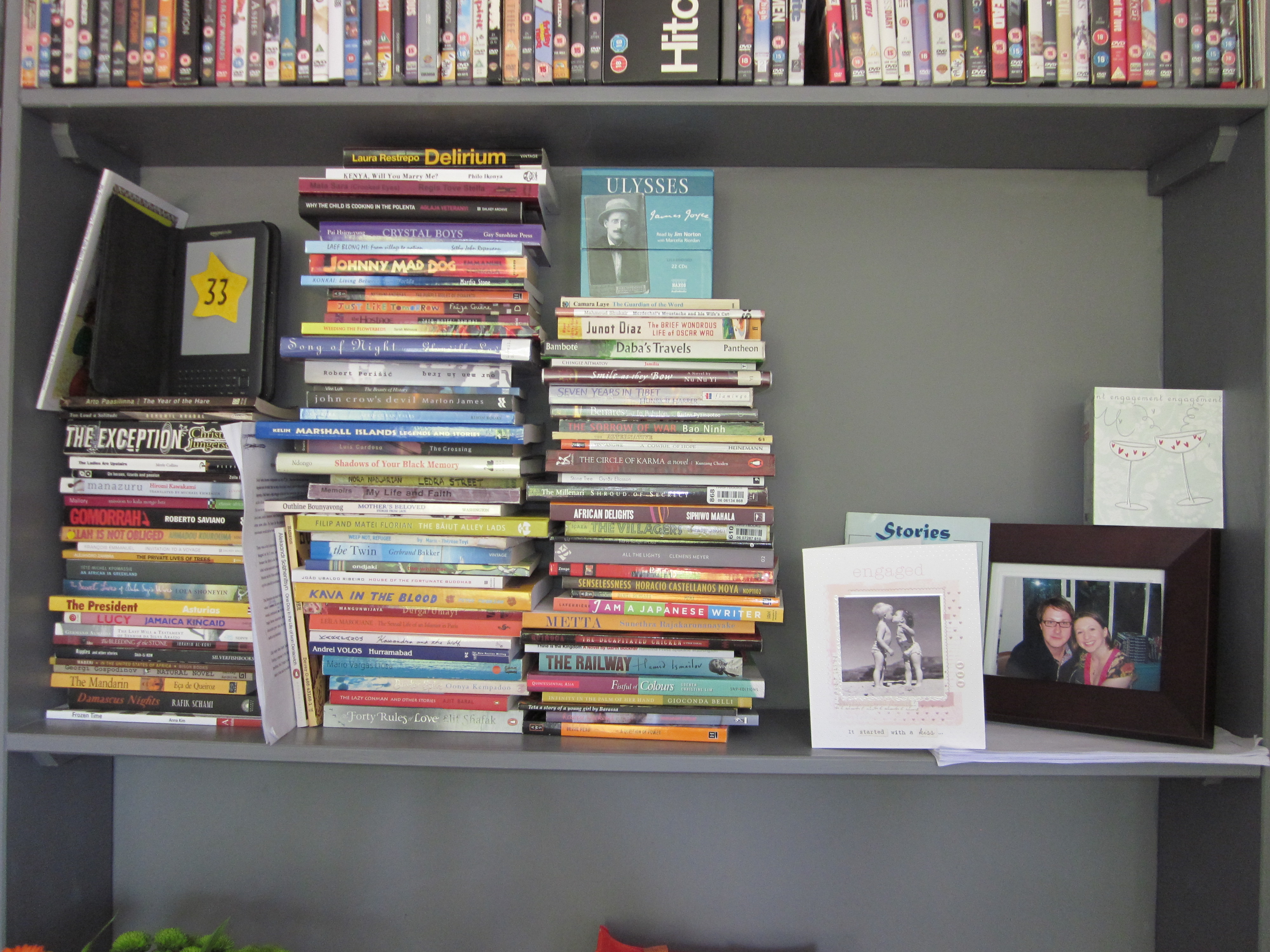
I chewed it over for a while and then in December last year, as I was making my final preparations to set off round the reading world, the solution dawned: an audiobook. I would listen to the novel on my weekly drive to my Sunday singing job. Listening one hour a week should enable me to get through the epic comfortably in six or seven months.

And so, in perhaps one of the more unusual requests I’ve made of her, when my mother asked what I might like for Christmas I announced that my gift of choice was an unabridged recording of James Joyce’s Ulysses. This she diligently found in the form of an edition from Naxos, one of the few unabridged audio versions out there. And so, on my first Sunday back in the harness after the New Year festivities I inserted CD number one of 22 into the car stereo and pressed play.

I’m not going to write much about Joyce’s book, which in a nutshell follows ad-man Leopold Bloom and young teacher Stephen Dedalus as their paths cross and recross over 24 hours in Dublin. You don’t need me to tell you that it’s extraordinary and if you do want to read more about it there’s enough criticism out there to sink a fleet of battleships.

In fact, I think that was part of the reason why I failed to finish the book first-time round. While I’m usually a great believer in disregarding introductions and footnotes on a first reading, and diving in blind to see what you make of the text for yourself before consulting anyone else’s opinion, something about the aura and reputation of this work made me feel unable to do that. It was as though I couldn’t trust myself to read it on my own, as Joyce first wrote it, and had to cling to the criticism like a child unable to take the stabilisers off its bike. The result was that I was flicking to the back of my annotated edition every second sentence and the rhythms so essential to the narrative never got a chance to flow.

With audio, this problem is non-existent. There are no annotations to make you worry that you’re not getting every allusion: instead there are just Irish actors Jim Norton and Marcella Riordan’s smooth tones, which they modulate deftly between the characters’ internal monologues, their memories and the moment-by-moment events of the day, as well as the voices of other people, making it instantly easier to locate yourself in the rich swirl of experiences kicked up by the text.

This means that you can relax and give yourself over to the narrative, allowing your own associations and memories to interact with Joyce’s text. Indeed, as I found my thoughts drawn to moments in my childhood and adolescence by the book’s biblical, classical and poetic references, I began to wonder whether all readers of Ulysses shouldn’t create their own personal footnotes to the text, showing the places that have evoked particular ideas or experiences for them.

There are parts of the book that work even better read out loud then they ever could on the page. From comic set pieces such as headmaster My Deasy’s terrible letter to the papers, which Norton delivers with great wit and timing, and aural effects such as the use of sibilance to convey the susurration of the sea, through to the many songs and musical references in the text, the audio version brings the book alive. I particularly liked the way that Joyce’s cannibalised version of the Lord’s Prayer, a text which is, after all, spoken much more than it is read, came across. In addition the production team has chosen to break up the text with snippets of music, much of it contemporaneous with the text, which adds a welcome extra flavour to the sound world – although I occasionally found myself distracted by trying to name the songs as the next instalment of narration began.

Indeed, distraction is the single biggest issue with the audiobook form. Unlike written texts, where you can flick back a page when you realise your eye has been skimming the words without taking them in, audiobooks are harder to navigate, particularly when you’re driving. As I steered my way around the back streets of central London, doing my best not to kill or be killed by map-reading tourists, cyclists, taxis and buses, I found I couldn’t always give the narrative the attention it deserved, with the result that I lost the thread a few times and had to resign myself to missing odd chunks of a minute or two here and there.

Although generally good, one or two directorial choices meant that some of the sections were harder to listen to than they might have been. In particular, I found the decision not to vary the intonation in the penultimate chapter ‘Ithaca’, which consists almost entirely of questions and answers, hard to swallow. While the intention may have been to create a soporific effect, as well as aping the dry rhythms of the catechism, it made for rather monotonous listening.

Nevertheless, the audio version got me through the text and for that I am very grateful. London traffic meant that it was  inevitably a patchy read, but it was a largely enjoyable one. I now feel that I will be able to return to the written text in future with much greater confidence and enthusiasm. And that great volume peering down at me from the bookshelf in the corner of the room holds no terrors anymore.

Ulysses by James Joyce, read by Jim Norton with Marcella Riordan, directed by Roger Marsh, produced by Nicolas Soames (Naxos, 2004)