Book of the month: Yun Ko-eun

‘What have you got in that you’re excited about?’ I asked Hunter at the Folkestone Bookshop when I popped in a while back.

As often happens when I walk into that place, this was the start of a long, fascinating conversation, in which I was ushered from shelf to shelf and table to table, and shown multiple tempting titles, many of them originally written in languages other than English.

I bought several, but one in particular stuck in my mind: Yun Ko-eun’s Art on Fire, translated from the Korean by Lizzie Buehler. It was the premise that got me. Since I read the hilarious Lake Como by Srđjan Valjarević, translated from the Serbian by Alice Copple-Tošić, for Serbia during my 2012 year of reading the world, I’ve had a weakness for novels that poke fun at art residencies. Indeed, beyond the titles I’ve featured on this blog, one of my favourite reads of this year was Ella Frears’s Goodlord, a book-length narrative poem in the form of an email to an estate agent, which features a section describing a disastrous experience at an artists’ retreat.

Art on Fire sounded like it was cut from similar cloth. Struggling artist turned food-delivery person An Yiji thinks her luck has turned when she is awarded a residency at the prestigious Robert Foundation in California. But there is a catch: the programme is overseen by Robert, a wonderdog who takes photographs and selects the participants, and at the end of each artist’s time at the Foundation, he chooses one piece they have created to be burned.

As the premise suggests, this is a novel that teeters on the surreal. So much about An Yiji’s experiences is recognisable – from the Californian wildfires that delay her collection from the airport to the lumbering mechanisms of the art world – and yet everything feels as though the contrast has been shunted up a notch or two, making the colours faintly cartoonish.

Nowhere is this more true than with the figure of Robert, the Foundation’s eponymous and unnervingly gifted dog, who communicates by means of a mysterious black box and several interpreters. He has very particular views on how artists should interact with him and writes An Yiji a series of passive-aggressive letters that keep her constantly on edge.

Coupled with the narrator-protagonist’s heightened mental state, this makes for an intense and often very funny read. An Yiji is so riddled with imposter syndrome that when the Robert Foundation’s director phones to offer her the placement, she assumes it’s a spam call. Perhaps as a result of the run of disappointments that have dogged her career, she tends to look for the worst in situations. To read her encounter with the skewed logic of the Foundation is to be taken into the fraught mindset many of us may have experienced during the height of the pandemic, when months of isolation made even the simplest things strange.

This unpeeling from reality allows Yun Ko-eun to show up the cracks in many of the things we take for granted. The uneasy relationship between art and commercialism comes under the spotlight, for example, when representatives from the nearby town of Q court An Yiji in the hopes that she will feature their businesses and settings in her work. There’s a brilliant interrogation of the concept of authenticity, which is approached from many angles and comes to a head through the fact that An Yiji’s story is being developed into a film by an actor she met on her way to the residency, who needs her to work with him and the director to decide the ending.

Perhaps most fascinating of all is the discussion of translation that runs throughout the pages. Robert’s approach to communication is intriguing: ‘While humans communicated with one another line by line […] Robert saved the entire space-time of a conversation in his head, like an enormous file transfer system.’ This means that there are several stages – and people – required to compress and reorder human utterances into messages he can digest. What’s more, although An Yiji speaks English, during their conversations she is required to speak through a Korean translator. She becomes enraged when she realises the intermediary is swapping her words for terms Robert prefers during their conversations, with the result that ‘phoenix’ becomes ‘Korean pigeon’ and ‘coffin’ becomes ‘supercar’.

Knowing that we are reading all this in Lizzie Buehler’s translation adds another level to the satire, making this a wonderful example of a book where the translation offers even more than the original.

And Art on Fire certainly offers plenty to start with. It is a rare instance of a deeply funny, feel-good book that has important, thought-provoking things to say about the world we inhabit. Reading it, I was reminded of the words of Eritrean writer Alemseged Tesfai, who told me about the use of humour in his work: ‘Say the unsayable light-heartedly and maybe it hits its target.’ Art on Fire hits its target repeatedly and gives us a lot of entertainment in the process. Highly recommended.

Art on Fire by Yun Ko-eun, translated from the Korean by Lizzie Buehler (Scribe, 2025)

Thanks so much to everyone who has read my work, attended my events and bought my books this year. Your support, enthusiasm and suggestions play a huge part in keeping me going. If you’d like to join the free Incomprehension Workshop taster on Tuesday 20 January 2026 at 7.30pm GMT, please register here: https://us02web.zoom.us/meeting/register/mvu2Yq8uRdCOZCinIaj_kA#/registration

Wishing you all a very happy New Year and many wonderful reads!

Book of the month: Yan Lianke

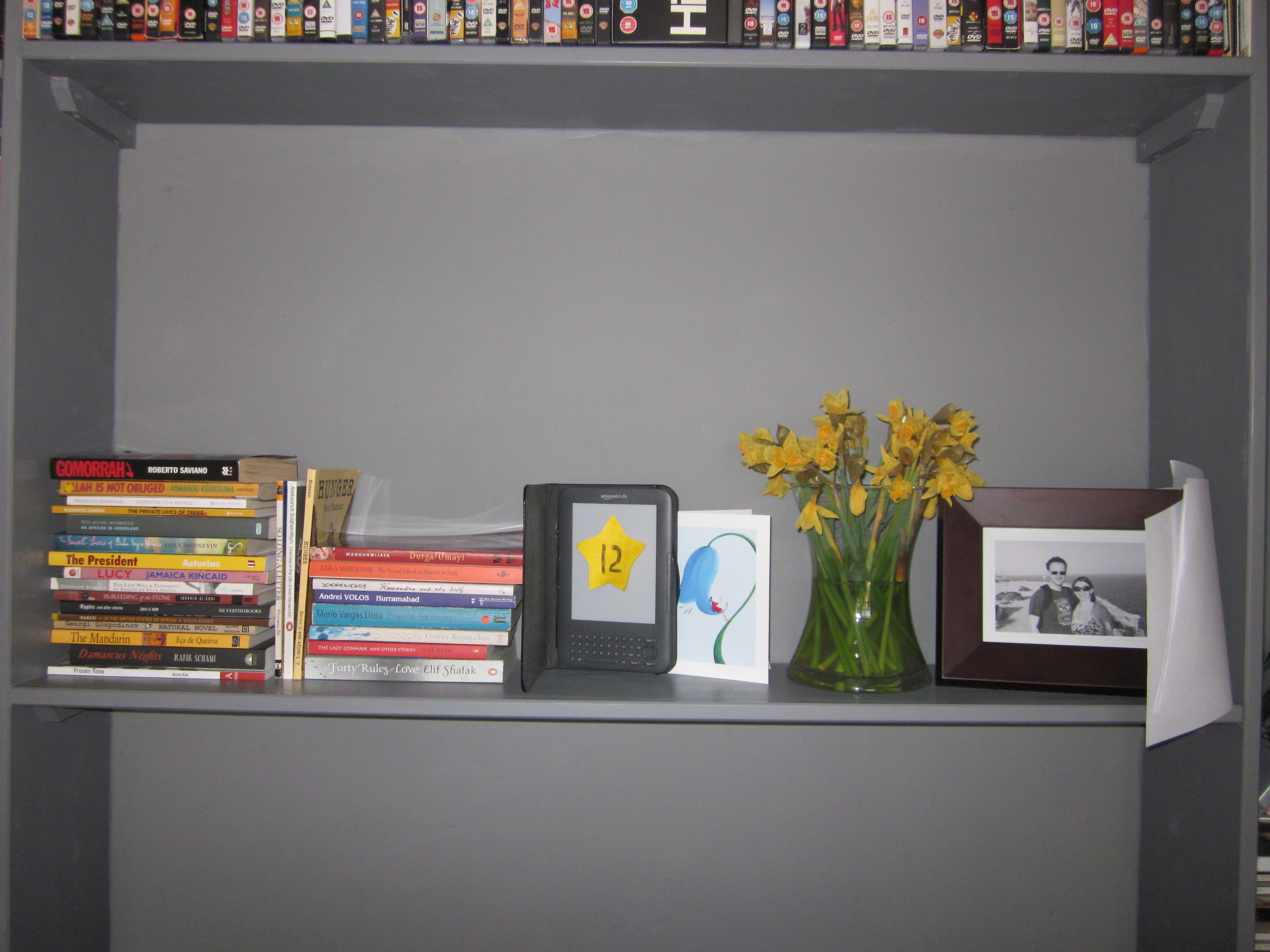
img_0698-001

This novel has the distinction of being the first book of the month to come from a country that I have already featured in this slot. My inaugural Chinese BOTM choice was Cao Wenxuan’s delightful children’s story Bronze and Sunflower, which this month won the 2017 Marsh Award for Children’s Literature in Translation. Hearty congratulations to its English-language translator, Helen Wang.

My next pick – or rather its author – has been on my radar since my original year of reading the world. Yan Lianke was one of a number of Chinese writers recommended to me by translator Nicky Harman, who kindly undertook to give me some advice on what I might read from the planet’s most populous nation. In the end, I went with a novel translated by Harman – Han Dong’s striking and unjustly overlooked Banished! – however, I was intrigued by what she had told me about controversial Beijing-based satirist Yan and have had it in mind to read his work since then.

So when I happened upon several translations of his novels in Hatchards bookshop on London’s Piccadilly a few weeks back, I decided to pick one out. Several sounded tempting, but it was the premise of Lenin’s Kisses that swung it.

Revolving around Liven, a village populated almost exclusively by disabled people in China’s remote Balou mountains, the narrative follows the unfolding of a plan by ambitious county official Chief Liu. With a view to enriching the region beyond its inhabitants’ wildest imaginings, he resolves to purchase Lenin’s embalmed corpse from Russia and use it as a tourist attraction to draw visitors from all over the world. In order to raise the funds to attempt this, he proposes to use Liven’s residents to stage a travelling freak show, with extraordinary and sometimes alarming results.

If the summary makes you think this is a quirky book, you’d be right. The story is decidedly odd and Yan makes no apology for that. Elements of the fantastic creep in – snow falls in summer, a woman with dwarfism is cured by having sex with a man of normal height, the freak-show performers prove themselves capable of mind-boggling feats.

What’s more, the structure of the book magnifies its strangeness. Weirdly arbitrary footnotes pepper the text, running on for pages and pages, sometimes with notes on the notes, so that the reader is sent hither and thither, as narrative within narrative opens and closes like the petals of rare flowers. This can be irritating at first (and I have to confess I wouldn’t want to attempt this book on an ereader), but when you relax into it, it quickly becomes part of the playfulness in what is at times a very funny book.

It is perhaps this use of humour that allows Yan to get away with some of the more daring political criticisms lodged in the text (unlike several of his other books, Lenin’s Kisses has not been banned in Mainland China and was even given the prestigious Lao She Literary award, although it did cost him his employment as an author for the People’s Liberation Army). Though much of the novel could be read as a criticism of capitalism – the worst events result from the accumulation of obscene wealth by the unexpectedly successful performers – there is no shortage of jibes at ‘higher ups’ closer to home.

Yan, who has admitted self-censoring his work, does a powerful line in pointed observations that could be read several ways. The following is a great example: ‘The government looks after its people and the people should remember the government’s kindness; this is the way things had been for thousands of years.’

Quirky though it is (and by far the funniest Chinese literary work I have read), the novel does share some characteristics with other books I’ve encountered from the nation. The language is earthier and more abrasive than you often see in anglophone literature – expletives abound in some sections and curses are hurled around rather casually. What’s more, descriptions of violence and bodily functions are quite graphic.

That said, the narrative also reflects many of the universal traits found in the world’s best storytelling too. Yan has extraordinary psychological insight and traces the thought processes of his characters with a deftness reminiscent of some of the greatest authors from the home nation of Lenin’s corpse. His depiction of the Hall of Devotion, for example, a room where Chief Liu records (and sometimes embellishes) his achievements alongside those of the world’s great communist leaders is wonderful. Similarly, in Grandma Mao Zhi, the formidable spokeswoman of the people of Liven, he creates an extraordinary portrait of a person spurred on and yet also destroyed by the desire to fulfil a vow.

Clever, daring, amusing and inventive, this is an excellent read. It thoroughly deserves the many accolades it has achieved and is without question a world-class book. The front of my copy features the following endorsement from celebrated Chinese-American writer Ha Jin: ‘The publication of this magnificent work in English should be an occasion for celebration.’ He is right.

Lenin’s Kisses by Yan Lianke, translated from the Chinese by Carlos Rojas (Vintage, 2013)

Indonesia: talking about revolution

The further I get into this project to read the world, the more I appreciate the challenge facing translators working with books written in societies very different from my own. Not only must they endeavour to create engaging and faithful reflections of the original texts, but they must often also find a way of explaining objects, customs and even whole belief systems that may have no counterpart in their target audience’s culture without turning the narratives into anthropological essays.

Some, like May Jayyusi and Christopher Tingley, the translators of Ibrahim Al-Koni’s The Bleeding of the Stone, choose to tackle this with a brief notes section at the back, to which readers can defer for help decoding terms they may not have come across before. In other cases, as with Rajaa Alsanea’s Girls of Riyadh, cultural and linguistic differences lead to a substantial reworking of the translated text, with controversial results.

Few books, however, can have required more fancy philological footwork than YB Mangunwijaya’s Durga/Umayi. Not only does this novel satirise most of the major political events in Indonesia from the 1930s to the late 1980s, but it also draws on the region’s shadow-play tradition, weaving a number of Indonesia’s myths into the text. On top of this, as translator Ward Keeler explains in the introduction, Mangunwijaya has helped himself to all the different dialects of Indonesian spoken in the country, creating his own ‘zany style that is without precedent in Indonesian or Javanese literature’. Phew.

The basic premise — thank goodness — is relatively simple. Central character, Iin, a young woman opposed to the ‘cooking-cleaning-cuddling view’ of her sex, finds herself with a front-row seat at most of Indonesia’s key historical events, from before the time of independence from the Dutch, through the Japanese occupation of the 1940s and the horrific communist massacres of the 1960s and beyond.

Mirroring the events shaping her nation, Iin morphs from a young idealist into a hardened globe-trotter, cutting cynical deals that will never benefit the people she used to care for most and changing her dress, manner and even her face and body to fit each new scenario. Like the beautiful goddess Durga of the title — who finds herself transformed into the monstrous Umayi when she refuses to have sex with her husband Lord Guru in public — Iin loses her identity in her effort to assert herself.

As with all great satirists, Mangunwijaya has an eye for the ridiculous and a talent for plunging pride into bathos. So we hear of ‘the Nippon Armed Forces who were undefeated but then were’ and the lament of the peasant farmers: ‘Oh God, when is this freedom era going to end, begging your pardon’. Again, like the best satire, this merciless stripping back of pretension and propaganda proceeds from deep, humane anger at the injustices heaped upon normal people, which bubbles up through the text, aerating and stirring the narrative.

For all its brilliance, however, this novel does come with a health warning. Delightful though Mangunwijaya’s ‘verbal high jinks’ can be, they demand a lot. Sentences spiral off across page after page, leaving the reader trailing behind them, struggling to keep hold of subjects and objects, nevermind the overall sense. At times, searching in vain for a main clause, I found myself wondering if I had any idea what was going on at all, as though the language was forcing me to share the bewilderment of the Indonesians as regime change after regime change sweeps their land.

This is not a book to curl up with. It’s a book to concentrate on and frown at and read bits of several times over. The effort it is worth it though: this is easily one of the most inventive, urgent and passionate texts I’ve read. It’s also a testament to what skilled translators, the neglected heroes of the world literature scene, can achieve. Hats off to you, Ward Keeler.

Durga/Umayi by YB Mangunwijaya (translated from the Indonesian by Ward Keeler). Publisher (this edition): University of Washington Press (2004)