‘I won’t disappear. I’m the people. I’m the poor. I am the truth. I’m a scream of protest in the face of crimes.’
I learnt to read when I was 30 years old. For the first three decades of my life, I believed that reading was about bringing context to books, unpacking the meaning of words, and using biographical, historical and critical references to understand what was being said.
But when I set out on my quest to read a book from every country in 2012, I quickly realised that this approach was not going to work. With only 1.87 days to find, read and write about each text I featured on this blog that year, there was no time for reading around and the careful critical analysis that had formed the backbone of my academic study of literature.
Faced with numerous texts from unfamiliar traditions, I had to accept that there were going to be a lot of things I didn’t know or couldn’t be sure of in the books I read that year. I would have to embrace incomprehension and see if I could have a meaningful encounter with these stories all the same.
This approach formed the basis of the reading workshops I now run in-person and online for curious readers at schools, universities and community groups. And it continues to inform my reading to this day.
Still, every so often, a text comes along that challenges me to take not-knowing to another level – and reminds me of the value of doing so. My latest Book of the month is a good example.
Shalash the Iraqi didn’t start life as a book. Instead, it began as a series of around 80 blog posts written in the wake of the fall of Saddam Hussein by an anonymous writer, also known as Shalash the Iraqi, living in Baghdad’s Thawra district. Radical in many senses – not least because of its biting satire and fearless criticism of the infighting, corruption and cruelty of the various factions struggling for control in Iraq – this collection of essays, short stories, parodies and polemics became an underground hit, a 21st-century samizdat text, printed out and circulated in secret. Now reassembled and curated by its still-anonymous author and translated by Luke Leafgren, this urgent writing is available to English speakers for the first time, nearly two decades after the events that prompted it.
There are plenty of opportunities for not knowing in this book. Bristling with references to local politicians, celebrities and scandals, as well as sectarian rifts, the text feels extremely slippery at times. There is little to hold onto and few footholds in many of the entries. Sometimes pages go past where it is impossible for someone without intimate knowledge of early-21st century Baghdad to retain much sense of what is being expressed.
Translator Luke Leafgren says in his afterword that he initially envisaged filling the book with encyclopaedic footnotes to help explain the multiple references. He (rightly in my opinion) decided against this on the basis that it would introduce more barriers than it removed. Instead, he invites readers to consult YouTube, Google maps and other online resources, reading the book in tandem with the internet on which it first appeared.
While this might aid understanding of some of the more information-heavy sections, however, it will not remove many of the challenges that come with this text for readers in other times and places.
Humour is one of the key issues. Knowing that the original blog posts were celebrated for their wit creates a strange tension in the mind. Are we supposed to regard descriptions of magical elephants and boys peeing oil as clever allegories for things we can’t pin down or surreal flights of fancy? Are the more extreme descriptions of the privations of life in occupied Iraq heartfelt laments or dark satire? Or both?
Nevertheless, there are moments where there can be no doubt of the humour at play. Many of these involve spoof pieces such as ‘The Shalashian Satellite Channel’, where a promise to give ‘each of our political parties an opportunity to introduce their platforms’ quickly disintegrates into muzzling candidates with lengthy adverts and irrelevant calls from viewers. There are also many zinging oneliners – take the description of Saddam Hussein’s bodyguards, ‘those men who would abandon said leader more than twenty years later so he could star in a TV show about sleeping alone in a pit’.
Similarly, at certain points there can be no mistaking the sorrow behind the words. A few paragraphs after the above, comes a particularly moving passage that reminds us of the damage Hussein wrought:
‘Then the sanctions settled in and transformed us from young men with dreams, striving for life, into street vendors with corner stalls; from excellent students into drivers’ assistants on minibuses; from lovers of life into scowling, deeply etched, prematurely aged faces.
‘[…]
‘Look at the Comrade Leader who destroyed our lives. Here he is, on trial for murdering a group of our people in Dujail. I also wanted to tell you that His Honor, the judge, is a kind man. He really does seem to be doing his job without remembering that the accused man standing before him did far worse than what’s listed on the charge sheet. He murdered our futures. He brought an end to our laughter and transformed our country from a paradise, the envy of nations, into a garbage dump picked over by black cats, as crows caw in the sky above.’
Yet Saddam Hussein is not the biggest villain in the book. One of the key challenges when you encounter stories from elsewhere are the moments when you realise you are not the reader the writer imagines. ‘You, dear reader, are also an Iraqi,’ writes Shalash. But of course the vast majority of those reading in English won’t be, except perhaps in a Je suis Charlie sense. Instead, we are more nearly aligned with Shalash’s greatest oppressor, the occupying forces who deposed Hussein and plunged Iraq into chaos.
For translator Luke Leafgren the response to this is to attempt to understand and amplify. One of his key motivations for undertaking the translation, he says, was his consciousness of being part of the culture that tipped Iraq into the savage instability that grips it to this day.
Given that the texts are not written in standard Arabic but in Shalash’s local dialect, this presented huge challenges. And there is no question that Leafgren has done a fantastic job in producing a lively, irreverent, coherent voice on the page, even if the text does creak occasionally in its attempts to convey the nuances of the original’s word play.
I’m with Leafgren when it comes to the importance of amplifying voices and attempting to use stories to establish common ground. But I also think that bewilderment and not-knowing have an important part to play when reading stories from elsewhere, even if it can make for a daunting read best approached in small sips day by day (in the manner in which the posts were first released) rather than a text that grips and sweeps you along.
It is by holding questions in our mind and remaining aware of the possibility that we have not understood perfectly that we can come closest to respecting the experiences and humanity of others.
This is perhaps particularly true when it comes to a text like Shalash the Iraqi. As the writer himself reminds us in his preface, bewilderment was central to what he and his compatriots lived through when the old order was bulldozed overnight: ‘I found myself a stranger in my own country, as bewildered as if I were suddenly thrust into the set of a movie about the Prophet of Islam in the early years of his ministry. Yes, my country vanished from the map after the invasion, and it was a bitter shock.’
In finding language exploded in this book and picking our way through words made strange, second-guessing ourselves at every turn, not knowing whether to laugh or cry, we perhaps come closest to the experience of those who first read these narratives. ‘See how quickly this story got from silly to deadly?’ writes Shalash in one of the earliest posts in the book. Well, quite.
Shalash the Iraqi by Shalash the Iraqi, translated from the Arabic by Luke Leafgren (And Other Stories, 2023)
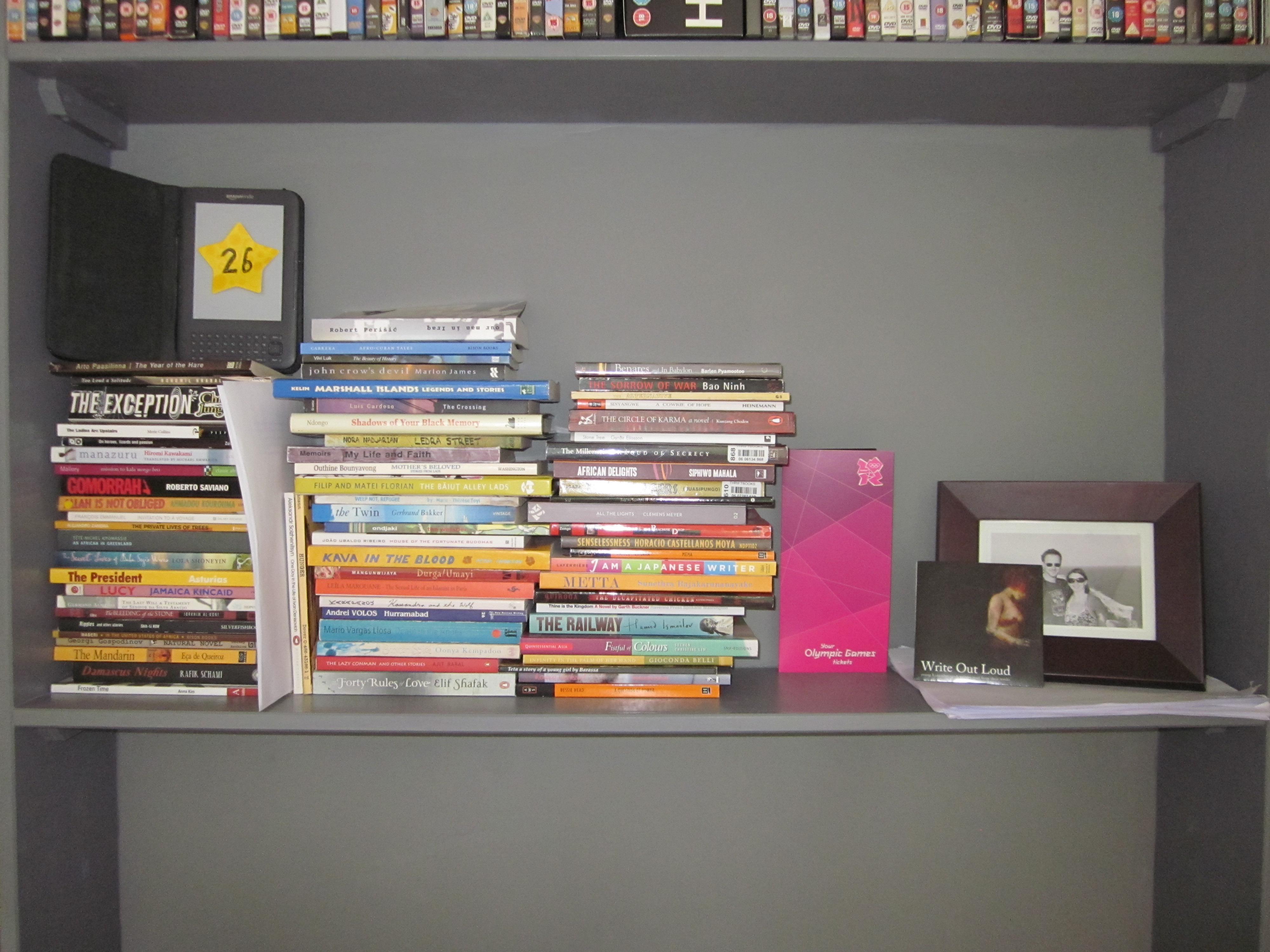
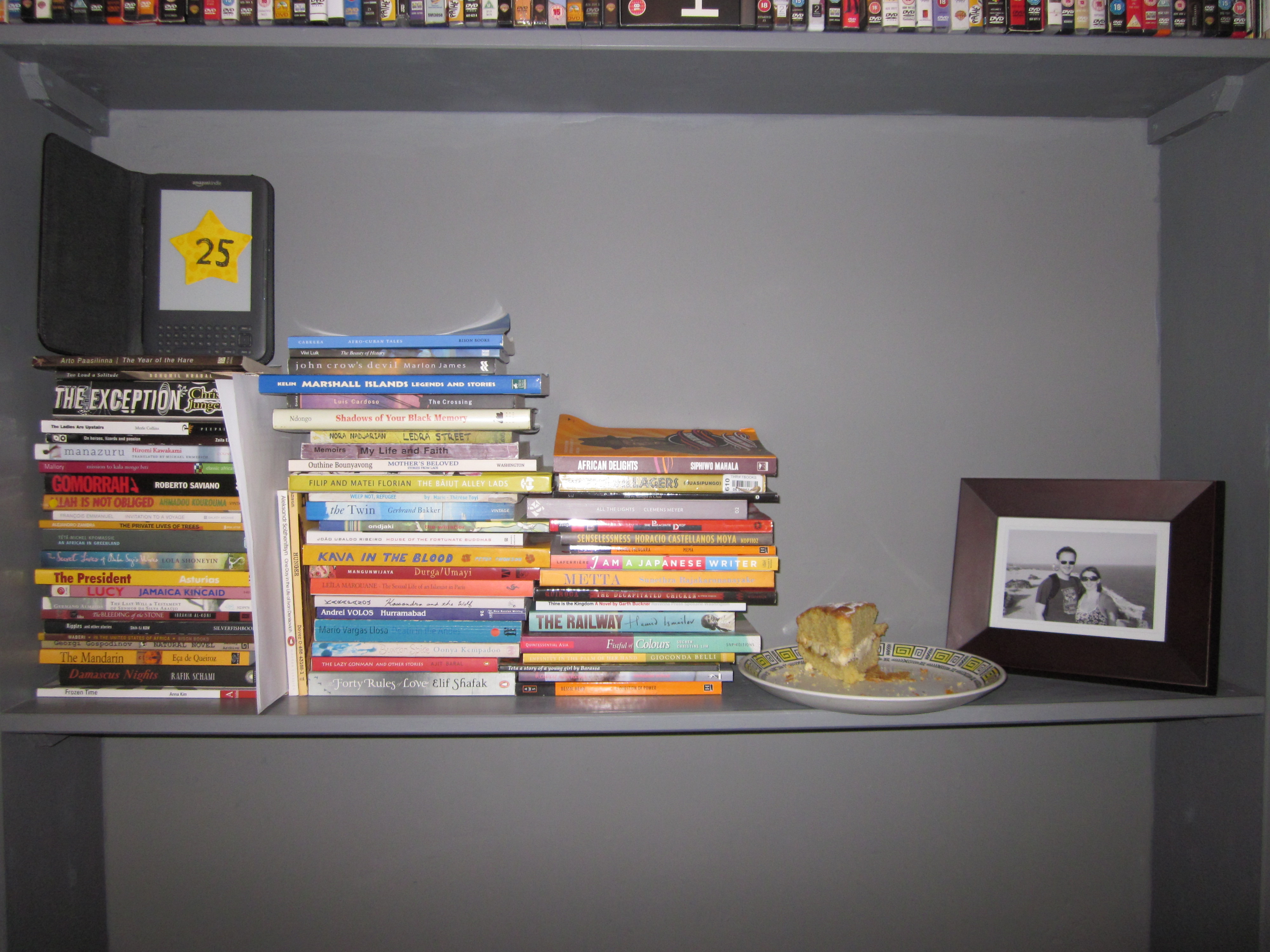
So there it is, up there on the star in the top left of the picture: the 53rd – and last – book I’ve read on my Kindle for this project. But which of the shortlisted places and peoples not featured on the main list did it come from? Basque Country, Bermuda, Catalonia, Faroe Islands, Kurdistan or Native America?
Well, the voting was fierce. Nearly 400 of you took part in the poll and there was plenty of passionate campaigning along the way. You can see the full breakdown of results on the Rest of the World page, but the headline news is that it came down to a two-horse race between Jaume Cabré’s Winter Journey from Catalonia and Jalal Barzanji’s The Man in Blue Pyjamas from Kurdistan. Cabré held the lead for a long time, but in the end, thanks to some vigorous lobbying on the part of #TwitterKurds, Barzanji romped home to secure the A Year of Reading the World wild-card spot.
Written after its author was named PEN Canada’s first ever Writer-in-Exile in 2007, The Man in Blue Pyjamas tells the story of poet and journalist Jalal Barzanji’s life in Iraqi Kurdistan, his three years of imprisonment and torture under Saddam Hussein’s regime – throughout which he remained in the night-clothes in which he was arrested – and the lengths he went to to secure a future for himself and his family on the other side of the world. It weaves together Barzanji’s memories, the experiences of people he met along the way, historical events and Kurdish traditions to present a compelling picture of the contested homeland that both shaped and nearly destroyed the writer.
With its account of what it means to grow up in a nation that does not fit into the neat country borders most of us use to organise the planet, the memoir is in many ways a very fitting ‘Rest of the World’ choice. Opening with a map showing Kurdistan spread across portions of Iraq, Syria, Turkey and Iran, the book owes its structure to the sense of fragmentation that Barzanji grew up with – ‘I must present my story in small pieces because my life has been in pieces,’ he writes before going on to leap between past, present, ancient history and future, like a spider spinning a web between far-distant points.
Yet the struggle for national and cultural autonomy is only part of the story: for Barzanji the battle to make a life as a writer is every bit as fraught. Born in a house with no books or pens, the writer had to contend with his family’s incomprehension of his ambitions, draconian and often bewildering censorship laws, and the challenges of funding and publishing his own work. Crucially, it was not his years of imprisonment by the Iraqi regime nor atrocities like the attack on Halabja, but the infighting between different Kurdish factions that made Barzanji decide he had to flee his homeland and throw himself on the mercy of smugglers, as he explained to his wife Sabah: ‘”I have to go to a place where I can continue to be an independent writer. I do not want to take sides in this civil war.”‘
In the face of such huge obstacles, under a regime that transformed the library in which he first discovered his love of words into the prison where he was tortured, Barzanji’s dedication to his craft is deeply moving. His portrayal of the stories of his fellow Kurds – from the waggish Ako’s account of the difficulty of consummating his marriage because of his family’s cramped sleeping arrangements, to the devastating drowning of Shwan in a bungled people-smuggling attempt – lays bare the sense of duty that drove the author to risk everything for the sake of reaching a country where these experiences could be written. Not that Barzanji is quick to take credit for this – ‘that’s the way writers are: they seldom think about the consequences of what they do or write,’ he claims, seeming to shrug at us from the page.
Indeed, Barzanji’s style is so unassuming that you only realise the scale of what he has achieved in this book gradually. His skill shines through from page to page in the details that bring the experiences described home to the reader: the blood on the prison walls, the dyed moustache of the torturer, the boyhood trick of placing a flis coin on the railway track and waiting for a train to squash it into something resembling a more valuable coin, and the terrifying darkroom and stick reserved for the mentally ill at the sheikh’s house. It also appears in his endearing honesty about his shortcomings – his social awkwardness at parties, his habit of losing his luggage, his daydreaming.
Only when you step back from these intimate and immediate observations and survey the fragmented narrative in its entirety do you realise the extent of its power. Taking us to a place that many refuse to accept exists, Barzanji reveals what it means to be forced to weigh freedom, self-expression and survival against belonging, duty and the law. Seen from the final page, the story in pieces transforms itself into a beautiful and beguiling whole. A humbling read.
The Man in Blue Pyjamas by Jalal Barzanji, based on a translation from the Kurdish by Sabah Salih (University of Alberta Press, 2012)
I was all set to read something by Dubravka Ugresic for my Croatian book when a Serbian colleague who reads a lot of literature from the region burst my bubble – surely I could find something more interesting from Croatia, she said. Never one to turn down a challenge (how do you think I ended up trying to read a book from every country in the world in a year in the first place?), I decided to give it a shot. But given that Dubravka Ugresic was the frontrunner in the recommendations I’d had so far, I was going to need some help.
My first port of call was the British-Croatian Society. In response to my appeal for books I could read in translation, their secretary put me in touch with Susan Curtis-Kojakovic, director of Istros Books, a company set up in 2010 to publish literature from South-east Europe in English. I was in luck: they had published a Croatian novel only that week.
Our Man in Iraq by Robert Perišič is the story of a Croatian journalist, Toni, who faces the sack when the ill-qualified reporter he has sent to cover the war in Iraq for his newspaper becomes increasingly erratic before disappearing altogether. Obliged to fabricate his colleague’s articles, all the while struggling to hold together his increasingly fragile relationship with his actress girlfriend, Toni begins to draw on his memories of Croatia’s own conflict, unaware of the ridiculous lengths he will have to go to try to save his career.
The Graham Greene reference in the title (it would be interesting to know whether this was in the original or added for the benefit of English readers) is more fitted to the novel’s witty tone than its content. Unlike in Our Man in Havana, our hero is not the bewildered novice parachuted into a remote corner of the world and forced to make the best of it, but the bungler who sent him. Given the gravity of the situation in Iraq, this reversal, which keeps the war-zone correspondent a shadowy, mysterious figure for whom we can’t feel too anxious, is probably necessary for the comedy to work. Still, it’s striking to see a comic novel set, partly – albeit indirectly – in Iraq.
Perišič’s wit is complemented by his insight into the dynamics of human relationships. This comes across most strongly in his descriptions of the ebb and flow of Toni’s interactions with his live-in girlfriend Sanja. ‘Part of our love (and understanding) thrived on nonsense,’ explains Toni, going on to portray the fluctuations in their daily conversations with just the right mixture of perceptiveness, self-deprecation and bathos – a tone which also enables him to launch into passages of detailed commentary about the personal and social affects of the Croatian War of Independence without losing the reader.
There are one or two problems with the text. In particular, though funny when Toni’s terrible impression of an English TV chef is transliterated in all its auricular weirdness, the editorial decision to represent regional accents or dialects with regional English accents is very disconcerting. We find Toni’s mother talking in uneven Scots, while a man from his home village sounds as though he might be more at home strolling through the East End.
These jar, however, because the novel is, for the most part, so well done. It is a thoroughly enjoyable and thought-provoking story, which, while recalling some of the comic greats that have gone before, add its own brave, quirky and refreshing perspective to the tradition. An unexpected delight. I’d like to read more.
Our Man in Iraq by Robert Perišič, translated from the Croatian by Will Firth (Istros Books, 2012)
There were quite a lot of contenders available in English for Iraq. Perhaps that’s not a surprise, given that the country has been in and out of Western headlines for more than the last 20 years. Still, it was good to know that the traumatic occurrences of recent decades had not disrupted storymaking in the region – or so I thought until I read this book.
The Madman of Freedom Square – the first commercially published short story collection by Hassan Blasim, co-editor of Arabic literary website Iraq Story – paints a brutal, yet layered picture of the effects of international events on individual lives in and around post-invasion Iraq. Often starting or ending with a mutilated corpse, the tales trace the connections that bind people to one another and reveal the psychological wounds that result when these ties are ripped apart. There are the refugees reduced to animal cruelty when the truck they are locked in is abandoned, the patriotic songwriter turned atheist who wanders the streets railing against God and existence only to meet a gruesome end, and the underground collective that roams Baghdad making art out of its murder victims.
More than anything, this is a book about the function of storytelling. From the very first tale, ‘The Reality and the Record’, in which a traumatised man tries to tell the right story to secure asylum at a refugee centre, the text interrogates the act of narrating, as though trying to identify its weak points and secret guilt.
Sometimes – as in ‘An Army Newspaper’, an account of an unscrupulous editor who gets trapped in his lies when the dead soldier whose work he has passed off as his own continues to submit reams of manuscripts – storytelling takes on monstrous, nightmarish proportions. At other points, as with the sensational anecdotes spread by gossipmongers in the wake of bomb blasts in ‘The Market of Stories’, it seems a low, self-indulgent exercise, a sort of ‘primitive tribal gibberish which tries to hide behind tasteless and gory laughter’.
That story, however, also holds something of a key to the text’s uneasy relationship with its own function. According to the narrator, it may have its roots in Iraq’s history:
‘Since the fall of Saddam Hussein there have been incessant calls for writing to be intelligible, realistic, factual and pragmatic. […] They claim that the writers of the past made the readers defect, whereas in fact for hundreds of years there were no readers in the country, in the broad sense of the word. There were only hungry people, killers, illiterates, soldiers, villagers, people who prayed, people who were lost and people who were oppressed. Our writers seem to have grown tired of writing for each other.’
It’s important to note, of course, that these are the narrator’s words rather than Blasim’s own. Nevertheless, the question of who narrates, who listens and the value of telling at all rankles throughout the book, inviting the reader to look beyond it to the man writing in Arabic in Finland – Blasim’s home since 2004 – and wonder who exactly these words are for.
Underpinning this unease are repeated comments on the world-altering properties of perspective, with many of Blasim’s narrators suffering from mental illness, trauma or profound emotions that render their accounts suspect. The most powerful example, however, comes in ‘The Virgin and the Soldier’, an account of two young lovers doomed to a horrific death when they are accidentally locked in at the sewing factory where they work at the start of a holiday:
‘In reality there was nothing in the factory but army uniforms, but the government’s aim was to make the UN inspectors suspect that the factory was used for prohibited military purposes. […]
On that morning the American satellite pictures could not of course detect the muffled screams on the second floor. The screaming was hardly audible, and desperate. From the end of a world that was dying it reached the sewing room, which was empty and looked like a dreary sunset over an abandoned city.’
Too much distance, Blasim seems to be suggesting, and we become unable to empathise with fellow human beings, like satellites monitoring the Earth from the exosphere. And yet, even as he writes this, the author draws us in to the heart of the events he describes, immersing us in their brutal, bloody and heartbreaking immediacy.
Some of the stories end less successfully than others and there are one or two twists that miss their marks, but overall this is a powerful and thought-provoking work that transports readers to the extremes of human experience – and a mental terrain most of us are lucky enough never to have to travel through. If Blasim needed proof of the validity of storytelling, he has written it.
The Madman of Freedom Square by Hassan Blasim, translated from the Arabic by Jonathan Wright (Comma Press, 2011)