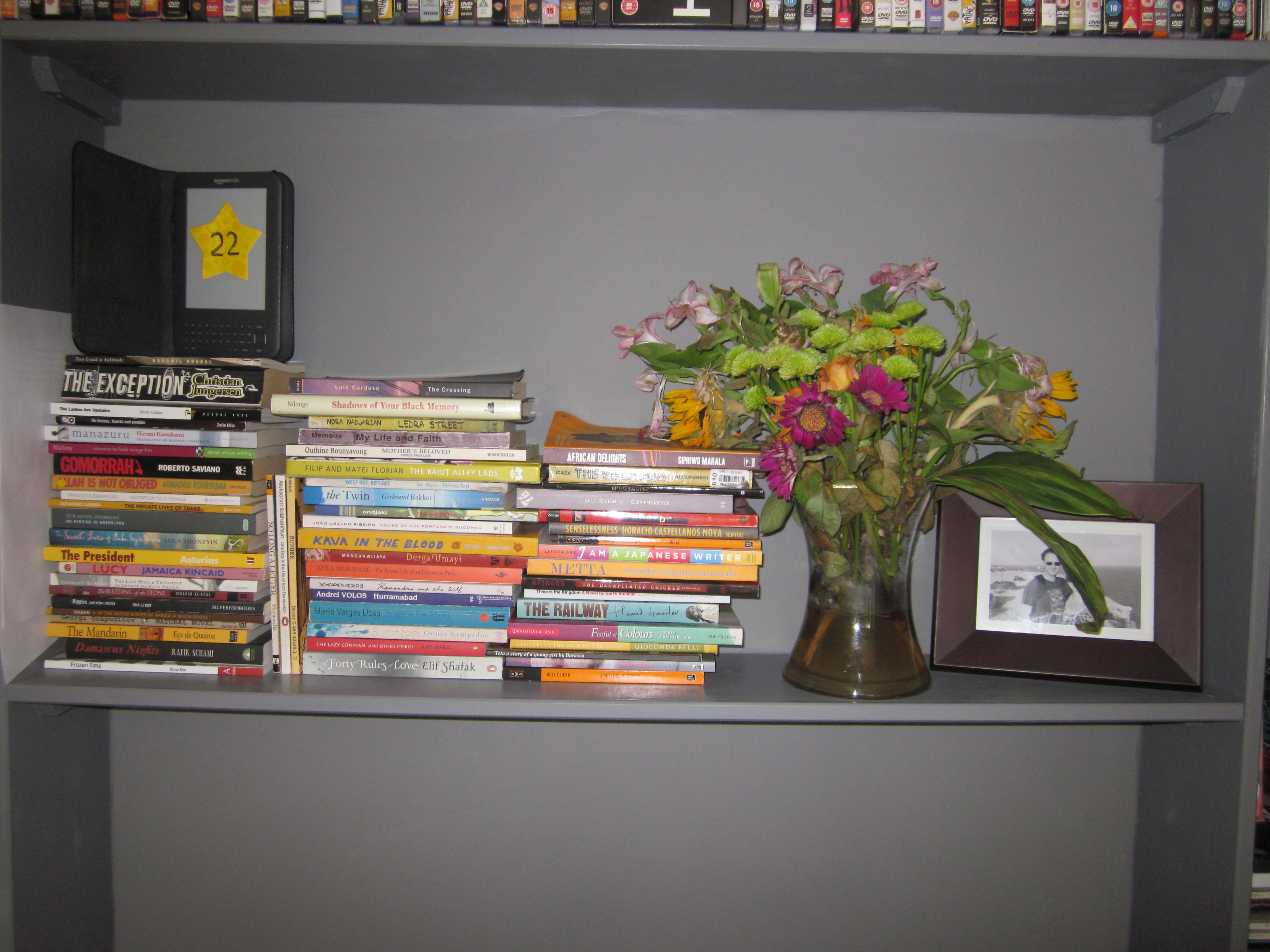
East Timor: poetry in motion

This book was recommended by The Modern Novel, a blogger writing about the development of the literary novel worldwide. TMN kindly posted a comment on this site helping me out with a few of the harder to reach destinations (there are still quite a few gaps on that there list and plenty of countries with only one or two titles suggested – go on, have a look and let me know what I’m missing).

Several of the recommendations weren’t available in translation – much more linguistically gifted than I am, TMN reads in French, German, Italian, Portuguese and Spanish, as well as English – however there were some great additions to the list among them. The Crossing by Luis Cardoso was one of these.

In actual fact, The Crossing is not technically a novel, it’s a memoir. Like me, TMN holds the view that the boundaries between these two genres blur the more closely you look at them, which is why we’re both including memoirs in our projects.

Telling the story of Cardoso’s childhood and adolescence in East Timor, the book reveals the nation’s troubled recent history through a small and touchingly precise lens. As waves of Portuguese, Japanese and Indonesian colonialism wash over the country, the author records the tragic impact of these events on the ‘people lost in time’ who have to live through them, caught between the oppressive yet relatively stable patterns of the past and the fragile freedom ahead.

This is a book as much about forgetting as it is about remembering. While Cardoso’s traumatised and exiled father frames the narrative – bumbling about Lisbon where his son is studying trying ‘to recover the memory he had lost’, all his fire and bluster gone – Cardoso himself seeks to reconcile the partial versions of events he encounters with his own fragmentary memories of his homeland.

A nostalgia for Portuguese rule – warmer than any other attitudes to colonialism I’ve read about so far this year – permeates much of the book. For characters like Cardoso’s father the Portuguese administration, despite its enforcement of apartheid, and its rigid and sometimes brutal practices, is ‘the erstwhile mother country […] even though the umbilical cord had been cut in such a way as to make the child bleed and the mother grieve’.

As well  as blending novel and memoir, Cardoso brings in elements of poetry too through his descriptions that conjure places and people as deftly as the briefest of stanzas. Time and again, he captures complex situations in a net woven only of a single sentence, as when he sets out his father’s deluded hopes for his son’s future:

‘He dreamed that, one day, I would take up a post in [an] administration [made up of people educated in Portugal] – the dreams of someone who has built a boat and wants to go on sailing through time, along the lost route of the colonizing caravels’.

The huge cast of walk-on characters and vast catalogue of events mentioned in this relatively slim book mean that occasionally the narrative can jump like a scratched record from one scene to the next. Several times, I found myself having to turn back a page or two, trying to work out how I had been thrust into a storm that seemed to have gusted up out of nowhere. Sometimes, there wasn’t really an explanation.

Taken as a whole, though, this is a touching, lyrical and sometimes playful account of the search for identity in a land you can only fleetingly call your own (East Timor only managed a few months of independence in 1975 before it was conquered by the Indonesians and at last gained its sovereignty in 2002). It makes a compelling artwork out of a shifting kaleidoscope of personal and political allegiances. A great suggestion.

The Crossing: A Story of East Timor (Cronica de uma travessia: A epoca do Ai-Dik-Funam) by Luis Cardoso, translated from the Portuguese by Margaret Jull Costa (Granta, 2000)

Fiji: no man is an island

Regime change seems to be the theme of the moment. No sooner had I finished YB Mangunwijaya’s satirical portrait of post-independence Indonesia than it was time to start Peter Thomson’s Kava in the Blood, an account of the coups that shook Fiji in 1987.

I was particularly intrigued to read the book because Dr Chakriya Bowman, Director of the Pacific Islands Forum Secretariat’s  Economic Governance Programme, found it for me after stopping by this blog. She very kindly visited the University of the South Pacific’s bookshop and emailed me the details and pictures of all the books she found that fitted the AYORTW criteria. Thomson’s EH McCormick Prize-winning memoir was one of these.

In fact, as Thomson acknowledges in his 1999 Foreword, Kava in the Blood contains not one story but two. Alongside his ‘account of what happened at Government House’, where he worked as Permanent Secretary of Information during 1987, he tells the poignant story of his love affair with the country his family emigrated to from Scotland four generations before he was born.

The question of what constitutes nationality and national identity is at the heart of the book. Not only is this the catalyst for the coups, sparked after Fiji’s first non-indigenous-dominated government came to power, but it also forms a powerful theme in Thomson’s personal life.

Despite having been born and brought up in Fiji, Thomson is forced to confront the fact that he has not been completely accepted into the ‘closed shop’ of Fijian society when the indigenous community closes ranks against ‘outsiders’ in the wake of the first coup. ‘I felt a creeping sense of delusion at being part of a country which, because of my European forbears, was now pointing a finger at me and saying “vulagi” — the Fijian word for visitor, or in this sense, foreigner’, he explains, going on to write wistfully of the ‘sense of oneness’ his indigenous peers must feel with the landscape and culture he loves.

This love is apparent throughout the book. It shows itself in Thomson’s humorous accounts of some of Fiji’s more bewildering traditions — ‘to those not used to it, a kava [Fiji’s national drink] session can have similarities to Chinese water torture,’ he writes — his deep knowledge of the nation’s culture, plants and animals and history, and his lyrical descriptions of life under the ‘arching starscape of our southern skies’.

The narrative is packed with fascinating and affectionate insights into Fijian society, including reflections on everything from Fijian patois through to the island’s prison system and the after effects of British colonial rule. Thomson’s recollection of establishing a polling station on Naqelelevu in 1976 in his capacity as district officer the day only one of the six eligible villagers turned out to vote is particularly memorable:

‘With absolutely no sense of the ridiculous the polling station was declared open. The voter went through the identification process and then turned to the little audience of seated villagers, ballot paper in one hand […]. Grinning self-consciously, he stood there long enough for the audience to take their mental snapshots of his moment of importance, and then another official guided him to the white wooden polling booth we had shipped with us.

‘The booth had been set up some distance from the table, giving the event an added sense of space and time. The official politely advised the protagonist to take his time with his vote. Inside the booth he did just that, while the rest of us on Naqelelevu that day looked on solemnly. Finally the booth started wobbling as he went through the motions of pacing his mark on the ballot paper. He emerged. Everyone pointed to the ballot box, and he went over to it and dropped the paper into its slot. He then stood for a while in front of the box like someone whose [sic] just won a TV gameshow, with a sheepish grin and not knowing quite where to put his hands.

[…]

‘With [the] lonely ballot paper… inadvertently eliminating the principle of the secret ballot, we packed up our gear, and bade farewell, sailing off to the south and leaving the islanders to their thoughts on the wonderful machinery of democracy.’

These rich recollections, along with Thomson’s exquisite accounts of his childhood on the islands, which read like extracts from a tropical Swallows and Amazons, more than make up for the jerky and episodic nature of the book, which sometimes feels more like a series scrapbook notes and jottings than a memoir. The addition of Thomson’s photographs into the 2008 edition heightens this impresion, giving the whole thing an immediate and personal quality. At points reading it feels as though you are sitting with Thomson under the giant rain trees outside his Waijevo residence, looking at his family album and waiting for the kava cup to come round.

Although writing in exile, after the second 1987 coup and four days of unlawful incarceration, during which he says ‘the umbilical cord to my homeland was cut’, Thomson’s love for Fiji clearly persists. As his two Afterwords suggest, his story of his island homeland is one from which he finds it hard to tear himself away. I did too.

Kava in the Blood by Peter Thomson (Booksurge, 2008)

PACIFIC APPEAL: do you know any good novels, short stories, memoirs, writers or even oral storytellers from other Pacific nations? Do you have friends or relatives in the region who might be able to suggest stories? Leave a comment or email ann’at’annmorgan.me and let me know.

Australia: neighbours

For almost any British child of the eighties, Australia feels like a home from home. Sanitised and unreal though they may have been, Erinsborough and Summer Bay were the favourite after-school hangouts in the days before cable and satellite TV and the characters that lived there were our friends. We flicked our sentences up at the end to fit in with them, talked Alibi in the playground and devised elaborate make-believe games involving Madge, Harold and Mrs Mangel. When I was lucky enough to have the chance to drive round the coast from Perth to Sydney a few years back, it really did feel like being both home and away.

I was excited to read my Australian choice for another reason too: this was the book that started this crazy venture to read a story from every country in the world. Last year, fellow blogger Jason Cooper stopped by my A year of reading women blog and said that he really wanted me to read Tim Winton’s Cloudstreet. I pointed out that Tim Winton didn’t fit with my theme, but Cooper was adamant: I would have to do another blog in 2012 and find a theme to fit round the book.

‘What about reading books from different countries?’ he suggested.

‘What about reading books from every country?’ I countered.

And so A year of reading the world was born.

Luckily, I can see why Cooper loves this book. Charting the story of two hard-up families forced to live together in a tumbledown house on the outskirts of Perth in 1943, the novel creates a world every bit as absorbing as the soap operas of my childhood — and which bears more than a passing resemblance to them: the narrative is divided up into neat little in-between-the-ad-breaks-size chunks, the story has an episodic quality as it pans round the large cast of characters and stretches out across 20 years, and there is even a relative who disappears off to Adelaide when times get tough.

But Cloud Street is more than a literary version of Ramsay Street. Against the backdrop of the war and its fallout, Winton unfolds the tribulations, rivalries and neuroses of the debt-ridden Pickles family and their tenants the Lambs, who move into town after a shrimping accident leaves their eldest brain-damaged and strips them of their faith. These he uses to test the boundaries of conventional wisdom on fate, personhood, evil and luck, charting the gradual coming together of the two clans as each of their members seeks some sort of peace with his or her lot.

It sounds like a recipe for mawkishness. What saves it is Winton’s extraordinary facility for crystallising delicate images and emotions in the bluff language of the everyday. Whether he’s describing ‘chooks racked along their perch like mumbling hats’ or someone’s reaction to the revelation of the human side of a serial killer — ‘There’s no monsters, only people like us. Funny, but it hurts’ — he manages to shuck the feeling he wants from the husk of bluster and ostentation that most writers never succeed in losing completely.

That said, Winton could have done with taking a leaf out of the soapwriters’ scripts in one respect: the last 10 per cent (in Kindle terms), where final cadence after final cadence ripples through the text, could have done with some serious cutting. Without the pressure of the six o’clock news to focus his mind, Winton gives in to the temptation to linger in the world he has constructed with the characters he loves longer than they need him.

All the same, I can’t say I blame him terribly much. It is a marvellous creation. And, hey, they tell me Neighbours is still going on Channel 5…

Cloudstreet by Tim Winton. Publisher (Kindle edition): Picador (2011).