Haiti: am I being stupid?

The question of what counts as ‘national literature’ is a tricky one. As I’ve found during the first four months of this project, lots of people have very different ideas about what it means.

Some people say it’s all about books by people from particular countries. Others think it has to be set in a certain place. The real hardliners claim it’s both, while another contingent argues that it’s more about what stories countries consider to be part of their national literature.

As the months have gone on, I’ve found myself leaning towards a definition involving books written by people with strong connections to particular nations. Usually these will be people with citizenship, but at the very least they’ll be writers who have lived in a country long enough for it to be woven into the story of who they are.

However, the protagonist of Dany Laferrière’s novel I am a Japanese Writer, which is on the shortlist for the 2012 Best Translated Book Award, would probably disagree. Having bagged an advance for his next novel on the strength of the title alone – it’s also called I am a Japanese Writer – the Haitian-Canadian struggles to get started on the manuscript. Claiming to be ‘tired of cultural nationalism’ and wanting to ‘show that borders have disappeared’, he attempts to immerse himself in whatever Japanese culture he can find in his home town of Montreal in the hope that a story will emerge from it. But when news of the book sparks a cultural movement in Japan and the Japanese embassy wants to involve him in all sorts of literary ventures and events, the writer finds he may have bitten off more than he can chew.

As the subject matter suggests, the book unpicks what makes up works of art. For my purposes, the meditations on cultural identity – from comments highlighting the oddness of concepts such as the ‘French kiss’, which ‘exists everywhere but France’, to full-blown discussions of nationality – were particularly fascinating. I couldn’t help but be challenged by one particular passage early in the narrative:

‘I don’t understand all the attention paid to a writer’s origins. […] Very naturally, I repatriated the writers I read at the time. All of them: Flaubert, Goethe, Whitman, Shakespeare, Lope de Vega, Cervantes, Kipling, Senghor, Césaire, Roumain, Amado, Diderot – they all lived in my village. Otherwise, what were they doing in my room? Years later, when I became a writer and people asked me, “Are you a Haitian writer, a Caribbean writer or a French-language writer?” I answered without hesitation: I take on my reader’s nationality. Which means that when a Japanese person reads me, I immediately become a Japanese writer.’

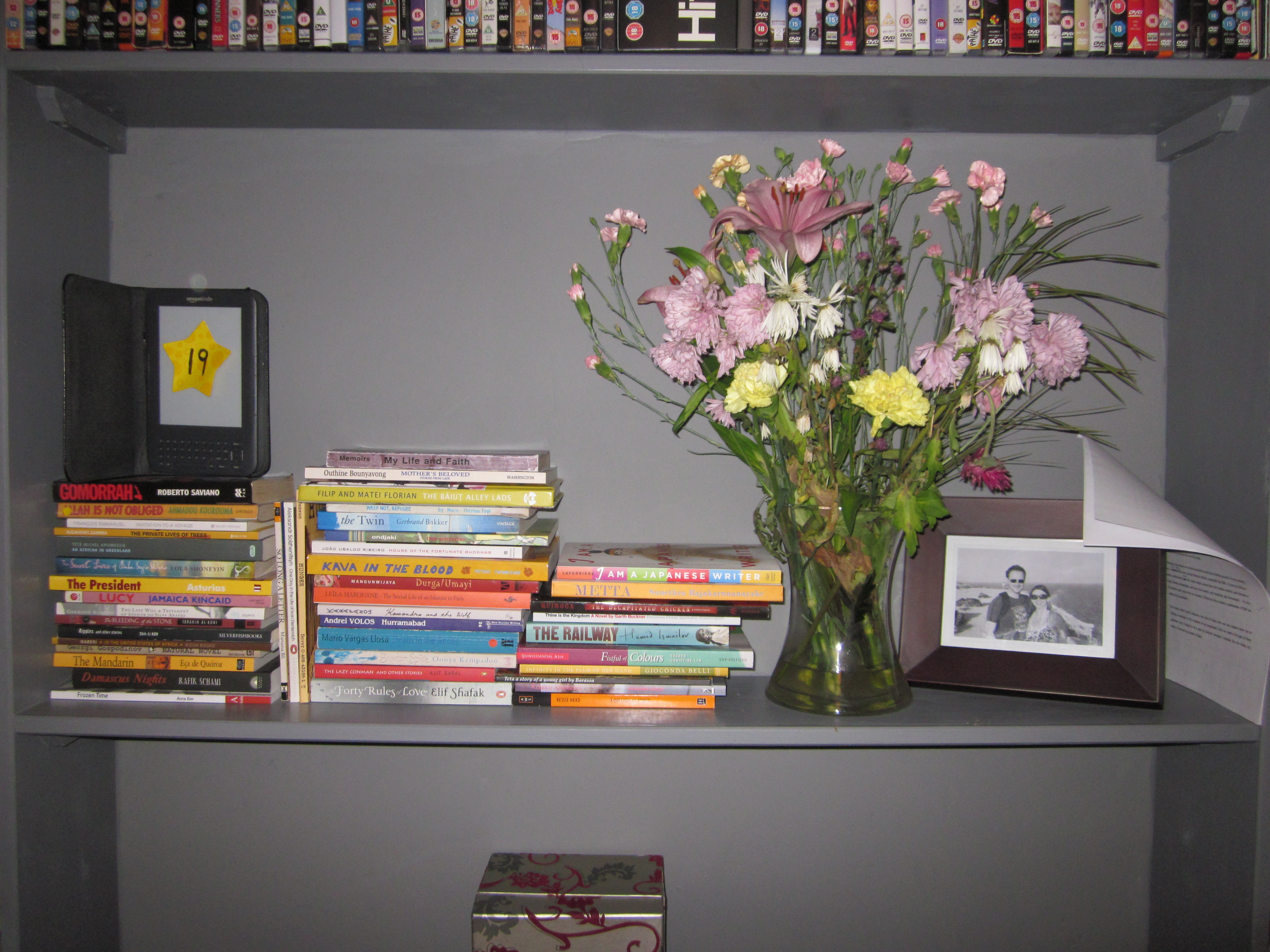
Where did this leave A Year of Reading the World then? Was I being foolish to even contemplate something so reductionist as trying to read a book from every country? Was I one of the ‘space police’ the protagonist describes, grimly shoehorning writers into boxes they would never choose? What if, as Laferrière’s protagonist would have it, I was simply assembling piles of British books on the shelf in my living room because, being British, I was unable to read books on any other terms?

These weighty discussions are offset by the narrator’s self-deprecating humour as he repeatedly dismantles his soap boxes and shifts ground. The witty portrayal of writer’s block and the protagonist’s ham-fisted attempts to immerse himself in Japanese culture – at one stage he bombards a bewildered Korean with questions on the assumption that the two countries are ‘the same thing’ – are great fun.

In addition, the arguments are undercut by the way Laferrière circles his readers, Sumo-wrestler-style, daring us to make the false move of conflating his protagonist with him. The writer may be a Haitian-Canadian living in Montreal and working on a novel with the same title as his creator’s, but he is of course not Laferrière. Or is he? And would it add any more authenticity and credibility to his arguments if the two were one and the same?

Ultimately, of course, the protagonist’s self-deterministic approach to his own work is blown apart by the wild reaction of the Japanese. Whether he likes it or not, the work he produces (or, in this case, has yet to produce) can not be controlled. As this fiendishly clever and enjoyable book demonstrates, the act of publishing is about setting a work free for others to criticise, categorise and cannibalise as they chose. Cultural nationalism may be a construct, but it is a construct to which the vast majority of the world subscribes.

Does that make it true? I don’t know. But hey, if all I’m doing here is assembling a library of British books, novels like this mean it’s definitely my most interesting and diverse collection to date.

I am a Japanese Writer by Dany Laferrière, translated from the French by David Homel (Douglas & McIntyre, 2011)

Laos: a helping hand

When you’re trying to get through a book from every country in the world in a year, the research can take up almost as much time as the reading. Whether you’re following leads for a sovereign state with apparently no literature available in English or trying to work out the best book to choose from a nation with oodles of stories on the market, googling and emailing can eat up hours.

So I was very grateful when Matt Read stopped by the blog and left a comment saying he’d decided to help me out researching one of the gaps on my list. He’d chosen Laos and, after a bit of googling, he’d concluded that Mother’s Beloved, a short story collection by Outhine Bounyavong, was a good bet.

I was particularly thankful for Matt’s help as Laos was shaping up to be one of the tougher nuts to crack. Politics and the legacy of Laos’s 22-year civil war mean that the country’s publishing industry is in a relatively early stage of its development. Many writers, including Bounyavong, had to finance and distribute their books themselves in the early stages of their careers and translation from Lao into English is rare.

The book was interesting for another reason too: containing both the Lao and English versions of the stories (with the Lao on the left and the English on the right), it would be the first parallel text I’d come across this year. I hurried to order my copy.

Simple and engaging, Bounyavong’s collection consists largely of first person accounts of moments where characters gain new insights into the world around them. These epiphanies often centre on a clash between the modern world and the ancient traditions and require the protagonists to develop more humility and respect for the natural world and their fellow human beings. So we see the frumpy girl at the village dance making a lasting match with the man who sees past her looks and the young upstart in the VIP stand at the basketball match taken down a peg or two when the charity collecting plate comes round and he faces revealing he is broke.

Often the stories provide fascinating insights into Lao culture. The title story, for example, hangs on the local belief that anyone eating in the presence of a pregnant woman is morally obliged to share the food with her. Similarly, the strange little vignette ‘Fifty Kip’ yields an intriguing explanation of the traditional criterion for judging whether children are ready for school: they must be able to reach their arms over their heads and touch their ears.

Now and then the moralistic tone of the stories sticks in the craw a bit. The modern world, synechdochically present in the Coke cans and fag packets hurled from passing logging trucks, is always bad, while the traditional ways – captured in the flight of birds and the frangipani, ‘the flower of glory for Laos’ – are good. The beautiful girls end up working as prostitutes and the plain ones find true love.

Taken as a whole, though, Bounyavong’s writing has an intriguing and wistful quality that captures what it’s like to live in a country caught in the approaching headlights of Western commercialism. The book will be of interest to anyone keen to know about life off the beaten track in South-east Asia. A thought-provoking read. Thanks Matt.

Mother’s Beloved: Stories from Laos by Outhine Bounyavong, translated from the Lao by ? (University of Washington Press, 1999) Strangely enough I couldn’t see a translator credited in my edition – can anyone tell me who this was?

When is a country not a country?

One of the first challenges I had to face when starting to prepare for my project to read a book from every country in 2012 was to decide exactly what I meant by ‘country’. Having grown up in the UK, where there’s always someone talking about making a bid for independence – whether it’s Northern Ireland, Scotland, Wales, Cornwall, Yorkshire or some of the feistier parts of south-east London – I had an inkling that this might be trickier than it first appeared.

But it wasn’t until I typed ‘number of countries in the world’ into Google that I realised quite what I was letting myself in for.

There are a lot of conflicting answers to the question. The UN has 193 members. There will be 205 countries represented at the London 2012 Olympic Games. And all in all there are at least 258 national flags in the world today (see the video below, which has 257 of them apart from the one for South Sudan, the world’s newest country, which declared independence from Sudan in July 2011).

Then there are the stateless nations, like the Kurds, who define themselves as a separate group but don’t have a territory to call their own. I’m not sure if anyone has counted these up, but I get the impression that the number of these depends on where you stand.

A lot of the issues have to do with the definition of what we mean by a sovereign state. As set out in the Montevideo Convention, sovereign statehood essentially boils down to having a permanent population, defined borders, a government and dealings with other states. You’re a state if you say you are and the people in and around you agree. But as the nightly news will tell you, this is often not as simple as it sounds.

The list I’m working from now comprises all UN-recognised countries plus Palestine and Taiwan. When I started the project, I was using what seemed to be the most universally accepted list of sovereign states out there. This included all UN-recognised countries, plus Kosovo. I took the liberty of adding Taiwan to this because it used to be a member of the UN and still maintains relations with many countries. This gave me a grand total of 196.

However as the project went on, I realised the list I’d been using was actually based on states recognised by Western countries such as the US. Given that this is a global project, this seemed a little wonky.

So I decided to change the world (there’s a phrase I’ve always wanted to write) and use a list of states with some degree of recognition (past or present) from the UN as a more global barometer of statehood. Counting permanent observer and ‘non-member entity’ Palestine and Taiwan, this came to 196 too and in practice only meant swapping Palestine for Kosovo on the list.  So this is what I did – not purely to save myself work, but also because as far as I could see recognition by this global organisation was one of the clearest and most universally agreed upon definitions of countryhood around.

It’s by no means a perfect system though and it will mean odd omissions from my list, like Puerto Rico and Hong Kong, both of which, despite having quite distinct cultures and histories are technically territories of other states. Still, it’s the best I’ve got to go on for now. And it will certainly keep me busy.

Please do keep the suggestions of titles coming – I’m going to need all the help I can get!

This post was updated on 10 June 2012 to reflect my decision to include Palestine in Kosovo’s stead on the list.