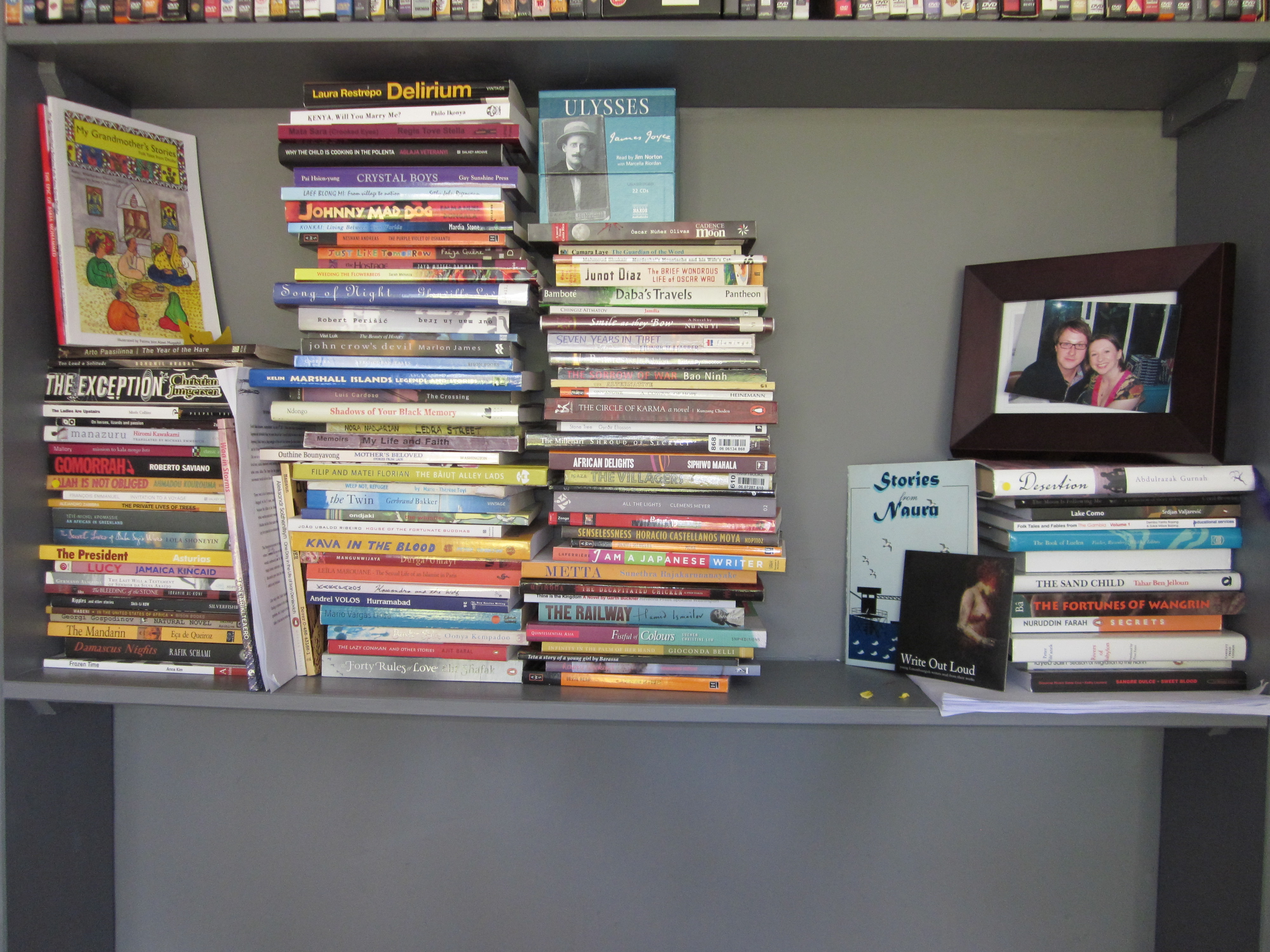
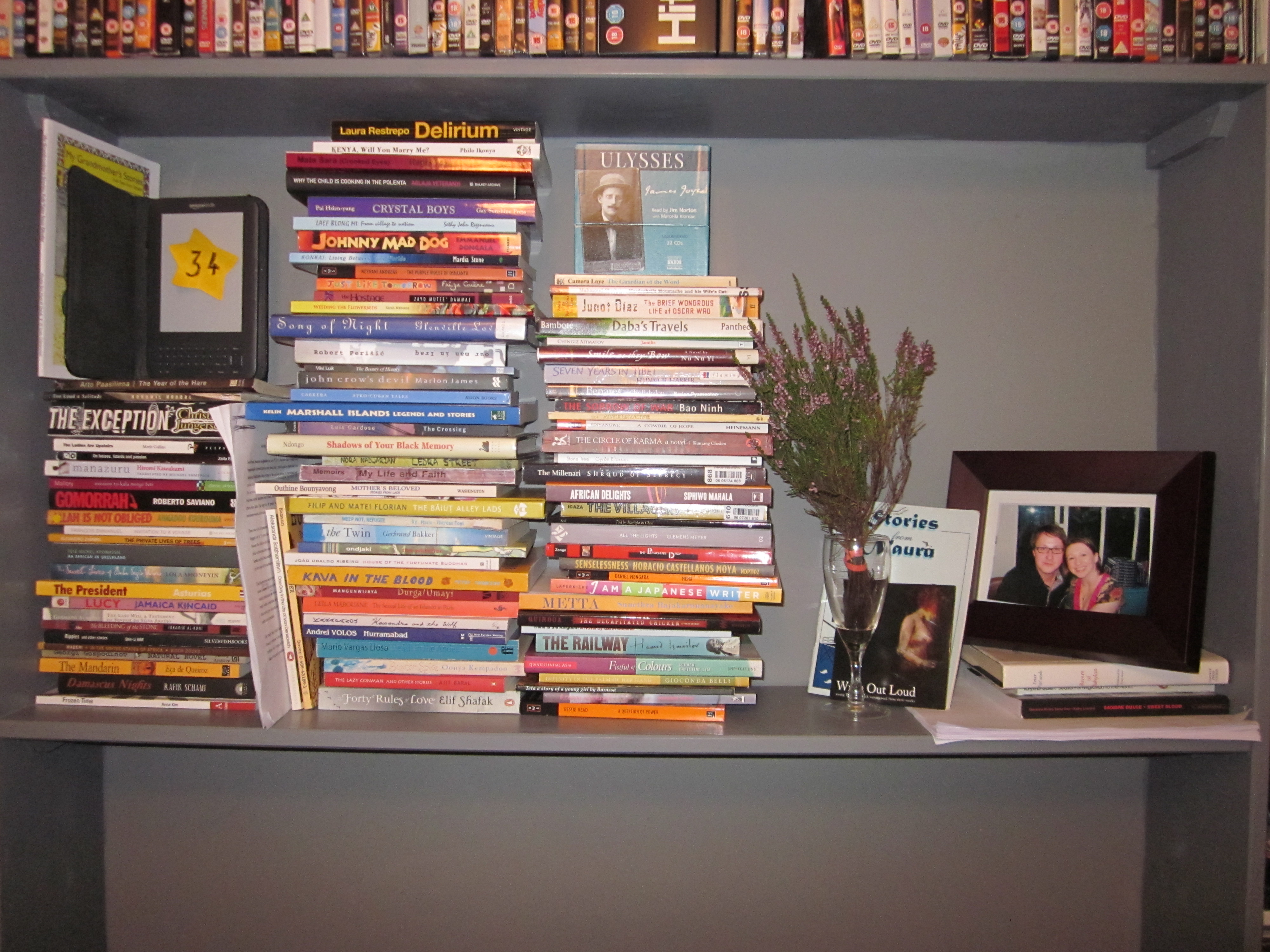
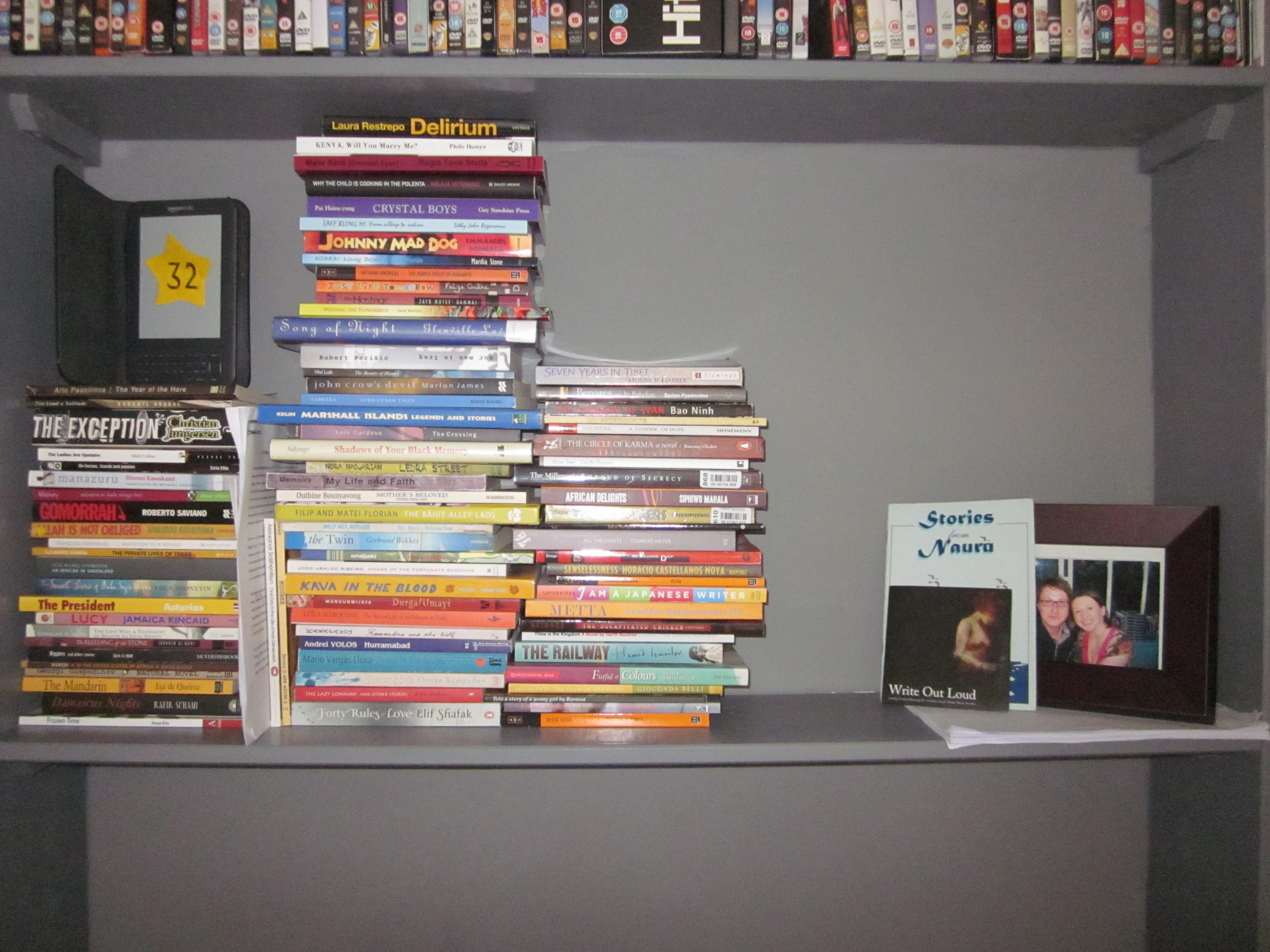
IMG_0368

I’d been trying to find an English-language Sierra Leonean alternative to work by Aminatta Forna for some time. I didn’t have anything against reading Forna – by all accounts she’s a very good writer – but I couldn’t help feeling that the British-born author had had a great deal of coverage since her most recent novel, The Memory of Love, won the Commonwealth Writer’s Prize Best Book Award 2011, and was short-listed for the Orange Prize for Fiction 2011, the IMPAC Award 2012 and the Warwick Prize 2011. I was curious to know what other stories Sierra Leone had to offer.

For a long time, the answer seemed to be not much. I did stoogle upon the website of the intriguing-sounding Sierra Leonean Writers Series, but my attempts to contact the company and find out how I could buy its books came to nothing. Other than that, most of the books out there from the West African nation – which is still recovering from an 11-year civil war that ended in 2002 – seemed to be decades old.

Then RebeccaV stopped by the blog and left a comment to say she was also involved in a global armchair adventure, in which she was trying to read around the world in 80 books. As fellow literary globetrotters can often be a great source of recommendations, I clicked through to her blog to see what she’d read so far. And there, staring back at me, was the answer to my Sierra Leonean quest: A Long Way Gone by Ishmael Beah.

Telling the story of the years Beah spent evading capture by the rebels in the Sierra Leonean jungle and then serving as a child soldier in the army before finally being rescued and rehabilitated, the memoir takes us into the heart of the civil war. Through its frank depiction of the extreme brutality the author experienced and participated in, and the courage and compassion of those who helped him, it reveals the best and worst that humanity is capable of –and the steps by which any one of us might get there.

The violence depicted in the book is among the most shocking and severe I have ever read about. From the gruesome descriptions of the massacre sites Beah passed through in his years of wandering in the jungle after the war separated him from his family, to the mutilated messengers carrying the Revolutionary United Front’s (RUF) ultimatums to the villagers it planned to attack, the suffering unleashed by the annihilation of social structures in much of the country is gut-wrenching. In the midst of the madness, particular sequences stand out – such as the cruel chain of events that saw Beah arriving in the village where his parents were rumoured to be staying only minutes after the RUF had struck, killing everyone in sight.

What stops the narrative from tipping over into the wallowing, sensationalist trauma memoir this book could so easily have been is the quality of Beah’s writing. The book brims with descriptions that capture the beauty, strangeness and sadness of the world through which he fled. We read how ‘the evening was waving its fingers, signaling night to approach’ and the boys ‘walked fast as if trying to stay in the daytime’, and how the Atlantic Ocean sounded like ‘the roar of big engines, the rolling of metal drums on a tar road, a thunder exploding, roll after roll’ to Beah and his companions when they encountered it for the first time.

In addition, the writer excels at capturing profound emotional shifts succinctly. When Beah heard the story of what the RUF did to his friend Saidu’s parents and sisters, for example, we read that his ‘teeth became sour’, while, on the day the army lieutenant recruited the boys to fight ‘it seemed as if the sky were going to break and fall on the earth’.

Beah’s acute sense of the weight and value of words enables him to go where many other authors might fear to tread. From the drug-fuelled army initiation process and his trembling first touch of a gun, through to his initial kill, and on to the point where ‘killing had become as easy as drinking water’ and even a psychological need, Beah takes us through his own dehumanisation. Having inhabited this with him, we are able to understand the reluctance of the child soldiers to be rescued and taken away from the only structure and purpose they knew. We can also appreciate the huge task facing the rehabilitation staff, many of whom expected to deal with traumatised children without realising that they would come in the form of armed and drugged killers bent on violence at all costs.

In light of this, Beah’s recovery, which we also witness step by painstaking step, and his account of his experiences are nothing short of remarkable. In fact, the memoir is one of the best things I’ve read. Utterly engrossing, it brought me close to tears several times, made me laugh, took me to places I could never otherwise imagine, and inspired me to marvel at the goodness, kindness and potential in the world. You can’t ask much more.

A Long Way Gone by Ishmael Beah (Fourth Estate, 2007)

Armenia: another side

October 20, 2012

It’s rare that a writer advises you against reading his or her work. But that’s what happened when Armand Inezian stopped by this blog back in August. Seeing that his collection of short stories, Bringing Ararat, was listed under Armenia, Inezian very honestly said that he didn’t feel his connection with the country was strong enough as, although he comes from an Armenian family, he grew up in Boston and can’t write in Armenian. He added that his work has not been translated into Armenian either.

It was great to have Inezian’s perspective, as the question of exactly where the boundaries of national literatures lie has been a recurring theme in this project. I’ve encountered people who think hugely differently about this: while some are happy to regard books by an author whose parents come from a country as being part of that nation’s literature, others claim that the writer must be born, raised and still living in that country to qualify. There are even those who insist that a book must also be set in the country in question to count.

Personally, I’ve found my perspective on this issue shifting over the year with each tricky dilemma I’ve encountered and I’m still not entirely sure where I stand on it. Still, if Inezian didn’t feel his book was an Armenian work, perhaps I should listen to him.

Nevertheless, I was keen to involve Inezian in some way. If I wasn’t going to read his book (and let’s face it the choice of Armenian literature available in English is not massive), then perhaps I could pick his brains instead. Were there any Armenian writers whose work he could suggest? The answer came in the form of a link to information about Armenian Golgotha by Grigoris Balakian on Goodreads.

I have to confess that my heart sank when my copy arrived. Not only was this, judging by the title and subtitle (A memoir of the Armenian Genocide, 1915-1918), a very serious book, it was also a very long one. Its 500 or so large pages were covered with dense and relatively small print. The first sentence, too, with its earnest consideration of the political atmosphere of Europe in the wake of the assassination of Archduke Franz Ferdinand, filled me with foreboding. What had Armand Inezian let me in for?

The book records Armenian priest Grigoris Balakian’s experiences during World War I. Having finished his divinity studies at the University of Berlin just as the conflict began, Balakian travelled home to Constantinople in the hope that he could be of service to the Armenian population there. But as the eyes of the world turned to the trenches in Western Europe, Balakian witnessed the Ottoman regime beginning to target the 2 million ethnic Armenians within present-day Turkey’s borders, deporting hundreds of thousands of people to die barbaric deaths along the lonely mountain roads and plains of Asia Minor.

Caught up in this forced exodus, Balakian spent three years travelling and working in constant fear of being executed like the thousands of corpses he encountered en route. With only his ingenuity, determination and faith to guide him, he attempted to shield, hearten and save his Armenian peers, all the while holding on to the hope that he would one day be able to share their story with the rest of the world.

Balakian was an extraordinary individual, whose character shines through on nearly every page. Following the dry political summary of the opening lines, the narrative quickly becomes personal and detailed, bearing witness to its author’s great presence of mind in the face of extreme events. Whether he is using an anti-war rally he attended as an ‘opportunity to study up close the psychology of the organized German working class’, bargaining with the authorities for the lives of his companions, or talking to an official guilty of the deaths of thousands of his countrymen, Balakian displays an uncommon ability to keep his head.

This detachment means that he is able to embark on ‘a process of harrowing mental record-keeping’, remembering and relating details that would be lost to most people and delivering reams of compelling and historically significant descriptions. From his rare, foreigner’s-eye-view  of Berlin in 1914, through to the ‘whirlwind of blood’ he encountered in Asia Minor, Balakian’s accounts are meticulous. He spares nothing in his effort to convey the horrendous sufferings of his friends and compatriots, many of whom he claims were tortured and hacked to death by mobs bearing household and farmyard implements to save the authorities the cost of bullets. ‘If all the seas were ink and all the fields were paper, still it would be impossible to describe, in detail, the reality of the endless tortures of hundreds of thousands of them,’ he writes.

For Balakian, recounting these events is a sacred act. As he explains in his author’s preface, he regards his work as a ‘holy book’ for Armenia, which was first founded in around 600 BC. It is also the fulfilment of a promise made to some of his massacred compatriots and the bedrock of his decision ‘not to die’ during the genocide, which he believes kept him alive.

Inevitably, with so much emotional freight to carry, the narrative occasionally gets bogged down. Some of the writing is overblown and hyperbolic – the author’s repeated laments over the ‘martyrology of Armenian virgins’, for example, stick in the craw. The storytelling also comes second to Balakian’s desire to include everything he remembers, meaning that the latter stages of the book can be hard going and repetitive. In addition, for a reader with no contextual knowledge like me, it’s hard to know how much of the often very anecdotal and partisan accounts to trust.

Nevertheless, this is an important and impressive memoir. It not only opens up a much-neglected chapter in history and challenges Westerners like me to rethink our version of the events of the early 20th century, but it also presents a moving portrait of one man’s survival, patriotism and faith. If you’ve ever questioned the point of storytelling, the answers are in this book.

Armenian Golgotha by Grigoris Balakian, translated from the Armenian by Peter Balakian with Aris Sevag (Vintage, 2010)

I emailed a lot of people during the search for this book. Some of the messages bounced. Others disappeared into the ether, never to be seen again. But lots of people did get back to me, usually to tell me one or both of two things: that there was no Kiribatian prose that they could think of and/or that there was someone I should contact at the university/library/community project across the way who might know more.

This impromptu game of e-tag led me through Guam, New Zealand, Kiribati itself, Samoa, Fiji, Hawaii and the States, until at last I emailed Sudesh Mishra, an associate professor in the school of creative and communication arts at Deakin University in Australia. He suggested that I look up Teweiariki Teaero and gave me his email address at the University of the South Pacific. Perhaps the poet would have a prose manuscript I could read.

I dropped Teaero a line. He replied the very next day to say that while no novel, short story collection or memoir by a writer from Kiribati existed, his anthologies On Eitei’s Wings and Waa in Storms contained prose pieces as well as poems. Would I be interested in reading one of those?

Curious to see how this mixing of genres worked, I asked which collection contained the greatest amount of short stories. A few weeks later a copy of Waa in Storms arrived.

Bringing together Teaero’s poetry, prose, drawings and paintings, the anthology comprises work from a particularly dark period in the author’s life, during which his parents fell seriously ill, his youngest daughter was hit by a car, and his home community on the atoll of Tarawa was shaken by a series of vicious child rapes. Melding depictions of particular moments and more general reflections on extreme emotions with anecdotes, satirical sketches and occasional rants about island life, the pieces present a rich and layered picture of Teaero’s year.

The use of language in the book is fascinating. While some pieces, including all the prose work, are written entirely in English, others, such as ‘Te Faika’, mix together verses in the Kiribatese language and verses in English. Yet others are written exclusively in Kiribatese. Teaero explains in his introduction that the reasons for this are tied to his desire ‘to express an idea as vividly as possible… [whether] this comes through the use of English, Kiribatese, visual image or any combination of the three’.

For the author, it seems, the three modes of expression have different strengths when it comes to certain ideas and emotions. Although it’s impossible for an English-language reader like me to tell what the subject matter of most of the Kiribatese work is, a note at the end of ‘E Kaaki Baina Te Ang’ (‘Teaia, Tarawa. 18th August 2000. The day my father passed away’) suggests that some of it at least contains extremely personal reflections on the writer’s emotional and family life, while many of the English pieces are outward-looking, focusing on politics, ecology and the wider community.

The inclusion of background details at the end of most of the pieces adds a fascinating layer of meaning to the collection. While some reveal the inspiration for the work, others such as the note, ‘Composed while sitting on the sand dunes in Sigatoka town. 28th January 2001,’ at the end of ‘Sad Parade’ introduce a powerful sense of immediacy to the act of writing, as though we are reading the story of the composition as much as the pieces themselves. And then there are the quirky observations that raise a smile and introduce a huge amount of warmth into the collection, such as the postscript to ‘Size Unlimited’:

‘Suva. 5th December 2000. Composed in the Botanical Gardens of USP. The frogs were very happy, hopping about and croaking joyously every-merry-where! Perhaps they were having an early Christmas party.’

Teaero’s writing seems, for the most part, disarmingly simple. He uses this to great effect in satirical stories such as ‘Merrily Verily Messing with Missing Milkfish’, where the sing-song, childlike tone of the piece is a great tool for sending up corrupt government officials. It can also pay dividends in poems such as ‘Tab-ulous Reunion’ where the almost banal heaping of platitudes on a former teacher builds in a mysteriously moving way. At times, however, the work does feel a little bald, particularly at the end of some of the prose pieces, where Teaero steps out from behind the narrative to appeal for a range of reforms, from equipping the police with breathalyzers and planting more trees at the local hospital to greater transparency in politics, as though he does not trust the story to speak for itself.

But perhaps most interesting of all is the fact that the distinction between poetry and prose in the collection often seems rather meaningless. Several of the poems read as stories, while prose pieces such as ‘Island Time’ and ‘Crowded Buses’ read more as poems that happen to be written in full sentences that stretch across the page. In addition, much of the work incorporates visual aspects, with font sizes and weights and the shape of the poems on the page adding emphasis. Just as outside events and Teaero’s life experiences bleed into and mingle with the works, so the forms mix with and change each other.

The result is a distinctive and memorable collection. Organised into four ‘Waves’, which loosely chart Teaero’s progress through what he calls his ‘annus horribilis‘ in the introduction, the work pulls together to tell a story of suffering and change. It is in many ways every bit as much a narrative as the novels, short story collections and memoirs I’ve read so far this year – and a striking challenge to the system of categorization I’ve used to talk about literature for much of my life.

Waa in Storms by Teweiariki Teaero (Institute of Pacific Studies, University of the South Pacific, 2004)

I’ve written before about how globally renowned literary figures from small countries can often overshadow their compatriots on the world stage, becoming the go-to writer for literature from or about their homeland while their peers struggle to achieve any kind of audience beyond the nation’s borders. But what about when you grow up with an international literary giant in your own family?

This was a challenge Vahni Capildeo, a Trinidadian poet with whom I got in touch through the London-based writers group Exiled Writers Ink, had to face. A mine of global literature information, Capildeo kindly gave me loads of book suggestions and contacts for people who might be able to help me track down work from some of the harder to reach places on the list. Then, a few emails into our exchange, she let slip that she had a manuscript of her unpublished memoirs that she could email to me if I was interested.

Normally when a writer suggests I read a book they’ve written, particularly an unpublished book, the alarm bells go off in my head. After all, such recommendations can hardly be considered impartial and, in my experience, there can often be an unfortunate inversely proportional relationship between the enthusiasm with which an author pushes their book at you and the quality of the work.

However, there were a few things that made me hesitate: firstly, Capildeo wasn’t exactly giving me the hard sell. In fact, after the first shy mention it took several months of wheedling and cajoling from me before she could be persuaded to send me the document, out of which she’d excised several sections that she did not think were ready to read. Secondly, Capildeo had published a number of poetry collections and, although the entire memoir had not made it into print, extracts of it had come out in Ian Sinclair’s London: City of Disappearances. And thirdly, there was the fact that she introduced the book by saying that, among other things, it was about ‘the difficulty of being a cousin of VS Naipaul but wanting to write poetry’.

Now that was something I was intrigued to know about. And so, with an apologetic glance at the Naipaul novel waiting above my desk – not to mention the burgeoning list of young Trinidadian writers gaining international recognition thanks to initiatives such as the Bocas Lit Fest – I passed over the great man in favour of his young relative, downloaded Capildeo’s pdf on to my Kindle and began to read.

As it turned out, the Naipaul connection was only a small part of this rich and complex book. Tracing Capildeo’s childhood in Trinidad and migration to the UK in her late teens, the narrative reflects on issues as diverse as the link between creativity and mental illness – Capildeo’s father suffered from schizophrenia – attitudes to homosexuality in the Caribbean and culture shock. There are thought-provoking evocations of both Trinidad, ‘a colonial land of Ozymandias’, and the UK, where the term ‘Western’ has ‘nothing to do with physical geography’ and people marvel at Capildeo’s perfect English, oblivious to the fact that she has spoken the language all her life.

Perhaps unsurprisingly, given her background, Capildeo sees the world through books and it is this that brings out her best writing. Whether she is discussing Michael Bond’s Paddington Bear or Victorian novels, Capildeo can be relied upon to bring fresh and often startling insights to her interpretations, reminding the reader again and again that the secret of great writing and great reading is bound up with recognition. But it is when cultural barriers and laziness stymie this recognition during a discussion of Jean Rhys’s Wide Sargasso Sea in the UK that the full force of Capildeo’s passion for what books can do if only we will take the trouble to let them becomes clear:

‘The other readers thought “flamboyant” was a simple adjective. They did not know, and had not looked up, that it was a tree name. So for them it was just a showy tree that Jean Rhys’s Antoinette wanted to be buried under, this desire perhaps a characteristic manifestation of Creole arrogance and gaudy tropical bad taste? So people could read this passage, even read the whole book, maybe read every book about – us – and not feel, or see – My imagination filled and shook with the flamboyant’s smooth-grained rind and fiery plumage.’

The Naipaul references when they come are disarmingly frank. Capildeo makes no secret of the dislike that exists between the branches of the family and the shadow the writer’s success cast over her father as he reeled from breakdown to breakdown. However, the fact of Naipaul’s international recognition, and his publication of works that ‘looked like real books [...]: austere, with few colours, unlike “West Indian novels” marketed as such’ also proved a secret spur to the young writer: ‘(So it was possible? But I put that thought away; it was too big).’

Inevitably for an unedited manuscript written some years ago at an early stage in Capildeo’s career, the work is somewhat patchy. We get the sense at points of a young author still mapping the geography of her emotions and coming suddenly and breathlessly upon peaks and ravines that she will get the measure of more precisely as her writing develops. In addition, although often vivid, the imagery occasionally staggers under the weight of one too many adjectives.

But this is nothing that a second pass through with the benefit of a few years’ distance can’t fix. And in fact Capildeo tells me she is thinking of doing this, with a view to trying to publish the work. I hope she does: there is too much richness here to be consigned forever to the bottom drawer. The book deserves far more readers than just me.

One Scattered Skeleton by Vahni Capildeo – extracts published in London: City of Disappearances ed. Iain Sinclair (Penguin, 2006)

Just after I’d finished reading this book, I had an email from a Liechtenstein publisher. ‘Now who recommended the Liechtenstein authors to you?!’ he wrote. ‘That’s embarrassing!’

I assume the reason for his embarrassment was that the only two authors with named books on the list were non-native residents of Liechtenstein – the German thriller writer CC Bergius and the Austrian explorer and mountaineer Heinrich Harrer, a controversial figure who joined the Nazi party shortly before the outbreak of the second world war. Yet, as I tried to explain in my response, there was method in the apparent madness of these suggestions, and it went something like this:

The search for a story from the tiny principality of Liechtenstein began with an email to a friend of a friend from the country, who suggested I contact an old teacher of hers who was involved with PEN-Club Liechtenstein. Sadly, the email address she gave me no longer seemed to work and my inquiries bounced straight back at me.

Time for plan B: I’d heard that a Liechtenstein author, Iren Nigg, had won the European Union Prize for Literature in 2011. Perhaps some of her work would be available in English? I dropped her a line and she very kindly responded. She was sorry, but other than the extract of her work in the prize-giving booklet, nothing had been translated yet. She attached the extract in case it was suitable for the project, but if I was looking for a complete work in translation, she recommended I contact her friend writer Stefan Sprenger (there’s a great interview with him about Liechtenstein literature on the Dalkey Archive Press website).

I emailed Sprenger but it was the same story with him. Although he had had some isolated pieces translated, none of his books were available in English in their entirety. To his knowledge, the only Liechtensteiner who had had a whole book translated into English in recent years was Prince Hans Adam II  von und zu Liechtenstein. His political treatise, The State in the Third Millennium, would not count for my purposes unless, he joked wryly, I were willing to consider it as a horror story.

Failing that, Sprenger suggested emailing Dr Peter Gilgen, a Liechtenstein academic specialising in literature and philosophy at Cornell University in the US. If anyone would know of Liechtenstein work available in English Sprenger warranted Gilgen was the man.

Gilgen came back with a full and thoughtful reply. No book-length Liechtenstein prose translations came to mind but he did know of a prose-poem, The Gravel by Michael Donhauserwhich was translated into English as a freestanding work some years ago. However, given that this was hard to find and not a prose work as such, he would like to suggest Bergius and Harrer, as both writers lived for many years in the principality. Indeed, Harrer, who claimed to be ashamed of his Nazi involvement in later life, was a member of PEN Liechtenstein and wrote his most famous work, Seven Years in Tibet, while living in the state.

And so it was, as I explained to my indignant correspondent, that I had included Bergius and Harrer on the list. However, if he could recommend another Liechtenstein work that I could read in English, I would be delighted to consider it.

Several weeks later, I have not heard anything further. And so, taking the risk that an email may be winging its way to me even now and hopeful that this post may winkle out some full-length Liechtenstein fiction for us Anglophone readers to enjoy, I am writing on Harrer’s memoir Seven Years in Tibet.

Given the tortuous route I’d taken to get to it, Harrer’s book about his attempt to make his way into the closed world of Inner Tibet felt like a rather appropriate read. Starting with his internment in and repeated escape attempts from an Indian prisoner of war camp at the outbreak of the second world war, the memoir charts Harrer’s flight into the country and his eventual arrival in the capital Lhasa, despite the best efforts of the Tibetan people, the hostile landscape and the occasional bear and leopard to stop him. Building a life in a society not thought to have been visited by Westerners before, Harrer and his companion Peter Aufschnaiter fell in love with the peaceful country and Harrer was even appointed to be a private film tutor to the young Dalai Lama, until the Chinese annexation of Tibet in 1949 forced them to return to Europe.

Harrer’s matter-of-fact accounts of his feats of derring-do are the secret of the book’s success. Whether he’s enduring recapture by the British, outwitting a band of Tibetan Khampas (robbers) on a lonely plain, or chasing a run-away yak in sub-zero temperatures, the writer remains stoic and restrained, observing after one disastrous episode with the Indian police, ‘we learned from this adventure a bitter but useful lesson’. Indeed, it’s impossible not to be impressed by his meticulous approach to each challenge and his dauntlessness in the face of countless setbacks. I found my fingers itching to write ‘stiff upper lip’ in the margins several times, before I remembered that this was not a British book and that the writer, had he been in Europe instead of South Asia during the years he describes, would most likely have been doing his best to make a number of stiff upper lips tremble.

Harrer’s insights into  Tibetan culture are, for the most part, fascinating. From polyandry among herders and the ‘burial’ practice of smashing a body up and leaving it out to be eaten by the birds, to the strange communication arrangements you have to make in a country that is not a member of the Universal Postal Union if you want to send a letter to the outside world, Harrer’s descriptions are engrossing and his love for the country is clear.

That said, the book is very much of its time – and of Harrer’s own prejudices. Sweeping and often patronising generalisations abound about Tibetans being ‘a happy little people full of childish humour’, their music having ‘no harmonies’, and their women, who ‘know nothing about equal rights and are happy as they are’.

But perhaps such a cast-iron belief in your own judgments and opinions is what it takes to be a pioneer. A more circumspect individual might have decided, on balance, that it was best to stay in the POW camp and wait out the war. I’m very glad he didn’t.

Seven Years in Tibet (Sieben Jahre in Tibet) by Heinrich Harrer, translated from the German by Richard Graves (Flamingo, 1994)

This book was recommended by The Modern Novel, a blogger writing about the development of the literary novel worldwide. TMN kindly posted a comment on this site helping me out with a few of the harder to reach destinations (there are still quite a few gaps on that there list and plenty of countries with only one or two titles suggested – go on, have a look and let me know what I’m missing).

Several of the recommendations weren’t available in translation – much more linguistically gifted than I am, TMN reads in French, German, Italian, Portuguese and Spanish, as well as English – however there were some great additions to the list among them. The Crossing by Luis Cardoso was one of these.

In actual fact, The Crossing is not technically a novel, it’s a memoir. Like me, TMN holds the view that the boundaries between these two genres blur the more closely you look at them, which is why we’re both including memoirs in our projects.

Telling the story of Cardoso’s childhood and adolescence in East Timor, the book reveals the nation’s troubled recent history through a small and touchingly precise lens. As waves of Portuguese, Japanese and Indonesian colonialism wash over the country, the author records the tragic impact of these events on the ‘people lost in time’ who have to live through them, caught between the oppressive yet relatively stable patterns of the past and the fragile freedom ahead.

This is a book as much about forgetting as it is about remembering. While Cardoso’s traumatised and exiled father frames the narrative – bumbling about Lisbon where his son is studying trying ‘to recover the memory he had lost’, all his fire and bluster gone – Cardoso himself seeks to reconcile the partial versions of events he encounters with his own fragmentary memories of his homeland.

A nostalgia for Portuguese rule – warmer than any other attitudes to colonialism I’ve read about so far this year – permeates much of the book. For characters like Cardoso’s father the Portuguese administration, despite its enforcement of apartheid, and its rigid and sometimes brutal practices, is ‘the erstwhile mother country [...] even though the umbilical cord had been cut in such a way as to make the child bleed and the mother grieve’.

As well  as blending novel and memoir, Cardoso brings in elements of poetry too through his descriptions that conjure places and people as deftly as the briefest of stanzas. Time and again, he captures complex situations in a net woven only of a single sentence, as when he sets out his father’s deluded hopes for his son’s future:

‘He dreamed that, one day, I would take up a post in [an] administration [made up of people educated in Portugal] – the dreams of someone who has built a boat and wants to go on sailing through time, along the lost route of the colonizing caravels’.

The huge cast of walk-on characters and vast catalogue of events mentioned in this relatively slim book mean that occasionally the narrative can jump like a scratched record from one scene to the next. Several times, I found myself having to turn back a page or two, trying to work out how I had been thrust into a storm that seemed to have gusted up out of nowhere. Sometimes, there wasn’t really an explanation.

Taken as a whole, though, this is a touching, lyrical and sometimes playful account of the search for identity in a land you can only fleetingly call your own (East Timor only managed a few months of independence in 1975 before it was conquered by the Indonesians and at last gained its sovereignty in 2002). It makes a compelling artwork out of a shifting kaleidoscope of personal and political allegiances. A great suggestion.

The Crossing: A Story of East Timor (Cronica de uma travessia: A epoca do Ai-Dik-Funam) by Luis Cardoso, translated from the Portuguese by Margaret Jull Costa (Granta, 2000)

There have been some intriguing books published about North Korea in recent years. From Barbara Demick’s outstanding Nothing to Envy to Blaine Harden’s Escape from Camp 14, an extract of which was published last month in the Guardian, there is no shortage of harrowing survivors’ accounts of life in the world’s most secretive state.

When I was starting to prepare for this project late last year, several people suggested that I contact the South Korean embassy in London to see if they knew of dissident literature by North Korean escapees that I could read. I was on the point of doing so when it occurred to me that, while this might well yield some fascinating texts, it would bring me no closer to knowing anything about literature inside North Korea itself. What did people in Pyongyang read? What stories were household classics in the land of the then-Dear Leader? I had to find out.

With this in mind, I visited the Democratic People’s Republic of Korea’s website and dropped them a line. I was delighted to receive an email back from Spanish-born North Korean Special Delegate Alejandro Cao de Benos (the first foreigner ever to be granted North Korean citizenship and allowed to work for the government) and the two of us had an extraordinary exchange about what books might be available for me to read in English. You can read a full account of our correspondence in the blog post I wrote for the Huffington Post at the time.

I was planning to give Mr Cao de Benos another try after the dust had settled from Kim Jong Il’s death, however in the interim I heard from Nicholas Mercury, founder of North Korea Books, and what he said intrigued me. He had been prompted to get into North Korean literature and subsequently start his business selling rare books in English from the DPRK after reading My Life and Faith, a memoir by Korean Army war correspondent and ardent DPRK patriot Ri In Mo. He commended it to me as a text that contained ’a point of view completely unknown in the West…that of utter love and devotion and sacrifice for a country, political system, and especially leadership, that (most) of the rest of the world prefers to despise and hate’.

I needed no further encouragement to give it a try and was delighted when the book arrived from an address in Beijing, accompanied by a DVD featuring subtitled extracts from DPRK films, military displays, dances and marching songs.

Telling the story of Ri’s early affinity for the DPRK’s ideology, his capture in 1952 and alleged 34 years of torture and imprisonment in South Korea ‘in blatant violation of the Geneva Convention’, and triumphal return to his homeland in 1993, My Life and Faith provides a fascinating insight into North Korea. At times extremely gripping, with overtones of jail literature by the likes of Albie Sachs and Nelson Mandela – to whom Ri is compared in the introduction – it presents a thought-provoking perspective on national identity and Western attitudes to the motherland. ‘It is not until they take off the colour glasses of “anti-communism” that they understand it’, he writes.

The human touches make the book. From the portrait of life in North Korea both before and after partition – where ‘widow kidnapping’ was once rife and many families were too poor to afford clothes and lived holed up in their houses ashamed to receive guests – to the descriptions of Ri’s wife sitting next to him as he writes, complaining about his old-fashioned turns of phrase, the sense of the man behind the narrative is strong.

These details win Ri credibility when he launches into broader ideological attacks, often citing statistics and events that few readers would have the means to verify. His tirades against ‘the US imperialists and Syngman Rhee puppet clique’ often have a familiar feel as they chime in closely with accusations levelled at the North Korean regime by the Western media. So we hear allegations of South Korean historians conveniently omitting or twisting facts, ‘lies’ from UN representatives, pro-Western propaganda in films and books, and a fascinating account of Ri’s interactions with the world’s media after his release in South Korea:

‘While talking with them, I found that there were differences in the way they expressed my ideas, and they seemed to take great effort to alter my words. When I said “people” by habit, they changed it to “the masses”[...] While altering my words in this way, the young journalists expressed the regrets [sic], “If the words used in north Korea are used, readers may find fault with them, so they should be altered somewhat. I’m sorry’

[...]

Many journalists with newspapers, radio and the foreign press visited me. They seemed to have not understood me well. There were instances of seriously distorted information.’

At times, the rhetoric undoes itself by too obviously pulling the tricks it ascribes to Western states. Ri regales us with the story of the South Korean soldier, a ‘victim of propaganda’ who killed himself rather than allow himself to fall into North Korean hands because he had heard exaggerated reports of the nation’s cruelty only to reel off a hysterical catalogue of Western atrocities in the next paragraph. The mawkish poems ‘Dedicated to the Dear Leader’ that pepper the narrative, the repeated assertions about the ‘deep solicitude’ of the nation’s leader and the accounts of the miracles that took place on the death of Kim Il Sung also have a distancing effect.

Nevertheless, I was impressed by how persuasive and compelling the book was. Now and then, in the face of its heartfelt appeals, I felt the see-saw tipping and found myself scrabbling for arguments to redress the balance. Then I remembered that, as Mr Cao de Benos confirmed to me, variations on this story – books ‘showing honour, loyalty and sacrifice for the motherland’ – are the only narratives allowed in the DPRK. Reading the world would not be an option there. And no amount of passion, rhetoric or idealism can make up for that.

My Life and Faith by Ri In Mo, translated from the Korean by ? (Foreign Languages Publishing House, Pyongyang, Juche 86 (1997))


Malawian artist Samson Kambalu begins his account of his childhood and rise to international recognition with a prologue remembering the day he and his Scottish fiancée notified the High Commission in Malawi of their intention to get married. Asked if he was doing this to get a British passport, Kambalu answered ‘Not really’ to the great indignation of the consul, who informed him crossly: ‘The answer is NO, OK? The answer is NO’.

The following 335 pages illustrate why that ‘Not really’ stands.

One of eight children born into a Christian family in the then-dictatorship of Malawi or ‘the abyss of the fourth world’ as he calls it, Kambalu grew up in the shadow of his intellectually ambitious yet ultimately frustrated clinical officer father, the Jive Talker of the title. Posted to remote locations all over the impoverished sub-Saharan country, the Jive Talker took refuge in alcohol and Nietzsche as his career crumbled and his family and their peers suffered ever greater privations until at last Kambalu’s parents died of AIDs-related illnesses around the turn of the millennium.

Yet this is no self-pitying catalogue of woes. Told with wit and flair, Kambalu’s account paints a picture of a vital place full of creativity and interest. Life there is a precarious business and the world is cruelly indifferent to individuals’ sufferings (‘Anybody who survives Malawi deserves to be called Superman’, he remarks at one point), yet it is a world Kambalu describes with dignity and humour.

This humour often tips over into the deeply touching, as when Kambalu remembers his friend Joe Bugner’s reaction to the news that he had secured a place at the highly competitive, state-funded, English-style boarding school Kamuzu Academy, known as the ‘Eton of Africa’:

‘You are the man. In future all that is wrong with the world you will only see on TV,’ which was a pretty poignant remark considering there was no TV in Malawi at the time.

Far from being a purely personal account though, The Jive Talker is in many ways a history of Malawi too, with much of the political and social development of the country over the last few centuries woven into the narrative. The description of the cultural split caused by the arrival of 19th century missionaries, which saw the country change from a matriarchal society in which family members were known only by their shared clan name into a patriarchal society where everyone had to have his or her own Christian name is fascinating, as are Kambalu’s reflections on the Banda regime.

The most interesting aspects of this episodic (and occasionally rambling) narrative, though, are the powerful insights into Kambalu’s development as a conceptual artist and the creation of the philosophy of Holyballism, which made his name. Described with such intensity that they sometimes take on an almost magical realist quality, these passages reveal the alchemy by which Kambalu was able to assimilate the conflicting cultures he grew up with and broker some sort of peace with his past — no mean feat.

The Jive Talker: Or, How to Get a British Passport by Samson Kambalu. Publisher (Kindle edition): Vintage Digital (2008)

What counts as a story?

December 22, 2011

It seemed so simple: read one book from every country in the world in 2012. What could possibly be confusing about that?

But as soon as I started to plan the project in earnest, the questions started coming in. Was I including poetry? What about plays? And memoirs? Where did I stand on biographies? Did journalism count? Did the books have to be contemporary?

I realised I was going to have to define my terms a little more carefully.

A lot of the people I spoke to about this project felt that I should stick to prose fiction. This was my first instinct too. After all, novels, novellas and short stories are the main media for storytelling, aren’t they? Surely I should keep a level playing field between all countries by reading only one particular kind of book?

But as time went on, I got more and more recommendations for intriguing books that wouldn’t fit that mould and found myself getting frustrated. I heard of literary award-winning journalism that had led to bounties being placed on writers’ heads and biographies detailing extraordinary lives, and I wanted to read them.

There were also books that straddled several genres. Dr Ruth Martin, who recommended Elias Canetti’s autobiographical work The Torch in My Ear for Austria, for example, wrote in her comment that ‘the writing is wonderfully literary and he does “embellish” the truth a little’. One man’s memoir might just be another man’s fairytale…

I also realised that, while prose fiction may be fairly ubiquitous, it’s by no means native to every culture. In fact, in places where stories tend to be passed on verbally, narrative poems may be much truer reflections of literature there.

The question of contemporaneity also gave me a dilemma or two. Much like M Lynx Qualey, who very kindly wrote a blog post setting out her recommendations for Arabic literature in translation,  I was tempted to keep to recent texts. But when Dr Valerie Henitiuk of the British Centre for Literary Translation told me that her all-time favourite translation was Sonja Arntzen’s rendering of the 10th century Japanese Kagero Diary, there was no way I was going to bar it from the list.

So, after chewing it over for a while, I decided that I would count all narratives that could be read to full effect by one reader on their own. This means memoirs, novels, short stories, novellas, biographies, narrative poems and reportage are in and, with regret, non-narrative poetry and plays are out.

I also decided that while I would stick to mainly contemporary stories, I wanted to leave the door open for fantastic blasts from the past. The one condition is that the works have to have been created when the country was in existence in something like its modern-day form.

So if you know of an outstanding eighth century Swedish epic, or an intriguing narrative poem from Tuvalu, now’s your chance to tell the world (well, me, at least) about it. Keep the suggestions coming in – there are still quite a few gaps on that there list…

Follow

Get every new post delivered to your Inbox.

Join 8,008 other followers