One of the great things about embarking on a world literature adventure like this is all the fellow literary globetrotters you meet along the way. There are lots of projects out there and each of them is slightly different, shaped by the personality and interests of the reader behind them.

Some people are only reading books set in particular countries; others are including poetry, plays and factual history books. Some are travelling from state to state as you would on a map, while others are leaping around all over the shop. And in addition to the hardcore nutters among us who set ourselves numerical and, in my case, time limits, there are many people who intend that the adventure should take them several years, if not decades.

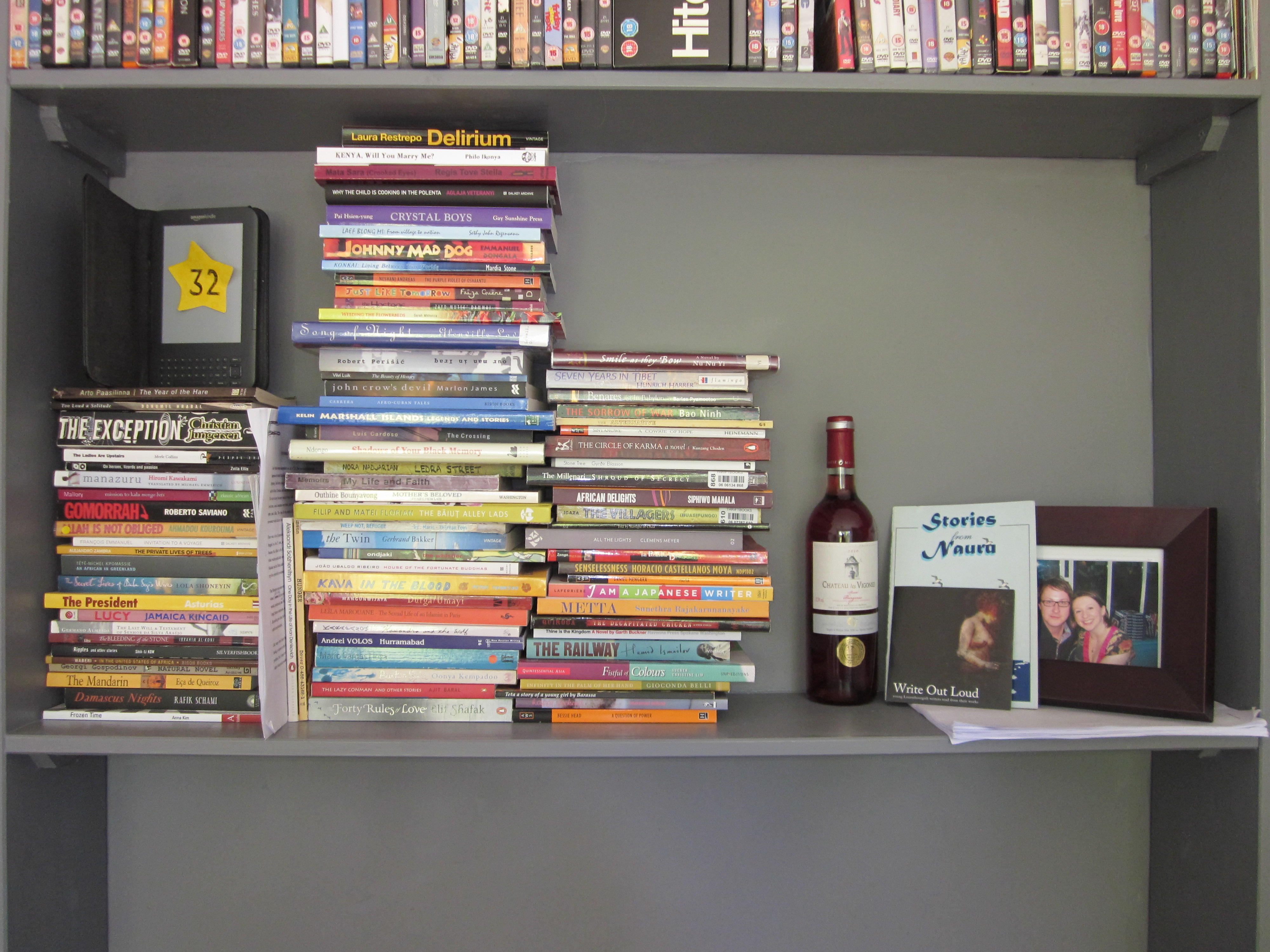
It’s always a pleasure to hear from other literary explorers, not least because they can often be a great source of ideas for countries I’ve yet to tackle. So when Paul in Canada responded to my Halfway Appeal with some suggestions from his own Reading Around the World project, I was intrigued to hear about them. In particular, his Myanmar choice, Smile As They Bow by Nu Nu Yi – the first novel by a writer living in the country to have been translated and published in the US, and shortlisted for an international literary prize, despite the best efforts of the Myanmar authorities to suppress it – sounded fascinating. I decided it was the book for me.

Set around the Taungbyon Festival, a massive celebration of nats (spirits) that happens in a small village near Mandalay three times a year, the novel follows Daisy Bond, one of the event’s most famous transgender natkadaws (spirit mediums), as he sets out to make the most of the extravaganza. A master at parting gullible and superstitious visitors from their money, the aging dancer puts on the performance of his life, ably assisted by his very much younger bodyguard and lover Min Min. But when his partner begins to fall for a beggar girl at the festival, Daisy’s precarious existence looks as though it may be about to crumble once and for all.

Yi’s sensuous descriptions of the hurly-burly of the event are a joy to read. Bustling with the interior monologues of a whole host of people – from the rich woman seeking spiritual guidance on what to do about her husband’s mistress and the elderly devotee fretting about the cost of the flowers she has had to offer, to the pickpockets moving through the crowds – the narrative bumps and jostles the reader so that you feel as though you are in the midst of the action.

Into this vibrant scene bursts the voice of Daisy Bond, easily one of the most irreverent and fabulous literary creations you are ever likely to meet. Buzzing with expletives, contradictions and fears, his distinctive interior monologue paints a complex and moving picture of a lifestyle that is at once based around a sham and yet a source of fulfillment and meaning. Bluntly honest about the fact that natkadaws such as he ‘deal in lies and pushing people to offer animals’ and ‘cook up crazy hopes ’cause we have to eat’, Daisy’s descriptions of his love of performing and the self-expression he finds as a transgender medium reveal that for all the cynicism of the cons he peddles, what he is doing has surprising value and significance – much like the festival itself, which though reinstated by the British ‘to create a diversion’ in colonial times has become a source of hope and a way of making a living for thousands of people.

This duality is particularly apparent in Daisy’s illicit relationship with Min Min (homosexuality is still illegal in Myanmar). Despite his frequent abuse and humiliation of the youth whom he bought as a teenager seven years previously, Daisy’s dependence on and feelings for the young man are clear. It is testament to Yi’s skill as a writer that, even though we want to see Min Min break free and follow his own desires, we cannot help feeling pity for Daisy, for whom ‘the gay life carries such heavy karma’ and who is perpetually haunted by the thought that his love is ‘going to leave [him] for a real woman’.

The result is a powerful, moving and memorable work that more than deserves its place on the Man Asia Literary Prize 2007 shortlist. It is an insight into a world of extremes, where conflicting truths weave together and catch the eye like spangles on a spirit dancer’s costume. Highly recommended.

Smile as they Bow by Nu Nu Yi, translated from the Burmese by Alfred Birnbaum and Thi Thi Aye (Hyperion, 2008)

Taiwan is the country with the most tenuous claim to be included on the list of independent countries I’m reading books from this year. It was a member of the UN until 1971, when the dispute between its government, the Republic of China, and the Chinese government, the People’s Republic of China, led to the UN voting to withdraw its recognition of the ROC and thus Taiwan. From that time onwards, although Taiwan governs its internal affairs independently and many countries around the world maintain informal diplomatic relations with it (the UK government sent a parliamentary delegation to visit the country in 2011, for example), the nation has officially been part of China. Only 22 UN members recognise it as a separate sovereign state.

I was curious to see what literature from this disputed land might be like, so when @markbooks suggested Pai Hsien-yung’s Crystal Boys, I was quick to add it to the list.

Claiming to be ‘the first modern Asian gay novel’, the 1983 book portrays the lives of a group of young male prostitutes in Taipei’s underworld. Following A-Qing, a teenage run-away who was expelled from school and thrown out of home for being found in a compromising position with a supervisor, the narrative explores the precarious lives of these young men, peeling back the layers to show the tenderness, vulnerability and hurt within.

The subject matter and suggestive cover picture of a half-naked Taiwanese youth set up an expectation of explicitness that is actually quite misleading. In fact, beyond passing references, the book doesn’t feature a single sex scene. Instead, all the drama and extreme experience is played out in the dialogue between the characters, in which cruel insults and desperate appeals are laughed off in a welter of banter. There is the boy Wu Min who talks about his plans for suicide only for his friends to think he is joking until he goes home to slash his wrists and the chief who pushes the youngsters into encounters with seemingly heartless abandon.

Yet, beneath the hard shell that nights around the lotus pond in Taipei’s New Park and later at the Cosy Nest café force them to develop, the boys possess a great deal of warmth and tenderness that often expresses itself in surprising ways. When Wu Min is in hospital and unable to meet his medical bills, the boys all donate blood to keep him alive – ‘what we share in common are bodies filled with aching, irrepressible desire and hearts filled with insane loneliness’, observes A-Qing, articulating the bond that ties him to his friends. In addition, A-Qing, who misses his younger brother Buddy, is forever adopting and protecting younger boys who remind him of home.

Indeed, by far the most daring and subversive aspect of the book is not its presentation of sexuality and prostitution but its use of those things to express ideas about nationhood, sovereignty and identity. As homosexuality was illegal in mainland China until 1997, it is effectively off-limits, out-of-bounds and dangerous territory in the book. This enables Pai Hsien-yung to use the crystal boys’ world as a powerful metaphor, as the opening lines of the novel show:

‘There are no days in our kingdom, only nights. As soon as the sun comes up, our kingdom goes into hiding, for it is an unlawful nation; we have no government and no constitution, we are neither recognised nor respected by anyone, our citizenry is little more than rabble. [...] It’s as though our kingdom were surrounded and hidden by a tightly woven fence – cut off from the outside world, isolated for the time being. But we are always keenly aware of the constant threat to our existence by the boundless world on the other side of the fence.’

At times, the narrative becomes a little stilted and episodic, with too many characters crowding in one after the other. Pai Hsien-yung’s tendency to stress the emotional suffering of the boys can also be a little repetitive and could have done with some tighter editing.

However, none of this detracts from the fact that this is a courageous and fascinating work from a writer not afraid to speak out against the majority. The book is a gripping insight into a fragile and contested world. Powerful stuff.

Crystal Boys (Nieh-Tzu) by Pai Hsien-yung, translated from the Chinese by Howard Goldblatt (Gay Sunshine Press, 1995)

This book was recommended to me by Justin at the African Books Collective when I dropped by the their stall at the London Book Fair back in April. I’m glad he brought it to my attention as the subject matter and cover – which makes the book look a bit like a self-help manual – mean that I probably would never have chosen it on my own.

Written by Dr Mardia Stone, a Liberian obstetrician and gynaecologist living in the US, the book is an account of her homosexual half-brother Konkai’s diagnosis and struggle with AIDS in the late eighties and early nineties. Charting her sibling’s decline and death back in the days when very little was known about the killer disease, Stone confronts her and her family’s fears and prejudices, weaving in and challenging the attitudes to homosexuality that she and her relatives grew up with in Liberia and discovering a capacity for love that breaks down social barriers.

Stone’s unflinching honesty and direct style make the book. From reflections on death and mortality through to confessions of her and her other siblings’ tendency to laugh at their brother and sweep his sexuality ‘under the carpet’ in the years before his illness, the book is fearlessly frank as well as touching and tender. At times this can make for shocking reading, as when Stone writes about Konkai’s deliberate promiscuity without protection after his diagnosis when his anger and pain were at their peak.

Stone’s frankness  also paves the way for some refreshingly open discussion of the approach to homosexuality in many African countries: ’You will sometimes hear African people say that Africans, for the most part, are not homosexuals because culturally or traditionally most Africans know nothing about homosexuality. [...] It is still taboo in many countries. Yet, I have seen a number of African homosexuals living “in” and “out of the closet” in Africa,’ she writes. Indeed, as Stone explains in her preface and again at the end of the book, a large part of her motivation for writing her brother’s story came from a sense that, because of this reticence, ‘Africans themselves are not writing their stories, everybody else is writing for them’.

In addition to its personal and cultural discussions, the book is also a valuable documentation of a key moment in the history of modern medicine. Having been a hospital doctor in New York during the eighties, Stone writes powerfully about the fear she and her colleagues felt when they first encountered patients with the newly discovered HIV/AIDS virus. Her account of her first exposure to a pregnant woman with the disease is particularly compelling:

‘The woman was immediately isolated. A stack of disposable gowns, masks, shoe covers, gloves and hats were placed in front of her room door. No one dared to enter without being properly suited. We looked like astronauts ready to enter a space shuttle every time we entered her room wearing our protective biohazard suits. Some of us even doubled [sic] gowned, double booted and wore triple hats and masks. We were that fearful. None of us wanted to go into her room alone so we always arranged to see her in pairs or as a group.

‘In the course of caring for our patient, I had to draw her blood. The very thought of this routine procedure was terrifying. [...] Terrified, I searched for a fellow resident to assist me, hold my hand and give me encouragement. No one agreed and no one was ‘available’. Even the nurses seemed to be on the snail track to Timbuktu, and because I had a heavy load of over twenty patients that day, I put on my brave face and with a brave heart entered the room alone, in my space suit.

[...]

‘”You people make me feel like a demon,” [the woman] said in response. “Why do you treat me this way? I may have AIDS, but I am a human being. I feel bad enough already and I am hurting because I may lose my baby. Is there no compassion left in any of you?”‘

Occasionally, the directness of the writing leads to assertions that some readers will find uncomfortable. In particular, the discussion of Konkai’s early abuse as a child by a young adult in Liberia and the role this may have played in the development of his identity and sexuality, while no doubt worth exploring, is muddy and at points seems to conflate homosexuality and paedophilia. However, as this seems at odds with Stone’s views elsewhere in the book, it’s possible that this is down to slightly awkward expression of these ideas rather than deliberate intention – it’s interesting to note the disclaimer at the beginning that states the work ‘is not a pronouncement on any debates about the nature of sexual orientation’. The closing sections of the book could also have done with some cutting.

All the same, this does not detract from the fact that this is a brave and often deeply moving book. Few would argue with Stone’s central discovery in the midst of Konkai’s cruel deterioration that ‘compassion is the key to our human experience’. A welcome voice from a part of the world where such subjects rarely get put into words.

Konkai: Living between two worlds by Mardia Stone (Cotton Tree Press, 2011)

Follow

Get every new post delivered to your Inbox.

Join 8,021 other followers